Best Adjustable Straps for Appliances: we compared
For most appliances, use two adjustable straps per item, one high and one low. I want soft webbing and a cam or ratchet I can stop before the cabinet bows. Bad tie-downs let fridges tip, washers crack hoses, and dryers get dented or scuffed. This roundup shows the best adjustable straps for each appliance type, how much tension to use, and which setups cut slip and dent risk.
This guide is part of our Ratchet straps and tie downs guide series.
Quick comparison
| Product | Badge | Best for | Price | ||
|---|---|---|---|---|---|
 |
Riubal Retractable Ratchet Straps (2-Pack) – 2 Inch x 10Riubal | Our pick | 2 in x 10 ft · 4,400 lb · Retractable | $52.99
Price as of 1 Oct 2026
|
View |
 |
CraftyDream 4 Pcs 2" Replacement Handle Ratchets Strap TieCraftyDream | Budget pick | 2 in wide · 11,000 lb · Replacement Ratchets | $33.99
Price as of 1 Oct 2026
|
View |
 |
Jack Boss Ratchet Tie Down Straps Set,1500 lbs BreakJack Boss | Also great | 1 in x 15 ft · 1,500 lb · 4-Pack | $19.99
Price as of 1 Oct 2026
|
View |
 |
4 Pack Universal Tie Down Strap Protector Sleeve RatchetFeliey | Pair with it | 4-Pack · 12 in · Oxford Polyester Sleeves | $15.99
Price as of 1 Oct 2026
|
View |
This comparison is for fit and failure risk, not marketing claims. The safest pick changes with the appliance body, the transport route, and whether the strap touches painted steel, plastic panels, or a bare frame.
How we chose
The main filter was working load limit, since appliance loads fail from slack, slip, and anchor problems long before a strap reaches its printed breaking strength. We also looked for clear length ranges, hardware that allows controlled tightening, and webbing that resists stretch and abrasion.
Padding mattered. So did edge guards, soft loops, and hardware that will not bite into a door seam or control panel. For appliances, a strap that is easy to stop before it over-compresses the cabinet is often safer than one that boasts a bigger number on the label.
We also weighed vibration behavior. A strap that holds in a driveway may loosen in a moving truck, especially around smooth refrigerator cabinets or painted washer panels. That is why the best choice changes by appliance type and transport condition.
Riubal retractable ratchet straps: best for general cargo control
Based on the spec sheet and owner feedback, this 2-inch by 10-foot retrievable ratchet set fits movers who want tidy storage and fast take-up for truck beds, trailers, and organized storage jobs. The spring-loaded clips and soft loops are useful when you need a clean attachment without messy webbing tail.
What stands out is the self-retracting layout. It keeps loose strap length from flopping around near appliance finish or a dolly frame, which helps in tight spaces. The drawback is fit: 2-inch hardware and a 4,400-pound break strength are more cargo-focused than appliance-focused, so this is not the first pick when you need gentler tension on finished panels.
CraftyDream replacement handle ratchets: best for replacing worn hardware
This is a parts-first buy for people who already own 2-inch straps and need fresh ratchet hardware with a higher stated break strength. The aluminum handle and double-ratchet design suit frequent adjustment on trailer or truck tie-downs, where the handle sees repeated use and corrosion matters.
The drawback is simple: this is not a complete appliance strap kit. It is replacement hardware, so it solves a worn-buckle problem but not strap width, length, padding, or surface protection. For appliance work, it only makes sense if the rest of the system is already sorted.
Jack Boss ratchet tie down straps: best for appliance moving on a budget
This 1-inch by 15-foot set is the most appliance-relevant option in the group because the narrower webbing and included soft loops suit cabinet-style loads better than bulky cargo straps. The 1,500-pound break strength, padded handles, and coated hooks make it a practical pick for refrigerators, washers, dryers, and similar household moves.
The drawback is tension control. A ratchet gives firm hold, but it can over-compress a refrigerator shell or dent a dryer panel if the user keeps cranking. It is also only as safe as the anchor point, so it still needs proper tie-downs and, in many cases, blankets or edge protection.
Feliey strap protector sleeves: best for preventing chafe
These 12-inch Oxford polyester sleeves are for the problem that plain strap listings often ignore: abrasion. They are useful when a strap passes over a sharp truck edge, a dolly rail, or a corner where hardware would otherwise rub a painted appliance surface during vibration.
The drawback is that sleeves do not tighten anything by themselves. They are protection, not restraint. They work best as a companion to a ratchet or cam strap, especially when the load path crosses an edge or when a refrigerator door, dryer lip, or stove edge sits near the tie-down line.
What straps work best for securing a refrigerator in a truck?
For a refrigerator in a truck, a ratchet strap with soft webbing, plus blankets and edge guards, is usually the safest setup. The cabinet is tall, the weight sits high, and vibration can work a loose strap free, so you want controlled tension, strong anchor points, and padding where the webbing contacts corners.
Why refrigerators need firmer tension control
Refrigerators tend to tip before they slide. That makes a firm but controlled tie-down more important than a simple hold. A ratchet strap is useful here because it lets the mover remove slack and stop once the cabinet is stable, instead of relying on stretch or guesswork.
Where to place straps on the cabinet and dolly
Use one strap high around the upper cabinet body and one lower around the lower third or dolly frame. Keep the webbing off handles, door edges, and control panels. If the fridge rides on an appliance dolly, the strap should help pin the cabinet to the dolly, not pull on fragile trim.
When padding or edge guards are mandatory
Padding becomes mandatory when the strap crosses a painted corner, a door seam, or a metal edge in the truck. Moving blankets protect finish and prevent door dings, while edge guards stop the strap from cutting into a corner during bounce and braking.
How do I keep a washer or dryer from shifting during a move?
Use two straps, one high and one low, and combine them with a moving blanket and corner protection. Washers and dryers are less top-heavy than refrigerators, but they still shift when the truck brakes or turns, especially if the strap presses on a smooth front panel rather than a stable frame.
Use two-strap restraint instead of one
One strap can let a washer pivot around its center. Two straps reduce that rotation and spread the load. The lower strap stops the base from walking, while the upper strap helps keep the cabinet upright. That arrangement is safer than trying to “win” with one very tight strap.
Pair straps with moving blankets and corner protection
Washer and dryer shells often mark easily. A moving blanket between strap and cabinet limits scuffs, and a protector sleeve or edge guard reduces chafe where the strap crosses a corner. This matters more on painted steel, glossy enamel, and control-panel edges than on bare structural rails.
Lock the appliance to the dolly or trailer floor
When the appliance is on a dolly, secure the unit to the dolly frame first, then secure the dolly to the truck bed or trailer D-rings. That creates two restraint layers. A single strap only protects one interface, and that is where many moves fail.
Are ratchet straps or cam buckle straps better for appliances?
Ratchet straps are better when the appliance is tall, heavy, or likely to tip, because they give more tension control. Cam buckle straps are safer when the finish is delicate and the load only needs light restraint, since they are quicker to adjust and less likely to over-tighten the cabinet.
When a ratchet strap wins
Ratchet straps win for refrigerators, upright freezers, and any load that needs firm hold against side-to-side sway. Common widths are 1 inch and 2 inches, with lengths often around 10 to 15 feet. Read both the working load limit and breaking strength labels; the WLL is the number that matters for planning.
When a cam buckle strap is safer
Cam buckle straps are better on washers, dryers, and finished appliances that should not be squeezed hard. They offer quick adjustment and lower tension, which reduces door and panel compression. The tradeoff is slip risk under vibration, so they are best when the load is already well seated and anchored.
Why over-tightening matters
Ratchets can create a false sense of security. If the strap bows a cabinet, the user has gone too far. Over-tightening can dent a dryer skin, crack plastic trim, or push a refrigerator door slightly out of square. The right goal is restraint, not compression.
Appliance strap decision table
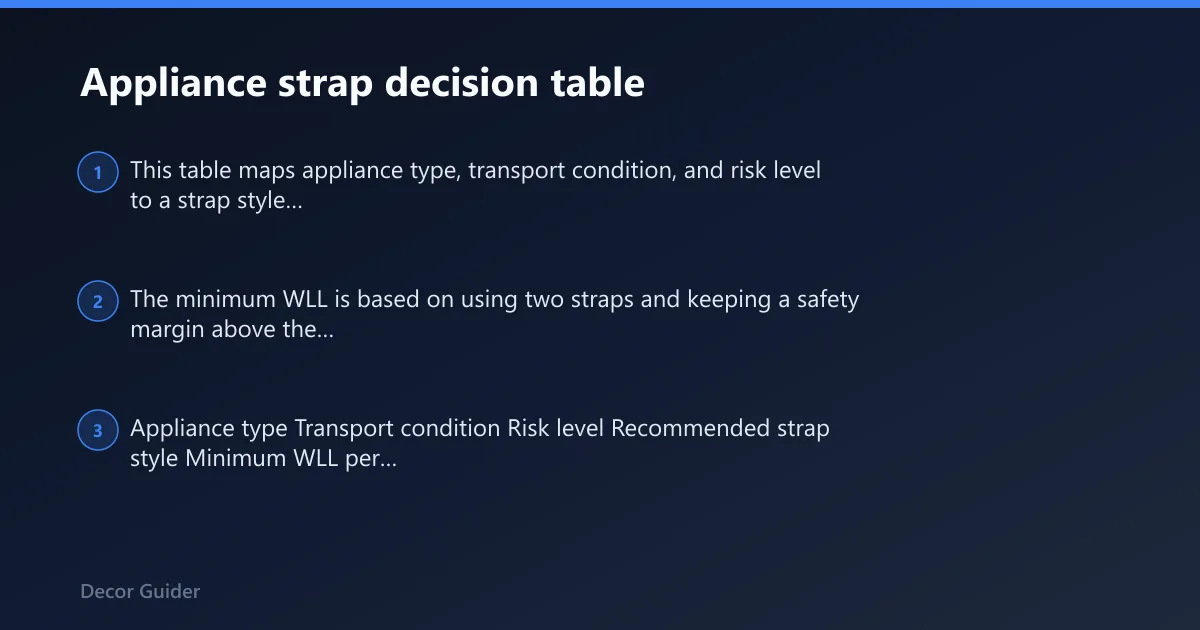
This table maps appliance type, transport condition, and risk level to a strap style that fits the failure mode. The minimum WLL is based on using two straps and keeping a safety margin above the appliance weight, not on chasing the biggest printed breaking strength.
| Appliance type | Transport condition | Risk level | Recommended strap style | Minimum WLL per strap | Length range | Padding or edge guards |
|---|---|---|---|---|---|---|
| Refrigerator | Truck or trailer move | High | Ratchet strap, 1 to 2 inch webbing, soft loops preferred | 500 lb | 10 to 15 ft | Yes, mandatory on corners and door seams |
| Refrigerator | Short in-home repositioning or storage | Medium | Cam buckle or light ratchet with soft webbing | 300 lb | 8 to 10 ft | Yes, if strap crosses finish |
| Washer | Truck move on level route | Medium | Cam buckle or light ratchet | 300 lb | 8 to 12 ft | Recommended on front corners and control panel edge |
| Dryer | Truck move with vibration | Medium | Cam buckle for light restraint, ratchet for dolly tie-down | 300 lb | 8 to 12 ft | Recommended, especially on front lip and side seams |
| Stove | Storage or short transport | Medium | Cam buckle with padding, or ratchet stopped early | 300 lb | 8 to 12 ft | Yes, protect knobs, glass, and painted edges |
| Upright freezer | Truck or trailer move | High | Ratchet strap with soft loops and blankets | 500 lb | 10 to 15 ft | Yes, mandatory on top corners |
What strap length do I need for a fridge, washer, or stove?
Most full-size appliances need 10 to 15 feet of strap, while smaller units can work with 8 to 10 feet. The right length depends on whether the strap wraps around the appliance body only, or must also reach a dolly frame, trailer D-ring, truck bed tie-down, or wall stud for storage.
Short appliances versus full-size models
A compact washer or apartment-size stove may only need enough strap to circle the cabinet and buckle cleanly. Full-size refrigerators usually need extra length because the strap must travel around the body, through a dolly rail or anchor point, and still leave room for controlled tightening.
Extra length for dolly wraps and anchor reach
Once a strap passes around an appliance dolly, the needed length jumps fast. A 10-foot strap can be too short if the anchor sits low in a truck bed or if you need to route the webbing around the frame and back into the buckle without bending it sharply.
How to avoid buying straps that are too short
Measure the appliance width, add the route around the dolly or anchor, then add extra slack for buckle space. If the strap needs to cross a blanket or protector sleeve, add more. Short straps are hard to rescue on move day, and loose hardware near a cabinet edge is a real hazard.
How many straps should I use to secure an appliance?
Use two straps per appliance in most cases. One strap is often enough only for very short repositioning or when the appliance is already locked inside a storage bay. Two straps stop rocking, reduce twist, and give a backup if one buckle loosens during vibration.
Why one strap is usually not enough
A single strap can allow the appliance to pivot around a fixed point. That creates side load on the strap and can drive the cabinet into a wall, truck side, or another appliance. Two points of restraint keep the load centered and reduce motion in both pitch and yaw.
Use anchor points that can carry the load
Truck bed tie-downs, trailer D-rings, and wall studs are the right type of anchor for storage or transport. Appliance handles are not. Handles can bend, slip, or tear away, and they often transfer force into thin sheet metal rather than into the structural body of the machine.
How to size WLL for appliance weight
The working load limit should be comfortably above the share of weight each strap sees, with a margin for braking, bumps, and side pull. For appliance moves, that usually means choosing straps with a WLL that is safely above the estimated load per strap, not merely “close enough” to the appliance’s weight.
What features matter most in adjustable appliance straps?
The most useful features are clear WLL labeling, enough length to wrap the appliance and anchor, controlled tension hardware, and webbing that resists stretch. For appliances, soft loops, padded handles, and abrasion protection usually matter more than a huge breaking-strength number.
Working load limit and label clarity
WLL tells you what the strap is meant to handle in normal use. Breaking strength is a maximum failure number, not a planning number. If the label does not clearly state WLL, length, and width, it is harder to judge whether the strap is suitable for an appliance move.
Webbing material and stretch resistance
Polyester webbing is the standard choice because it resists stretch better than many softer tie-down materials, holds up well against abrasion, and handles weather exposure better than webbing that absorbs moisture and lengthens under load. Less stretch means less surprise slack after a few miles.
Padding, abrasion protection, and edge guards
Padding protects finishes. Edge guards stop webbing from sawing against a corner. Abrasion sleeves are worth using when the strap passes over metal, a dolly rail, or any point where vibration could turn friction into wear. On appliances, protection often solves the problem that raw strength cannot.
How do I avoid damaging appliance doors, finish, or control panels when strapping them down?
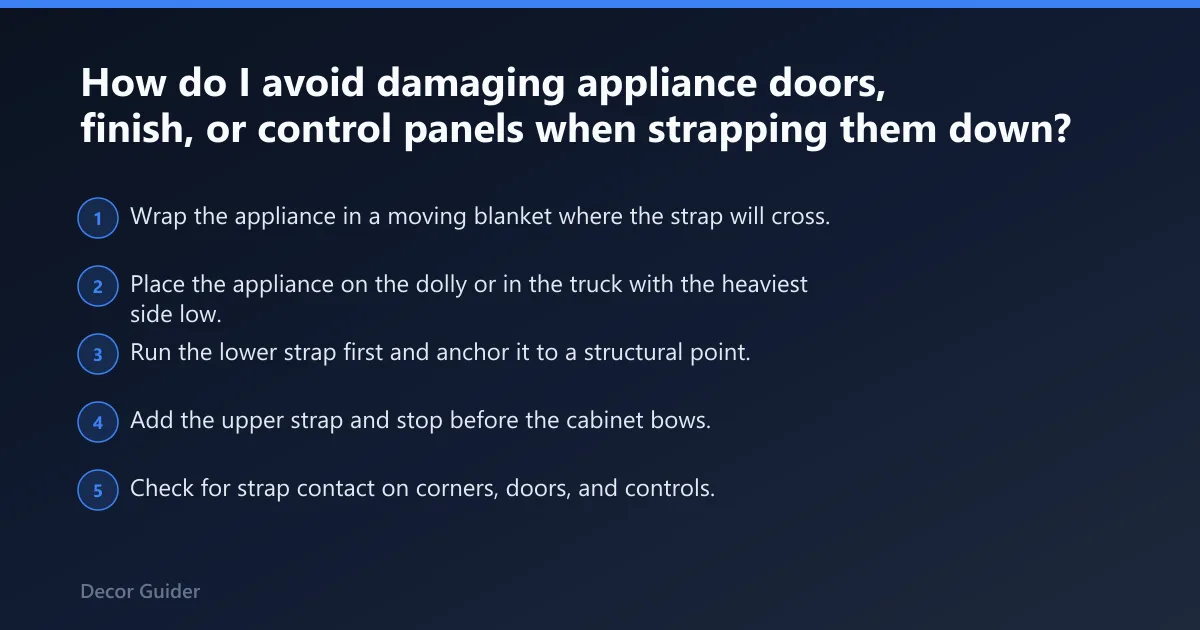
Avoid damage by keeping straps off handles, door gaps, knobs, and control panels, then adding blankets or sleeves wherever the webbing touches the shell. Most appliance damage comes from pressure and rubbing, not from load alone, so the contact path matters as much as the buckle choice.
Use moving blankets between straps and finish
Moving blankets are not optional when the strap touches painted steel, glossy enamel, or plastic trim. They prevent scratch marks and also help spread pressure across a wider area. This is especially useful on refrigerator doors, washer fronts, and stove side panels.
Avoid fragile appliance handles as anchor points
Handles are for opening doors, not holding tie-down force. If a strap is pulled through a handle, it may pinch the door out of alignment or break the mount. Route straps around the cabinet body or dolly frame instead, and let the hardware do the load-bearing work.
Follow a simple setup sequence
- Wrap the appliance in a moving blanket where the strap will cross.
- Place the appliance on the dolly or in the truck with the heaviest side low.
- Run the lower strap first and anchor it to a structural point.
- Add the upper strap and stop before the cabinet bows.
- Check for strap contact on corners, doors, and controls.
- After the first few miles, retighten if the webbing settles.
Which one should you buy?
For a refrigerator move, buy a ratchet strap set with soft loops, then add blankets and edge protection. For washers and dryers, a lighter ratchet or a cam buckle strap is usually safer because it reduces panel compression. For storage, the best pick is the strap that reaches the anchor cleanly without excess tail.
Best pick by budget
If budget is tight and the appliance is a washer, dryer, or stove, the Jack Boss ratchet tie down straps are the most practical of the four because they are appliance-friendly and include soft loops. If the setup is mostly cargo or trailer work, the Riubal retractable set is easier to keep organized, but it is less appliance-specific.
Best pick by appliance type
For refrigerators and upright freezers, choose a ratchet setup with padding first. For washers and dryers, a cam buckle or light ratchet is usually the safer restraint because it lowers the chance of over-tightening. For strap chafe protection, add the Feliey sleeves to any setup that crosses metal or a corner.
Best pick for storage versus transport
For storage against a wall stud, use a strap that can be tensioned lightly and checked later, with padding wherever it contacts the cabinet. For transport, prioritize the ability to stop tightening early and hold position under vibration. If the route is rough, control matters more than a high printed break number.
Frequently asked questions
Can I use moving straps on an appliance dolly?
Yes, and that is often the safest place to use them. Strap the appliance to the dolly frame first, then secure the dolly itself to the truck bed or trailer. That two-stage restraint reduces tip risk and keeps the appliance from walking off the dolly during turns or stair handling.
Products related to this article
Sponsored / affiliate links. As an Amazon Associate I earn from qualifying purchases. I may earn additional commission from eligible campaigns.