Curtain Size Calculator: Measure Width and Length
Measure the rod width first, then choose total curtain width at about 1.5 to 3 times that width and a length that lands just above the floor for a clean finish. Skip those numbers and you risk narrow, skimpy panels or curtains that hover awkwardly above the floor. This guide shows how to size width, drop, rod placement, fullness, and ready-made pack counts without guesswork.
How is this calculated?
Press Calculate to see the math with your numbers.
What this curtain size calculator does

- Dual metric/imperial scales for accurate measurements
- Reinforced ABS frame for durability in heavy use
- Compact design fits easily in tool storage
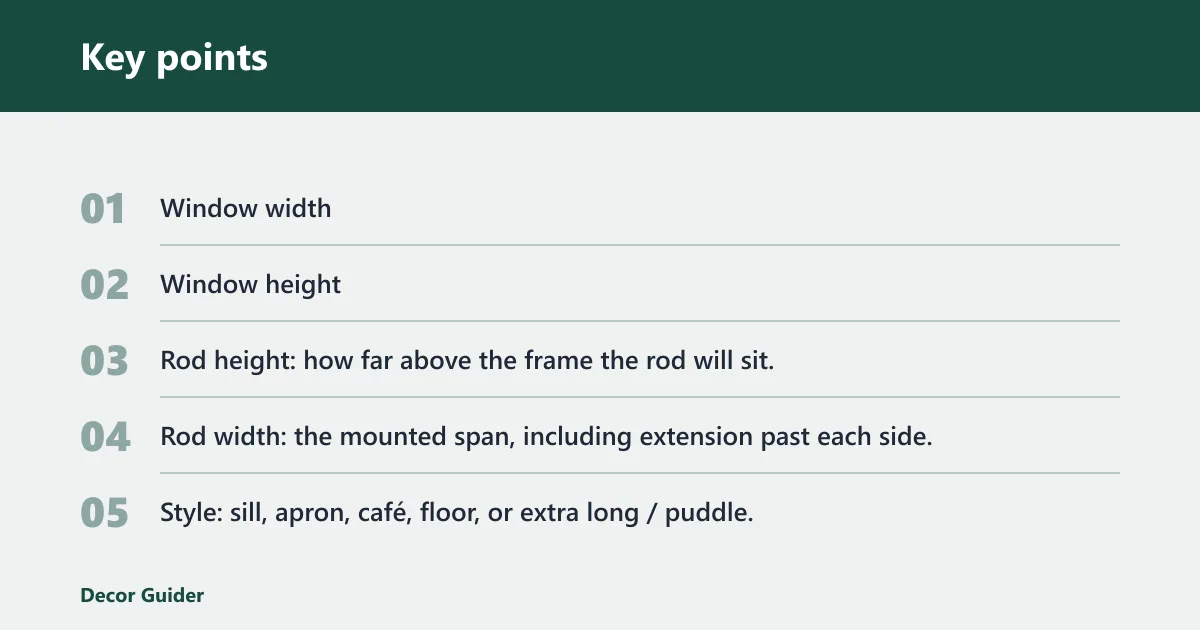
This guide turns five inputs into a buying plan: window width, window height, rod height, rod width, and your finish style. It then helps you compare finished drop, recommended width, fullness ratio, and panel count with a package label before you buy.
It also separates three measurements that shoppers often mix up. The window opening tells you the opening size. The installed rod tells you the span curtains must cover. The finished drop tells you where the hem should land after the rod is mounted.
Inputs it needs
- Window width: the opening or outside frame width, depending on whether you want coverage inside the trim or beyond it.
- Window height: from the top of the opening down to the sill, apron, or floor.
- Rod height: how far above the frame the rod will sit.
- Rod width: the mounted span, including extension past each side.
- Style: sill, apron, café, floor, or extra long / puddle.
What it outputs
The output should answer one buying question at a time. How wide should the curtains be. How long should the panels be. How many panels should you order. And whether a ready-made size can work, or whether the room needs custom sizing because the rod position or window height is unusual.
When ready-made works and when custom sizing helps
Ready-made panels usually work best when the rod height lands near a standard length and the width math fits common pack counts. Custom sizing becomes more useful when the window is very tall, the patio opening is wide, or the rod must sit higher than usual to correct short ceilings or awkward proportions.
How to measure a window for curtains
Start with the window opening, then measure the installed rod path. That order matters because curtains should be sized to the rod, not only the frame. If you buy to the frame alone, the panels can end up too narrow, too short, or both.
Measure the window opening and note trim type
Measure the visible opening width and height first. Then note whether you are working from inside trim or outside frame. Inside trim measurements matter for trim-to-trim coverage. Outside frame measurements matter when you want the curtains to cover more wall and make the window read larger.
Choose rod height and rod extension
Rod placement is commonly about 4 to 6 inches above the window frame. Common rod extension is 3 to 6 inches past each side of the window. That extra span helps the curtains clear the glass when open and gives the opening more visual width.
Higher placement is often better for taller ceilings. A higher rod shortens the visible wall above the window and can improve proportion, but it also changes the finished drop you need to buy.
Convert inches to centimeters or meters
Mixed-unit shopping causes avoidable mistakes. If the package is listed in inches and your tape measure is metric, convert before you order. A safe method is to keep the same unit through the whole calculation, then round up only after you finish the math.
- Inches to centimeters: multiply by 2.54.
- Centimeters to inches: divide by 2.54.
- Feet to inches: multiply by 12.
- Meters to centimeters: multiply by 100.
Round conservatively. If your computed finished drop lands between lengths, choose the longer panel if the fabric can be hemmed. Choosing the shorter one risks a visible gap above the floor or sill.
How wide should curtains be compared with the window?
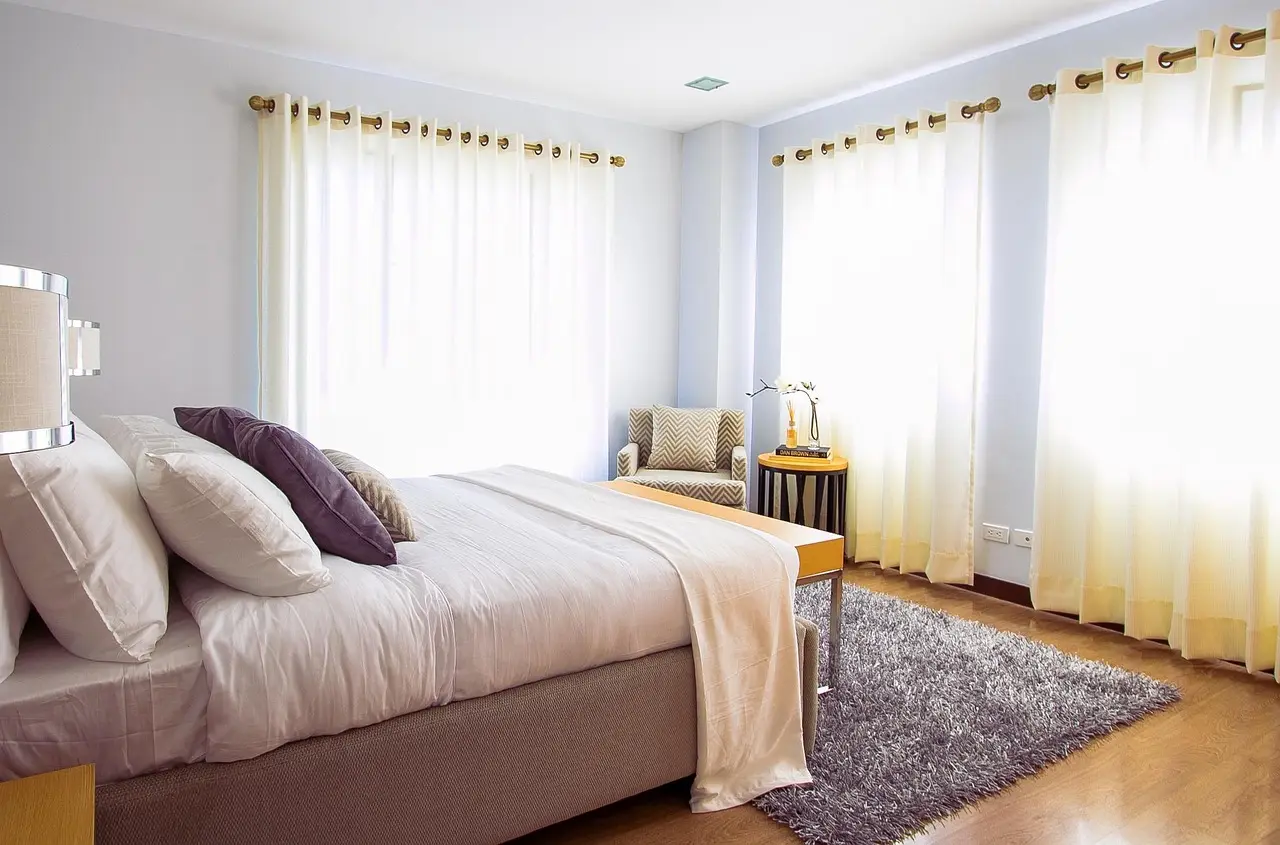
Curtains usually need more width than the window because fabric has to gather when closed and still cover the opening cleanly when open. A common starting point is 1.5x to 3x the rod width. Light-gather panels suit less formal looks, while fuller ratios create deeper folds and a denser drape.
Choose a fullness ratio
The calculator supports fullness ratios from 1.5x to 3x. Typical curtain widths are 2, 2.5, or 3 times the rod width. Standard fullness uses the width formula Rod width × 2. Deluxe fullness uses Rod width × 2.5. Ultra fullness uses Rod width × 3.
- 1.5x light gather: lighter folds, less bulk, better when the curtain will stay open often.
- 2x standard: balanced drape for many rooms.
- 2.5x deluxe: fuller folds, better visual density.
- 3x ultra: deep gather, more fabric, more stack-back.
How fabric type and heading style change fullness
Sheer and lightweight fabrics usually need more width to avoid a sparse look. Heavier fabrics can look full with less width because the folds hold more shape. Heading style matters too. Pinch pleat and tailored headings usually need more planning than a simple rod pocket because the heading already uses part of the fabric width to form the top.
Room traffic matters as well. In a kitchen or a doorway, too much fullness can crowd the opening and make the curtain harder to stack back. In a formal living room, more fullness often looks better because the panels are not being pushed aside all day.
How to calculate total curtain width from ready-made panel width
Ready-made curtain panel widths are often 50 to 54 inches each, though widths vary by market and heading style. That means the number of panels matters as much as the width ratio. A pair of 50-inch panels gives 100 inches of fabric width before gathering. On a wide window, that may still be too narrow once you apply 2.5x or 3x fullness.
Suppose a rod spans 84 inches and you want standard 2x fullness. The target total curtain width is 168 inches. If each ready-made panel is 50 inches wide, a pair gives only 100 inches, so you would need more panels or a wider panel size.
Curtain length styles and standard lengths
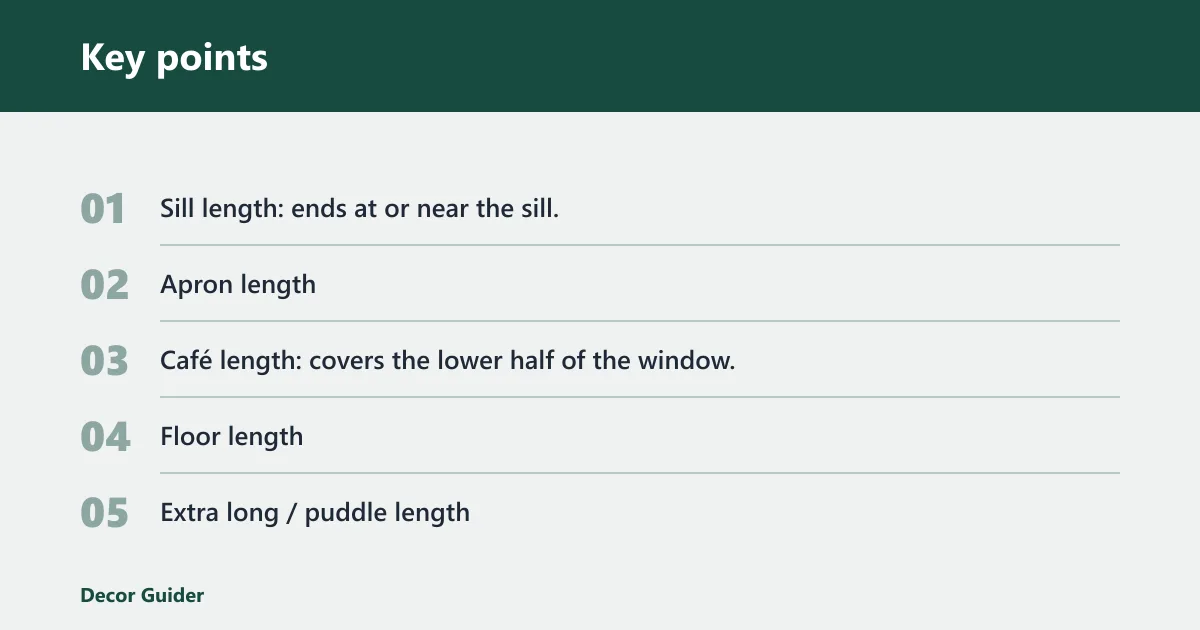
Length style depends on where the hem should land relative to the floor or sill. Sill length stops at the sill. Apron length lands below the sill. Café length covers only the lower part of the window to the desired coverage line. Floor length reaches the floor, and extra long or puddle length extends below the floor line for a pooled effect.
Length styles and finished drops
- Sill length: ends at or near the sill.
- Apron length: ends below the sill, above the floor.
- Café length: covers the lower half of the window.
- Floor length: reaches the floor with a clean skim.
- Extra long / puddle length: extends past the floor for a pooled effect.
For sill, apron, café, and floor-length curtains, the finished length should be based on the installed rod height and the style you want to reach. For café length, size to the desired coverage line rather than using a fixed fraction of the window. For extra long curtains, puddle depth is added beyond floor length.
Standard ready-made lengths
Standard long curtain lengths listed are 72, 84, 96, and 108 inches. A standard long curtain chart also shows 63, 84, 96, 108, and 120 inches. Standard ready-made lengths vary by market and product line. Short curtain sizes listed are 24 and 36 inches.
Those numbers matter because they are the shelf sizes most shoppers compare first. If your finished drop is close to one of them, ready-made panels may work without alterations. If the target sits between two lengths, order the longer size and hem down if needed.
Choosing a length by room
Kitchen windows often work well with café, sill, or apron lengths because those styles keep fabric above counters and sinks. Living rooms usually look best with floor-length curtains. Tall rooms often need 108-inch or 120-inch panels, especially if the rod is mounted high to keep the room visually balanced.
How high should I hang a curtain rod?
Mount the rod 4-6 inches above the frame as a standard starting point. That placement helps the window feel taller and keeps the top of the curtain from crowding the glass. If you want a more dramatic look, or if the ceiling is tall, place the rod higher and recalculate the length from that new point.
How rod height changes the finished drop you need
Rod height is not just a style choice. It changes the finished drop directly. A rod mounted higher means the curtain must be longer to reach the sill, apron, or floor. If you keep the same panel length after moving the rod up, the hem will sit higher than planned.
Say your window height is 60 inches and the rod sits 6 inches above the frame. A floor-length target now needs to start from that higher mounting point, not from the top of the frame. That is where many short-panel mistakes begin.
How many curtain panels do I need?
Panel count depends on total width, fullness, and how the panels are sold. A single panel can work for a narrow window or a side panel. A pair is the most common setup. Three or four panels are better for wider spans, patio doors, or when a brand sells narrower packs that must be combined to reach the needed width.
Single panel, pair, 3 panels, and 4 panels
- Single panel: useful for very narrow windows or decorative use.
- Pair: the common choice for standard windows.
- 3 panels: helps on wider windows when a pair would be too narrow.
- 4 panels: often used for very wide windows or patio doors.
Whole-pack rounding
Always round up to the next pack that meets your width target. If the math says you need 175 inches of total width and the pack provides 100 inches per pair, two pairs may be necessary even if one pair seems close. A little extra width is safer than too little because it improves closure and stack-back.
How to size wide windows and patio doors
Wide openings need special attention because the rod span grows quickly and the fabric has farther to travel when opened. For patio doors, check the stack-back space on each side before you choose the fullness ratio. High fullness on a very wide door can swallow wall space and block light when open.
Curtain sizing decision table
| Scenario | Rod height above frame | Rod extension per side | Fullness ratio | Target finished drop | Likely ready-made panel count | Common mistake to avoid |
|---|---|---|---|---|---|---|
| Standard living room window | 4-6 inches | 3-6 inches | 2x to 2.5x | Floor length with a clean skim | Pair, or 4 panels if each panel is narrow | Sizing to the frame instead of the installed rod |
| Low kitchen window | 4 inches | 3-4 inches | 1.5x to 2x | Apron or café length | Single pair | Choosing floor length where it will hit counters or clutter the work zone |
| Tall-ceiling room | 6 inches or higher | 4-6 inches | 2.5x to 3x | 108 or 120 inches, depending on rod height | Pair, sometimes 3 panels for wider span | Buying a standard length before confirming the higher mount |
| Wide patio window | 4-6 inches | 6 inches | 2x to 2.5x | Floor length with side clearance | 4 panels or whole-pack rounding | Underestimating the total width and leaving a gap at center or edges |
Frequently asked questions
What size curtain calculator
A curtain size calculator uses your rod width, rod height, desired fullness, and target length to turn window measurements into a buying size. The key is to size to the installed rod, not only the opening, because the rod extension and mounting height change both width and drop.
What size curtains do I need calculator?
The size you need depends on whether the curtain will cover a sill, apron, floor, or puddle finish. Start with the rod span, then choose 1.5x to 3x fullness based on fabric and room use. After that, compare the finished drop with the nearest ready-made length.
How do I measure curtains in inches or centimeters?
Use one unit through the whole process, then convert before ordering if needed. Multiply inches by 2.54 to get centimeters, or divide centimeters by 2.54 to get inches. Round up when the next size avoids a short hem or a narrow width.
What fullness ratio should I use for curtains?
Use 1.5x for a lighter gather, 2x for standard fullness, 2.5x for a fuller drape, and 3x for an ultra-full look. Lightweight fabric usually needs more width, while heavier fabric can look full with less. Busy rooms often need less bulk for easier opening and closing.
How many curtain panels do I need for one window?
That depends on rod width, panel width, and fullness. A pair is common for standard windows, but wide openings may need 3 or 4 panels. Check the package width per panel, then round up to the next pack size so the finished curtain covers the rod without gaps.
Should I size curtains to the window or the rod?
Size to the rod. The window opening is only the starting point. The installed rod, plus its extension past each side and its height above the frame, determines the real width and finished drop. That is the main reason curtains can look too short or too narrow after delivery.
What are standard curtain sizes in the UK and US?
Shopping terms can differ, especially for ready-made lengths and pack labels. Check whether the listing gives one panel, a pair, or a whole pack before ordering.
Products related to this article
Sponsored / affiliate links. As an Amazon Associate I earn from qualifying purchases. I may earn additional commission from eligible campaigns.