Dining Chair Shipping Size Chart
For a dining chair shipping size chart, start with the chair’s widest point, then add about 2-4 in for padding. Add 1-2 in to the other dimensions. A typical packed chair often lands near 22 x 24 x 40 in, but armless and stacking chairs can be smaller. Bad sizing drives avoidable freight charges, carton failures, and quotes that miss dimensional weight. This guide turns chair width, depth, and height into carton sizes, with a simple chart, packing allowance rules, and freight-ready measuring steps.
How big is a dining chair for shipping?

For shipping, the packed width and packed height usually matter more than seat height alone. Seat height still helps with clearance checks, but the box size comes from the widest point, the front-to-back footprint, and the space you need around wood, upholstery, or woven parts.
A chair can be small at the seat and still ship in a large carton if it has arms, tall posts, or a wide back frame. For planning, think in ranges rather than exact model names: low side chairs tend to pack smaller, while tall-back and armed chairs need more carton room because the outer dimensions set the box, not the seating surface.
As a shipping rule, a chair is often still parcel-friendly when the packed box stays in a normal carton range after padding. Once the outer carton becomes long, bulky, or hard to stack, freight quotes may be the better option.
Why seat height is secondary to packed width and depth
Seat height affects whether a chair fits under a table, but it does not set the carton footprint by itself. The seat may be narrower than the chair frame, and the widest point may be at the arms, posts, or back frame rather than the seat edge.
Seat dimensions can vary slightly by seat material, so a shaped wood seat, solid wood seat, seagrass seat, or paper cord seat may need a different wrap profile even when the chair looks similar. That changes the packed width and depth more than the seat height does.
When a chair is small enough for parcel shipping
Parcel shipping is more likely when the chair breaks down cleanly, stacks efficiently, or has no arms and a modest back. A fully assembled chair with a tall back or wide arm span can move into oversized carton territory quickly, especially if the carton must protect finish corners and protruding posts.
Use this as a planning test: if padding, corner protection, and carton wall thickness add several inches to every side, the final box may no longer fit the carrier quote you expected. That is where dimensional weight, oversize handling, or freight pricing starts to matter.
How do you measure a dining chair for a box?
Measure the chair at its widest point, its deepest point, and its tallest point before you choose a carton. For shipping, do not rely on seat width alone. Arm caps, back posts, and curved frames often extend beyond the seat and decide the outer box size.
Measure the widest point, not the seat alone
- Measure the full width. Put the tape across the chair’s widest side-to-side point, including arms, posts, and the outer edge of the back frame if they extend past the seat.
- Measure the full depth. Measure front to back at the deepest point, which may be the front leg line, the seat itself, or a curved back section depending on the style.
- Measure the full height. Measure from floor to the top of the highest point on the chair, including tall backs, decorative crest rails, or finials that increase the carton height.
Measure seat depth and packed thickness
Seat depth drives how long the carton must be after you add wrap and carton clearance. A deeper seat or a thicker upholstered build may need more internal space even if the back height is moderate.
For planning, add the padding allowance to the chair’s deepest point, then add room for the carton wall and any corner protection. That is the number that should control box length or box height, depending on how the chair is packed.
Quick measure checklist
| Measure this first | Why it matters | What to record |
|---|---|---|
| Widest point | Sets carton width and often drives dimensional weight | Width including arms, posts, and back frame |
| Overall back height | Sets carton height and can trigger oversize quotes | Floor to top of the highest point |
| Seat depth | Sets the front-to-back carton footprint | Deepest usable point of the chair |
| Seat material | Changes protection needs and packed thickness | Wood, upholstered, woven, or mixed |
| Breakdown status | Fully assembled or broken down changes the box size a lot | Assembled, partially disassembled, or flat-packed |
Dining chair shipping chart
This chart gives practical carton ranges for common chair groups. The ranges assume normal retail packing, not custom crate work, and they include modest allowance for wrap, corner protection, and carton wall thickness. If your chair has unusual carving, very thick upholstery, or wide arms, move to the next larger range.
| Chair type | Typical packed box range, in. | Packing allowance | Estimated DIM-weight impact | Shipping note |
|---|---|---|---|---|
| Armless side chair | 20-22 x 22-24 x 36-40 | +2-3 in around width and depth; +1-2 in height | Often parcels well, but width can still drive cube | Best fit for standard carton shipping if the frame packs flat |
| Upholstered chair | 22-24 x 23-26 x 38-42 | +3-4 in around cushioned faces; +1-2 in height | Higher cube because padding prevents tight nesting | Use crush protection so the fabric and foam do not compress in transit |
| High-back chair | 22-24 x 24-26 x 42-48 | +2-3 in width and depth; +2-4 in height | Height can push the carton into oversize pricing | Watch tall crest rails, finials, and long posts |
| Chair with arms | 24-28 x 24-28 x 38-44 | +3-4 in width for arms; +1-2 in elsewhere | Arms often raise the DIM weight more than the seat does | Most likely to need a larger carton or freight quote |
A common first-timer mistake is measuring only the seat and then buying a carton sized to that number. If the arms or back posts sit outside the seat line by 2 in on each side, the box must grow to match the real outer width.
How does packing allowance change the final box size?
Packing allowance is not a guess. It is the added space needed for wrap, edge boards, corrugate thickness, and movement control inside the carton. For most dining chairs, that allowance is what turns a tight measure into a realistic shipping size.
Wood chairs and surface protection
Wood chairs need corner protection, face wrap, and enough room to keep finish points from rubbing through the carton. A chair with exposed rails or carved edges usually needs more padding than a plain side chair with smooth lines.
If the chair ships assembled, the outer box may need extra width so the legs do not press against the walls. If the chair ships broken down, the legs and back may nest more tightly, which can reduce carton size and shipping cost.
Upholstered seats and crush space
Upholstered chairs need crush space because foam, springs, and fabric do not like direct pressure. Add enough room so the carton closes without compressing the seat into the frame.
That extra room often increases both width and depth. A chair that looks compact before packing can become a much larger carton once you protect the seat face and the top of the back.
Woven seats and edge protection
Woven seats, including seagrass and paper cord, need edge protection so the weave does not snag or flatten. These seats can look slim but still need a little more clearance around the seat opening and the chair apron.
Seat dimensions can vary slightly by seat material, so the packed size should be based on the finished chair, not just a catalog dimension.
What size box fits different chair styles?
Style family matters because the frame profile changes the packed cube. Farmhouse, cottage, and Martha Washington chairs can all sit in the dining chair category, but their backs, posts, and arm details pack very differently. Use style as a guide, then confirm the actual chair measurements.
Farmhouse and cottage chairs
Farmhouse and cottage chairs often pack efficiently when the back is open and the seat is simple. In the article’s reference set, the Farmhouse dining chair family reaches the mid-30s in overall back height, while the Cottage dining chair is listed at 18 1/2-inch seat height, which shows how style and seat height can differ without telling you the full carton size.
For shipping, the useful lesson is that these styles usually sit in a moderate carton range unless the back is unusually tall or the seat is heavily cushioned. Focus on the full outer footprint rather than the style label alone.
Martha Washington chairs
Martha Washington chairs can be taller and more formal in profile, so they often need more vertical carton room than a plain side chair. In the article’s reference set, this style reaches the low-40s in overall back height, which places it near the upper end of the common dining-chair carton range.
When the back is this tall, confirm the packed height before you request a parcel quote. Tall cartons are more likely to create dimensional-weight pressure even when the chair itself is not especially heavy.
Chairs with sled bases or wider posts
Chairs with sled bases or wide rear posts often need a wider box than the seat width suggests. The frame can spread outside the seat, and that extra width is what changes the carton and the quote.
If the base profile prevents nesting, you may need to ship the chair in a longer carton or separate parts of the chair for better cube efficiency.
Use these planning checks for grouped chairs
- Usable underside height: start with 10 to 12 inches of vertical space as a useful planning check when chairs ship with tables or need to nest under a structure.
- Usable table span: measure the distance between legs or supports, not tabletop width alone, when deciding how many chairs can ship together or sit on a pallet.
- Clearance allowance: use 24 inches per chair position as a practical first estimate when you are planning clustered shipments or staged delivery space.
How do dimensional weight and freight limits affect cost?
Dimensional weight can raise shipping cost even when a chair is light. A larger carton uses more carrier space, so the quote may price against size rather than actual weight. Once the box gets tall, wide, or long enough, freight becomes more likely than parcel service.
A simple DIM-weight calculation
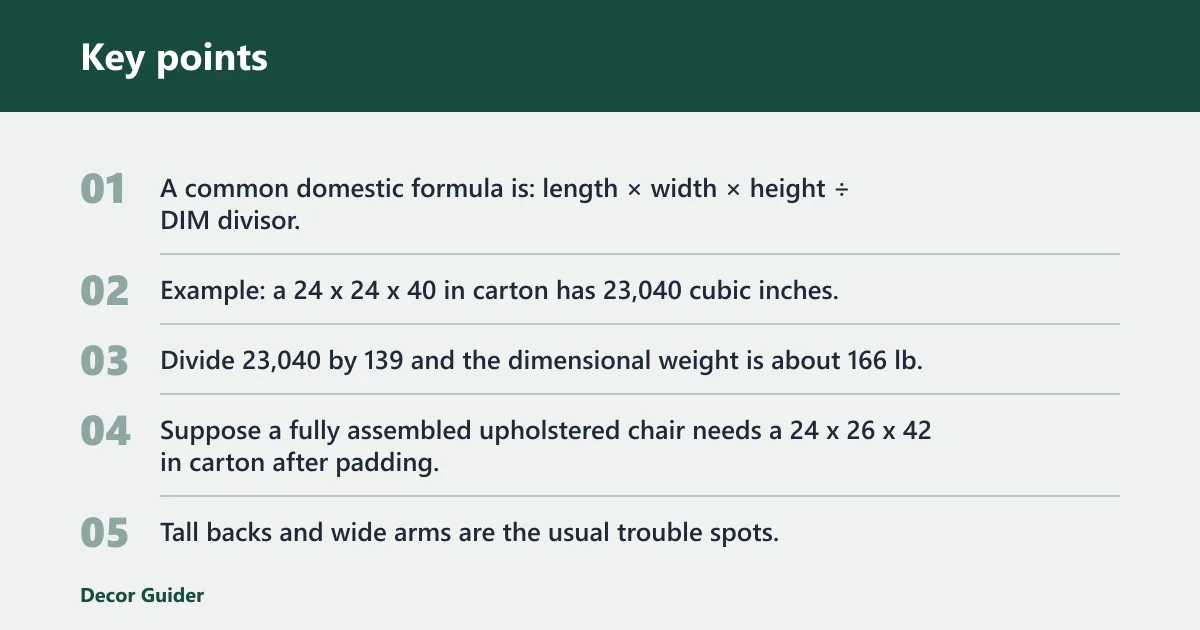
A common domestic formula is: length × width × height ÷ DIM divisor. One common divisor is 139, but carrier rules vary by service and can change by date, so treat any divisor as an example rather than a fixed promise.
Example: a 24 x 24 x 40 in carton has 23,040 cubic inches. Divide 23,040 by 139 and the dimensional weight is about 166 lb. Even if the chair itself weighs far less, the quote may use the dimensional figure if it is higher than the actual weight.
Suppose a fully assembled upholstered chair needs a 24 x 26 x 42 in carton after padding. That carton has 26,208 cubic inches. Using the same 139 divisor, the dimensional weight is about 188 lb, which is a strong sign that the carton size, not the chair weight, will control the quote.
When carton size pushes a chair into freight
Freight becomes more likely when the chair is too large to quote efficiently as a parcel item, when the carton is hard to stack, or when protective packaging makes the box bulky enough to trigger oversize handling. Tall backs and wide arms are the usual trouble spots.
Broken-down chairs may stay in parcel range more easily than fully assembled chairs. If the seat, back, and legs pack separately, each piece can use a smaller carton or a better pallet layout.
Why multiple chairs may ship better on a pallet
Multiple chairs can sometimes ship with less waste on a pallet than in separate cartons, especially when the chairs nest or break down cleanly. Pallet stacking helps control cube, protects corners, and can reduce the number of separate cartons that the carrier bills.
Use the 24-inch-per-chair-position estimate only as a planning allowance, not as a carton size. It helps you judge cluster space, staging room, and pallet layout, but the box for each chair still depends on the actual chair dimensions and the padding you add.
Frequently asked questions
How big is a dining chair?
A dining chair usually sits in a fairly narrow size range, but the exact dimensions vary by style and model. For shipping, the important numbers are the widest point, the seat depth, and the overall back height. Standard seat height starts at 16 1/2 inches in the reference chart and reaches 18 1/2 inches for the Cottage dining chair.
How wide is a dining chair?
The width depends on the widest point, not just the seat. Arms, side posts, and the back frame can make the chair wider than the seat itself, and the guide warns that the seat alone may be narrower than the chair frame. Measure the outermost points before you choose a carton.
What size box do I need for a dining chair?
Use the chair’s widest point plus 2-4 in for padding, then add 1-2 in to the other dimensions. That usually places many chairs in a packed range near 22 x 24 x 40 in, but armless and stacking chairs can be smaller, while armed or tall-back chairs need more room.
How do I measure a dining chair for shipping?
Measure three things: width at the widest point, depth at the deepest point, and height to the highest point. Then add the space needed for wrap, corner protection, and carton walls. If the chair ships fully assembled, the outer carton will usually be larger than if the chair breaks down into parts.
What dining chair dimensions matter for shipping cost
Width, depth, and packed height matter most because they drive carton volume and dimensional weight. Seat height matters more for fit under a table than for shipping cost. A taller back such as 44 1/2 inches can push the box toward oversize pricing even when the chair is not heavy.
Will a dining chair fit in a shipping box?
Yes, if the carton is sized to the chair’s widest point, deepest point, and tallest point after padding. Armless side chairs often fit in standard cartons more easily than chairs with arms or tall backs. If the padded carton becomes too bulky, freight may be the better quote.
Products related to this article
Sponsored / affiliate links. As an Amazon Associate I earn from qualifying purchases. I may earn additional commission from eligible campaigns.