
Dining Table Shipping Cost Chart
Dining table shipping usually runs $50–$200 for parcel-eligible compact tables, $200–$600 for freight, and $600+ for oversized or white-glove delivery; once a table is about 72 inches long or heavier than 100 pounds, freight is the safer assumption. If you guess wrong, a low checkout price can turn into liftgate, stair, residential, or re-delivery charges that add hundreds. This guide gives a dining table shipping cost chart by size and method, plus the hidden fees to check before buying.
Dining table shipping basics
Seat count is only a rough size cue. Shipping is set by box size, weight, shape, and delivery method. Many common dining tables span roughly 74-235 cm in width and 107-230 cm in length, and shape can affect whether the table can stay in parcel service or needs freight handling.
What seat count means for size and box volume
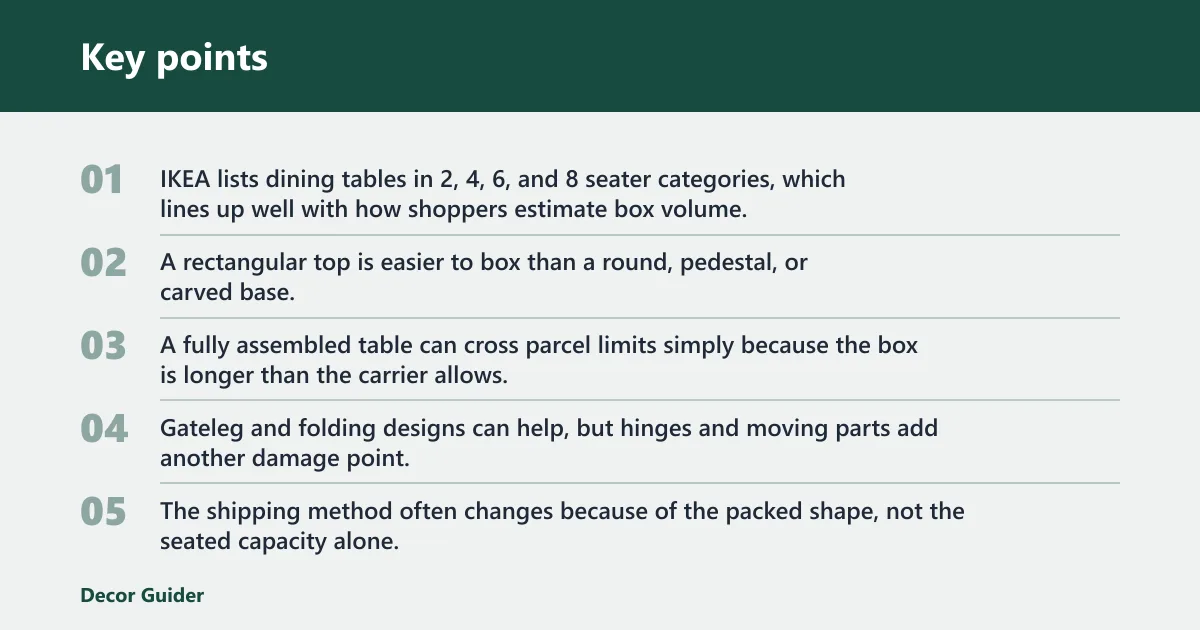
IKEA lists dining tables in 2, 4, 6, and 8 seater categories, which lines up well with how shoppers estimate box volume. A 2-seater often stays compact enough for parcel service, while 6- and 8-seater tables usually move into freight because the top is longer, wider, or both.
For context, a SANDSBERG table is listed at 110×67 cm, a MÖRBYLÅNGA table at 140×85 cm, and a SKOGSTA dining table at 235×100 cm. Those sizes sit in very different shipping tiers even before packaging is added.
How shape changes shipping eligibility
A rectangular top is easier to box than a round, pedestal, or carved base. Flat-pack designs with a disassembled top and legs cut box volume, lower damage risk, and are more likely to remain parcel-eligible. A fully assembled table can cross parcel limits simply because the box is longer than the carrier allows.
Gateleg and folding designs can help, but hinges and moving parts add another damage point. The shipping method often changes because of the packed shape, not the seated capacity alone.
When a table becomes too large for parcel
Parcel carriers become less practical as length, girth, and dimensional weight climb. Once the packed table is long enough to need palletization, LTL freight is usually the better fit. Oversize thresholds, package width, and package height matter as much as the actual table weight.
Shipping a fully assembled 8-seater in a long carton is where surprises start. The box may still be light enough for parcel on paper, yet too large for standard networks or too vulnerable to edge crush and corner damage.
How much does it cost to ship a dining table
Costs vary by parcel versus freight, zone distance, weight, and accessorial charges. A compact flat-pack table can land near the low end of parcel pricing, while a large or assembled dining table usually moves by freight, where residential delivery, liftgate service, and re-delivery can push the total up fast.
Parcel shipping cost drivers
Parcel pricing usually tracks package length, package width, package height, actual weight, and dimensional weight. If the dimensional weight is higher than the scale weight, the carrier bills the larger number. Zone distance then changes the rate as the shipment moves farther from the origin.
Carrier type matters too. A national parcel carrier, a regional furniture carrier, and an e-commerce marketplace carrier can quote very different totals for the same table because their oversize rules and residential surcharges are not the same.
LTL freight cost drivers
LTL freight is common once a dining table is too long or too fragile for parcel. The shipment may need a pallet, shrink wrap, and corner protection, and the bill can add residential surcharge, liftgate fee, appointment delivery, and limited-access charges if stairs or tight access slow the drop.
Freight class also matters. Oversize thresholds and palletization can shift a table into a class that costs more to handle, especially if the base is awkward or the top cannot lie flat.
Where residential and accessorial fees appear
Residential delivery often costs more than dock-to-dock freight because the carrier must route a truck to a home address and handle smaller drop sizes. White-glove delivery costs more still because it can include in-home placement and assembly, not just curbside drop-off.
A common first-timer mistake is comparing a curbside quote with a white-glove checkout total. Those are different service levels, so the lower quote can look cheaper until the extra fees appear at dispatch.

Dining table shipping chart
This chart uses common size bands and packaging patterns to show where a dining table usually lands. It is an estimate, not a carrier quote. The same table can move one tier up or down depending on finish, packing quality, distance, and whether it ships flat pack or assembled.
| Table type | Typical size or packed volume | Likely shipping method | Typical fee drivers | Risk of oversize or damage |
|---|---|---|---|---|
| 2-seater | About 67×67 cm to 110×67 cm; small carton or flat pack | Parcel, often standard or oversize parcel | Dimensional weight, zone distance, residential surcharge | Low to moderate; corners and legs can chip |
| 4-seater | About 120×74 cm to 140×85 cm; medium carton | Parcel for flat-pack, otherwise small freight | Package length, weight, carrier type, delivery zone | Moderate; long tops are easy to scuff |
| 6-seater | About 152×80 cm to 180×90 cm; large carton or pallet | LTL freight or curbside freight delivery | Liftgate fee, palletization, residential surcharge, access | Moderate to high; box flex and edge crush become common |
| 8-seater | About 200×100 cm to 235×100 cm; palletized freight | LTL freight, curbside, or white-glove | Oversize thresholds, appointment delivery, stair carry, re-delivery | High; long tops and heavy bases need strong packaging |
| Extendable | About 120/180×74 cm to similar multi-length cartons | Parcel if flat-packed; freight if assembled or bulky | Extra hardware, larger carton count, dimensional weight | High; slides, leaves, and rails can shift in transit |
| Gateleg | About 26/89/152×80 cm when folded and opened | Parcel for compact packs, freight for larger configurations | Hinge protection, carton length, finish sensitivity | Moderate to high; moving joints can rub during transit |
| Folding | About 67×67 cm when collapsed | Parcel, often the cheapest tier | Weight, carton rigidity, damage prevention, residential delivery | Low to moderate; folded frames can dent if loose-packed |
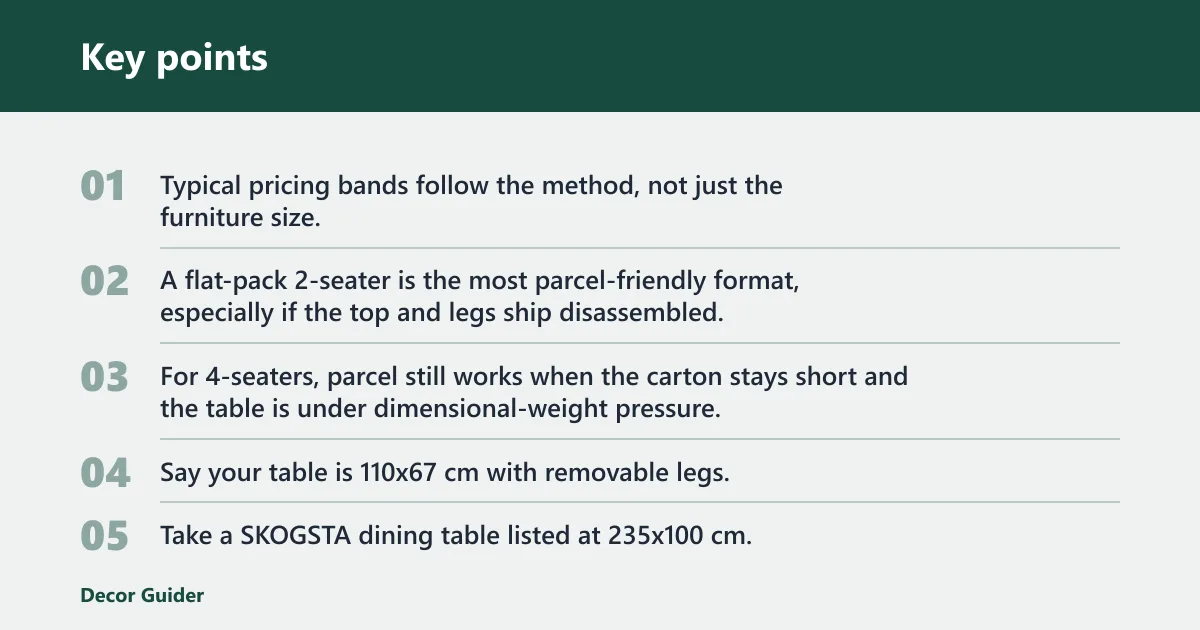
Typical pricing bands follow the method, not just the furniture size.
2-seater and 4-seater tables
These are usually the cheapest to ship because their packed dimensions stay smaller. A flat-pack 2-seater is the most parcel-friendly format, especially if the top and legs ship disassembled. For 4-seaters, parcel still works when the carton stays short and the table is under dimensional-weight pressure.
Say your table is 110×67 cm with removable legs. That can ship much more cheaply than a similar table sent fully assembled, because the carton stays narrower and the carrier is less likely to apply oversize handling.
6-seater and 8-seater tables
These usually move into freight because the top length pushes the carton beyond common parcel comfort zones. Once a table is closer to 180 cm, 200 cm, or longer, parcel damage risk rises and the shipping quote often includes palletization or liftgate service.
Take a SKOGSTA dining table listed at 235×100 cm. That size is far more likely to be freight than parcel, and the final price can change sharply if the delivery address needs stairs, a narrow entry, or no dock access.
Extendable, gateleg, and folding tables
Extendable tables can be economical to ship when the leaves and frame pack tightly. A VIHALS extendable table is listed at 120/180×74 cm, which shows how the shipped and expanded sizes can differ. That flexibility helps, but the moving parts need careful packing.
A NORDEN gateleg table is listed at 26/89/152×80 cm, and a GUNDE folding table is listed at 67×67 cm. The folding table is usually the easiest parcel shipper of the three, while the gateleg table can move between parcel and freight depending on how it is boxed.
Which shipping method fits your table
The right method depends on the table’s packed length, weight, and fragility. Parcel suits compact flat-pack tables. Curbside freight fits larger boxed tables. White-glove delivery is the best fit for heavy, delicate, or high-value tables that need room placement and assembly.
Parcel shipping for flat-pack tables
Parcel shipping works best when the top and legs are disassembled, the box is rigid, and the final carton stays within the carrier’s length and weight rules. Flat-pack furniture shipping also lowers the chance of abrasion because each part can be wrapped and separated inside the box.
- Measure the packed box. Check length, width, and height in inches and centimeters. Use the outer carton, not the tabletop alone, because carriers rate the box, not the furniture description.
- Compare dimensional weight. Multiply the outer dimensions using the carrier’s formula, then compare that result with actual weight. The higher billable weight usually decides the price.
- Confirm parcel eligibility. Check the carrier’s oversize limits before checkout. If the carton exceeds the limit, freight is usually cheaper than a rejected parcel or a return charge.
Curbside delivery for larger boxed tables
Curbside delivery is common for freight shipments that are too large for parcel but do not need in-home placement. The driver drops at the curb or driveway edge, which keeps the price below white-glove service. The catch is that you must handle the move indoors yourself.
If the box is long and heavy, ask whether the quote includes a liftgate. Without it, the shipment may be cheaper on paper but harder to receive safely.
White-glove delivery for heavy or delicate tables
White-glove delivery usually includes in-home placement and assembly, which is why it costs more than curbside delivery. It makes sense for glass tops, pedestal bases, and finished wood that can scar easily if dragged or tipped.
Use it when the delivery path is tight or the table has a premium finish that should not be handled like a standard freight carton. The added labor often costs less than damage repair.
How do you measure a table for shipping?
Measure the table the way the carrier will see it: packed size, weight, and access. You need inches and centimeters, the seat count, and the delivery path clearance. Doorways, turns, stairs, and elevators can all change whether a shipment can move as curbside, liftgate, or white-glove.
Measure length, width, and height in inches and centimeters
Record the longest side first, then the widest point, then the packed height. For tables with leaves or folding sections, measure both the stored size and the expanded size. The smaller number helps parcel eligibility, while the larger one helps you avoid a failed delivery plan.
Use the outer carton size if it is already boxed. A small change in width or height can push a shipment into a more expensive dimensional-weight bracket.
Check weight and dimensional weight
Actual weight matters, but dimensional weight can cost more when the box is bulky and light. That is common with wood tops, padded corners, and oversized cartons. If the dim weight is higher, the carrier bills that number instead of the scale reading.
That is why a light folding table can still cost more than expected when it ships in a wide box. The billable weight follows space as much as mass.
Measure doorway and delivery path clearance
Measure the front door, hall turns, stair width, and any elevator opening before you choose a delivery method. A table that fits the truck may still fail at the doorway, and that can trigger stair carries or re-delivery.
Keep at least a little clearance on each side of the box. If the box has to be tilted to pass through, the risk of finish scuffs and corner dents goes up.
How to pack a dining table safely
Good packing keeps a table eligible for cheaper shipping and cuts the chance of corner crush, scratches, and hinge damage. The goal is to reduce movement inside the carton and keep the load stable if the package is stacked or shifted in transit.
- Disassemble loose parts. Remove legs, leaves, hardware, and any loose brackets. Pack them separately in a labeled bag so they do not scratch the top or get lost.
- Wrap the tabletop fully. Use foam padding or a soft protective layer over finished surfaces, then add corner protectors. This limits chip damage where the box takes the hardest hits.
- Choose a double-wall box. Use a double-wall carton for wood, glass, or heavy tops. A single-wall box is more likely to bow or split under stacking pressure.
- Secure the load tightly. Add strap or pallet wrap for freight, and keep every part from sliding. Movement inside the package is a major cause of edge wear and cracked corners.
For glass panels, add extra padding around every edge and avoid voids in the box. A pedestal base needs more bracing than a four-leg table because the center of mass shifts and can punch through weak packaging.
Picture a 140×85 cm dining table shipped with the top loose inside a carton. A single hard stop can drive the edge into the box wall. The same table, boxed flat with corner protection and foam padding, has a much lower damage risk.
What raises dining table shipping costs
Several line items can push a table above the quoted base rate. The biggest are size, weight, distance, and delivery level. After that come residential surcharges, liftgate service, stair carries, and any extra handling tied to the table’s shape or finish.
Material and finish risks
Glass, polished wood, marble-look tops, and glossy finishes need more padding and more careful handling. That increases packing cost and sometimes the service level. A scratch-prone finish may justify white-glove delivery even if the table is not especially heavy.
Heavier bases also raise the bill because they increase labor and may trigger freight instead of parcel. Metal bases can ship efficiently when disassembled, but bulky one-piece bases are harder to move.
Oversize, liftgate, and residential fees
Oversize fees appear when the carton exceeds parcel limits or needs freight handling. Liftgate fees apply when the receiving address lacks a dock or forklift. Residential surcharge is common for home delivery, and stair carries can be added when the driver has to move the table beyond the curb.
These charges are the reason a low checkout estimate can change later. The base rate may look manageable, then accessorials add up once the shipment is booked.
Damage-prone shapes such as pedestal, glass, and extendable tables
Pedestal tables are harder to stabilize, glass tops are harder to protect, and extendable tables have moving parts that can shift. Gateleg and folding tables are easier to box in compact form, but hinges need bracing. Those shapes often cost more to ship because the carrier expects more breakage risk.
What is table rate shipping? In shipping terms, it usually means a quoted rate based on the table’s dimensions, weight, service level, and distance rather than a flat furniture price. That quote can be convenient, but it still changes when the box crosses oversize thresholds or needs special handling.
Frequently asked questions
How do shipping costs change by table size and weight?
As table length, width, and packed height increase, the shipment is more likely to move from parcel to freight. Heavier tables can also trigger higher actual-weight charges, while lighter but bulky cartons can cost more through dimensional weight. Larger tables also face more handling and accessorial fees.
What size dining table is cheapest to ship?
The cheapest table to ship is usually a small flat-pack 2-seater or folding table with a compact carton. A table near 67×67 cm, such as a GUNDE-style foldable unit, often fits parcel rules more easily than larger rectangular tables. Lower volume and lower damage risk keep the quote down.
Can a dining table be shipped flat pack?
Yes. Flat-pack furniture shipping is often the best way to reduce cost because the top and legs ship disassembled, which shrinks box volume and lowers damage risk. It also improves parcel eligibility for smaller tables and can avoid freight handling for models that would otherwise be too bulky.
How to ship a table without damage
Use a double-wall box, corner protectors, foam padding, and strap or pallet wrap. Separate loose hardware, brace moving parts, and keep the tabletop from shifting inside the carton. For glass, pedestal, or extendable tables, add extra protection and consider freight or white-glove service.
Do extendable or gateleg tables cost more to ship?
They often can. Extendable and gateleg tables may pack smaller, but they also have hinges, slides, and moving sections that need more protection. If the box still ends up long or heavy, the table may move into freight pricing even when the folded footprint looks compact.
Products related to this article
Sponsored / affiliate links. As an Amazon Associate I earn from qualifying purchases. I may earn additional commission from eligible campaigns.