
Home Furnishing Shipping Cost Chart
A home furnishing shipping cost chart usually starts with parcel delivery for lamps and decor at about $10-$75, white-glove delivery for sofas at $150-$600, and freight for oversized pieces at $300-$1,200, plus fees. Skip the chart, and a “cheap” quote can swell with stair carries, long carries, fuel surcharges, and assembly charges. This guide breaks those numbers down by item type, delivery method, distance tier, and common add-ons, so you can budget the full delivery bill.
What this furniture cost chart covers
This chart compares common home furnishings by item type, likely shipping method, billable size or weight driver, add-on fees, and the most common cost traps. It focuses on domestic home-furnishing delivery choices homeowners actually face: parcel, LTL freight, white-glove service, and containerized freight for larger multi-room moves.
The estimates are budgeting figures, not final quotes. Actual quotes vary by exact route, distance tier, season, fuel surcharges, and access conditions. A home survey and several quotes still matter when the load is large or access is awkward.
Which items appear in the chart
The chart includes a sofa, bed frame, dining table, chairs, nightstand, TV stand, wall art, lamps, and mirrors. Those items cover the most common furnishing problems: bulky single pieces, fragile boxed goods, flat-pack items, and awkward shapes that trigger add-on fees.
How the chart helps you compare delivery methods
Use it to match the item to the right service level before you request quotes. A lamp may stay in parcel service, while a sofa may move better as white-glove delivery or LTL on a pallet. That early match keeps you from comparing the wrong type of quote.
What each cost row includes
Each row below shows a realistic base shipping band, the method most often used, the main billable driver, and the add-ons that usually move the total. It also flags the most common failure case, such as oversized dimensions, stair carries, or disassembly. In the calculator-style version below, the same items are paired with distance tiers and a simple estimate formula so you can self-calculate before requesting quotes.
How much does shipping furniture cost?

The same piece can price differently by origin, destination, distance, and service level, so the carrier’s routing matters as much as the furniture itself.
Local deliveries usually stay on the low end if the item is boxed and easy to handle. Regional and long-distance shipments rise with distance, accessorials, and whether the carrier is moving a partial load or a dedicated truck. Door-to-door routing costs more than simple terminal handoff, but it often prevents damage and missed handoffs.
Typical rate bands by item size and service level
Smaller items often fit parcel service, which prices by carton size, weight, and zone. Bulky furniture tends to move by LTL when it can travel on a pallet, or by white-glove service when it needs in-home placement. Multiple rooms or mixed loads can push the shipment toward containerized freight or a full-service move.
Local, regional, and long-distance cost tiers
Local service is usually the cheapest because linehaul distance is short and access can be simpler. Regional shipments add zone-based carrier pricing, and long-distance routes add more linehaul time, more handling, and more room for fuel surcharge changes. Door-to-door or terminal-to-terminal routing can also shift the total, depending on who handles pickup and final delivery.
Why the same piece can quote differently by carrier
One carrier may quote a sofa as a palletized LTL shipment, while another treats it as inside delivery with setup. That difference alone changes the bill. The quote can also shift if the pickup point is residential, if the truck needs a liftgate, or if the delivery address has stairs or a narrow driveway.
Furniture shipping cost chart

| Item | Distance tier | Service level | Typical method | Estimated shipping cost | Expected add-on range | Simple estimate formula | Main billable driver | Likely add-ons | Common cost pitfall |
|---|---|---|---|---|---|---|---|---|---|
| Sofa | Local to long-distance | Curbside, LTL, or white-glove | White-glove or LTL | $150-$600 | Liftgate, residential stop, inside delivery, disassembly | Base item rate + distance tier + access needs | Oversize cubic volume and handling complexity | Liftgate, residential stop, inside delivery, disassembly | Stair carry or oversized frame raises the bill fast |
| Bed frame | Local to long-distance | Parcel or freight | LTL or parcel for flat-pack parts | $120-$450 | Inside delivery, assembly, storage | Base item rate + distance tier + assembly or storage | Packed length and box count | Inside delivery, assembly, storage | Headboard or side rails may exceed parcel limits |
| Dining table | Local to long-distance | Freight or white-glove | LTL or white-glove | $180-$700 | Liftgate, white-glove placement, disassembly | Base item rate + distance tier + handling complexity | Tabletop size and crate volume | Liftgate, white-glove placement, disassembly | Large tops often need special handling and more space |
| Chairs | Local to long-distance | Parcel or freight | Parcel or LTL | $25-$120 each | Residential stop, packaging, insurance | Base item rate + distance tier + packaging needs | Carton size and stackability | Residential stop, packaging, insurance | Multiple chairs can move from parcel into freight pricing |
| Nightstand | Local to long-distance | Parcel or freight | Parcel or LTL | $40-$150 | Inside delivery, limited access | Base item rate + distance tier + access needs | Boxed dimensions and weight | Inside delivery, limited access | Drawers or fragile finishes need stronger packing |
| TV stand | Local to long-distance | Freight or white-glove | LTL or white-glove | $80-$250 | Assembly, residential surcharge | Base item rate + distance tier + assembly | Flat-pack volume and weight | Assembly, residential surcharge | Glass doors or long panels raise damage risk |
| Wall art | Local to regional | Parcel | Parcel | $10-$75 | Insurance, specialty packaging | Base item rate + distance tier + fragility | Length, width, and fragility | Insurance, specialty packaging | Oversized art can jump out of parcel pricing |
| Lamps | Local to regional | Parcel | Parcel | $10-$75 | Insurance, extra packing | Base item rate + distance tier + packing level | Box size and breakage risk | Insurance, extra packing | Shade and base may need separate protection |
| Mirrors | Local to long-distance | Parcel or white-glove | Parcel or white-glove | $50-$200 | Inside delivery, insurance | Base item rate + distance tier + fragility | Fragility and oversized dimensions | Inside delivery, insurance | Large mirrors are often billed like fragile freight |
Which shipping method fits your furniture?
The cheapest method is the one that fits the item without forcing special handling. Parcel works for small boxed furnishings. LTL fits bulky single pieces that can ride on a pallet. White-glove or inside delivery is better for fragile, heavy, or hard-to-move items. Containerized freight makes sense when you are moving multiple rooms or a mixed load.
Parcel for small boxed items
Use parcel for lamps, small mirrors, wall art, and some nightstands when packed dimensions stay manageable. Parcel pricing is usually driven by zone, box size, and weight. It is usually the cheapest option until the box becomes oversized or fragile enough to need custom packing.
LTL for bulky single pieces on a pallet
Use LTL when a sofa, dining table, or TV stand can ride safely on a pallet. This works best when the item is crated or boxed and the origin and destination can handle dock or curbside transfers. LTL often costs less than full-service delivery, but it may need a liftgate or inside move.
White-glove or inside delivery for fragile or heavy items
Choose white-glove or inside delivery when the item needs room placement, unpacking, or extra protection. Inside delivery includes liftgate service and takes the shipment beyond tailgate service, which matters when the item cannot be left curbside. This is common for sofas, mirrors, and fragile finishes.
Containerized freight for multiple rooms or mixed loads
Use containerized freight when a full-room or whole-home shipment is more efficient than piece-by-piece rates. It can reduce handling for mixed loads, but the total rises with service level, access, storage, and any route-specific charges. It is usually not the first choice for a single lamp or chair.
What changes the final quote?
The final quote combines freight, accessorials, insurance, and any storage charges. Residential and commercial stops price differently. Liftgate and inside-delivery services add fixed fees. Limited access, stairs, disassembly, and oversize pieces can change the total quickly even when the base rate looks low.
Residential and commercial stop fees
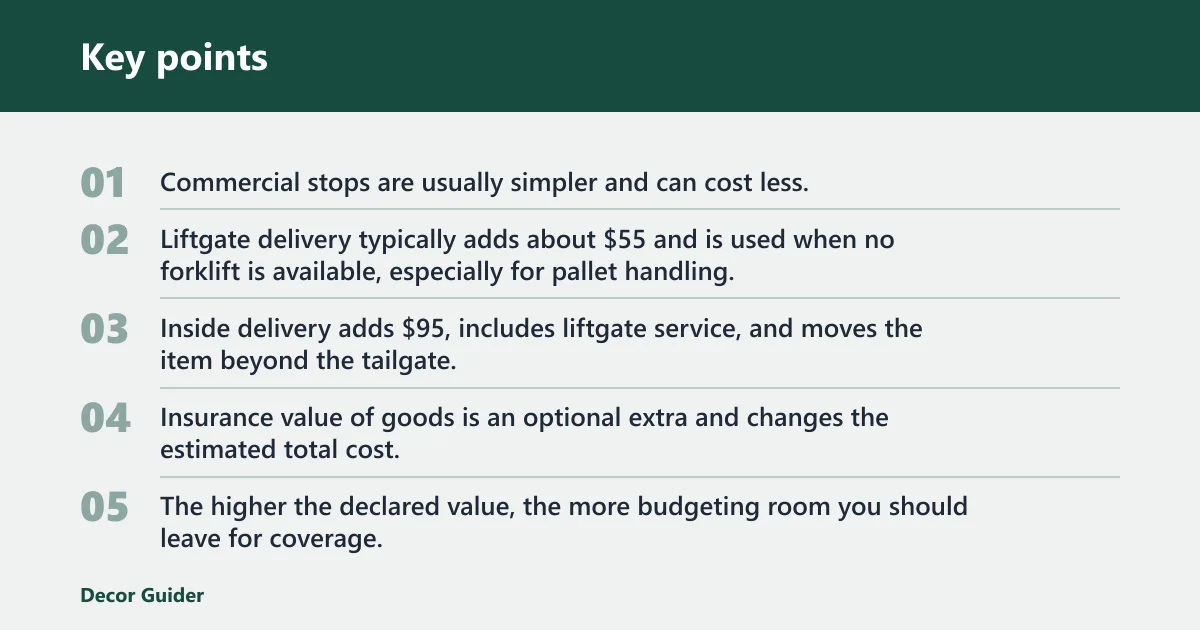
Residential delivery is often more expensive than commercial delivery because carriers must navigate neighborhoods, tighter streets, and less predictable unloading conditions. The residential delivery surcharge is often about $55, and it applies to stops that may involve extra truck navigation and handling complexity. Commercial stops are usually simpler and can cost less.
Liftgate and inside-delivery charges
Liftgate delivery typically adds about $55 and is used when no forklift is available, especially for pallet handling. Inside delivery adds $95, includes liftgate service, and moves the item beyond the tailgate. Those charges matter when the furniture cannot be safely lowered by hand at the curb.
Insurance value of goods and storage time
Insurance value of goods is an optional extra and changes the estimated total cost. The higher the declared value, the more budgeting room you should leave for coverage. Destination storage is another optional extra, measured in months, and it can add meaningful cost if the item cannot be received right away.
Access issues, stairs, and disassembly
Stairs, long carries, narrow hallways, and limited parking often trigger extra handling fees. Disassembly also adds labor when a bed frame, dining table, or sofa has to be broken down before loading. A common first-timer mistake is quoting the furniture size only, then discovering the truck can reach the curb but not the front door.
Say your sofa measures 90 inches long and has to go up two flights of stairs. The base freight may look reasonable, but the stair carry, inside delivery, and possible disassembly can push the bill far above the original number. One access issue changed the whole quote.
Suppose a boxed mirror ships well by parcel, but the destination needs five months of storage. The freight piece may be small, yet the storage line can become a major part of the total estimate. That is why the shipping method and the receiving plan should be priced together.
How do you estimate furniture shipping rates?
Start with the item’s packed size, then match it to the right service level, then add route and accessorial fees. For a budgeting estimate, the best result comes from measuring the piece or carton, identifying the distance tier, and checking whether the destination needs liftgate, inside delivery, insurance, or storage.
-
Measure the item.
Record length, width, height, and the packed shape, not just the furniture footprint. Oversize dimensions often matter more than the raw weight when a carrier sets the billable volume. -
Choose the service level.
Match the item to parcel, LTL, white-glove, or containerized freight. A small boxed lamp belongs in parcel pricing, while a sofa or dining table often needs freight or inside delivery. -
Add accessorial fees.
Check for the liftgate fee, the residential delivery surcharge, and the inside-delivery fee. Add insurance value of goods if the item is fragile or expensive. -
Include storage if needed.
If the destination cannot receive the item immediately, add destination storage by month. This keeps the estimate close to the real landed cost instead of the freight-only number. -
Compare at least two quotes.
Ask each carrier how they treat stairs, limited access, disassembly, and split delivery. The cheapest base rate can become the most expensive final invoice once accessorials are included.
What affects furniture shipping cost comparison between carriers?
Carrier pricing changes with zone-based routing, service level, origin and destination access, and whether the shipment is treated as parcel, LTL, or special handling. Fuel surcharges, route conditions, and season can also move the quote. That is why two carriers can show very different totals for the same chair or sofa.
Common cost pitfalls to avoid
The biggest mistakes are simple: undermeasuring, ignoring accessorials, skipping insurance, and forgetting storage or split-delivery charges. A furniture quote that looks low on freight alone can become expensive once delivery conditions are added.
Undermeasuring oversized pieces
Measure the packed item, not the showroom dimensions. A dining table that seems manageable in the room may require a much larger crate once the legs are removed or the top is protected. That extra volume can move the shipment out of parcel pricing and into freight pricing.
Forgetting accessorial fees
Liftgate, residential delivery, and inside delivery are not small details. Together, they can add meaningful cost to a modest shipment. If the carrier has to navigate a driveway, stairs, or no-dock unloading, those extras should be on the quote before you book.
Skipping insurance on high-value items
Insurance value of goods is optional, but fragile mirrors, artwork, and premium furniture often deserve it. The added cost may be easier to accept than a replacement claim after damage. Budgeting for coverage is part of the true shipping total.
Ignoring storage or split-delivery charges
Destination storage measured in months can change a low quote into a much higher one. Split delivery creates a similar problem when one item arrives first and the rest follow later. If the receiving date is uncertain, ask for storage pricing up front.
Frequently asked questions
What is a furniture shipping cost chart
A furniture shipping cost chart compares common items by method, estimated price band, and add-on fees. It helps you compare a sofa, bed frame, dining table, chair, nightstand, TV stand, wall art, lamp, and mirror without mixing parcel pricing with freight pricing.
What does liftgate delivery add to furniture shipping costs?
Liftgate delivery adds about $55 and is used when no forklift is available, especially for pallet handling. It matters when the truck cannot unload to a dock. If the carrier also needs to bring the item inside, inside delivery can add more on top of that.
Is residential furniture delivery more expensive than commercial delivery?
Yes, residential furniture delivery is often more expensive than commercial delivery because home stops can involve more navigation, more handling, and fewer unloading aids. The residential delivery surcharge is often about $55. Commercial stops are usually simpler and can keep the total lower.
How do I calculate shipping furniture rates?
Measure the packed item, pick the right method, and then add route and fee inputs. Use distance, service level, liftgate, residential delivery, inside delivery, insurance value of goods, and destination storage measured in months. Then compare at least two quotes so the final estimate reflects the real delivery bill.
What is the cheapest way to ship furniture?
The cheapest way is usually parcel for small boxed items or LTL for a single bulky piece that can travel on a pallet. Keep the shipment simple, avoid unnecessary inside delivery, and confirm access before booking. A low base rate is only cheap if the add-ons stay low too.
Products related to this article
Sponsored / affiliate links. As an Amazon Associate I earn from qualifying purchases. I may earn additional commission from eligible campaigns.