Shipping a Mirror Cost / Price Guide
Shipping a mirror usually costs about $20–$60 by parcel for small, framed pieces, and about $75–$200+ by freight for larger mirrors; replacing it can be cheaper when the mirror is oversized, frameless, or low value. Poor packing or the wrong service often means cracked glass, higher claims friction, and a bill that exceeds the mirror’s worth. This guide gives you a size-and-value decision tree for parcel, freight, double-boxing, or replacing the mirror based on destination.
How much does it cost to ship a mirror?
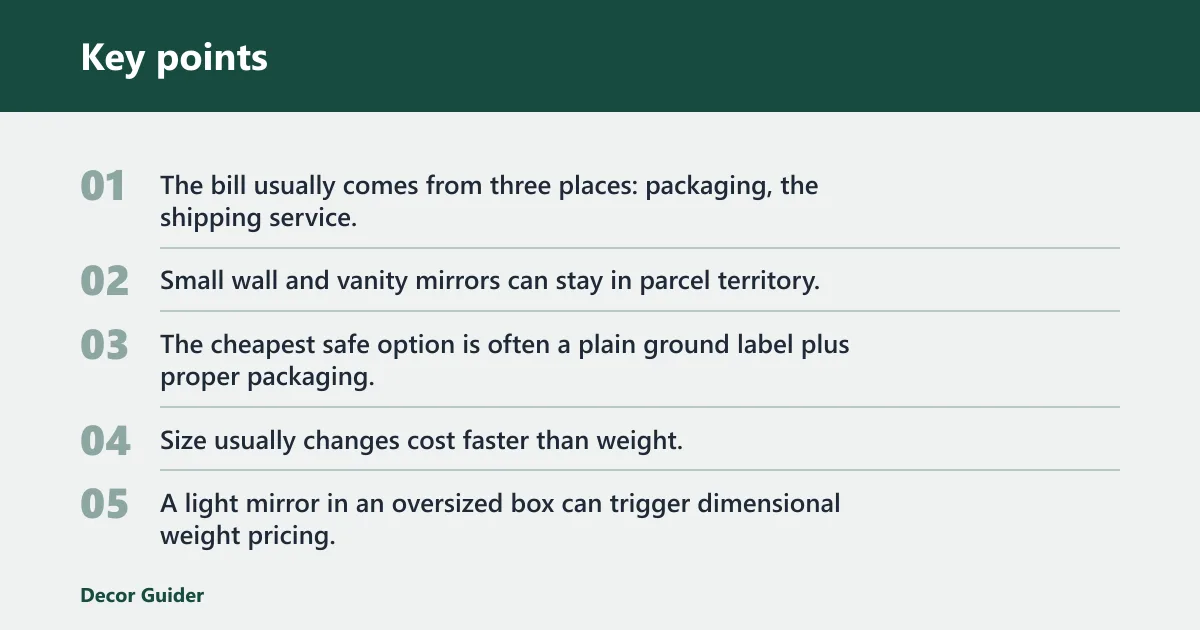


The bill usually comes from three places: packaging, the shipping service, and the risk controls around the glass. Small wall and vanity mirrors can stay in parcel territory, while full-length mirrors usually move into freight because their packed size and shape push past practical parcel limits. The cheapest safe option is often a plain ground label plus proper packaging.
What drives the bill most
Size usually changes cost faster than weight. A light mirror in an oversized box can trigger dimensional weight pricing, which means the carrier charges for the box volume rather than the actual pounds alone. Distance matters too, but a large packed footprint can add more to the quote than a long route.
Packaging also moves the total in a real way. A mirror box, foam corner protectors, bubble wrap, cardboard backers, and packing tape are not optional extras on fragile glass; they are the difference between a usable claim and a broken frame arriving in pieces. Insurance adds less than many people expect, but it still belongs in the estimate.
Why the same mirror can land in parcel, freight, or replacement territory
A small framed mirror may ship as a parcel if the packed piece stays under 70 lb and 130 in length plus girth. Full-length mirrors usually exceed parcel limits and must go freight. Once the mirror is large enough to need heavy padding or a crate, replacement can be the lower-risk choice if the item itself is inexpensive.
Say your mirror is a 24×36 inch framed wall piece with modest weight and you are shipping it a regional distance. Parcel service can still make sense if the packed box stays compact and the carrier does not add oversized surcharges. Change only the size, and the same mirror can move from a $100-ish shipment to a freight quote that is several times higher.
What a realistic low, mid, and high cost band looks like
A small wall mirror may cost about $85–$180 total to ship. A medium mirror can commonly run about $250–$480 to ship. A premium large mirror can exceed $500 and may approach about $700–$850, especially when the mirror is ornate, boxed heavily, or moved by freight with extra handling.
Mirror shipping scenarios
Use the table below as a decision aid, not a quote sheet. Match your mirror to the closest packed size, packed weight, and service level. If your mirror sits between two rows, choose the higher-risk row and price in stronger packaging or freight before buying a label.
| Scenario | Packed size | Packed weight | Likely shipping mode | Packaging stack | Insurance recommendation | Realistic cost band |
|---|---|---|---|---|---|---|
| Small framed vanity mirror | About 22×28×6 in | 5–10 lb | Parcel, ground | Foam corner protectors, rigid cardboard face backers, bubble wrap, double-wall box, packing tape | Buy declared value protection if the mirror is decorative or custom-cut | $35–$90 |
| Small wall mirror | About 28×34×7 in | 10–15 lb | Parcel, ground | Corner protectors, rigid face protection, bubble wrap, double-wall box, tape, void fill | Recommended; total shipped cost often makes insurance worthwhile | $85–$180 |
| Medium framed mirror | About 32×44×8 in | 15–25 lb | Parcel if limits allow; otherwise freight | Double-boxed parcel with cardboard backers, foam corners, bubble wrap, strong tape | Strongly recommended, especially for glass over $200 | $250–$480 |
| Large wall mirror | About 40×52×10 in | 25–40 lb | Freight or special handling | Double-boxing plus outer stabilization, or custom crate for ornate frames | Buy higher declared value; the shipment is costly enough that claims matter | $350–$650 |
| Full-length mirror | About 20×66×12 in | 30–55 lb | Freight | Crate or reinforced freight packaging, rigid face protection, edge blocking, heavy tape | Recommended, with declared value matched to replacement cost | $500–$850 |
| Ornate antique mirror | Varies by model; often bulky once packed | Varies by model | Freight or custom crating | Custom crate, foam blocking, face protection, corner bracing, professional pack-out | Recommended at a higher declared value; the frame can cost as much as the glass | $600–$1,000+ |
How to read the table: if your mirror is still small enough to stay under parcel limits, the bill often stays closer to the low and middle ranges. If the packed box gets large enough to invite dimensional weight charges or special handling, freight becomes the practical choice even before the mirror feels “heavy.”
What size mirror can still ship by parcel?
A mirror can still ship by parcel when the packed box stays under 70 lb and 130 in length plus girth. Bare mirror size does not decide the label by itself. Packed dimensions, padding depth, and frame bulk are what usually push a piece out of parcel-friendly territory.
Why packed dimensions matter more than the bare mirror size
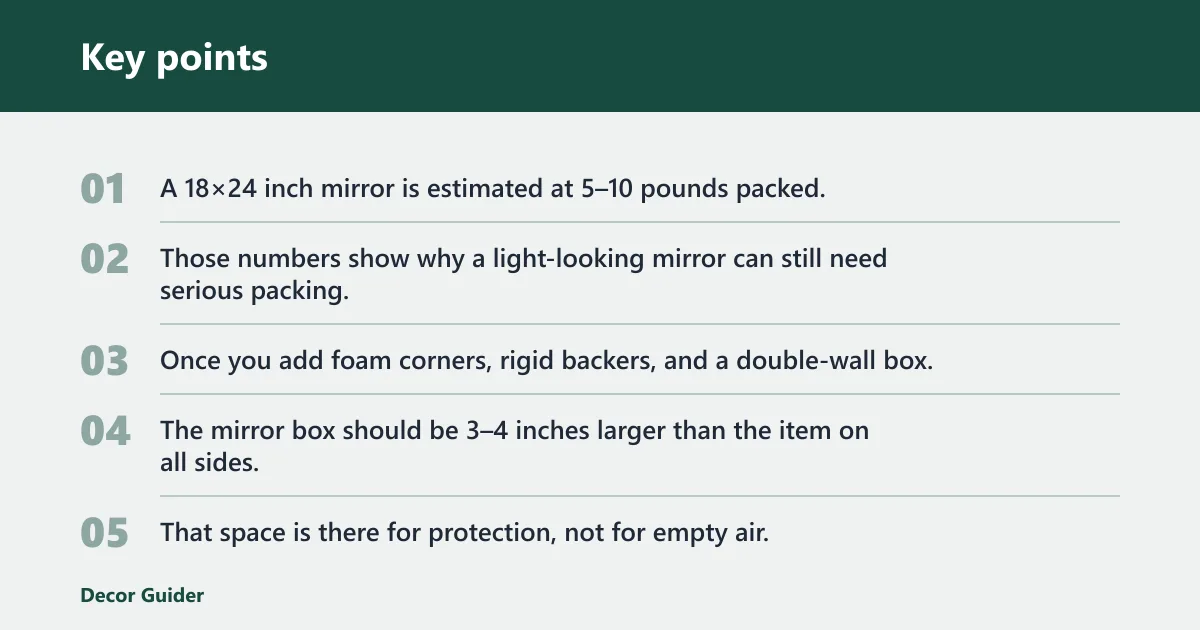
A 18×24 inch mirror is estimated at 5–10 pounds packed, and a 24×36 inch mirror is estimated at 10–20 pounds packed. Those numbers show why a light-looking mirror can still need serious packing. Once you add foam corners, rigid backers, and a double-wall box, the parcel footprint grows fast.
The mirror box should be 3–4 inches larger than the item on all sides. That space is there for protection, not for empty air. If the box is too tight, the glass can press into the wall of the carton. If it is too loose, the mirror can shift and crack at the corners.
How length plus girth changes the rate class
Length plus girth is the practical test that matters for many parcel quotes. A mirror that is not especially heavy can still become expensive if the box is long and deep. Oversized box impact is real because the carrier may charge by dimensional weight, not by the actual packed pounds alone.
Parcel-friendly usually means the shipping box is still manageable with standard ground service and without major surcharges. Once the box size becomes awkward to sort, stack, or move by conveyor, the carrier may route it into a higher-cost class or reject parcel service entirely. Check the current carrier service guide before buying the label.
When a small or medium mirror stays parcel-friendly
Small vanity mirrors, small wall mirrors, and some medium framed mirrors can still work as parcels if the packaging stays compact. Ground labels usually cost less than expedited service, so standard ground is the default starting point when the mirror still fits. Residential delivery can add cost, but it is still simpler than freight for these sizes.
When does a mirror need freight or crating?
A mirror needs freight when its size, weight, or shape no longer fits parcel service in a practical way. Full-length mirrors usually exceed parcel limits and must go freight. Custom crating becomes the better option when the mirror is very large, ornate, antique, or valuable enough that a standard box does not provide enough protection.
Weight triggers and oversized-box pressure
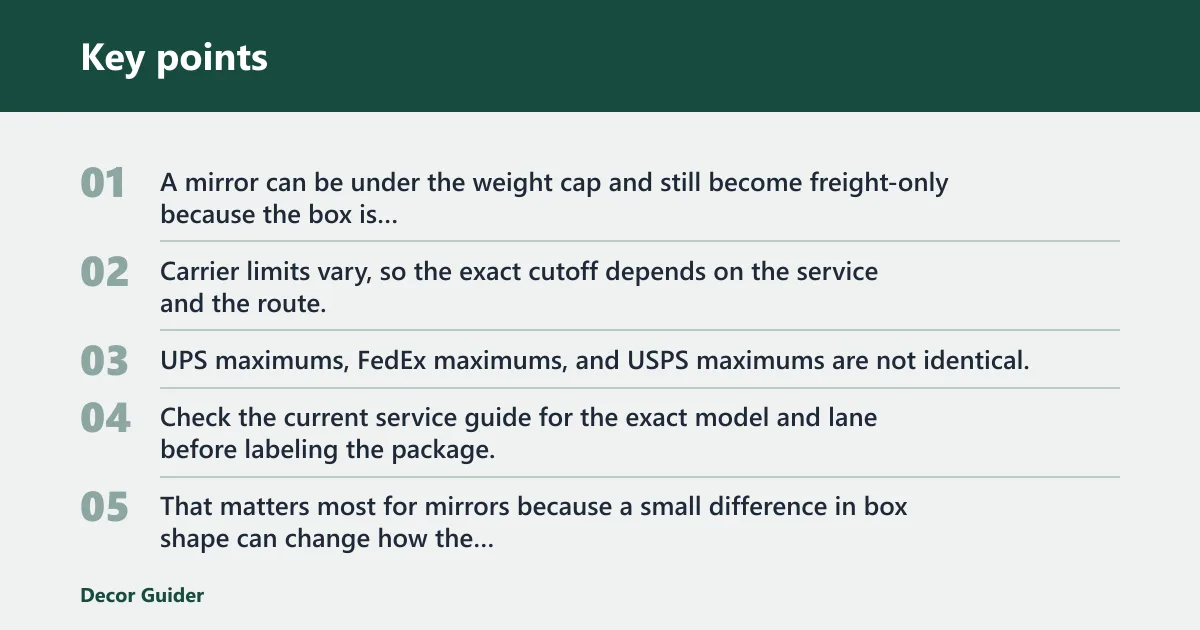
Weight is only part of the decision. A mirror can be under the weight cap and still become freight-only because the box is too long, too bulky, or too awkward to protect well in parcel flow. Carrier limits vary, so the exact cutoff depends on the service and the route, not on one universal number.
UPS maximums, FedEx maximums, and USPS maximums are not identical. Check the current service guide for the exact model and lane before labeling the package. That matters most for mirrors because a small difference in box shape can change how the carrier classifies the shipment.
Ornate, antique, and full-length mirrors that often need extra protection
Ornate and antique mirrors often need more than bubble wrap because the frame itself can chip, crack, or split before the glass even fails. Full-length mirrors are vulnerable because the long panel flexes during movement. A double-boxed parcel may work for some medium pieces, but freight or crating is usually the safer route for oversized glass.
When custom crate pricing can beat the damage risk
Custom crating makes sense when replacement is costly, the frame is delicate, or the destination is far enough away that repeated handling raises the breakage risk. A custom crate can add a meaningful amount to the shipment, but it can also reduce the chance that an expensive mirror arrives as a claim instead of a usable object.
Picture an antique mirror with a carved wood frame and a broad glass surface. If the piece is worth several hundred dollars or more, a custom crate may cost less than the combined risk of a break, a denied claim, and a replacement search for a matching frame.
Use rigid face protection first, then cushion the edges, then immobilize the whole piece in a double-wall box or crate. Bubble wrap alone is not enough for glass. The goal is to prevent flex, edge contact, and shifting inside the carton so the mirror arrives with the frame and glass intact.
Face protection with rigid backers and corner protection
Start with cardboard backers on the face and back. Add foam corner protectors so the most vulnerable points are shielded from impact. Then wrap the mirror with bubble wrap and keep the surface flat and supported. For framed mirrors, the frame edge needs the same attention as the glass face.
- Cover both faces with rigid cardboard backers.
- Fit foam corner protectors to the frame or glass edge.
- Wrap the piece in bubble wrap without crushing the glass.
- Place it in a double-wall box sized 3–4 inches larger on all sides.
- Fill voids so the mirror cannot move inside the carton.
- Seal all seams with packing tape and reinforce the edges.
Double-wall box use and how to size it
A double-wall box is the right baseline for mirrors over $200 or for very large glass items. The extra wall strength helps the carton survive stacking and handling. If the box is too large, the mirror can slide. If it is too tight, the padding compresses and stops protecting the glass.
Packaging materials were estimated at $15–$40 on the low end. That can rise when the mirror needs stronger padding, a second box, or a crate. The packaging stack often matters more than a cheap label, because a low-rate shipment with poor protection is still a bad shipment.
Tape, fill, and void control that keep the mirror from shifting
Use strong packing tape on all seams and edges. Void fill should hold the mirror in place, not crush it. If you can hear the mirror move in the box, the package is not ready. Carriers may ignore fragile labels, so internal restraint matters more than printed warnings.
Carrier choice and insurance
Choose the carrier after you compare box size, packed weight, service level, and the route. Ground service is usually the least expensive starting point. Residential delivery can add cost, and white-glove or special handling is mainly for oversized, delicate, or high-value pieces that need extra care beyond standard parcel flow.
UPS, FedEx, and USPS limit checks to verify before you buy a label
Do not assume the same rules apply across carriers. UPS maximums, FedEx maximums, and USPS maximums differ by service, and the exact limits can change. Before you print the label, confirm the current length, girth, and weight rules for the exact service you plan to use.
Ground shipping, residential delivery, and special handling tradeoffs
Ground shipping is usually the least expensive service when parcel shipping is still allowed. Residential delivery can increase the total because the carrier is delivering to a home address instead of a business dock. Special handling or white-glove service can be worth it for a large mirror, but it usually lifts the bill into freight territory.
Declared value, included coverage, and when to buy more insurance
Insurance was estimated at $5–$15 in the average range. That small add-on can matter a lot when the mirror is custom, antique, or hard to replace. Declared value should match the real replacement exposure, not just the glass cost, because the frame and finish can be the expensive part.
Double-boxing is recommended for mirrors over $200 or very large glass items. That does not remove the need for insurance; it lowers the chance of damage and helps support the claim if something still goes wrong. For low-value mirrors, replacement may be cheaper than paying for more protection than the item is worth.
Frequently asked questions
How much is a mirror?
A basic wall or vanity mirror can be inexpensive to buy, while custom, framed, beveled, or antique pieces cost far more. Price changes with size, frame material, finish, and whether the mirror is stock or made to order. A mirror’s shipping cost often climbs much faster than its retail price.
How much does a mirror cost?
Mirror prices vary by type. Small vanity mirrors can be low-cost, but large wall mirrors, full-length mirrors, and custom pieces can move into much higher price bands. If the mirror is ornate or antique, the frame and finish may matter as much as the glass itself.
What is mirror shipping?
Mirror shipping means moving a glass mirror with packaging and a service level suited to fragile, breakable items. Small mirrors can often go parcel, while full-length or oversized mirrors may need freight or custom crating. The packed size, weight, and value drive the choice.
Average cost to ship a mirror
The final bill depends on packed size, service level, packaging, and declared value.
How to ship mirror safely
Ship it safely by using rigid face backers, corner protection, a double-wall box, and enough internal padding to stop movement. Choose ground service when the mirror still fits parcel limits, and move to freight or crating when the packed size or value makes parcel shipping risky.
Products related to this article
Sponsored / affiliate links. As an Amazon Associate I earn from qualifying purchases. I may earn additional commission from eligible campaigns.