USPS vs UPS for Shipping Furniture
USPS is usually the better fit for small, dense, low-risk furniture parts. UPS is the safer default for bulky, heavier, or higher-value pieces when tracking and handling matter more than base price. Pick the wrong carrier and you can pay more in damage claims, surprise fees, or delays from a bad fit. This guide compares USPS vs UPS on size, weight, cost, speed, tracking, pickup, and surcharge exposure, with nearby alternatives for boxed components and larger furniture.
| Decision factor | USPS | UPS for Shipping Furniture | Winner |
|---|---|---|---|
| Small furniture parts | Strong fit for chair legs, hardware, drawer fronts, and cushions when boxed tightly | Also workable, but often more than you need for a small, low-risk parcel | USPS |
| Heavier boxed pieces | Works up to 70 lbs on USPS Ground Advantage, but box size can still get awkward | Better fit for heavier shipments and bulkier boxes with more handling needs | UPS for Shipping Furniture |
| Tracking and handling | Tracking is available on eligible services, but detail can be less granular | End-to-end visibility is a stronger selling point, especially for higher-value parts | UPS for Shipping Furniture |
| Pickup convenience | Free Package Pickup is available | Pickup options exist, but they may be free or paid depending on account and service level | USPS |
| Speed options | Priority Mail and Priority Mail Express give faster USPS choices for certain parcels | UPS Ground is slower than express services, but shipping-speed options are broader | UPS for Shipping Furniture |
USPS vs UPS for furniture shipments
The real split is not “cheap versus expensive.” It is “small, dense parcel versus bulky, higher-risk shipment.” USPS fits boxed parts that stay compact and do not need special handling. UPS is the safer default when the box is larger, the contents matter more, or you want stronger tracking and pickup control.
That difference matters for furniture pieces that ship apart from the main item. Chair legs, drawer fronts, sofa hardware, and folded cushions often fit USPS better. A boxed nightstand, thick tabletop, or heavier replacement component usually fits UPS better.
Furniture shipping decision matrix
| Item type | Boxed dimensions | Estimated weight band | Carrier fit | Likely fee risks | Safest service choice |
|---|---|---|---|---|---|
| Chair legs | Long, slim box; compact cross-section | Under 2 lb to light-mid range | USPS | Oversize shape if the tube is long; extra padding increases size | USPS Ground Advantage |
| Sofa hardware | Small box or padded mailer | Under 2 lb | USPS | Low, unless dense metal pushes the package above a small-parcel threshold | USPS Ground Advantage or Priority Mail |
| Drawer fronts | Flat box; wide face, modest depth | 2+ lb is common | UPS for Shipping Furniture | Bulky-but-light packaging can trigger dimensional pricing | UPS Ground |
| Chair cushions | Compressed box or poly bag in carton | Light to mid-range | USPS | Size inflation from compression wrapping | USPS Priority Mail or Ground Advantage |
| Nightstand parts | Medium box, often double-walled | Mid to heavy | UPS for Shipping Furniture | Dimensional pricing, surcharge exposure, and handling issues | UPS Ground |
| Disassembled tabletop | Large flat box | 2+ lb, often well above that | UPS for Shipping Furniture | Oversize handling and higher damage risk if the panel flexes | UPS Ground |
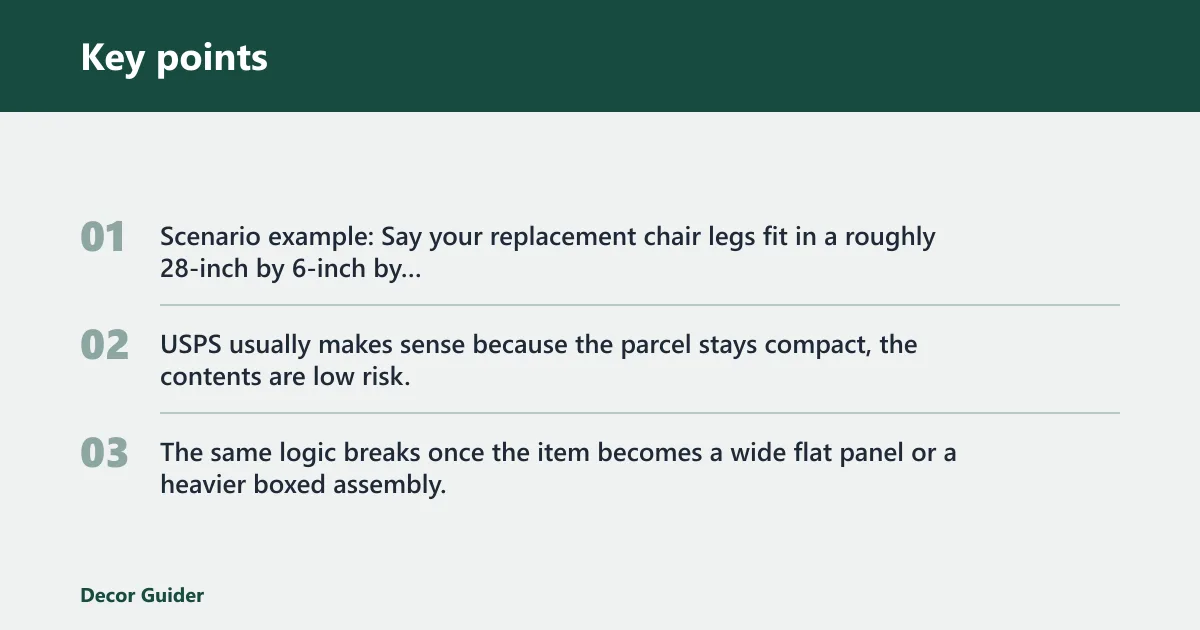
Scenario example: Say your replacement chair legs fit in a roughly 28-inch by 6-inch by 4-inch box and weigh under about 2 pounds. USPS usually makes sense because the parcel stays compact, the contents are low risk, and the shipping need is simple. The same logic breaks once the item becomes a wide flat panel or a heavier boxed assembly.
Which carrier is cheaper for your box?
USPS often comes out cheaper for smaller, lighter parcels, especially when the box stays compact and you can use Priority Mail, Priority Mail Express, or USPS Ground Advantage. UPS can become the better value once weight rises and the package is bulky enough that a low base rate matters less than avoiding extra handling problems.
Base rate differences
USPS Ground Advantage is a low-cost package option, and USPS also offers free Priority Mail and Priority Mail Express boxes and envelopes. That helps when you are shipping a small furniture part that can fit into standard packaging without forcing custom carton costs.
Flat-rate versus dimensional pricing
Flat-rate packaging can help with dense items that fit cleanly into USPS boxes, but it does not solve every furniture shipment. A bulky-but-light part can cost more than expected because the box shape, not just the scale weight, starts driving the price.
When bulky packaging changes the math
Once a furniture box gets wide, flat, or awkward, UPS often becomes the cleaner choice. That is where weight and box shape start working against USPS, even if the item itself is not especially heavy.
Which is faster and more predictable?
USPS gives you clear speed tiers for small furniture parcels, while UPS gives you more delivery-speed control for heavier boxes. If timing matters and the item is valuable, UPS tends to feel more predictable because tracking and handling are built around higher-visibility parcel movement.
USPS Priority Mail timing
USPS Ground Advantage is a 2-5 day option for packages up to 70 lbs, which makes it useful when speed is secondary to keeping the shipment economical.
UPS Ground speed options
UPS Ground is a strong fit for heavier shipments, and UPS is described as providing guaranteed express shipping. For furniture parts that need tighter timing or more handling control, that range of service choices can matter more than saving a few dollars at checkout.
Saturday delivery and cutoff effects
The same source says it offers free regular Saturday delivery, while UPS can charge extra for Saturday delivery. That difference matters when a shipment has to move over a weekend, because the same deadline can produce very different final pricing.
Tracking, pickup, and delivery handling
UPS generally has the edge for end-to-end visibility and delivery-status detail, while USPS remains strong for easy label creation and free pickup. For furniture, that gap matters most when the box is valuable, fragile, or headed to a buyer, repair shop, or return center.
End-to-end tracking
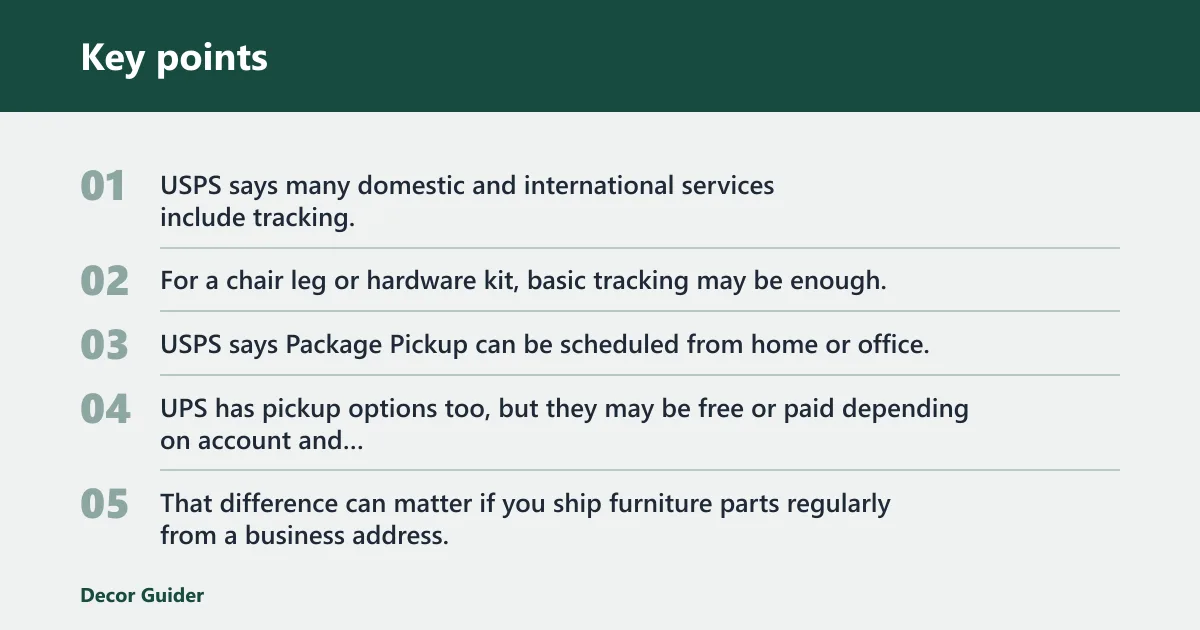
The same source says many domestic and international services include tracking, and UPS is known for detailed shipment-location updates. For a chair leg or hardware kit, basic tracking may be enough; for a replacement tabletop or a resale shipment, more visibility can reduce loss risk and follow-up calls.
Free versus paid pickup
The same source says Package Pickup can be scheduled from home or office, and it also says it has free Package Pickup. UPS has pickup options too, but they may be free or paid depending on account and service level. That difference can matter if you ship furniture parts regularly from a business address.
PO box delivery and address limits
USPS can deliver to PO boxes, which is useful for buyers who use one as a mailing address. UPS generally delivers to street addresses, so the final delivery point can influence the carrier choice before cost does.
Scenario example: Suppose you are mailing a box of sofa hardware to a buyer who only accepts PO box delivery. USPS is the practical pick because the address itself narrows the choice. If the same shipment were going to a warehouse dock with a street address, UPS would become more competitive on tracking and handling.
Surcharges that change the price
Surcharges are where a “cheap” quote stops being cheap. UPS may add fuel surcharges, residential or delivery-area surcharges, extended area surcharges, remote area surcharges, and Saturday delivery fees. The same source says it has no surcharges for residential delivery and offers free regular Saturday delivery.
Fuel and delivery-area surcharges
Fuel surcharges and delivery-area charges matter most when the destination is difficult or the route is expensive to serve. If your furniture part is going to a remote address, UPS pricing can climb faster than the base quote suggests.
Remote-area and Saturday delivery fees
Remote-area surcharges and Saturday delivery fees can change the decision on a late-week shipment. A parcel that looks economical on Monday may become less attractive once weekend timing or a hard-to-reach address gets added.
Residential and pickup-related charges
The same source says it has no surcharges for residential delivery, which helps for home shipments of small furniture parts. On the UPS side, the pickup model can be convenient, but it is worth checking whether your service level includes a paid pickup rather than a free one.
Choose USPS if… / Choose UPS for Shipping Furniture if…
USPS is the better pick when the furniture part is small, dense, and low risk. UPS for Shipping Furniture is the better pick when the box is heavier, more awkward, more valuable, or needs stronger tracking and handling control.
Choose USPS if…
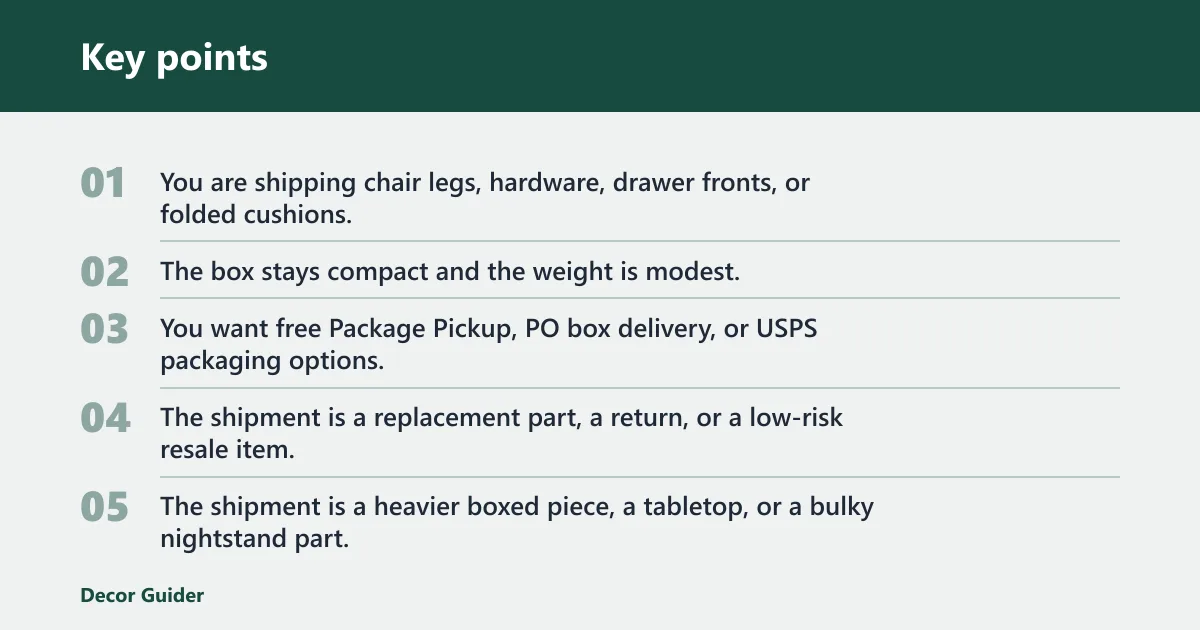
- You are shipping chair legs, hardware, drawer fronts, or folded cushions.
- The box stays compact and the weight is modest, especially below the 2+ pound point where size starts to matter more.
- You want free Package Pickup, PO box delivery, or USPS packaging options.
- The shipment is a replacement part, a return, or a low-risk resale item.
Choose UPS for shipping furniture if…
- The shipment is a heavier boxed piece, a tabletop, or a bulky nightstand part.
- You need more detailed tracking and stronger delivery visibility.
- You expect surcharge exposure to be worth the tradeoff because the item value is higher.
- You want pickup flexibility for business shipping or repeated outbound parcels.
A common first-timer mistake is choosing a carrier based only on a sofa’s weight instead of its oversized dimensions and handling needs. A 3-pound cushion bundle can be easy for USPS, while a 3-pound flat panel can push UPS into the safer lane because the box shape increases handling risk and can trigger less favorable pricing.


Frequently asked questions
Shipping furniture ups vs fedex
UPS and FedEx are both common parcel choices for furniture parts, but for this decision the more useful comparison is whether the box is compact enough for USPS or better suited to UPS. FedEx often enters the conversation when the shipment needs fast delivery or precise delivery updates, but it is not usually the first stop for low-risk small parts.
Does ups ship furniture?
Yes, UPS ships boxed furniture components and other parcel-sized furniture items. It is a better fit for heavier or bulkier pieces than USPS, especially when the shipment benefits from stronger tracking, pickup options, and more delivery-speed choices. Large, fully assembled furniture is a different category and usually needs a freight-style approach.
Shipping usps vs ups
USPS vs UPS comes down to package size, shape, and risk. USPS is usually the cleaner choice for small, dense parts and low-risk replacements, while UPS is better for heavier or more awkward boxes where tracking and handling matter more than the lowest base price.
Shipping costs ups vs usps
Shipping costs can flip depending on the box. USPS often wins on compact, lighter furniture parts, especially with Ground Advantage or flat-rate packaging. UPS can become the better value when the box is heavier or when USPS packaging starts to look inefficient because of size or shape.
Can usps ship furniture safely?
USPS can ship many furniture parts safely if the item is boxed well and the shipment stays compact. Chair legs, hardware, drawer fronts, and cushions are the best candidates. The risk rises when the box is large, oddly shaped, or heavy enough that movement inside the carton becomes hard to control.
Usps shipping vs ups
USPS shipping works best when simplicity and lower cost matter more than delivery-detail depth. UPS is the stronger choice when the furniture part is bulkier, higher value, or headed to a buyer who needs tighter tracking. For furniture, the box itself usually makes the decision before the carrier does.
Products related to this article
Sponsored / affiliate links. As an Amazon Associate I earn from qualifying purchases. I may earn additional commission from eligible campaigns.