Truck Bed Tarps Cost
Truck bed tarps usually cost about $40 to $200, but total ownership can reach about $80 to $350 once you add tie-downs, clamps, or a frame. A poor fit can leak, flap, or shift, damage cargo, and waste money on parts you still cannot trust. This guide breaks down price ranges, fit factors, and when a tarp costs more than a hard or folding bed cover.
Factors affecting tarp pricing
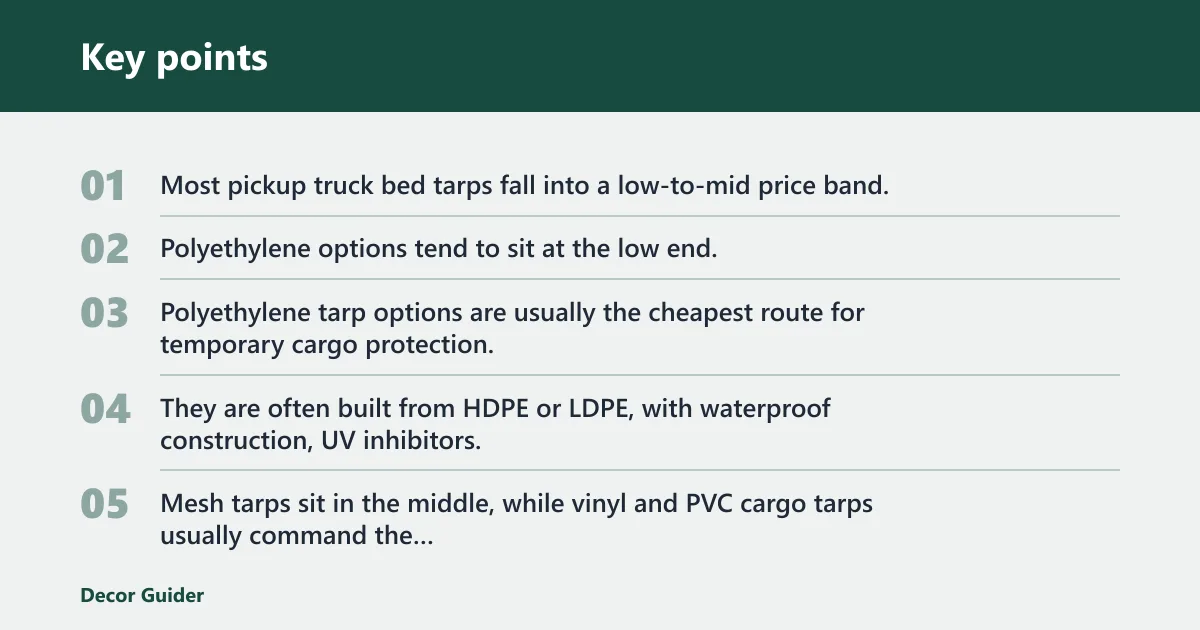


Most pickup truck bed tarps fall into a low-to-mid price band, but the real spend depends on material, bed size, and how much hardware you need to keep the tarp secure. Polyethylene options tend to sit at the low end, while vinyl and heavy mesh versions cost more because they use heavier fabric, stronger hems, and better hardware.
Typical price ranges by tarp type
Polyethylene tarp options are usually the cheapest route for temporary cargo protection, with many retail listings landing around the low end of the market on major sellers such as Harbor Freight tarps and The Home Depot tarps. They are often built from HDPE or LDPE, with waterproof construction, UV inhibitors, and tear resistance that suit occasional use more than constant exposure. Mesh tarps sit in the middle, while vinyl and PVC cargo tarps usually command the highest price because they are made for tougher transport use and better edge reinforcement, such as the heavy-duty listings on Mytee Products truck tarps and Tarps Now vinyl tarps.
What drives the price up or down
Thickness matters. A 5 mil tarp is usually easier to fold and handle, while a 20 mil tarp is heavier and more abrasion-resistant, and those thickness examples appear on supplier listings such as Tarps Plus 5 mil tarps and Tarps Plus 20 mil tarps. Grommet spacing also affects value, since reinforced metal hardware placed every 18–24 inches gives more tie-down options than sparse spacing, as shown in product specs from Mytee Products and Sportsman’s Guide tarp listings. UV resistance, seam quality, and reinforced hems can push a tarp into a higher price tier.
Bed shape matters too. Short beds need less material than long beds. Stepsides and beds with unusual rail shapes may need more adjustment, extra hardware, or a larger tarp so the edges can reach anchor points without pulling tight across corners. Sizing guidance from dump and cargo tarp suppliers such as Lookout Mountain Dump Truck Tarps commonly recommends ordering extra length beyond the bed for overlap and fastening.
When a low-cost tarp makes sense
A lower-priced tarp makes sense when you only need temporary coverage for dry debris, light rain, or a one-time haul. A pickup truck bed tarp is best judged as a temporary cover, not a permanent closure system. If you move mulch, tools, or boxed goods a few times a month, a simple setup can be enough.
Say your truck has a short bed and you only need to keep weekend supplies dry. A poly tarp with basic tie-downs may be the practical choice. Say you haul gravel on rough roads every week. In that case, a heavier tarp with stronger hems and better anchors is usually the safer buy.
Truck bed tarp cost breakdown
The full spend is usually three parts: tarp price, hardware, and any setup or installation help. If you only compare tarp stickers, you can miss the real total by a wide margin. A low-priced tarp with weak anchors can end up costing more than a better tarp that is ready to secure properly.
| Truck bed tarp type | Economy or heavy-duty | Short-bed or long-bed fit | Includes hardware? | Tarp price | Tie-down hardware cost | Optional installation cost | Typical total spend | Comparable soft roll-up / hard folding bed cover total cost | When this line item applies |
|---|---|---|---|---|---|---|---|---|---|
| Poly | Economy | Short bed to standard long bed with sizing adjustments | No | $40-$90 | $20-$40 | $0-$50 | $60-$180 | Soft roll-up: about $300-$700; hard folding: about $700-$1,500, based on common retail listings from AutoAnything tonneau covers and RealTruck tonneau covers | Best for light cargo, temporary weather coverage, and lower-hassle storage needs |
| Mesh | Economy to midrange | Short bed, long bed, and mixed-use beds where airflow matters | Sometimes | $60-$130 | $25-$50 | $0-$75 | $85-$255 | Soft roll-up: about $300-$700; hard folding: about $700-$1,500, based on common retail listings from AutoAnything tonneau covers and RealTruck tonneau covers | Use when airflow matters more than full rain blocking, or when you want load restraint with less wind drag |
| Vinyl / PVC | Heavy-duty | Short bed or long bed with more anchor points and tighter fit demands | Sometimes to yes | $90-$200 | $30-$70 | $25-$100 | $145-$370 | Soft roll-up: about $300-$700; hard folding: about $700-$1,500, based on common retail listings from AutoAnything tonneau covers and RealTruck tonneau covers | Fits heavier cargo, repeated road use, and buyers who want stronger seams, D-rings, and better water resistance |
Tarp price
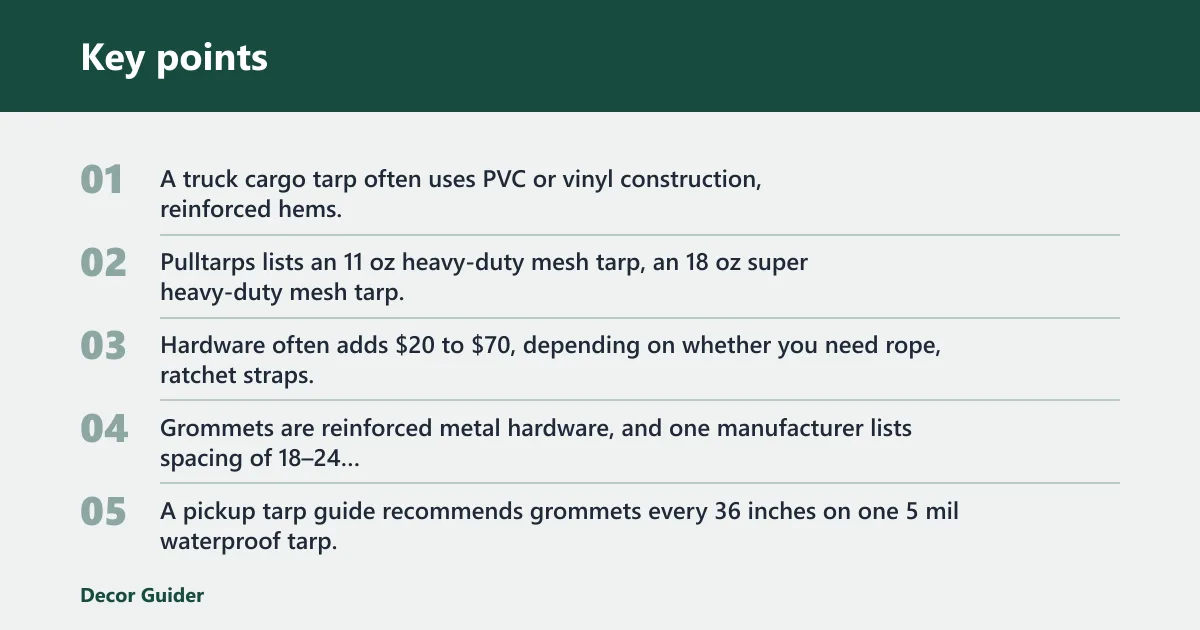
The tarp itself is only part of the bill. A truck cargo tarp often uses PVC or vinyl construction, reinforced hems, rust-resistant grommets, and D-rings for secure transport. Pulltarps lists an 11 oz heavy-duty mesh tarp, an 18 oz super heavy-duty mesh tarp, and an 18 oz waterproof vinyl tarp, which shows how weight and material can move the price up.
Tie-down hardware and grommets
Hardware often adds $20 to $70, depending on whether you need rope, ratchet straps, clamps, hook sets, or extra anchor points. Grommets are reinforced metal hardware, and one manufacturer lists spacing of 18–24 inches on cargo tarp products from Mytee Products. Grommets every 36 inches on one 5 mil waterproof tarp, but tighter spacing usually gives more tie-down compatibility and better control at the corners.
Optional installation or setup
Setup costs depend on whether you need a simple strap pass-through or a more involved frame. Optional installation may include cutting, fitting, or adding anchors so the tarp stays seated over bed rails. For buyers who want a fixed, repeatable setup, labor can matter as much as the tarp itself.
How much tarp do you need?
Choose size from bed length first, then check rail height and tailgate shape. A tarp that is too short leaves cargo exposed, and one that is too large can catch wind and pool water. One tarp option is described as universally sized to fit long beds, short beds, and stepsides, but most buyers still need to verify fit before buying.
Measure bed length and width
Start with the bed interior dimensions, then add enough reach for the tarp to cover the top edge and anchor points. Lookout Mountain says most dump tarps are ordered 7′ or 7.5′ wide, and recommends a tarp length 2′ longer than the bed it will cover. That extra length helps account for overlap and fastening.
Account for bed rails and tailgate shape
Bed rails change how the tarp sits. Tall rails need more side drop, while shallow rails may leave less room for tie-downs. Tailgate shape also matters because square corners and rounded corners distribute tension differently. If the tarp rides on the rails instead of inside the bed, edge slack becomes a wind and abrasion risk.
Short beds, long beds, and stepsides
Short beds are simpler to cover, but they can still need careful fastening if the tailgate angle is steep or the rails are wide. Long beds need more material and usually more anchor points. Stepsides often need extra attention because the body shape changes the path from bed rail to tie-down point, which can affect both fit and total hardware spend.
Which material fits your budget?
Polyethylene is the best-known budget option, mesh works well where airflow matters, and vinyl or PVC is the strongest fit for repeat cargo duty. The right choice depends on whether you need occasional rain protection or a more durable cargo tarp with reinforced hems and better resistance to stretching under load.
Polyethylene tarps
Polyethylene tarps use HDPE or LDPE construction and are often sold as waterproof covers with UV inhibitors. They are lightweight, simple to fold, and easier to store than heavier vinyl. The tradeoff is that lighter material can wear faster at the edges, especially where it rubs against bed rails or cargo corners.
A common pickup bed guide recommends a 5 mil waterproof tarp, while a heavier example in the same guide is listed at 20 mil thickness. That spread shows the basic tradeoff: thinner tarps are easier to handle and cheaper, while thicker tarps usually resist abrasion better and can feel less convenient to install.
Vinyl and PVC cargo tarps
Vinyl and PVC options are common when the goal is tougher load protection. Bollison describes truck cargo tarps as protective covers for transportation, and these products often use reinforced hems, rust-resistant grommets, and D-rings. They are a better fit when you want stronger edge control and more confidence in wet conditions.
One manufacturer lists 100% waterproof performance and UV resistance of up to 500 hours. That does not remove the need for good seam and edge treatment. Water can still move through weak stitching, loose folds, or pooled low spots if the tarp is not tensioned properly.
Mesh tarps for lighter coverage
Mesh tarps are useful when you want airflow, reduced wind drag, or quick load containment. They are often chosen for debris or loose cargo that does not need full rain blocking. Mesh is less suitable for moisture-sensitive loads, but it can be a smart middle ground when you want coverage without a fully sealed top.
Thickness, waterproof rating, and UV resistance
Thickness affects abrasion resistance and handling weight. Waterproof ratings matter, but 100% waterproof claims are only part of the story because seams and edges still need to shed water. UV inhibitors help reduce sun-fade and material breakdown, which matters if the tarp stays outdoors for long periods. A thinner tarp can be fine for light use; a thicker one usually suits rougher hauling.
How do you secure a pickup bed tarp?
Good security comes from the attachment system, not the tarp alone. Grommets, tie-down points, D-rings, and cargo nets all help keep the tarp from lifting or shifting. If the edges are loose, wind can work under the fabric, water can pool, and abrasion can wear through the contact points.
- Measure the bed, cargo height, and tie-down locations before buying the tarp.
- Lay the tarp over the load so the overhang reaches all anchor points evenly.
- Start fastening at the corners, then move to the long sides and tailgate edge.
- Use grommets, straps, or clamps to create firm tension without crushing the fabric.
- Check for slack, then re-tighten after a short drive if the load settles or the wind shifts the tarp.
Grommets and spacing
Grommets are reinforced metal attachment points that make tie-downs less likely to tear through the tarp edge. Many truck cargo tarp products use 18–24 inch spacing, while some pickup tarp guides use wider spacing on lighter products. Tighter spacing usually gives more control on bed corners and across the tailgate.
Tie-down points and D-rings
D-rings give you cleaner strap routing than a bare tarp edge, especially when the load shifts during braking or cornering. Use existing bed anchors when possible, and add clamps or hooks only if they lock the tarp down without crushing the fabric. The goal is firm tension without pulling the tarp into a stress point.
Cargo net use with or without a tarp
A cargo net can work alone for loose items or with a tarp when you need extra restraint. A cargo net expands from 4’x6′ to 8’x12′, which shows why a stretchable net can adapt to different loads. Use hooks and carabiners to keep the net connected at consistent points, and do not rely on a net alone for moisture-sensitive cargo.
A common first-timer mistake is tightening the center and leaving the corners loose. That setup looks secure at a glance, but wind can still get under the edge and flutter the tarp against the bed rail until the fabric wears through.
Pickup tarp cost breakdown table
The easiest way to judge value is to separate each line item before you buy. Tarp price tells only part of the story. Hardware, setup, and fit changes can shift the total enough that a mid-priced tarp ends up costing less than a cheaper one with extra add-ons.
| Line item | What it includes | When it applies | Typical impact on total spend |
|---|---|---|---|
| Tarp body | Polyethylene, mesh, vinyl, or PVC sheet with hems and grommets | Always | Usually the largest base price difference between budget and heavy-duty options |
| Tie-down hardware | Rope, ratchet straps, hooks, clamps, D-rings, and anchor points | When the tarp has to stay fixed at highway speed or in wind | Adds about $20-$70 in many setups |
| Setup or installation | Fitting, trimming, anchor placement, or frame work | When the bed shape is unusual or the tarp needs repeatable mounting | Can add $25-$100 depending on complexity |
| Fit adjustments | Longer tarp length, extra width, or more tie points for rails and tailgate shape | For short beds, long beds, and stepsides that do not match a standard layout | Raises total spend when the first-size tarp does not sit cleanly |
Tarp or truck bed cover?
A tarp is temporary coverage. A truck bed cover is a more permanent buy. If you want quick removal, flexible use, and lower entry price, a tarp usually wins. If you want cleaner sealing, better theft deterrence, and less daily setup, a hard or folding cover may be the better buy even with the higher upfront price.
Temporary coverage versus permanent coverage
Truck bed tarps are built for fast install and removal. They are practical for seasonal use, one-off hauling, or situations where cargo shape changes often. A bed cover stays on the truck and usually gives a neater fit, but it gives up the easy swap-out that makes tarps so adaptable.
Cost comparison by use case
For a low-use driver, a tarp can remain the cheaper answer even after hardware. For frequent highway hauling, the added spend on stronger material and better anchors may still be lower than moving straight to a hard cover. The decision should be based on how often you load the bed and how much weather protection you actually need.
When a bed cover may be the better buy
If your cargo stays in the truck often, a bed cover can make more sense because you avoid repeated setup and reduce edge lift. It is also the clearer choice when you want a more finished look and more consistent sealing across the bed rails. Compare the total spend, not just the sticker price.
Frequently asked questions
How much do truck bed tarps cost?
Most truck bed tarps run from $40 to $200 before hardware, with retail examples on major sellers such as Harbor Freight tarps and Mytee Products truck tarps showing the market spread. Once you add tie-downs, clamps, or a frame, the total often reaches $80 to $350. Poly options sit lower, while vinyl and heavy mesh products move toward the upper end because of stronger fabric and better edge hardware.
What size tarp do I need to cover a truck bed?
Measure bed length first, then check rail height and tailgate shape. A common rule is to choose a tarp a little longer than the bed, and some guides recommend 2′ extra length from suppliers such as Lookout Mountain Dump Truck Tarps. If your truck has stepsides or tall rails, add more room for overlap and tie-downs.
Where can I buy truck bed tarps near me?
You can usually find truck bed tarps at truck accessory stores, trailer supply shops, farm and hardware retailers, and online sellers that stock cargo tarps. Look for product pages that state thickness, grommet spacing, material type, and whether the tarp is waterproof or only water-resistant.
How do I cover a pickup truck bed with a tarp?
Lay the tarp over the cargo so it covers the rails evenly, then secure it at the grommets with straps, hooks, or clamps. Keep the corners tight, check that the tailgate edge is not open, and recheck after driving a short distance because wind can loosen a poor setup.
What is the difference between a truck tarp and a truck bed cover?
A truck tarp is temporary, flexible, and usually cheaper. A truck bed cover is more permanent and often seals the bed with a hinged, folding, or rigid panel system. Choose a tarp for fast, adaptable coverage; choose a cover when you want a fixed solution and cleaner daily use.
Are heavy-duty truck tarps worth the extra cost?
Heavy-duty tarps are worth the extra cost when you haul often, drive at speed, or need better abrasion resistance. They usually bring thicker fabric, stronger hems, and more reliable grommets. If you only need occasional weather protection, a lighter tarp can still make sense.
How much does installation or setup add to the total cost?
Basic setup may add nothing if you already have anchors and straps. More complete installation can add about $25 to $100 when you need extra tie points, a frame, or better fit work. The more unusual the bed shape, the more likely setup will affect the final price.
Which tarp material is best for weather protection and budget?
Polyethylene is usually the best budget pick for temporary weather protection because it is lightweight, waterproof, and widely available. Vinyl or PVC is better when you need stronger transport use and more durable edges. Mesh works well for airflow, but it is the weakest choice for keeping out rain.
Products related to this article
Sponsored / affiliate links. As an Amazon Associate I earn from qualifying purchases. I may earn additional commission from eligible campaigns.