Chair Shipping Cost Problems
Chair shipping costs rise mainly because dimensional weight, not chair price, sets the bill; shrink the carton, remove wasted air, and you can cut charges fastest. If you ignore that, you pay more per shipment and absorb avoidable damage claims. This guide shows which variables matter most, how packing changes the rate, and what to fix first to control cost.
Why chair shipping costs jump

Chair shipping cost problems usually start with carton volume, then spread into damage risk, accessorials, and service level. A light chair in an oversized box can price like a heavier item because carriers often bill on dimensional weight. Once packaging fails, returns and replacements can cost more than the original freight.
Size, weight, and dimensional weight
For parcel shipping, a chair’s folded size often matters more than its actual weight. If the carton gets large relative to mass, dimensional weight can overtake actual weight and drive the bill up. That is why a compact folding chair can ship far cheaper than a rigid chair with the same seat weight.
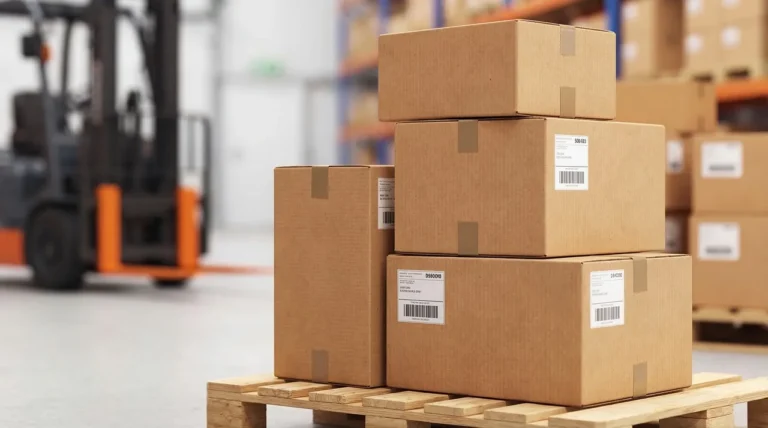
Oversized cartons are the classic trap. A chair that looks “light enough” can still trigger a high rate because empty space inside the box counts against you. The fastest fix is usually not a cheaper label; it is a smaller carton with less dead air and a tighter part layout.
Damage risk and returns
Poor packing raises cost in a different way. Scratches, crushed corners, bent arms, and loose hardware can create claims, returns, rework, and replacement shipments. Those costs often show up after the label is bought, which is why shipping quotes can look low and still miss the true bill.
A common first-timer mistake is shipping an assembled chair in a carton that fits the seat but leaves the backrest free to shift. The carton may look acceptable from the outside, then fail in transit because part-to-part movement damages the finish and weakens the package.
Service level, lane, and accessorials
Service level changes the total as much as packaging does. Parcel, courier, and freight all price differently, and each service adds or avoids different fees. Residential delivery, liftgate service, oversize handling, and re-delivery can turn a simple shipment into an expensive one even before the chair crosses the country.
Lane choice matters too. A nearby shipment may stay in parcel or courier territory, while cross-country moves more often push you toward freight, especially for bulk loads or rigid chairs. If the chair is large and the box is bulky, the lower base rate can vanish under accessorials and minimum charges.
Chair shipping decision table
The table below maps common chair types to the most likely cost driver, the most likely fix, and the shipping method that feels the problem first. Use it to decide what to change before you ask for a fresh quote.
| Chair type | Dimensional weight risk | Damage risk | Packing method | Likely cost lever |
|---|---|---|---|---|
| Office chair | High if the back, arms, or base stay assembled and force a tall carton | Medium to high because casters, armrests, and backs can rub or shift | KD packing with an outer corrugated carton; EPE formed frame or foam bags; corrugated dividers for hardware and parts | Carton height and service level; parcel rates often move first |
| Rocking chair | High when the runners or curved arms prevent tight stacking | High because long surfaces and curved parts can scuff or crack | Partial KD packing when possible; double-wall outer carton; EPE foam protection at contact points | Carton volume; freight becomes more likely once the shape no longer fits parcel economics |
| Folding chair | Low to medium if the folded size stays tight | Medium because hinges and edges need restraint | Compact folded packing; foam bags or edge protection; separate hardware if needed | Folded size; parcel shipping is most sensitive to extra inches in the carton |
| Dining chair | Medium if the backrest and legs set the box width or height | Medium because finished surfaces can mar easily | KD packing when design allows it; dividers between seat and backrest; outer carton sized to avoid empty space | Carton width and returns risk; freight or courier can become cheaper than oversized parcel |
| Chair parts | Low for small parts, higher for mixed kits in one oversized box | High if parts contact each other in transit | Corrugated dividers; hardware in separate bags or boxes; EPE foam bags for finished surfaces | Pack density and mixed-SKU handling; the cost driver is usually wasted space, not weight |
For office chairs, the most important question is whether the folded or knocked-down package can stay compact without sacrificing protection. For rocking chairs, the problem is often shape, not mass. For folding chairs, the box footprint is usually the main cost lever. For dining chairs and parts kits, control of empty space and movement usually matters most.
What folded size changes
Folded size changes carton dimensions, and carton dimensions change dimensional weight. That is the chain that makes one chair cheap to ship and another unexpectedly expensive. If the folded chair still needs a tall or wide box, the carrier may bill as if the shipment were much heavier than it really is.
Carton dimensions and dimensional weight
A folded chair that reduces the box by even a small amount can sometimes move the shipment into a cheaper billing tier. This matters most in e-commerce parcel shipping, where oversize fees and dimensional billing often start before actual weight becomes the main issue. Small changes in height or width can matter more than a few pounds on the scale.
When a carton is oversized, the carrier is charging for the air around the product. That is why KD packing is often more cost-efficient than assembled packing. KD packing reduces carton volume and improves container loading quantity, so the same shipment can fit more units per pallet or per container.
When a folded chair still ships big
Some chairs fold, but not tightly enough to solve the cost problem. A folding lounge chair with a wide profile or a chair with protruding hardware may still need a long carton, and that length can push the shipment into a higher service class. Folded does not always mean economical.
Picture a folding chair that closes flat but still leaves a roughly 36-inch carton because of the hinge geometry. If the same chair could be shipped at about 28 inches with better part alignment, the savings would come from the smaller box, not from the chair itself.
Why chair type changes the fold footprint
The fold footprint depends on the chair’s structure. Office chairs often break down into seat, backrest, base, and hardware. Folding chairs collapse differently, but the hinge assembly may still set the final carton size. Dining chairs and rocking chairs often require more careful orientation because their fixed shapes limit how tightly they can nest.
Which packaging cuts damage risk?
Packaging cuts damage risk when it holds parts still, cushions contact points, and keeps surfaces from touching each other. The right outer carton controls crush resistance, while the inner protection controls scratches and part-to-part movement. You need both if the shipment has mixed components or finished surfaces.
Outer corrugated carton choice
One competitor uses double-wall corrugated cartons for office chair shipping, with carton burst strength specified at 250–300 lb. That kind of carton can make sense when protection has to improve without turning the package into an oversized box. Protection matters, but so does carton volume; a stronger box that is too large can still raise the bill.
Burst strength helps describe resistance to bursting under pressure, but it does not solve every shipping problem by itself. You still need the carton to match the chair’s shape and packing method. If the outer box is too large, the dimensional weight penalty can erase the protection benefit.
EPE foam protection and foam bags
Office chair packaging can include an EPE formed frame, and it can also include EPE foam bags for surface protection. These are useful when you need to prevent scratches and light impact damage without moving to custom-molded plastic. EPE helps stabilize the chair finish and keep parts from rubbing during transit.
Use EPE where the finish touches the carton or another component. It is especially helpful around armrests, painted bases, and visible frame surfaces. If the chair has multiple finished parts, EPE can do more for damage control than simply adding more empty space around the product.
Corrugated dividers for mixed chair parts
Corrugated dividers separate the backrest, seat, and base. That matters when one carton carries mixed chair components, because the dividers reduce part-to-part damage and help the load keep its shape. Hardware may also be packed separately in bags or boxes so it does not mar finished surfaces or disappear in the bottom of the carton.
For mixed kits, dividers often pay for themselves by reducing rework. They are also useful when the shipment includes multiple chair parts in one outer carton and the pieces need to stay aligned during stacking.
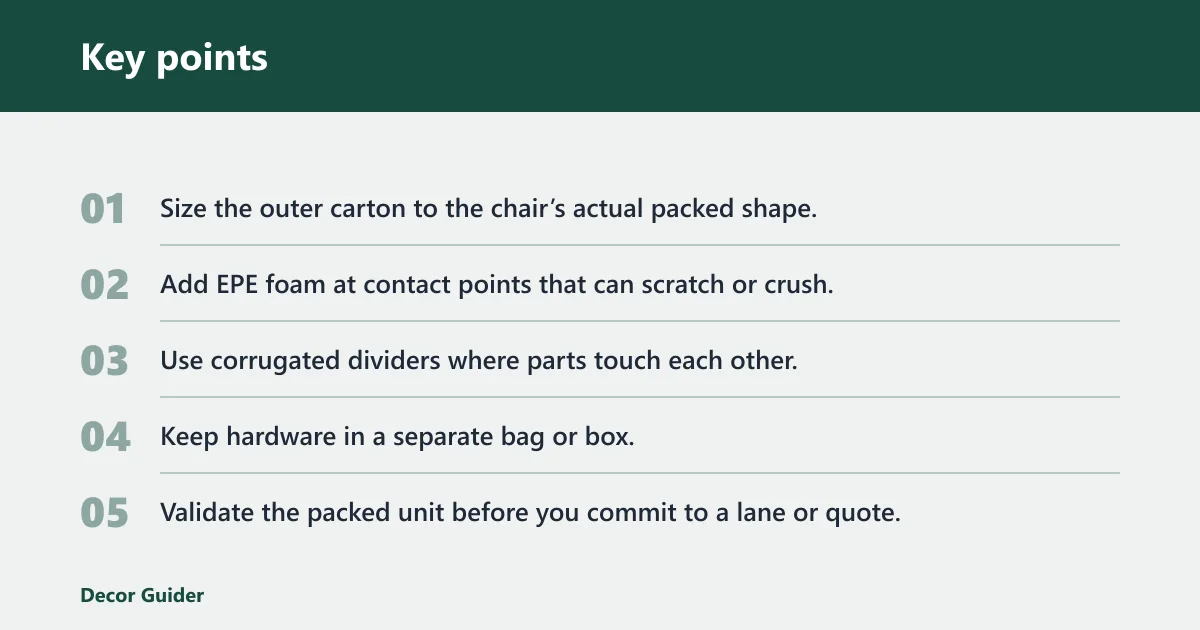
- Size the outer carton to the chair’s actual packed shape, not to the empty space you can afford.
- Add EPE foam at contact points that can scratch or crush.
- Use corrugated dividers where parts touch each other.
- Keep hardware in a separate bag or box.
- Validate the packed unit before you commit to a lane or quote.
KD packing versus assembled packing
KD packing usually ships more efficiently than assembled packing because it reduces carton volume and improves loading density. Assembled packing may be easier for the user, but that convenience often raises shipping costs. The difference shows up first in parcel rates, then in pallet density, and finally in container loading.
Volume reduction and loading quantity
KD packing lets you separate the seat, backrest, base, and hardware into a tighter package. That improves the number of chairs you can fit into a container and can lower the shipping cost per unit. In contrast, assembled packing leaves more dead air and can cut the number of units that fit in the same space.
A 20GP container can hold around 180–230 KD-packed office chairs. A 40GP container can hold around 380–460 KD-packed office chairs. The exact quantity depends on chair size, carton dimensions, and loading method. Those numbers matter because even a small change in carton size can change the total freight cost per chair.
When assembled packing raises cost
Assembled packing becomes expensive when the chair shape forces a larger carton or when the carton must be reinforced heavily to protect a finished product. The buyer may appreciate the convenience, but the bill can rise because the shipment occupies more cubic space and may trigger more handling fees.
Suppose a dining chair could ship as KD in a compact box, but assembled packing requires a box with extra height to protect the back. That taller carton may move the shipment from parcel into freight territory, or from standard freight into oversize handling.
Which shipping methods feel the difference most?
Parcel shipping feels dimensional weight first. Freight feels pallet density and accessorials first. Courier services often sit between them, but bulky chair cartons can still pick up oversize or handling surcharges. The less efficient the packing, the faster each service type starts to look expensive.
How shipping terms change the bill
FOB, CIF, and DDP are useful because they help compare the complete price breakdown, not just the freight line. They expose where hidden shipping charges sit and show how packaging, freight, and destination handling affect landed cost. If you compare only one term, you may miss the fee bucket that is hurting the shipment.
FOB versus CIF versus DDP
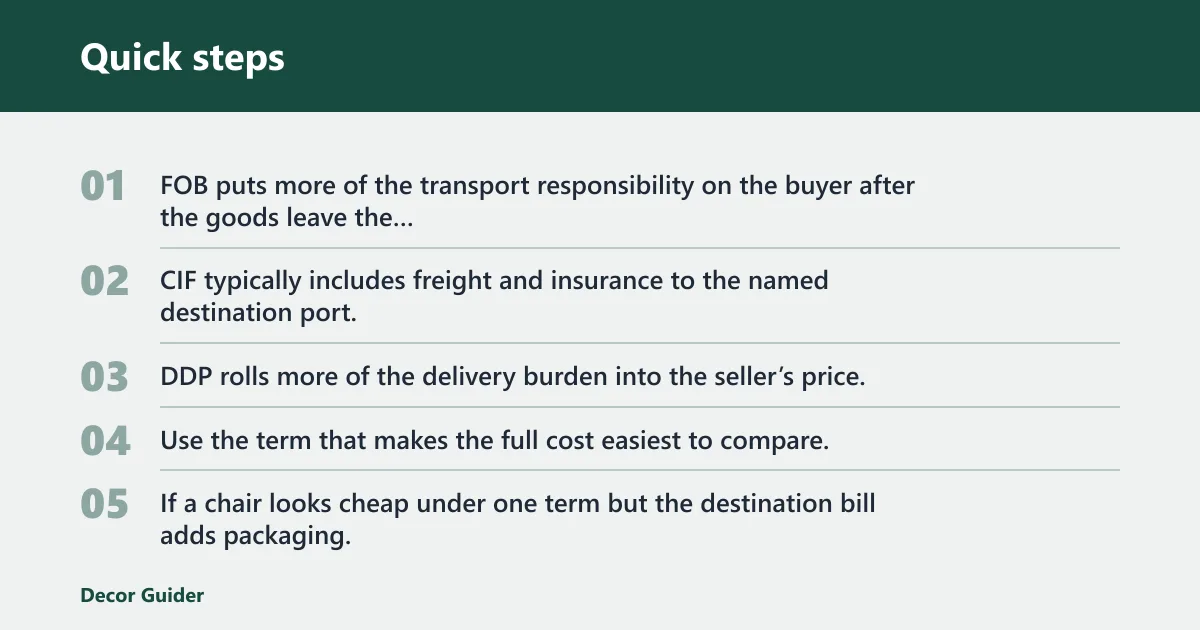
FOB puts more of the transport responsibility on the buyer after the goods leave the seller’s control point. CIF typically includes freight and insurance to the named destination port, but it can still leave destination charges unpaid. DDP rolls more of the delivery burden into the seller’s price, which can make the quote look higher while reducing surprise charges later.
Use the term that makes the full cost easiest to compare. If a chair looks cheap under one term but the destination bill adds packaging, freight handling, or delivery fees later, the apparent savings may be fake.
Hidden charges tied to packaging and freight
One competitor identifies hidden charges like packaging, tooling, or shipping costs. That is exactly where chair shipments often go wrong. A quote may not fully reflect carton upgrades, mixed-load handling, or the extra volume created by assembled packing.
Accessorials are another common bucket. Residential delivery, liftgate service, re-delivery, and oversize fees can change the final bill even when the base freight quote looks reasonable. For chair shipping, the hidden cost is often not the lane itself. It is the packaging and the handling attached to the lane.
How to compare landed cost
Start with the carton size, then compare the shipping terms. Ask what is included, what is excluded, and which party pays for packaging, inland movement, port handling, or final delivery. If the shipment is for a single chair, parcel or courier pricing is usually the relevant comparison. If the shipment is bulk, container loading and landed cost matter more.
Chair shipping becomes uneconomical when the carton is oversized, the chair must ship assembled, or the load contains mixed models that cannot pack tightly. A single rigid chair can also cross that line if it needs heavy protection but still does not fit efficiently in a parcel carton. At that point, the cheapest label is often the wrong target.
How to ship a chair
Start by measuring the folded or knocked-down package, not the fully assembled chair. Choose the smallest carton that still protects the parts, then add EPE foam, corrugated dividers, and separated hardware as needed. If the carton becomes large enough to trigger dimensional weight, compare parcel, courier, and freight before you buy the label.
How to ship a chair across country
For a cross-country move, choose the service after you know the packed dimensions and damage risk. A compact chair may stay in parcel, but larger or rigid chairs often move to freight or courier. Compare the full delivered price, including accessorials and any packaging costs, before you decide.
How much to ship furniture across country?
The cost varies widely by size, packing method, service level, and accessorials. A small, compact chair shipped in a tight carton can be far cheaper than a rigid or assembled one that forces dimensional billing. For a single chair, parcel pricing may be lower; for bulky loads, freight is often the better comparison.
How much does shipping furniture cost?
Furniture shipping cost depends on the dimensions, weight, protection level, and delivery terms. For chairs, the bill usually rises fastest when the carton is large, the service is expedited, or the shipment needs special handling. If you need an exact number, compare quotes with the packed dimensions and the delivery address in hand.
Why are chairs so expensive to ship?
Chairs are expensive to ship because they combine awkward shapes, finished surfaces, and a high chance of wasted carton space. Even light chairs can bill high when dimensional weight applies. Damage risk also drives up the total through claims, replacements, and returns, especially when the chair ships assembled or in a loose carton.
What factors affect furniture shipping cost
Size, actual weight, dimensional weight, packing method, route length, service level, and accessorials all affect the final bill. For chairs, carton volume and damage risk often matter more than the chair’s base price. FOB, CIF, and DDP terms can also change what you see in the quote and what you pay later.
How do I reduce dimensional weight on a chair shipment?
Reduce dimensional weight by shrinking the carton footprint, removing dead air, and choosing KD packing where the design allows it. Keep the backrest, seat, base, and hardware arranged tightly, and use dividers or foam only where protection is needed. A smaller box is the quickest way to lower parcel charges.
What packaging stops chair damage during shipping?
Use a carton that fits the packed shape, then add EPE foam protection at finished surfaces and corrugated dividers where parts can rub together. For office chairs, double-wall corrugated cartons with 250–300 lb burst strength are one documented option, but the carton still has to stay compact enough to avoid excess volume charges.
What is the difference between KD and assembled chair packing?
KD packing breaks the chair into parts and usually cuts carton volume, which improves container loading quantity and lowers shipping cost. Assembled packing is easier for the end user, but it generally takes more space and can raise freight, parcel, and handling costs. The difference is usually largest when dimensional weight applies.
How much does a transport chair cost?
A transport chair’s shipping cost depends on whether it folds compactly, how much protection it needs, and whether the carton stays small enough to avoid dimensional weight. If the chair packs flat, parcel shipping may be reasonable. If the carton is large or the route is long, freight or courier pricing may be more appropriate.
Products related to this article
Sponsored / affiliate links. As an Amazon Associate I earn from qualifying purchases. I may earn additional commission from eligible campaigns.