How to Compare Sofa Shipping Quotes Line by Line
Compare sofa shipping quotes by normalizing pickup, packing, accessorials, transit time, and damage coverage, then rank them by total landed cost, not the lowest headline price. Miss one fee or service gap, and a cheap quote can turn into a much higher final bill or a delivery problem. This guide shows you how to compare sofa shipping quotes line by line, spot hidden charges, and build a fair bid checklist.
What sofa shipping quotes cover
A useful quote should state the pickup and delivery ZIP or state, sofa dimensions, weight or cubic space, service level, carrier type, delivery window, insurance or declared value, and any access limits. It should also say whether the price is binding, estimated, or subject to remeasurement after pickup.
What belongs in a quote
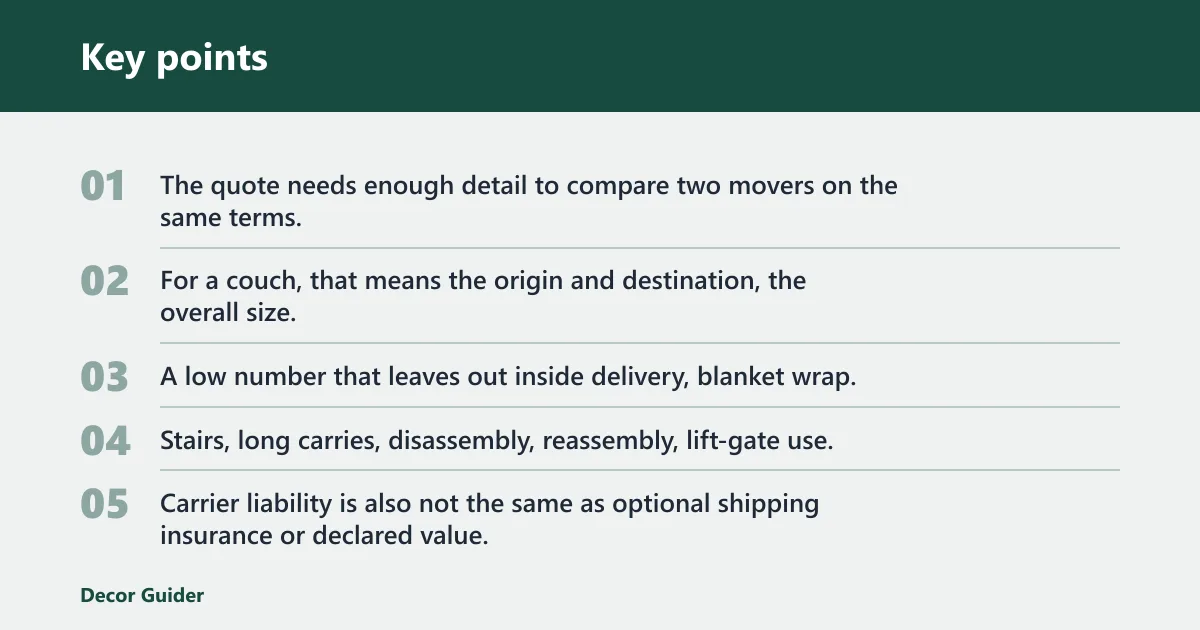
The quote needs enough detail to compare two movers on the same terms. For a couch, that means the origin and destination, the overall size, stair or elevator access, whether inside delivery is included, and whether the carrier is a furniture mover, broker, or direct transport company.
That difference matters. A low number that leaves out inside delivery, blanket wrap, or insurance is not equal to a fuller quote that includes them.
What can change the final price?
Accessorials often move the bill. Stairs, long carries, disassembly, reassembly, lift-gate use, and white-glove handling can all change the total. Carrier liability is also not the same as optional shipping insurance or declared value, so a quote with basic liability coverage may still leave you exposed on a higher-value sofa.
Some quotes are estimates that can change after remeasurement or after the carrier sees the pickup site. That is a failure case, not a minor detail.
What you need before requesting quotes
Get the sofa’s size, access details, and service preferences before you ask for bids. The more complete the input, the less likely you are to receive a low quote that is built on missing work. For domestic moves, distance, size, route type, and service level are major price drivers, and Shiply notes that larger items need more space and can raise quotes.
Measure the sofa correctly
Record the full length, depth, and height. If the item breaks down, note the packed dimensions too. For sectionals, sleeper sofas, recliners, antiques, oversized pieces, and non-runnable items, state each component clearly so carriers know what they are pricing.
Note pickup and delivery access
List stairs, tight hallways, elevator access, curb access, and parking limits at both addresses. Urban pickup and drop-off points often have more carriers nearby, so bids can run lower there. Remote pickup areas can cost more because movers travel farther. If the route is irregular or the address is outside a common lane, expect a wider spread in bids.
Gather service preferences
Write down whether you need door-to-door delivery, terminal-to-terminal handoff, packing help, white-glove service, or special handling for antiques. Shiply says white-glove delivery includes disassembling, packing, loading, and unloading, and it generally costs more. Summer is often the easier shipping period, while winter weather can raise cost.
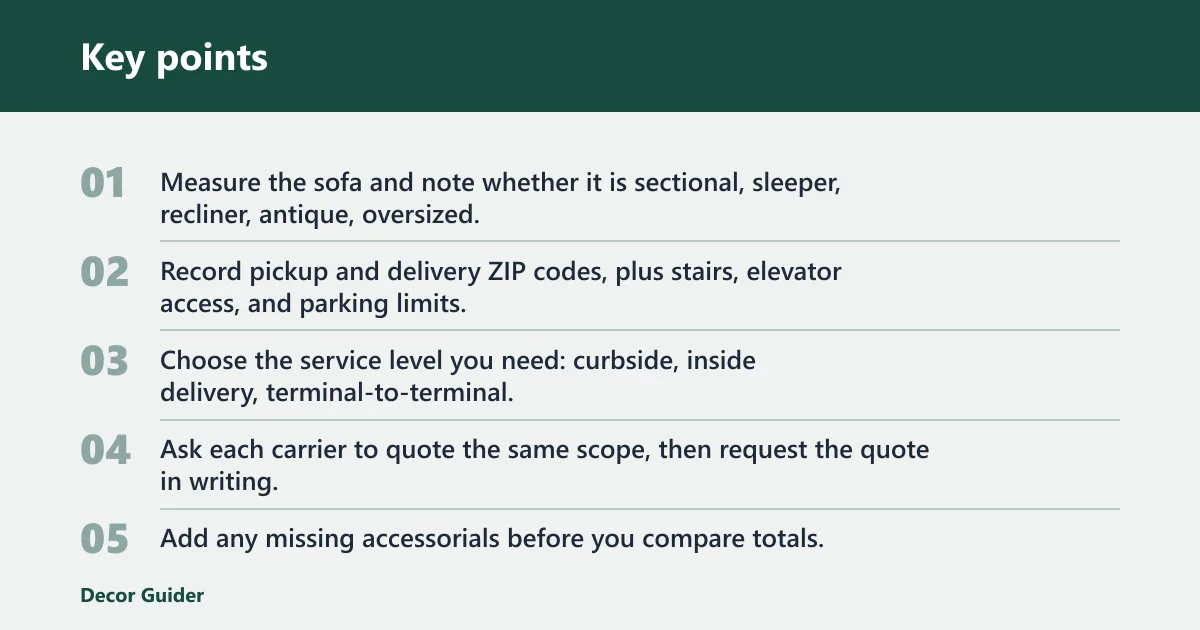
- Measure the sofa and note whether it is sectional, sleeper, recliner, antique, oversized, or non-runnable.
- Record pickup and delivery ZIP codes, plus stairs, elevator access, and parking limits.
- Choose the service level you need: curbside, inside delivery, terminal-to-terminal, or white-glove.
- Ask each carrier to quote the same scope, then request the quote in writing.
- Add any missing accessorials before you compare totals.
Compare sofa shipping quotes step by step
Compare every bid on identical terms. Use the same pickup and drop-off scope, the same access assumptions, the same insurance basis, and the same delivery window. If one quote is for basic curbside drop-off and another includes inside delivery, the lower price is not the better deal.
Step 1: Put every quote on the same scope
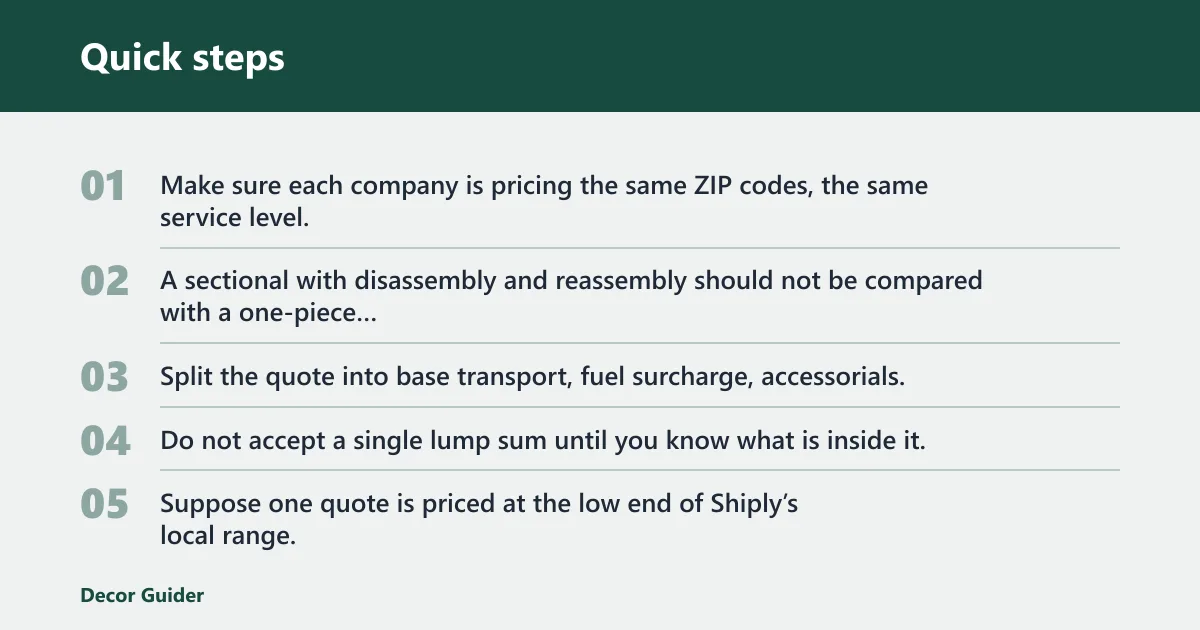
Make sure each company is pricing the same ZIP codes, the same service level, and the same sofa details. A sectional with disassembly and reassembly should not be compared with a one-piece couch that is ready to load.
Step 2: Separate base rate from extra charges
Split the quote into base transport, fuel surcharge, accessorials, insurance or declared value, and any remeasurement risk. Do not accept a single lump sum until you know what is inside it.
Suppose one quote is priced at the low end of Shiply’s local range, approximately $75 to $250, but it excludes inside delivery and insurance. Another quote is closer to Shiply’s long-distance range of $300 to $600 but includes those items. The second bid can be the better value once the full scope is counted.
Step 3: Compare transit time and delivery window
Transit time matters when you need the sofa for a move-in date or a staging deadline. A narrow delivery window is usually easier to plan around than a vague estimate. Route availability matters too; carriers that already travel the lane can often price more cleanly than those adding a one-off detour.
Step 4: Check liability, insurance, and cancellation terms
Read the coverage terms line by line. Carrier liability is the mover’s limited responsibility under its own terms, while shipping insurance or declared value is separate protection you may choose to buy. Also check cancellation timing, refund rules, and whether the carrier can reprice the job after inspection.
A common first-timer mistake is assuming the lowest sofa shipping quote includes every fee, from stair carries to fuel surcharges. For many sofa moves, it is an estimate until the carrier confirms access, dimensions, and handling needs.
Is door-to-door more expensive than terminal-to-terminal?
Often, yes. Door-to-door delivery is often the most common request because the carrier picks up at the origin address and drops off at the destination address, but that convenience can cost more than terminal-to-terminal service. Terminal service can save money when you can handle drop-off and pickup yourself.
When door-to-door is worth the added cost
Choose door-to-door when the sofa is bulky, the access is difficult, or you need a predictable handoff at both ends. It is usually the better fit for sectionals, sleeper sofas, and large items that are awkward to move through a terminal.
When terminal-to-terminal can save money
Terminal-to-terminal can work if you can deliver and collect the sofa at designated points and you do not need inside delivery. It usually requires more effort from you, but it can lower the quote when the route is flexible and the item is standard sized.
Which quote is actually cheaper?
The cheapest quote is the one with the lowest total landed cost after you add the base rate, accessorials, insurance, and any special handling. Headline price alone is a poor guide when one carrier excludes stairs, inside delivery, or blanket wrap and another includes them.
Use total landed cost, not headline price
Rank bids by the full amount you are likely to pay, not by the number in the first email. That is the clearest way to compare a firm price with an estimate. It also helps you spot a low bid that is cheap only because it leaves out the hard parts of the job.
Apply a simple scoring rubric
Use a 10-point scale so bids can be compared on more than price alone. Score each bid in four buckets: scope clarity, access coverage, damage protection, and cancellation terms. Then compare the numbers beside the total landed cost.
- Scope clarity, 0-3 points: pickup and delivery ZIPs, dimensions, and service level are fully stated.
- Access coverage, 0-3 points: stairs, long carries, disassembly, or lift-gate needs are explicitly included or priced.
- Damage protection, 0-2 points: liability terms and optional insurance or declared value are clear.
- Cancellation terms, 0-2 points: refund and rebooking rules are written in plain terms.
Sofa shipping quote comparison worksheet
Use this worksheet to compare bids side by side. Keep the same sofa details across every row so the comparison stays fair. If a carrier will not state a field, mark it as missing and treat that as a warning sign.
| Carrier | Base rate | Fuel surcharge | Pickup and delivery type | Accessorials | Insurance | Transit time | Cancellation terms | Total landed cost |
|---|---|---|---|---|---|---|---|---|
| Carrier A | $75 | Quoted separately | Door-to-door | Inside delivery not included | Carrier liability only | Quoted separately | Check before booking | $75 plus extras |
| Carrier B | $250 | Quoted separately | Terminal-to-terminal | Customer handles pickup and drop-off | Declared value available | Quoted separately | Check before booking | $250 plus extras |
| Carrier C | $300 | Quoted separately | White-glove, door-to-door | Disassembly, packing, loading, unloading | Quoted separately | Quoted separately | Check before booking | $300 plus extras |
They are not full totals unless the quote says the listed services are included.
How to score each bid
Add the points next to the total landed cost. A bid with a slightly higher price can win if it includes inside delivery, clearer liability terms, and a tighter delivery window. If two bids tie on points, pick the lower landed cost.
Common mistakes
The biggest errors are easy to spot once you know what to look for. Most of them come from comparing different service scopes, not from choosing the wrong carrier type. Fix the scope first, then decide on price.
Ignoring accessorial fees
Do not compare a quote that assumes curbside drop-off with one that includes stairs, a long carry, or white-glove help. Those are not small details. They change the work the carrier must do.
Comparing estimates with firm quotes
Put estimate-to-estimate and firm-to-firm quotes on separate lines. An estimate subject to remeasurement should not be scored the same way as a fixed, written total.
Choosing price over service fit
A lower bid can be the wrong choice for an antique, an oversized sectional, or a fragile sleeper sofa. In those cases, enclosed transport and careful handling can be worth more than a small savings.
Picture a 94-inch sectional going from a fifth-floor walk-up to a suburban home. The cheapest bid can look attractive until you notice that it excludes stair carry and inside placement. The better quote is the one that actually covers the access.
Prevention is simple: send the same dimensions, access notes, and service request to every carrier before you accept a price.
Frequently asked questions
How do I compare sofa shipping quotes the right way?
Put every bid on the same terms: same pickup and delivery ZIPs, same dimensions, same access, same delivery type, and same coverage. Then rank the quotes by total landed cost, not by headline price alone. A simple worksheet makes mismatched bids obvious.
What details do I need to get an accurate shipping quote for a couch?
Give the carrier the sofa’s dimensions, weight or cubic space if known, pickup and delivery ZIP or state, stairs or elevator access, delivery window, and any special handling needs. Include whether you want inside delivery, white-glove help, or declared value coverage.
Why are some furniture shipping quotes much cheaper than others?
Cheaper quotes often leave out accessorials, insurance, or inside delivery. Some are based on an easier route, a nearby urban pickup, or terminal-to-terminal service. Others may be estimates that can change after remeasurement, so the first number is not the final bill.
Is door-to-door shipping more expensive than terminal-to-terminal for a sofa?
Usually yes, because door-to-door adds pickup and drop-off at the actual addresses. Terminal-to-terminal can cost less if you can handle transport to and from the terminals yourself. The better choice depends on convenience, access, and how much work you want to take on.
Should I choose open or enclosed transport for a sofa?
For sofa shipping, proper furniture transport is more important than an open trailer idea. Enclosed transport is the better fit for high-value, antique, or delicate pieces because it offers more protection. Ask the carrier what furniture-specific method it uses and what packing protection is included.
What hidden fees should I look for in a furniture shipping quote?
Watch for stairs, long carry, inside delivery, blanket wrap, disassembly, reassembly, lift-gate use, fuel surcharges, and added insurance or declared value. Also check whether the carrier can reprice the job after inspection or remeasurement. Those terms often matter more than the base rate.
Products related to this article
Sponsored / affiliate links. As an Amazon Associate I earn from qualifying purchases. I may earn additional commission from eligible campaigns.