Ratchet Straps Cost: What to Pay by Strap Size
Most ratchet straps cost about $5 to $15 for basic 1-inch, 10- to 15-foot straps, while 2-inch cargo straps usually run about $15 to $40 and heavy 3-inch to 4-inch commercial straps can climb much higher. Prices vary by retailer, pack size, length, hook style, and hardware, so compare the working load limit, assembly break strength, and webbing break strength separately before you buy. For securement, follow the load rating on the strap and the cargo securement rules that apply to your load; WSTDA and FMCSA guidance both emphasize using the right tiedown for the job rather than chasing the lowest sticker price.
Ratchet straps price ladder
The fastest way to read ratchet strap cost is by size tier. Width, length, hook style, and capacity all push the price up, but not evenly. A short 1-inch light-duty strap can be a budget item, while a longer 2-inch or 75 mm strap with better end fittings costs much more. Prices below are best read as typical retail bands, not fixed quotes, because single-strap and 4-pack pricing can change by retailer and bundle size.
| Strap width | Common length | Typical hook/end style | Typical capacity band | Likely buyer use case | Price range to expect |
|---|---|---|---|---|---|
| 1 inch / 25 mm | 8 ft to 15 ft / about 6 m | S hooks, snap hooks | 500 lb to 750 lb WLL | Light furniture moves, small equipment | $4 to $12 |
| 1.5 inch / about 38 mm | 15 ft to 27 ft | Wire J hooks, flat hooks | 750 lb to 1,000 lb WLL | Appliance moving, general cargo securement | $8 to $20 |
| 2 inch / 50 mm | 9 m, 27 ft, 30 ft | Flat hooks, wire J hooks, chain anchor ends | 1,000 lb to 3,333 lb WLL; common assembly break strengths are much higher | Trailer use, heavier cargo, frequent tie-downs | $10 to $35 |
| 4 inch / 75 mm | 12 m, longer custom lengths | Flat hooks, chain anchor ends | 3,000 kg, 5,000 lb, 6,000 kg, 10 ton examples | Heavy cargo securement, commercial loads | $35 to $80+ |
What do ratchet straps cost?
For most shoppers, a single strap is cheaper than a set, but pack pricing often lowers the unit cost. Basic retail straps can start around a few dollars for light-duty 25 mm gear. At the higher end, heavy-duty 75 mm straps can jump into the tens of dollars each, especially when the end fittings and ratchet hardware are upgraded. If you are comparing listings, check whether the posted number is for one strap or a 4-pack, because that difference often explains the biggest price swings.
Single strap vs multi-pack pricing
Single-strap pricing fits one replacement or one extra tie-down. Multi-packs usually cut the unit price, which matters for moving day or trailer use, where you need several matching straps. Check the seller’s unit price, not only the pack total. In a practical ladder, a single household strap may be the cheapest way to secure one load, while a 4-pack is usually the better buy when you need a matching set for a truck bed or small trailer.
Strap-only cost vs kit cost
Strap-only pricing covers the webbing, ratchet, and end fittings. Kit pricing may add storage bags, soft loops, or other accessories, which changes the total. If you are comparing stores, make sure you are not mixing a bare strap with a bundled kit. That mistake makes one price look lower than it really is. For a fair comparison, keep the same length, width, hook style, and capacity rating when you line up alternatives.
When wholesale changes the unit price
Wholesale and custom orders can change unit cost fast. The more common the size, the better the chance of a lower per-strap price in larger quantities. Custom lengths, special hooks, or branded runs usually cost more per unit than a standard retail strap of the same width. The WSTDA also treats tiedown performance as a systems issue, so the rating and hardware matter as much as the headline price.
How width changes the price
Width is one of the clearest price drivers. Narrow straps cost less because they use less webbing and lighter hardware. Wider straps cost more because they carry heavier loads and often use stronger ratchets and end fittings. A wider strap is not automatically the better buy; it is only worth the extra cost if the load and tie-down points justify it.
1 inch and 25 mm straps
One-inch and 25 mm straps sit at the low end of the market and are most often used for light duty. Harriscos says 1 inch ratchet straps are most commonly used for light duty tie down applications. That usually means short moves, small gear, or light cargo where you want control without paying for commercial-grade hardware. For this tier, the best-value buy is usually the shortest strap that still reaches your anchor points comfortably.
For household moves, this is the good tier: inexpensive, compact, and enough for small items when the WLL matches the load. It is usually not the right choice for heavy appliances or repeated trailer duty.
1.5 inch and 2 inch straps
One-and-a-half-inch straps sit between light-duty and serious cargo work. They often cost more than 1-inch straps because they carry more load and tend to use stronger hardware. Two-inch straps are the most common ratchet strap used for cargo securement, according to Harriscos. That common size often lands in the mid-price tier because it balances capacity and price for trailer use, cargo runs, and repeated tie-down work.
For a pickup bed or utility trailer, this is often the better tier: it usually gives a stronger WLL, more hardware choices, and a better balance of price and durability than a 1-inch strap. It is the most practical upgrade when the load is heavier or the anchor points are farther apart.
4 inch and 75 mm straps
Four-inch and 75 mm straps are the heavy-duty end of the market. They are used when the load is large, the tie-down points are farther apart, or the user wants more margin for commercial work. WSTDA-style heavy tiedown systems and FMCSA cargo securement rules both point toward matching the strap to the load rather than overspending on unnecessary capacity.
For heavy equipment, this is the best tier: it is the right fit when the cargo demands higher capacity, larger hardware, and more webbing area. It is usually overkill for furniture moves, but it is the right category when the application is industrial or commercial.
How length affects cost
Longer straps usually cost more than shorter ones, even when width stays the same. More webbing means more material cost, and longer straps are often paired with heavier hardware. That is why 6 m, 9 m, 12 m, 27 ft, and 30 ft straps sit above short 8 ft or 15 ft options. A longer strap only earns its keep when it solves a spacing problem you actually have.
Short straps for light-duty jobs
Short straps around 8 ft to 15 ft are common for furniture moves, small cargo, and short anchor distances. They are often the cheapest option because they use less webbing and are easier to store. If your load is compact, a short strap avoids paying for length you will never use. For a household move, this is usually the most efficient answer when the load sits close to the truck wall or trailer rail.
Common mid-length retail sizes
Mid-length straps such as 15 ft, 27 ft, and 9 m cover many general-purpose jobs. They are common because they fit trailers, small trucks, and mixed cargo without being awkwardly short. This is the middle of the market where buyers often compare single-strap and 4-pack pricing because the total order usually includes several tie-downs. Mid-length straps are often the best balance for people who need one product that works across a few different jobs.
Long straps for trailer and cargo use
Longer straps around 12 m and 30 ft are usually bought for trailer work, larger cargo, or loads that need extra reach. They cost more than short straps and are less convenient for indoor moving tasks. If you only need to secure a couch or a washer, a very long strap is usually wasted spend. Buy the extra length only when the anchor geometry or load shape requires it.
How much strength do you need?
Working load limit, assembly break strength, and webbing break strength are not the same number. WLL is the safe working rating for the assembled tiedown. Assembly break strength is the force at which the completed strap assembly fails in test conditions. Webbing break strength is the fabric’s own failure point before hardware and stitching are considered. Shop by WLL first, then compare the break strengths only to understand the margin above that working rating.
Light-duty and medium-duty bands
Light-duty straps often sit around 500 lb to 750 lb WLL, which suits small loads, furniture, and general household moves. Medium-duty straps commonly move into the 1,000 lb WLL area, which is better for appliance moving and heavier cargo. As the WLL rises, the price usually rises too, and so does the quality you should expect from the hardware and stitching. Do not compare a webbing break number against a lower WLL as if they were the same thing.
Heavy-duty ratings and what they cost
Heavy-duty straps cost more because the webbing, stitching, hardware, and ratchet all need to handle more force. Examples such as 5,000 lb, 6,000 kg, and 10 ton ratings sit in the premium tier. WSTDA guidance and FMCSA cargo securement rules both support selecting tiedowns based on the actual load and securement need, not on marketing language. For buyers, that means the price premium only makes sense when the job really needs the rating.
For pricing context, a 2-inch strap may be sold with a modest WLL but a much higher assembly break strength, while a heavy 75 mm strap may carry both a higher WLL and a much higher assembly rating. Those are different measurements, and using them interchangeably leads to bad comparisons.
Hook style and ratchet type
End fittings and ratchet hardware can move the price as much as width does. The strap may look similar on a shelf, but the hook style can change how it attaches, how fast it sets up, and how much you pay. The best choice is the one that fits the anchor point cleanly without forcing you to improvise.
S hooks, flat hooks, and wire J hooks
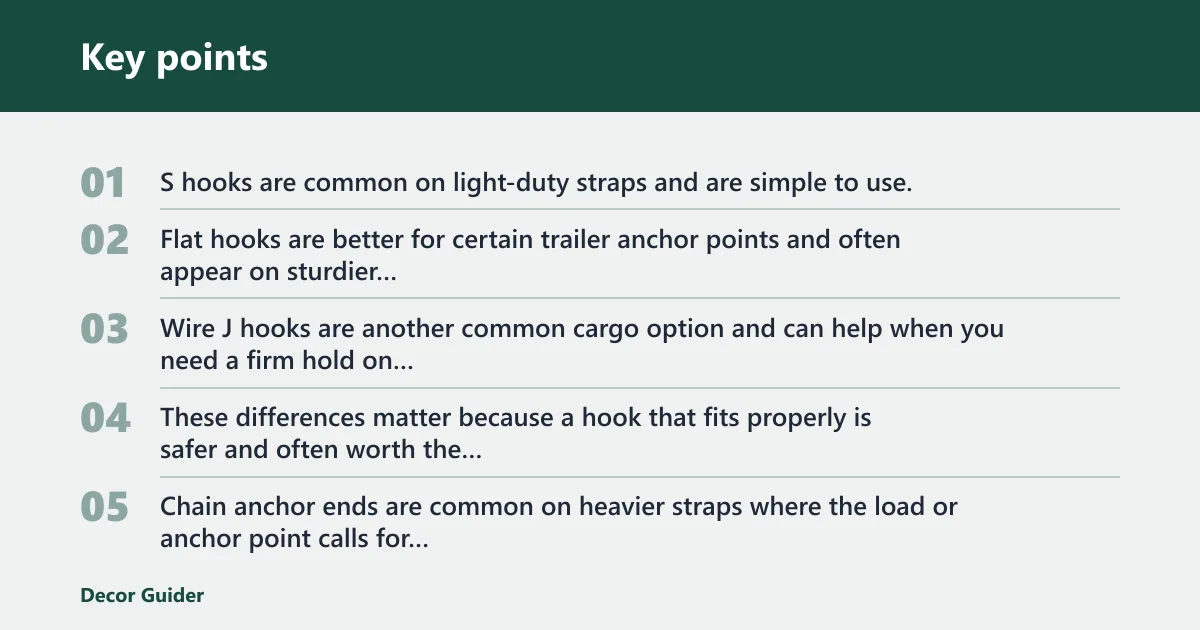
S hooks are common on light-duty straps and are simple to use. Flat hooks are better for certain trailer anchor points and often appear on sturdier straps. Wire J hooks are another common cargo option and can help when you need a firm hold on specific tie-down points. These differences matter because a hook that fits properly is safer and often worth the extra few dollars.
Chain anchor ends and snap hooks
Chain anchor ends are common on heavier straps where the load or anchor point calls for metal hardware with more bite. Snap hooks are often used when quick attachment matters. These end fittings can raise cost because they add material and a more specialized attachment style. If you are securing heavy equipment or a trailer load, these end styles are often worth the premium; for a simple household move, they may be unnecessary.
Classic ratchet, Ergo ratchet, and cam lock alternatives
A classic ratchet is the most familiar style and usually the base-price option. An Ergo ratchet is often priced higher because the handle design aims to improve comfort and control. Cam lock alternatives can be simpler to use on lighter cargo, but they are not a direct substitute for every job, and price depends on the full build. If you are comparing mechanism styles, compare the whole strap assembly rather than the handle alone.
For brand-agnostic shopping, a ratchet strap with the right WLL, the right length, and the right hook style is usually a better buy than a trendy mechanism with a weaker overall rating. The mechanism should support the job, not define it.
Which strap fits your job?
The right strap is the one that matches the load, the anchor points, and the distance between them without wasting money on excess capacity. For furniture and appliance moving, a lighter strap can be enough if the rating is appropriate and the hardware fits the anchor points. For trailers and cargo securement, a wider strap with the correct hooks usually makes more sense. The best value comes from fitting the job, not from buying the strongest strap on the rack.
Moving furniture and appliances
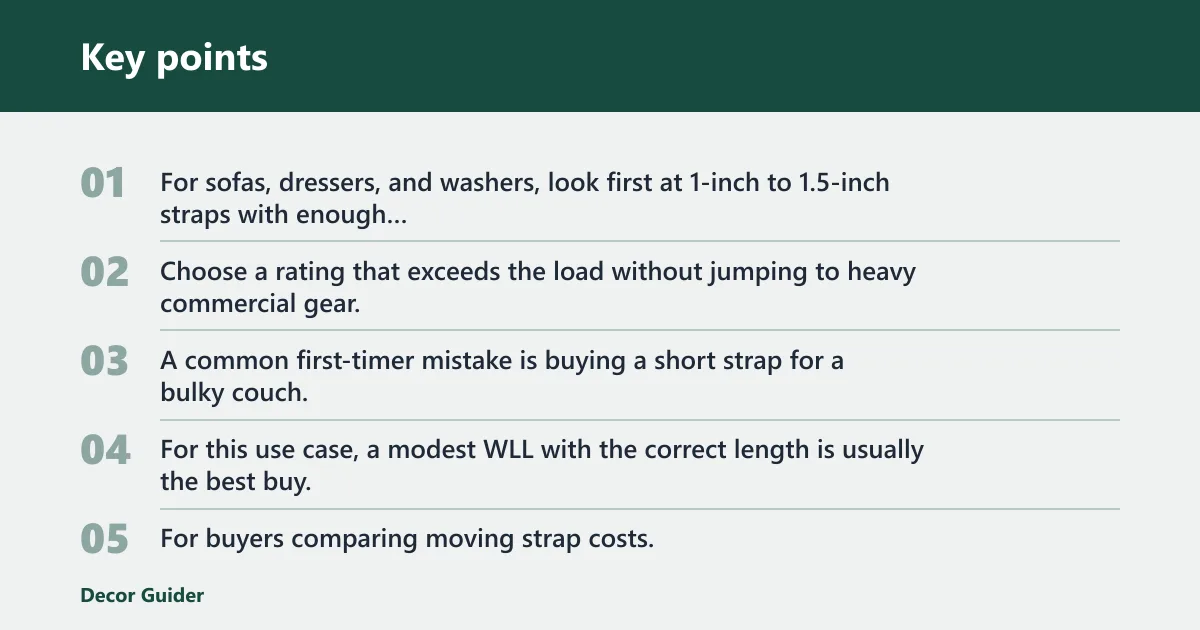
For sofas, dressers, and washers, look first at 1-inch to 1.5-inch straps with enough length to wrap the item and anchor it safely. Choose a rating that exceeds the load without jumping to heavy commercial gear. A common first-timer mistake is buying a short strap for a bulky couch, then finding the ratchet sits too close to the frame. For this use case, a modest WLL with the correct length is usually the best buy.
For buyers comparing moving strap costs, the cheapest option is not always the lowest-risk option. A slightly higher price can buy better hardware, easier tensioning, and a more usable length.
Trailer and cargo securement
For trailer use, 2-inch straps are the practical middle ground for many buyers. They are common, easier to source, and usually better suited to repeated outdoor use than very light straps. If the cargo is unusually heavy or the tie-down points are far apart, move up to a longer or wider strap rather than forcing a small one to do the job. That is also where WSTDA and FMCSA guidance matter most, because the tiedown must match the load and the securement method.
Choosing a strap without overbuying
Start with the load, then the anchor points, then the length. If you only need occasional moving-day use, a lower-cost retail strap is often enough. If you are securing cargo every week, the extra cost of better hardware and longer webbing is easier to justify. A smart purchase usually means buying the smallest strap that still meets the WLL, reaches the anchor points, and uses the correct end fittings.
Say your load is a compact washer for a local move. A 1-inch strap may be fine if the anchor points are close and the WLL is appropriate. Suppose the same washer is going on a trailer with wider anchor spacing. A 2-inch strap with a better hook end will usually be the better buy, even if it costs more. That is the difference between buying to the task and buying to the label.
Frequently asked questions
How much do ratchet straps cost?
Basic ratchet straps usually start around $4 to $12 for light-duty sizes, while common 2-inch straps often land in the $10 to $35 range. Heavy-duty 75 mm straps can run far higher. The best price depends on width, length, hook style, WLL, and assembly break strength. A 4-pack often lowers the unit price, but only if the pack is built with the same rating and hardware you need.
How much are ratchet straps?
Most buyers will see the biggest retail volume in the $5 to $15 range for smaller straps and the $15 to $40 range for mid-duty cargo straps. Prices rise when the strap is longer, wider, or fitted with more specialized ends or ratchet hardware. If you need several straps at once, compare the single-unit price against the 4-pack unit price before deciding.
How much does a ratchet strap cost?
A single strap can cost less than a meal or much more than a premium tool accessory, depending on the build. The main drivers are width, length, hook style, and rating. A light household strap may be a low-cost purchase, while a heavy-duty commercial tiedown can be a major line item. The same width can also vary by retailer and bundle size, so compare like with like.
What size ratchet strap do I need?
Choose the shortest length that still reaches comfortably, then match the width and WLL to the load. A 1-inch strap is often enough for light furniture, a 2-inch strap is often better for trailers and heavier cargo, and 4-inch or 75 mm straps belong in heavy-duty or commercial settings. If the anchor points are wide apart or the load is bulky, length becomes just as important as capacity.
Are ratchet straps worth the money?
Yes, when the strap matches the job. Ratchet straps are usually worth the money because they give controlled tension, reliable hold, and a reusable way to secure cargo. The value comes from choosing the right capacity and hardware, not from buying the cheapest option available. A well-matched strap can prevent damage to cargo, truck beds, and trailers.
How many ratchet straps do I need?
The number depends on the cargo length, weight, shape, anchor points, and the securement rules that apply to your load. There is no safe generic minimum for every job. Match the number to the load geometry and use enough tie-downs to control movement from more than one direction when required. For odd-shaped or top-heavy cargo, more than one strap is often necessary even if the item itself is not especially heavy.
How long do ratchet straps last?
Service life depends on use, storage, weather exposure, and whether the strap has been overloaded or damaged. Check for frayed webbing, cracked stitching, bent hooks, and a ratchet that no longer runs cleanly. Replace any strap that shows wear in the load path or hardware. If the strap has been exposed to heavy UV, road salt, or sharp edges, inspect it more carefully before reuse.
Where can I buy ratchet straps?
You can buy them from hardware stores, trailer supply shops, moving-supply retailers, and online sellers. Price comparison matters because the same width and length can be sold as a basic strap, a premium strap, or part of a larger kit. Check the exact WLL, break strength, and end fitting before you buy, and compare the single price against the 4-pack unit price when a pack is available.
Sources
Federal Motor Carrier Safety Administration cargo securement guidance; Web Sling and Tie Down Association capacity terminology and tiedown best practices; retailer product listings used for price ranges, width bands, and typical end-fitting formats. Prices vary by retailer, pack size, and hardware configuration.
Products related to this article
Sponsored / affiliate links. As an Amazon Associate I earn from qualifying purchases. I may earn additional commission from eligible campaigns.