Shelf Safety Strap Cost: What to Expect Before Buying
Shelf safety straps are worth buying when you price the job, not the label. A fair shelf safety strap cost often lands around $25-$80 per shelf once anchors, screws, and labor are counted, and that extra spend can help turn a shaky bargain into a more dependable install.
This guide is part of our Ratchet straps and tie downs guide series.
Pros and cons of buying shelf safety straps
For most bookcases and shelving units, shelf safety straps are a cheap way to cut tip-over risk. I judge them by the wall, the shelf height, and the load on top. A plain kit can be fine, but only if the anchor hardware fits your wall and the unit is not top-heavy or stuffed with weight.
Pros
- Low entry price for a real safety upgrade.
- Works for many bookcases, cube units, and shelving systems.
- Can be permanent for a home or temporary for a move.
Cons
- Cheap kits often miss anchors or screws.
- Drywall-only mounting is weak for heavier units.
- Hidden costs can exceed the strap price fast.
Who it’s for and when straps are worth paying for
Shelf straps make sense for renters, homes with kids or pets, earthquake-zone buyers, and anyone anchoring a tall or narrow unit. They matter less for short, wide storage pieces that sit low and carry light loads. If a shelf is tall, packed on top, or easy to pull forward, paying more for better hardware is justified.
Renters and temporary installs
Renters often need removable hardware and a kit that does not force a big tool buy. A furniture strap with clear stud or drywall hardware can work well if the lease allows wall holes. If the unit is moving soon, choose reusable straps and standard screws.
Families with kids or pets
Homes with climbing kids or jumping pets should avoid weak adhesive-only options. A solid anti-tip strap set with stud anchoring is the better spend, especially for a bookcase with open cubbies, a narrow footprint, or stored weight high on the unit.
Earthquake-zone buyers and tall units
In seismic areas, an earthquake strap is often the smarter purchase because it is meant to stay in place and mount to studs. Tall shelving, including units in the rough 58-inch and 72-inch range, needs more attention because height raises tip risk even when the base looks stable.
How much do shelf safety straps cost?
Shelf safety straps usually cost about $10-$35 per set, and installed cost can land somewhere around $25-$80 per shelf once anchors, screws, and labor are included. Skip the hidden costs, and you may end up with weak mounting, another trip to the hardware store, or a tip-over risk that costs far more than the straps.
Budget, mid-tier, and premium price benchmarks
A budget shelf safety strap kit is usually the cheapest single-pack option and often covers one unit. Mid-tier kits tend to include better brackets, longer webbing, or more complete hardware. Premium packs are usually multi-strap sets or heavy-duty anti-tip kits made for larger shelving and thicker wall attachment points.
Single-strap vs multi-pack pricing matters because the advertised price may look low while the per-unit cost rises once you add a second or third shelf. A multi-pack can be the better buy for matching furniture throughout a room, but only if each strap includes the correct wall fasteners.
Per-pack vs per-unit pricing
Per-pack pricing usually looks better at checkout, but it can hide waste if you only need one anchored shelf. Per-unit pricing is clearer for comparing a single bookcase against a full shelving wall. For mixed rooms, it helps to calculate the cost per secured unit before buying.
What comes in a shelf safety strap kit?
A basic shelf safety strap kit usually includes one or more straps, a wall plate or bracket, and a small screw set. Better kits also include anchors, a tensioning buckle, and instructions that show which wall type is supported. The missing parts matter because hardware choices change both safety and final cost.
Typical strap length and adjustability
Most straps adjust enough to reach from the back of a shelf to the wall without pulling the unit crooked. That matters for deeper bookcases and units with uneven backs. A strap that is too short, or barely fits, often leads to poor placement and weak holding power.
Wall attachment type and bracket style
Wall attachment is where many shoppers get tripped up. Some kits use a simple screw plate, others use a metal bracket, and some use a loop that works with a stud anchor. For heavier shelving, a stud anchor is the safer choice than a drywall anchor, especially when the unit can be pulled forward.
Included screws, anchors, and missing parts
Anti-tip hardware should list screw type, bracket count, and whether anchors are in the box. If the kit says nothing about anchors, assume you may need to buy them separately. Missing parts often include replacement screws for a shelf with thin backing, plus a stud finder and drill bit if you do not already own them.
What affects the price of shelf safety straps?
The biggest price swings come from wall type, load size, and whether the kit is meant for permanent anti-tip use or temporary moving restraint. A cheap strap on paper can become a poor deal once you add stud anchors, replacement screws, or labor for a shelf that is hard to reach.
Stud finder, drill bits, and replacement screws
Even a basic install may require a stud finder, a bit for pilot holes, and screws that fit the bracket and the shelf material. Particleboard and thin backing can strip easily, so many installs need better fasteners than the kit includes. Those extras are small individually, but they add up quickly.
Drywall anchor vs stud anchor decisions
A drywall anchor can be fine for light furniture, but it is the weaker choice for a tall bookcase or overloaded shelf unit. Stud anchors are preferred when the shelf is tall, top-heavy, or expected to stay put long term. The anchor choice often affects the total more than the strap brand.
Optional labor and pro installation
If the unit is large, awkward, or placed in a finished wall with hidden obstacles, pro installation may be worth the added expense. Labor changes the decision fast when the shelf is tall or valuable, because a bad install can pull out under load. That is why installed cost matters more than the tag price.
Are shelf anti-tip straps different from earthquake straps?
Yes. Shelf anti-tip straps are usually general furniture restraints, while earthquake straps are meant for seismic use and are commonly mounted to wall studs for stronger hold. Metal versions are stiffer and often feel more permanent, while webbing versions are easier to adjust and replace after moving furniture.
Permanent anti-tip use versus moving straps
Furniture straps meant for moving often loosen and re-tension easily, which is useful during transport but not ideal for long-term wall restraint. Permanent anti-tip straps are built to stay in place once adjusted. If the shelf will live against the wall, the permanent option is the better fit.
Metal vs webbing variants
Metal earthquake hardware usually feels more fixed and can suit heavier bookcases. Webbing straps are common for lighter furniture and simpler installs. The right choice depends on how much movement you want to allow, how visible the strap will be, and whether the wall mount must resist repeated tugging.
Code, insurance, and seismic-use notes
In earthquake-prone areas, buyers should prefer hardware intended for seismic restraint rather than generic shelf ties. Some insurance and building requirements may care about the mounting method, especially stud attachment. A kit sold for moving should not be treated as a substitute for a proper anti-tip or seismic strap.
Do I need straps for IKEA KALLAX or similar shelf units?
Yes, for many setups. IKEA KALLAX and similar cube or open shelf units can be low enough to seem stable, but height, load placement, and wall anchoring still matter. The 30 1/8 in, 57 5/8 in, and 71 5/8 in size range changes the risk quickly once items are stacked on top or children can climb them.
Shelf unit sizes and stability risk
A 30 1/8 in unit is less likely to tip than a taller version, but it still benefits from anchoring if the top holds heavy items or sits in a kids’ room. A 57 5/8 in unit has a more obvious tipping risk. A 71 5/8 in unit is the type that usually deserves wall attachment without debate.
Price context for common shelving units
Cost comparisons help frame strap spending. IKEA KALLAX Shelf unit, white, 30 1/8×57 5/8 inches costs $79.99. IKEA KALLAX Shelf unit, white, 16 3/8×57 5/8 inches costs $59.99. IKEA KALLAX Shelf unit, black-brown, 30 1/8×30 1/8 inches costs $49.99. Those prices make a good strap kit feel like a small add-on, not a big project.
Other reference points matter too. IKEA EKENABBEN Open shelf unit, aspen/white, 27 1/2×13 3/8×60 5/8 inches costs $69.00. IKEA LACK Wall shelf unit, white, 11 3/4×74 3/4 inches costs $99.99. IKEA JONAXEL Shelf unit, white, 31 1/2x15x63 inches costs $69.99. Tall units deserve the better hardware choice.
Can I use furniture straps instead of shelf safety straps?
Sometimes, yes. A furniture strap can do the same restraint job if it has a strong tensioning method, suitable wall hardware, and enough adjustability for the shelf depth. The important part is fit, not the product label. For moving, furniture straps are often the better choice. For permanent use, anti-tip straps usually win.
Tensioning method, adjustability, and reusability
Good straps have a tensioning buckle or ratchet-like adjustment that holds once set. That matters because a loose strap can still allow the shelf to shift. Reusable straps are useful if the unit will move, but a reusable part is not automatically strong enough for permanent heavy-duty anchoring.
When furniture straps are the better option
Use furniture straps when the shelf is part of a move, when you need temporary restraint, or when the wall attachment point may change soon. They are also useful for rearranging storage during a renovation. For a loaded, tall, permanent bookcase, use the strap type designed for anti-tip restraint.
Are adhesive shelf straps safe for heavy bookcases?
No. Adhesive-only shelf straps are a poor choice for heavy or top-heavy bookcases, and they are especially weak on painted drywall, textured walls, or dusty cabinet surfaces. Adhesive can help organize light cords or very light fixtures, but it should not be the main support for a shelf that can tip.
If the unit is tall, loaded, or near children, choose hardware that reaches a stud or uses the correct mechanical anchor. Adhesive may look cleaner, but clean appearance is not a substitute for holding power. For heavy shelves, the safer spend is on real fasteners, not sticky pads.
Cost breakdown table: three shelf scenarios
The table below separates strap price from the hidden costs that usually decide the final bill. These are practical purchase scenarios, not bundle promises. The point is to compare the full installed cost before buying a kit that looks cheap on the shelf.
| Scenario | Strap-only price | Required hardware add-ons | Optional install labor | Typical installed total |
|---|---|---|---|---|
| Budget shelf | $10-$15 | $5-$12 for basic anchors, screws, and a replacement bit or finder share | $0 if DIY, or $40-$60 for a simple visit | $15-$27 DIY, or $55-$87 with labor |
| Standard bookcase | $15-$25 | $8-$18 for stud anchor hardware, better screws, and pilot-hole supplies | $0 if DIY, or $50-$80 if hired out | $23-$43 DIY, or $73-$123 with labor |
| Tall heavy unit | $20-$35 | $12-$25 for stronger brackets, stud-rated hardware, and replacement fasteners | $0 if experienced DIY, or $80-$140 for pro install | $32-$60 DIY, or $112-$200 with labor |
What is a fair price for shelf safety straps?
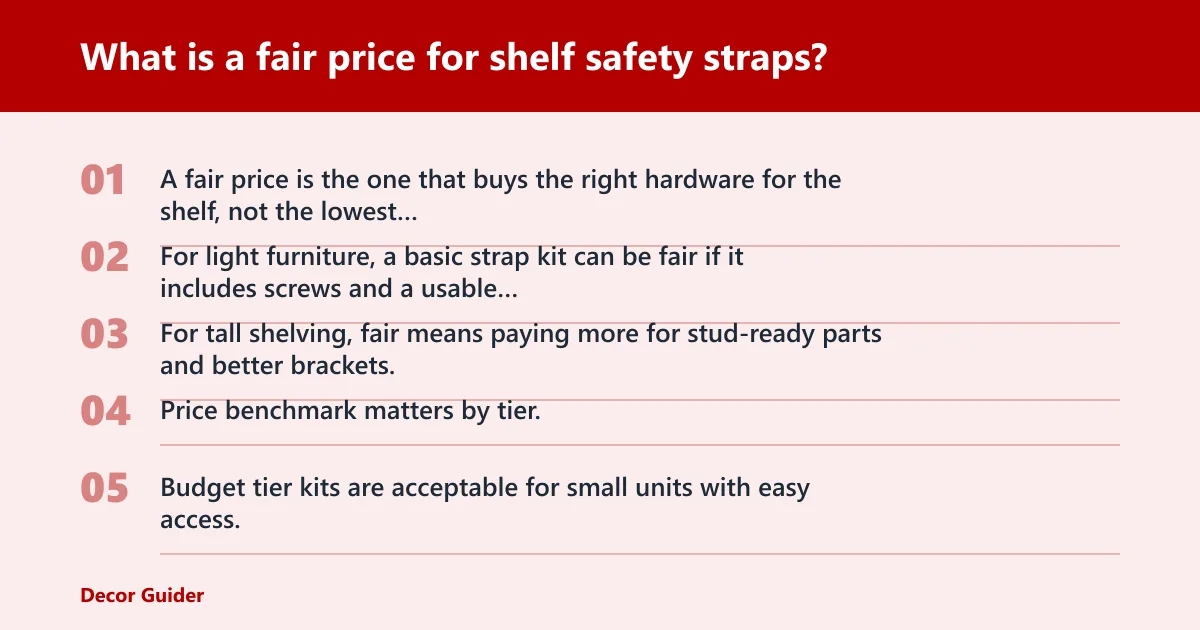
A fair price is the one that buys the right hardware for the shelf, not the lowest sticker in the aisle. For light furniture, a basic strap kit can be fair if it includes screws and a usable wall mount. For tall shelving, fair means paying more for stud-ready parts and better brackets.
Price benchmark matters by tier. Budget tier kits are acceptable for small units with easy access. Mid-tier kits make sense for most standard bookcases. Premium tier packs fit tall, heavy, or high-risk units where the cost of a failure is much higher than the difference in strap price.
Frequently asked questions
What size or hardware comes with shelf safety straps?
Most kits include one or more adjustable straps, a wall bracket or plate, and screws. Better kits also include anchors, but that is not guaranteed. Before buying, check whether the kit is built for studs, drywall, or both, because the wrong hardware can make an inexpensive strap unsafe.
Products related to this article
Sponsored / affiliate links. As an Amazon Associate I earn from qualifying purchases. I may earn additional commission from eligible campaigns.