How Much Do Furniture Moving Straps Cost?
Furniture moving straps are commonly priced at about $15 to $40 for basic pairs, about $40 to $80 for better-rated shoulder or forearm sets, and about $80 to $150 for specialized heavy-duty systems; choose based on load rating and carrying style, not price alone. Pick the wrong pair and you can strain your back, drop a dresser, or pay for damage that costs far more than the straps. This guide breaks down strap types, typical price ranges, weight ratings, and which sellers usually give the best value.
How moving strap style, padding, and hardware drive price
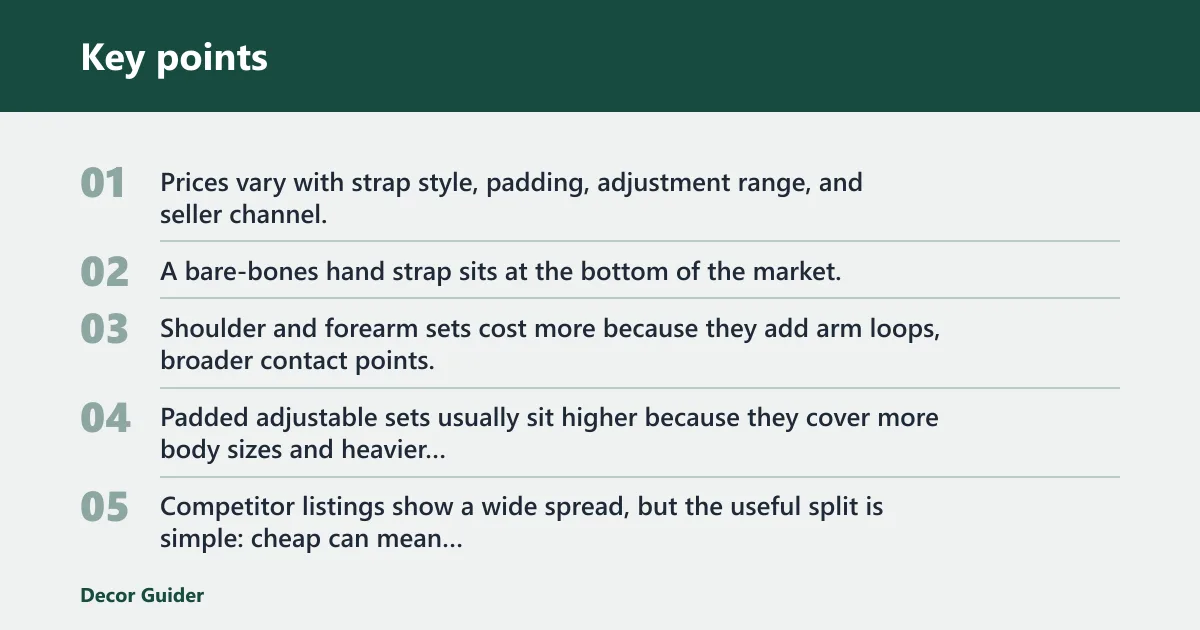


Prices vary with strap style, padding, adjustment range, and seller channel. A bare-bones hand strap sits at the bottom of the market. Shoulder and forearm sets cost more because they add arm loops, broader contact points, and more control for bulky items. Padded adjustable sets usually sit higher because they cover more body sizes and heavier loads.
Competitor listings show a wide spread, but the useful split is simple: cheap can mean light-duty, basic, or single-strap replacements; midrange usually covers common two-person moving jobs; premium usually means better padding, stronger hardware, or a more specific carrying system. Load rating matters, yet fit and control matter just as much.
Typical price range by strap style
For a basic pair, the low end often starts near $15 to $20. Shoulder and forearm sets are often around $25 to $40 for entry listings, while more complete or better-known sets may be around $40 to $50. Padded adjustable systems can move above that, especially when the seller frames them as heavy-duty or multi-use.
Shoulder straps typically cost $25 to $30. The same guide says forearm straps for two people cost $30 to $40. That lines up with product pages that place one common shoulder-dolly style near $49.99 and a lower-cost team strap near $19.99.
What drives price up or down
Padding, adjustability, and hardware quality push prices upward. So does a higher claimed load capacity. Brand-positioned items from a manufacturer store often cost more than marketplace listings with similar layouts. Specialty cargo suppliers can also price higher when the strap is part of a more specific moving or lifting system.
Cheap straps are not automatically bad. They are often enough for a light dresser, a small table, or a short carry on a flat path. They become weak choices when the object is wide, awkward, or hard to balance. Stairs and tight corners expose flimsy straps fast.
When the lowest price is enough
If you are moving one light piece on an open hallway, a low-cost strap may be fine. A single-user hand strap or a basic pair can work when the object is easy to grip and the route is short. That is the case where you should shop for the cheapest acceptable strap, not the strongest one.
Say your job is a small bookshelf from a bedroom to a truck parked outside. A basic strap can be enough if the piece is stable, the path is flat, and the handlers can keep the load centered. If the same bookshelf has to turn a narrow stair landing, a more controlled two-person setup is the safer buy.
Which strap type fits your move?
The right strap type depends on the object, the route, and how many people are lifting. Shoulder straps suit bulky furniture and bigger appliances. Forearm straps help two people share the lift with arm loops. Hand straps are the cheapest option for lighter items. Padded adjustable straps are the most flexible when size and balance vary.
Shoulder straps for bulky items
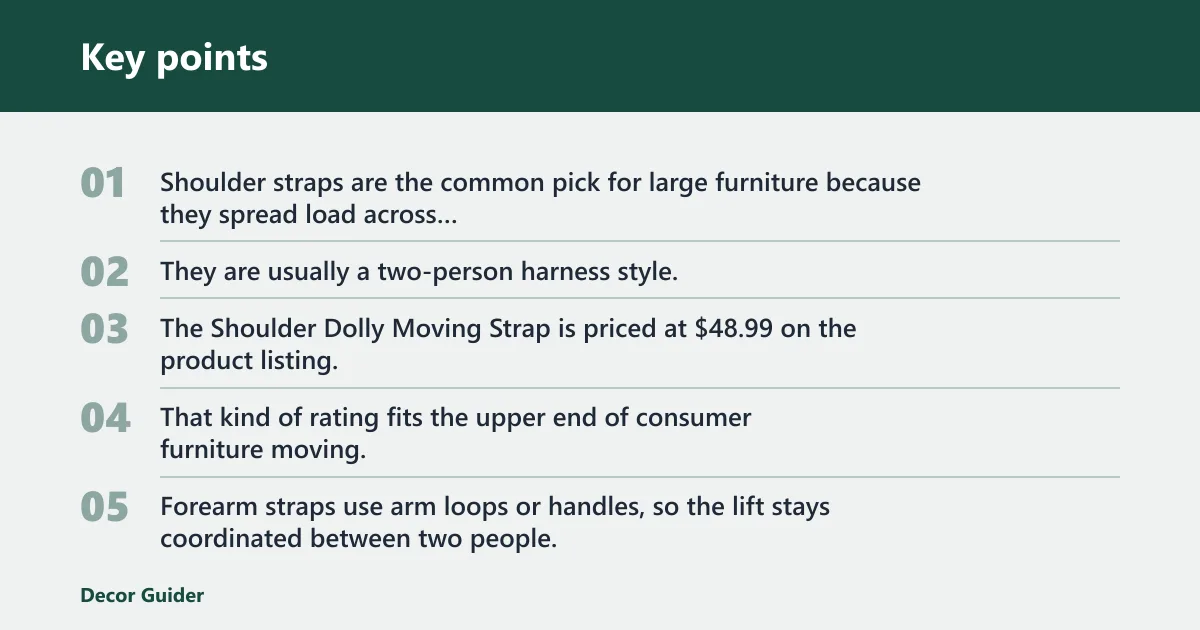
Shoulder straps are the common pick for large furniture because they spread load across the torso and shoulders instead of forcing all the grip into the hands. They are usually a two-person harness style, and competitor guides place them in the $25 to $30 range for standard versions.
The Shoulder Dolly Moving Strap is priced at $48.99 on the product listing, and ShoulderDolly® Moving Straps are priced at $49.99. Both are listed at 800 lbs. That kind of rating fits the upper end of consumer furniture moving, but the object still has to fit the strap geometry.
Forearm straps for two-person lifting
Forearm straps use arm loops or handles, so the lift stays coordinated between two people. They are useful when hands need more control than a shoulder harness offers. A moving straps guide places two-person forearm straps at $30 to $40, which is a middle price band for this style.
This style can feel steadier for awkward objects such as short cabinets or bulky boxes, but it still depends on matched height, clear communication, and a load that can sit level between carriers. A strap that slips or rides up is too basic for a difficult carry.
Hand straps for light, single-user jobs
Hand straps are the lowest-cost type and the simplest to buy. They are best for lighter items and short carries where one person can keep control without a full harness. They are not the first choice for stairs, a very wide piece, or anything that needs to stay level over a long distance.
Use hand straps when the goal is modest lifting help, not full carry assistance. If the object is heavy enough that your grip is the weak point, move up to a better strap style instead of saving a few dollars on the wrong tool.
Padded adjustable straps for mixed use
Padded adjustable straps are the best match when you need one set to cover more than one job. They usually cost more because they fit a wider range of body sizes and tend to support both 1-person and 2-person use. For heavy-duty work, they are often the safer buy because control matters as much as raw rating.
Some listings put these straps near 800 lbs. That makes them attractive for heavy furniture, but capacity alone does not solve stair corners, narrow halls, or a mattress that bends in the middle. A better fit often beats a higher number on the box.
Moving strap price matrix
This table gives the quickest price map. Use it to compare strap type, a typical competitor price, load capacity, and the kind of move that usually justifies the cost. The value tier is about fit for purpose, not just the sticker price.
| Strap type | Typical price seen in competitor listings | Load capacity | Best use case | Likely value tier |
|---|---|---|---|---|
| Shoulder straps | $25 to $30; examples at $48.99 and $49.99 | 800 lbs | Bulky furniture, appliances, two-person carry with better load spread | Mid to high |
| Team or furniture moving straps | $19.99 to $40 | 650 lbs; some guides claim up to 1000 lbs | General two-person lifting for lighter or medium-size furniture | Low to mid |
| Padded adjustable straps | $40 to $80 | Up to 800 lbs | Mixed use, 1-person and 2-person setups, heavy-duty carries | Mid to high |
| Replacement or single-strap options | $16.81 to $32.99 | Varies by listing | Replacing a missing strap, light-duty or single-user carrying | Low |
The table shows why a cheap listing is not always the best value. A $16.81 strap can be a bargain for a light job, but a $49.99 set may be the better buy if it gives the control needed for a stair turn or an appliance with awkward weight balance.
What load capacity should you buy?
For most buyers, 650 lbs covers many common furniture moves, while 800 lbs is the safer target when the item is heavy, bulky, or hard to balance. A guide that mentions up to 1000 lbs is pointing at a high-end claim, not a promise that every move becomes easy or safe.
650 lbs versus 800 lbs
TeamStrap Furniture Moving Straps are priced at $19.99 and have a 650 lbs load capacity. The US Cargo Control page shows both a 650 lbs option and an 800 lbs option. The gap matters because the extra capacity often comes with better build quality, more confidence at the margin, or a better fit for heavier furniture.
Shoulder Dolly Moving Strap has an 800 lbs load capacity, and ShoulderDolly® Moving Straps can lift up to 800 lbs. Those ratings make sense for large furniture and many appliances, but only when the strap is sized correctly and the route is manageable.
When 1000 lbs claims matter
Moving straps can support up to a thousand pounds. Treat that as an upper claim, not the first reason to buy. If your object is oversized, slippery, or hard to keep level, a high number does not fix poor balance or poor hand placement.
Capacity is one part of the decision. Strap width, body fit, and how the load sits between carriers can matter more on a staircase or through a narrow hall. A lower-rated strap that fits better can outperform a bigger number that shifts during the lift.
Capacity limits versus real handling
Do not buy only by the printed rating. A strap can be rated for a load and still feel unstable if the furniture is too long, too tall, or too awkward for the carry path. The risk rises fast when the object blocks vision or forces a twisted walk.
A common first-timer mistake is choosing a cheap strap for a sofa that has to pivot through a tight doorway. The rating may look fine on paper, but the real problem is control, not raw strength.
Where should you buy moving straps?
The best place to buy depends on whether you want the cheapest acceptable price, a known brand, or a more specialized setup. Manufacturer stores often give clearer specs. Big-box marketplaces usually have the lowest entry price. Specialty cargo suppliers are best when you want a more exact fit or heavier-duty options.
Manufacturer store
Buy here when you want the exact model, clean specs, and a better sense of the rating. The trade-off is price. The Shoulder Dolly Moving Strap at $48.99 and ShoulderDolly® Moving Straps at $49.99 show how brand-direct listings can sit above mass-market pricing even when the capacity is the same.
Big-box marketplace
This is where the cheapest moving straps usually appear. Walmart listings include moving straps priced from $16.81, and Walmart lists a Hyper Tough shoulder moving strap set at $29.97. That channel is useful for low-cost buys, quick pickup, or a basic pair for a simple move.
Specialty cargo supplier
A specialty cargo supplier is worth checking when you need a more specific weight class or a heavy-duty option. US Cargo Control lists both a 650 lbs option and an 800 lbs option, which makes comparison easier if you want a tighter choice between light and heavy use.
If the move involves a washer, dryer, or a wide cabinet, this channel often gives the clearest path to a strap that matches the job rather than the cheapest price tag.
Are moving straps worth it for one item?
For a single item, straps are worth buying when the move is awkward, heavy, or likely to involve stairs, door turns, or a long carry. They are less compelling for one easy object on a flat path, where a friend and a basic dolly may do the job at lower cost.
Buying versus renting or hiring help
If you only need to move one light-to-medium item, a low-cost strap may still beat renting equipment or paying help. If the item is large and difficult, the cost gap narrows fast because the risk of damage or injury rises. One bad carry can cost more than the strap and the helper together.
Best value for one-time moves
For a one-time move, the best value is usually the cheapest strap that still matches the object and the route. That often means a $19.99 team strap for a manageable two-person carry, or a stronger shoulder set when the item is bulky and hard to keep level.
Suppose you need to move a heavy dresser down two flights of stairs. A bargain strap with a weak fit is a poor tradeoff there. The better value is the strap that holds position, keeps both movers aligned, and reduces the chance of a dropped corner.
When straps are the wrong tool
Straps are the wrong buy when the item is too unstable, too slick, or too large for the route. They also fall short when a person must twist hard to keep the load moving. In those cases, a cart, appliance dolly, or hired help may be the better spend.
Frequently asked questions
How much do furniture moving straps cost?
Basic pairs usually start around $15 to $40, with better shoulder or forearm sets often landing at $40 to $80. Specialized heavy-duty systems can run $80 to $150. The best price depends on the strap type, the load rating, and whether you need a single-user or two-person setup.
Where to buy moving straps?
Buy from a manufacturer store when you want the exact model and clear specs, a big-box marketplace when you want the lowest entry price, and a specialty cargo supplier when you want heavier-duty or more specific options. The cheapest channel is not always the best fit for the move.
What is the difference between shoulder straps and forearm straps?
Shoulder straps spread weight across the shoulders and torso, which helps with bulky items and larger loads. Forearm straps use arm loops or handles and keep two movers linked at the arms. Shoulder styles usually suit larger, awkward furniture better, while forearm styles often feel simpler for standard two-person carries.
Can moving straps be used for heavy furniture and appliances?
Yes, but only when the strap type, fit, and load path match the job. Shoulder and padded adjustable straps are common for heavy furniture and many appliances. Capacity ratings such as 650 lbs or 800 lbs help, but they do not guarantee control on stairs, tight corners, or slippery surfaces.
What load capacity should I look for in moving straps?
For common furniture moves, 650 lbs is a practical baseline, while 800 lbs is a better target for heavier or awkward items. A 1000 lbs claim may appear in guides, but it should not replace judgment about size, balance, and route. Capacity is only one part of the purchase.
Do moving straps come in 1-person and 2-person versions?
Yes. Hand straps are often the closest thing to a single-user option, while shoulder and forearm sets are usually built for two people. Padded adjustable straps can cover both setups. Choose the version that matches the object and the number of people available, not just the lowest price.
Products related to this article
Sponsored / affiliate links. As an Amazon Associate I earn from qualifying purchases. I may earn additional commission from eligible campaigns.
 Furniture Sliders 4 Pack, 3.5 Inch Heavy Duty Reusable Furniture Moving Sliders for Hardwood Floors and Carpet, Beige Floor Protection Pads for Chairs, Sofas, Tables and Home Moving
 Furniture Moving Tool Set Supports up to 750 lbs, Furniture Dolly and Lifter for Easy Furniture Lifting and Moving (White Fashion Style)