Moving Straps vs Furniture Sliders
Furniture sliders are generally best for short, flat moves on compatible floors, while moving straps are more suitable for lifts, stairs, thresholds, or awkward carries. Pick the wrong tool and you can scratch floors, strain backs, drop corners, or stop the move halfway. This guide compares moving straps vs furniture sliders so you can choose fast, move furniture safely, and know when each tool fits.
This guide is part of our Ratchet straps and tie downs guide series.
| Decision factor | Moving Straps | Furniture Sliders | Winner |
|---|---|---|---|
| Best motion | Lifting, pivoting, and carrying with two people | Gliding across a floor with limited lifting | Depends on task |
| Stairs and thresholds | Better fit for stairs and awkward transitions | Poor fit when the item must step up or down | Moving Straps |
| Floor compatibility | Less dependent on surface type because the item is lifted | Must match hardwood, tile, laminate, or carpet | Moving Straps |
| Solo use | Possible in some cases, but usually a two-person system | Useful for some solo repositioning on flat floors | Furniture Sliders |
| Control with bulky loads | Better for weight distribution and awkward balance | Better for items that already sit flat and stable | Moving Straps |
Lift versus slide: choose the right tool for your floor
The core trade-off is simple: moving straps reduce the need to drag by turning the move into a lift, while sliders cut friction so the item can glide. Use straps when the path includes stairs, thresholds, or uneven balance; use sliders when the move stays short, flat, and matched to the floor.
Lift versus slide: the core trade-off
Moving straps are a two-person lifting system with padded shoulder harnesses. They use body position and weight distribution to make heavy items easier to carry, especially when the load needs to be tilted, turned, or raised over an obstacle. Furniture sliders are pads that let furniture move across floors with less lifting, but they only work well when the surface and the item’s feet or legs match the pad.
A common first-timer mistake is trying to “help” a sofa over a threshold with sliders. The front pads catch, the rear legs lag, and the whole piece twists. That is a strap problem, not a slider problem.
Where a dolly fits
A moving dolly is the third option when the item can be rolled instead of carried or slid. A moving dolly is often a better choice for larger flat-bottom items that sit securely on a base, though it is not ideal for stairs. If the item cannot sit stable on wheels, or if the route includes steps, straps usually fit better.
What changes the choice?
Floor surface, load balance, and the route decide whether sliding or lifting is safer and faster. A short move across a clear room calls for a different tool than a dresser that has to clear a doorway, turn a corner, and then climb stairs. The right choice starts with the path, then the item, then the people available.
Floor surface: hardwood, tile, laminate, or carpet
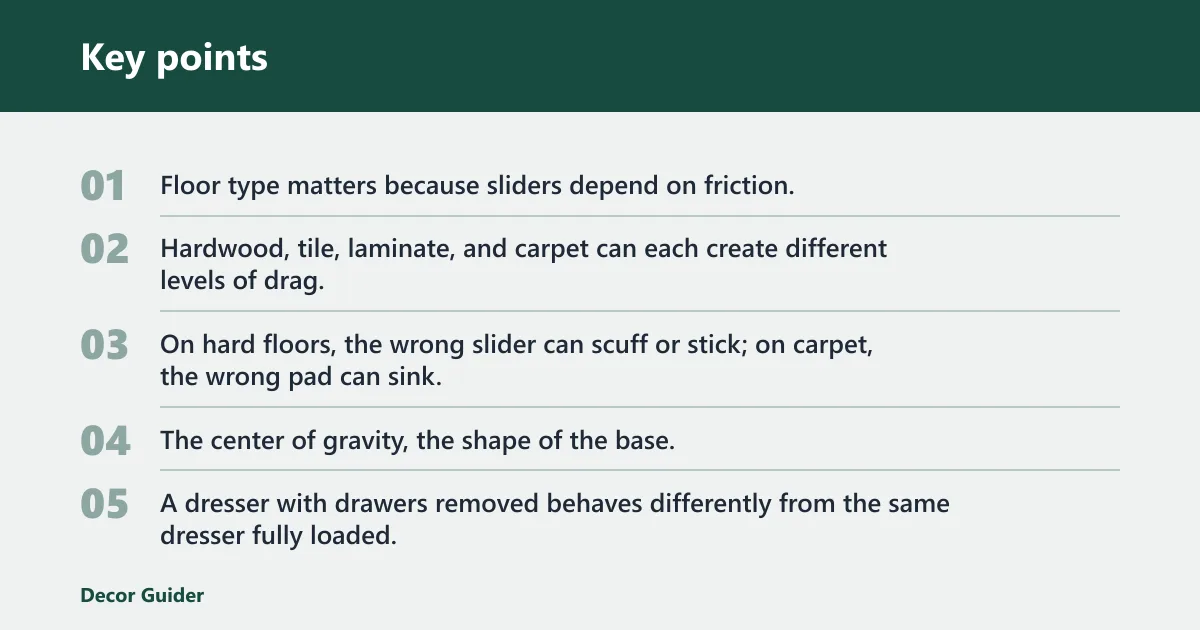
Floor type matters because sliders depend on friction. Hardwood, tile, laminate, and carpet can each create different levels of drag, so the pad material should match the surface. On hard floors, the wrong slider can scuff or stick; on carpet, the wrong pad can sink, snag, or stop moving altogether.
Load weight, balance, and center of gravity
Heavy furniture is not only about mass. The center of gravity, the shape of the base, and where the weight sits inside the piece all affect whether it can be slid in a straight line or needs to be lifted and steadied. A dresser with drawers removed behaves differently from the same dresser fully loaded.
Suppose a bookcase is light enough to move, but the top shelf is full and the base is narrow. Sliders may still work on a flat floor, but the load can tip when you turn a corner. Straps give you more control because the weight is shared and the item stays more upright.
Doorways, corners, and clearance
Doorway width, threshold height, and corner clearance can decide the move before the item even starts. If the piece barely clears the opening, lifting with straps may be easier than trying to drag a corner across the jamb. Sliders help only when the path stays open and level enough for the pads to keep contact.
Furniture sliders by floor type
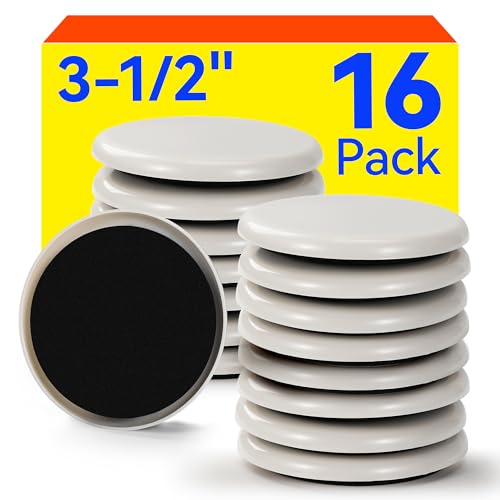
Furniture sliders are best for short-distance repositioning on a floor that matches the pad material. They come in round and square shapes, and the size has to match the furniture feet or legs so the load sits centered on the pad. When the fit is wrong, the pad can slide out or tip under pressure.
Hardwood and laminate
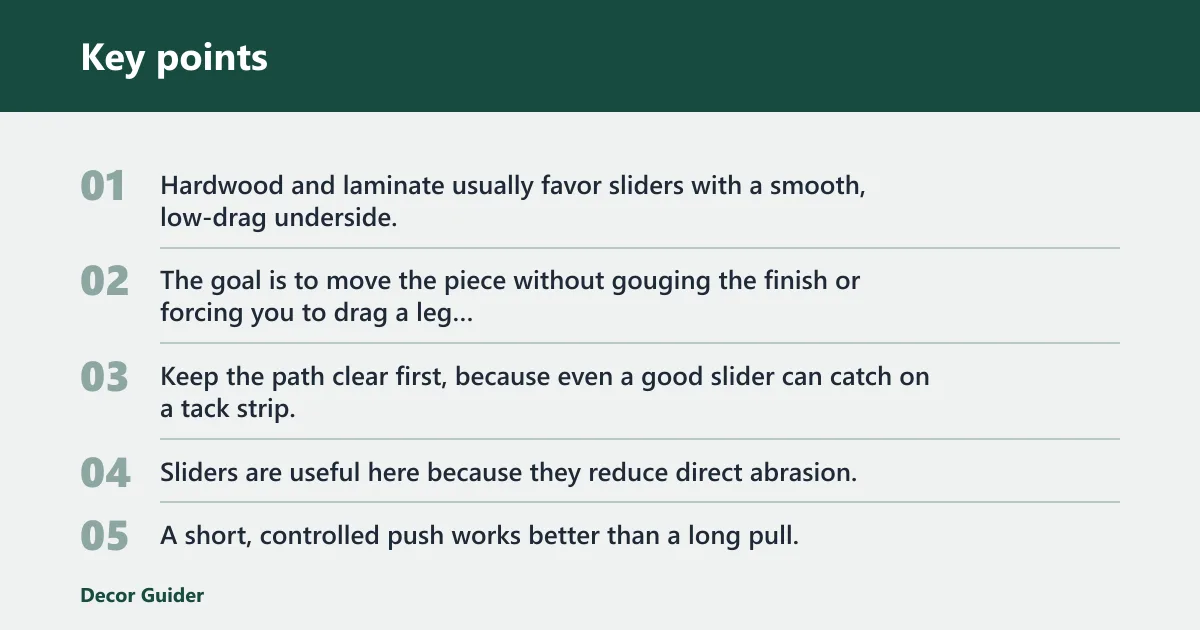
Hardwood and laminate usually favor sliders with a smooth, low-drag underside. The goal is to move the piece without gouging the finish or forcing you to drag a leg directly across the floor. Keep the path clear first, because even a good slider can catch on a tack strip, raised transition, or loose board.
Tile and other hard surfaces
Tile needs steady, even contact. Sliders are useful here because they reduce direct abrasion, but grout lines and uneven tile edges can interrupt the glide. A short, controlled push works better than a long pull, especially with a heavy chest or cabinet.
Carpet and pile height
Carpet changes the equation because the pad must move over fibers instead of a smooth surface. Sliders designed for carpet are meant to reduce digging and resistance, but pile height matters. Thicker carpet makes short moves harder and may be a stronger case for lifting, rolling, or partial disassembly.
Round versus square pads
Round pads are common under chair and table legs, while square pads can suit flatter bases or broader feet. The main rule is fit: the pad has to cover the foot or leg without slipping past the edge. If the furniture foot is narrow or oddly shaped, a mismatched pad can twist or shift under load.
Moving straps by lift type
Moving straps are the better tool when the move depends on lifting rather than gliding. They reduce bending and twisting because the load sits on the carriers’ bodies instead of pulling from the hands alone. Two common styles are shoulder straps and forearm straps.
Shoulder straps for bulky items
Shoulder straps use padded shoulder harnesses and are usually sold as a set. They work well for bulky items such as mattresses and sofas, where the size is awkward even if the path is clear. This Old House also notes their use for appliances like washing machines and refrigerators, which need careful control during a carry.
Forearm straps for control and balance
Forearm straps loop over the forearms and can improve control on heavier, awkward items. They are a good fit for file cabinets and dressers, where balance matters more than speed. According to Moving.com, forearm straps cost about $25, while shoulder straps start at $40.
Why two-person movement matters
Moving straps are a two-person lifting system. That matters because the load has to rise, level out, and move in sync, especially on stairs or around turns. If one person moves early or shifts weight suddenly, the item can tilt, strain the carriers, or hit a wall.
How straps reduce bending and twisting
Straps keep the load higher and spread weight across the body, so the arms and back do less isolated work. That reduces the need to stoop under a dresser or twist while carrying a sofa through a doorway. The benefit depends on coordination, though, so the carriers still need a stable stance and a clear route.
Which tool works for stairs?
Moving straps are the safer fit for stairs because stairs create a high-risk moving environment. The load must be lifted in sync, footing has to stay stable, and the route has to stay clear. Sliders are a poor choice on steps because they are built to glide on a surface, not to manage each tread and riser.
Why stairs favor lifting systems
Stairs often force the item into a steep angle that changes the balance point every few steps. A lifting system keeps the item under control while the carriers manage the rise. Moving straps can make stairs easier than a dolly for heavy items because the load stays on the movers instead of trying to roll or drag.
Why sliders are a poor fit on steps
Sliders depend on flat contact, and steps break that contact immediately. A pad may catch on an edge, slide off the furniture foot, or leave the item unstable between steps. That creates a drop risk, which is exactly what you want to avoid on stairs.
Route planning and stable footing
Before any stair move, clear the route, check footing, and decide who leads and who follows. Tight landings and turns deserve extra attention because the item may need to pivot while still under load. If the path is narrow or the balance looks questionable, disassemble the piece or use a different tool.
Moving Straps vs Furniture Sliders decision matrix
Use this matrix as the quick rule: short and flat favors sliders; lifted, stepped, or awkward favors straps. The main job is matching the tool to the route, the floor, and the load balance before you start moving.
| Scenario | Best tool | Why it wins | Main risk |
|---|---|---|---|
| Single room repositioning | Furniture Sliders | Short, flat move on a compatible floor with little lifting | Pad mismatch or floor scuffing if the surface is wrong |
| Doorway or threshold move | Moving Straps | Better control when the item has to clear a lip or turn tightly | Lost balance if the carriers do not move together |
| Stairs | Moving Straps | Built for two-person lifting through a high-risk path | Slip or strain if footing and timing are poor |
| Solo move | Furniture Sliders | One person can sometimes reposition a flat, stable piece | Not suitable for heavy, tall, or top-heavy items |
Choose Moving Straps if… / Choose Furniture Sliders if…
Choose Moving Straps if the move involves stairs, a threshold, a narrow corner, or an item with awkward balance. Choose Furniture Sliders if the furniture stays on one level, the floor matches the pad material, and the move is short enough that lifting is the bigger problem than friction.
Best-case uses for straps
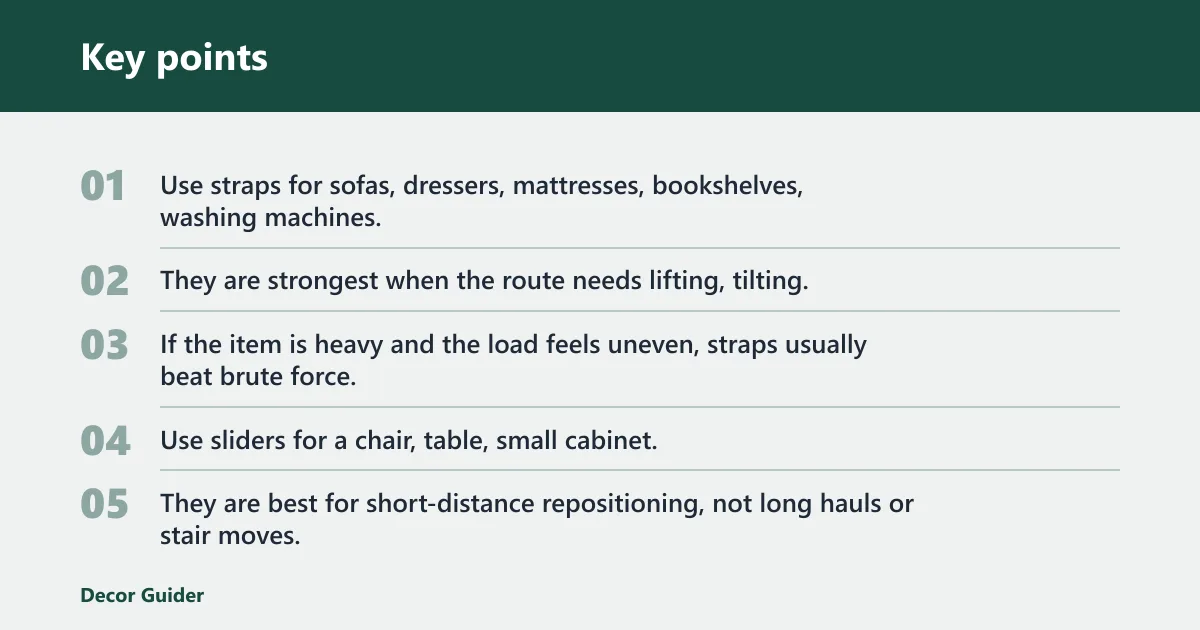
Use straps for sofas, dressers, mattresses, bookshelves, washing machines, and refrigerators when two people can move together. They are strongest when the route needs lifting, tilting, or careful control through a doorway. If the item is heavy and the load feels uneven, straps usually beat brute force.
Best-case uses for sliders
Use sliders for a chair, table, small cabinet, or other furniture piece that needs to shift across hardwood, laminate, tile, or compatible carpet. They are best for short-distance repositioning, not long hauls or stair moves. Round and square shapes both work, as long as the pad matches the foot or leg.
When a moving dolly is the better call
Choose a moving dolly when the item can be rolled safely on a stable base. That is often the cleaner option for larger flat-bottom furniture that is too awkward to slide but does not need to be carried up steps. Skip the dolly if stairs are part of the route.

Frequently asked questions
Moving straps vs furniture sliders: which should I use?
Use furniture sliders for short, flat moves on compatible floors, and moving straps for lifts, stairs, thresholds, or awkward carries. If the item must be raised, turned tightly, or moved over a step, straps are the better fit. If it only needs to glide a few feet, sliders usually make more sense.
How do you use furniture sliders to move furniture?
Lift one furniture foot at a time, place a slider under each contact point, then push or pull the piece slowly across the floor. Keep the path clear and move in short controlled shifts so the pads stay centered. The furniture should stay level, not dragged from one corner.
How do you use furniture sliders on hardwood or carpet?
On hardwood, tile, or laminate, choose a slider designed for smooth hard surfaces so it does not grab or scuff. On carpet, use a pad made for pile so it can move without sinking or snagging. In both cases, match the pad size to the furniture feet or legs.
Can moving straps be used to move furniture down stairs?
Yes, but only with clear route planning, stable footing, and synchronized partner movement. Stairs are a high-risk moving environment, so straps are the better tool than sliders, not a guarantee of safety. If the piece is too large, too heavy, or too awkward, break it down first.
How do I move a single heavy piece of furniture by myself?
For one-person moves, start with sliders if the piece is stable, low enough to control, and moving across a compatible floor on one level. If the item has to cross a threshold, go up or down stairs, or stays top-heavy, stop and get help or use another method. Solo carrying is where mistakes happen fastest.
What furniture is safer to slide than to lift?
Furniture with a flat, stable base and predictable weight, such as a small dresser, sideboard, or table, is often safer to slide than to lift on the right floor. Tall, top-heavy, or awkwardly balanced pieces are the opposite. If the center of gravity feels uncertain, lifting with straps or using a dolly is usually smarter.
Products related to this article
Sponsored / affiliate links. As an Amazon Associate I earn from qualifying purchases. I may earn additional commission from eligible campaigns.