Parcel Post vs Flat Rate Shipping for Household Goods
For household goods, choose Flat Rate Shipping for Household Goods only when a small, dense item fits the box or envelope with no wasted space; otherwise Parcel Post is usually cheaper and safer because you pay by size and weight. Using the wrong service can overpay on light bulky decor, crush fragile pieces in a forced box, or create damage from poor packing. This guide compares Parcel Post-style USPS parcel pricing with Flat Rate Shipping for Household Goods by item type, so you know which household goods belong in each option before you buy postage.
| Decision factor | Parcel Post | Flat Rate Shipping for Household Goods | Winner |
|---|---|---|---|
| Best fit for shape | Better for odd shapes, thin items, and bulky decor that needs a custom box | Better for compact, dense items that fit the packaging without forcing it | Parcel Post |
| Cost control | Price changes with weight, zone, and sometimes dimensions | One fixed price if the item fits approved packaging and the box closes without alteration | Flat Rate Shipping for Household Goods |
| Risk of paying for empty space | Lower if you can choose a right-sized box; higher if dimensional weight applies | Higher when the item is light but bulky and leaves unused space | Parcel Post |
| Best use case | Frames, lamps, textiles, and oversized but light household items | Books, cabinet hardware, small appliances, and other dense items | Tie |
How USPS prices each option
Parcel Post-style USPS parcel pricing uses your own packaging and is priced by weight and destination zone, while Flat Rate Shipping for Household Goods uses USPS-branded packaging with one fixed price if the item fits. USPS zone pricing ranges from Zone 1 to Zone 9, so the same box can cost more as the destination gets farther away.
USPS Priority Mail ships items up to 70 lbs in 2-3 days, and USPS Ground Advantage-Retail covers packages up to 70 lbs in 2-5 days. Priority Mail Express ships items up to 70 lbs with a 1-3 days money-back guarantee. Flat Rate packaging is available for domestic and international mailings, and USPS provides free Flat Rate boxes and envelopes.
Why shape still matters for household items
Household goods fail the fit test in ordinary ways: a lamp base is dense but the shade is not, a picture frame is thin but breakable, and a dish set often needs padding that eats box space. Flat Rate shipping only works when the item fits the packaging and can close without alteration.
That means rigid pieces do well when their footprint matches a box, but thick corner protectors, bubble wrap, and filler can push a borderline item outside the limit. A forced box is a bad deal. It wastes space and raises damage risk.
When does Flat Rate save money?
Flat Rate Shipping for Household Goods saves money when a dense item fits a small approved box or envelope, especially on longer zone shipments where parcel prices rise with distance. It also helps when the package would otherwise be charged by weight plus dimensions. Small, heavy, compact items are the clearest winners.
Dense items that fit in small boxes
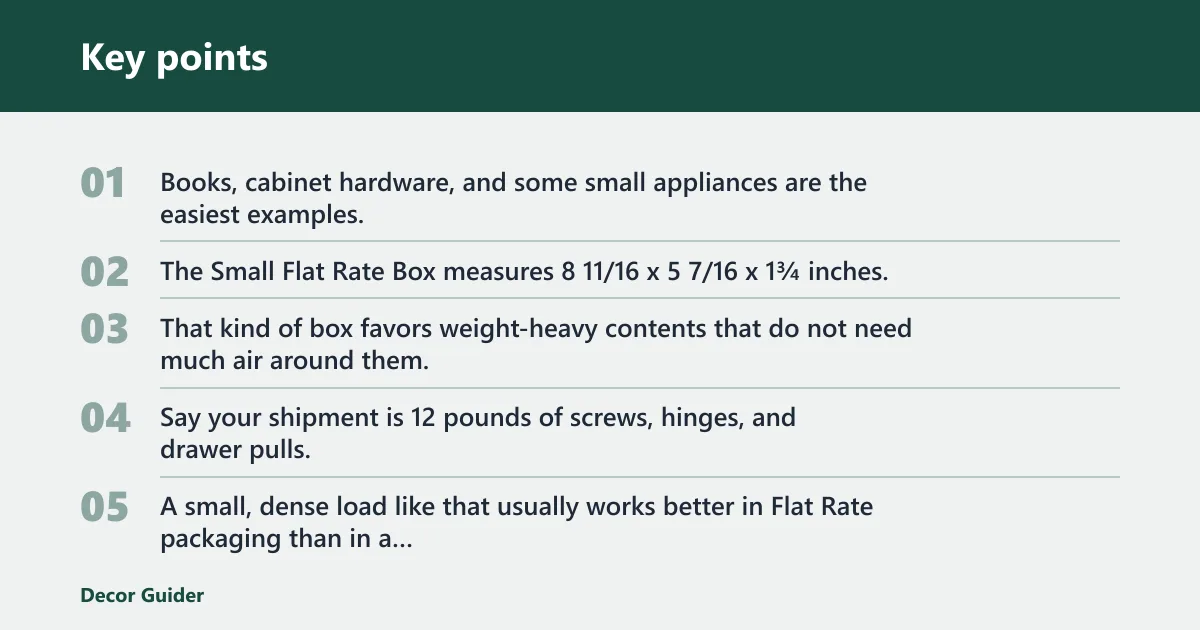
Books, cabinet hardware, and some small appliances are the easiest examples. The Small Flat Rate Box measures 8 11/16 x 5 7/16 x 1¾ inches, and its commercial rate example is about $10.59. That kind of box favors weight-heavy contents that do not need much air around them.
Say your shipment is 12 pounds of screws, hinges, and drawer pulls. A small, dense load like that usually works better in Flat Rate packaging than in a custom box, because the fixed price stays the same as the weight rises within the limit.
Items that travel far enough to raise parcel cost
Zone matters. A compact package going from Zone 1 to Zone 9 can cross into a higher parcel price band, while Flat Rate stays fixed if the item fits. The farther the destination, the more Flat Rate tends to help for dense goods that already fit the box.
That crossover weakens on short trips. Nearby shipments can make Parcel Post cheaper because zone pricing stays lower, so Flat Rate loses some of its advantage when the destination is close.
Household goods that stay compact and rigid
Flat Rate works best when the object keeps its shape under pressure. Cabinet hardware, folded textiles, and tightly packed books are good examples because they do not need much void fill. The box closes cleanly, and the packing stays stable in transit.
The best Flat Rate candidates are not just heavy. They are heavy for their size. That is the difference that matters.
When should you skip Flat Rate?
Skip Flat Rate Shipping for Household Goods when the item is light but bulky, awkwardly shaped, or fragile enough to need a larger protective shell. In those cases, parcel shipping in your own box is usually cheaper and safer because you can match the box to the object instead of forcing the object into the box.
Light but bulky decor and packing filler
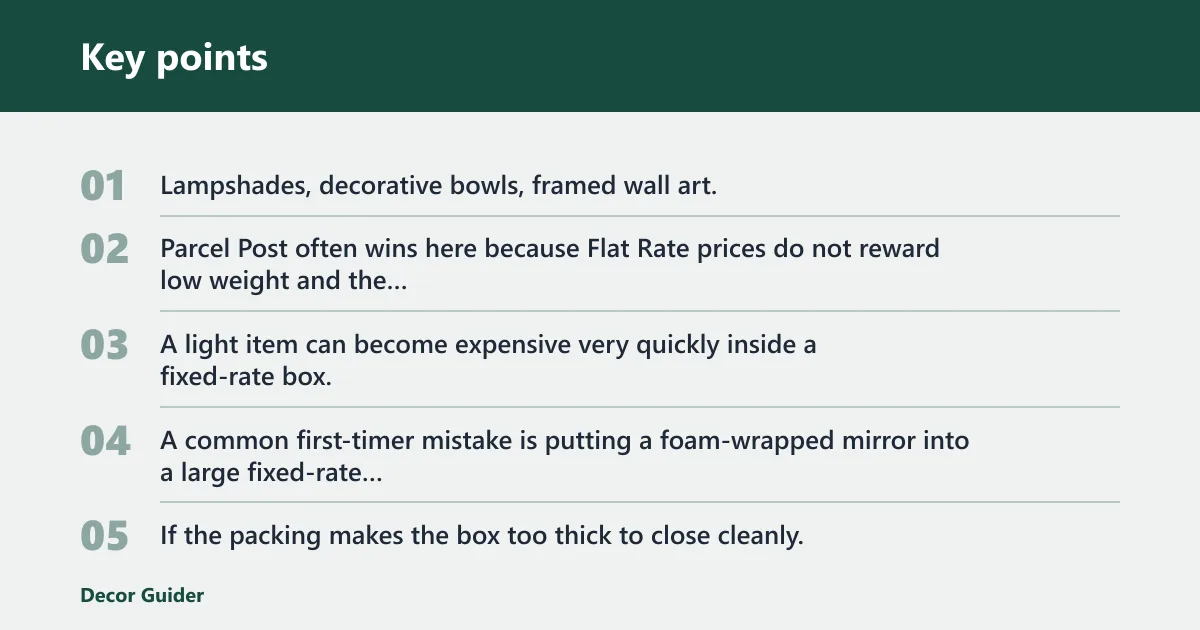
Lampshades, decorative bowls, framed wall art, and many decor pieces take up space without adding much weight. Parcel Post often wins here because Flat Rate prices do not reward low weight and the box volume can be wasted. A light item can become expensive very quickly inside a fixed-rate box.
A common first-timer mistake is putting a foam-wrapped mirror into a large fixed-rate box because the outer size looks convenient. If the packing makes the box too thick to close cleanly, the shipment is already wrong before it leaves the counter.
Odd shapes that waste box volume
Long lamp arms, sofa brackets, and bed frame parts often leave corners or empty channels that must be filled. That space can push a package into a larger Flat Rate box than the item deserves, or it can force you to overpay for unused capacity. Custom parcel packaging gives you more control over that fit.
Dimensional weight also matters for larger parcels. Packages over 1 cubic foot in volume can be charged using dimensional weight, which is calculated as Length × Width × Height ÷ 166. That makes a broad, light item a poor candidate for a big own box.
Fragile pieces that need extra padding
Frames, mirrors, and dishes often need double-wall support, edge protection, and enough clearance to keep impact away from the surface. If padding makes the package too thick, Flat Rate loses its appeal. The box may fit the item on paper but fail once protection is added.
Suppose a 24-inch picture frame needs corner protectors and two inches of padding on each side. A parcel box sized to the frame can be the cheaper, safer move if the added cushioning would make a Flat Rate box close poorly or force a size jump.
Household shipping decision table
This table gives a practical household-goods decision path. It separates shape, fit risk, and the cost trigger that usually decides the shipment. Use it before you choose a box size, because the right service often changes with the item’s geometry, not just its weight.
| Household item | Best USPS option | Fit risk | Main cost trigger |
|---|---|---|---|
| Mirror | Parcel Post | High: fragile glass needs padding and a rigid custom box | Extra padding and box thickness can make Flat Rate too small |
| Lamp | Parcel Post | High: base and shade usually want different protection | Bulky shape can waste Flat Rate volume |
| Picture frame | Parcel Post | Medium to high: thin edges break easily | Protection layers can force a larger box |
| Dish set | Flat Rate Shipping for Household Goods | Medium: breaks if stacked loosely | Dense packing in a small box keeps the fixed price efficient |
| Cabinet hardware | Flat Rate Shipping for Household Goods | Low: compact parts pack tightly | Weight concentrates into a small volume |
| Sofa parts | Parcel Post | High: long or irregular pieces waste space | Length and padding can exceed the useful Flat Rate size |
| Bed frame parts | Parcel Post | High: narrow parts often need a long custom box | Odd length drives custom parcel sizing |
| Decor | Parcel Post | Medium to high: many pieces are light but bulky | Empty space makes Flat Rate inefficient |
| Books | Flat Rate Shipping for Household Goods | Low: square, dense, and easy to stack | Heavy weight in a small box favors fixed pricing |
| Textiles | Parcel Post | Medium: soft items compress well but can be bulky | Volume, not weight, usually drives cost |
| Small appliance | Flat Rate Shipping for Household Goods | Medium: depends on cord storage and shape | Dense, compact appliances often fit the box well |
| Mixed moving supplies | Parcel Post | Variable: depends on which items dominate the box | Choose based on whether the load is dense or bulky |
Mirror, lamp, and picture frame
These items lean toward Parcel Post because the real cost is not the object alone. It is the object plus padding, corner guards, and a box that can survive pressure without crushing the contents. Flat Rate becomes awkward when protective material makes the package too thick to close.
Dish set, decor, and textiles
Dish sets can favor Flat Rate when they are stacked tightly and protected well inside a small box. Decorative pieces and textiles are the opposite: they often occupy a lot of space for very little mass, so Parcel Post usually avoids paying for unused volume.
Books, cabinet hardware, and small appliances
Books and cabinet hardware are the strongest Flat Rate candidates on this list. Small appliances can go either way, but compact models with dense internal weight often fit a fixed-rate box better than a large custom carton. The deciding factor is whether the item fills the box cleanly or leaves a lot of air around it.
Sofa parts and bed frame parts
These are usually Parcel Post shipments because their lengths and angles are hard to box efficiently. A long rail or bracket may fit only in an oversized carton, and oversized cartons are where fixed-rate pricing stops looking friendly. The more irregular the shape, the more likely parcel pricing wins.
Can you use your own box for Priority Mail?
Yes. USPS Priority Mail uses your own packaging, and the price is calculated by weight and destination zone. That is useful when the box can be sized tightly around the item, especially for light or bulky household goods that would waste space in a Flat Rate box.
USPS also offers Flat Rate packaging as a separate option. The trade is simple: your own box gives you sizing control, while Flat Rate gives you a fixed price only if the item fits the approved packaging and the box closes without alteration.
When your own box is cheaper
Your own box is usually cheaper when the item is light, when the destination is nearby, or when the object would force you into a larger Flat Rate package than necessary. A custom box also helps when the item has an awkward profile but can be wrapped tightly enough to avoid excess volume.
For household goods, that often means frames, lamps, and decorative pieces. The cost follows the actual parcel rather than the largest box the item can be squeezed into.
How box size affects cost
Box size affects cost in two ways: by direct parcel pricing and by dimensional weight on larger packages. If the volume exceeds 1 cubic foot, dimensional weight can matter, and a bulky but light item may price higher than expected. That is why a right-sized box matters so much for decor and moving supplies.
Flat Rate avoids that calculation, but only after the fit test is passed. If the item does not fit cleanly, the fixed price is not a bargain.
Does Flat Rate have a weight limit?
Yes. Flat Rate shipping still has a weight limit tied to the USPS service, and the practical limit for these Priority Mail options is 70 lbs. That said, the box size is usually the real limiter for household goods, because many items run out of space before they run out of allowable weight.
The Small Flat Rate Box, Medium Flat Rate Box, and Large Flat Rate Box each have their own size constraints. The Medium Flat Rate Box comes in two variants: top-loading at 11¼ x 8¾ x 6 inches and side-loading at 14 x 12 x 3½ inches, with a commercial rate example of about $19.98. The Large Flat Rate Box measures 12¼ x 12¼ x 6 inches, with a commercial rate example of about $27.76.
Where heavier items fit best
Heavier items fit best in the smallest box that closes cleanly. That is why books, hardware, and compact appliance parts often do well in Flat Rate packaging. The more weight you can concentrate into a small footprint, the more likely Flat Rate saves money.
The Flat Rate Envelope measures 12½ x 9½ inches, the Legal Flat Rate Envelope measures 15 x 9½ inches, the Padded Flat Rate Envelope measures 12½ x 9½ inches, and the Priority Mail Express Flat Rate Envelope measures 12½ x 9½ inches with a commercial rate example of $31.11. Envelopes are best for flat paperwork, thin textiles, and other items that stay slim.
Choose Parcel Post if… / Choose Flat Rate Shipping for Household Goods if…
Choose Parcel Post if the item is light but bulky, fragile enough to need substantial padding, or shaped in a way that wastes space in a fixed box. Choose Flat Rate Shipping for Household Goods if the item is dense, compact, and fits cleanly in approved packaging without altering the box or envelope.
- Choose Parcel Post if the item needs a custom box, if padding changes the thickness a lot, or if the destination is close enough that zone pricing stays low.
- Choose Parcel Post if the item is a lamp, frame, mirror, sofa part, or bed frame part that would be awkward in a fixed box.
- Choose Flat Rate Shipping for Household Goods if the item is books, hardware, a compact dish set, or a small appliance that packs tightly.
- Choose Flat Rate Shipping for Household Goods if the shipment is dense enough to make the fixed price beat weight-based pricing, especially to farther zones.
Check one thing before you buy postage: does the object fill the space cleanly, or does it fit only after you push padding into every gap? If it needs force, Parcel Post is usually the better move. If it fills the box cleanly, Flat Rate is worth a close look.
Frequently asked questions
Is flat rate shipping cheaper than parcel post for household goods?
Not always. Flat Rate Shipping for Household Goods is cheaper when the item is dense, fits the box cleanly, and would otherwise be priced higher by weight or distance. Parcel Post is usually cheaper for light, bulky decor, wide textile bundles, and awkward shapes that waste box volume.
When does flat rate shipping save money on heavy items?
Flat Rate saves money when a heavy item fits in a small box or envelope and the destination is far enough that zone-based parcel pricing climbs. Dense items like books, cabinet hardware, and some small appliances are the strongest candidates because the fixed price does not rise with weight or zone.
Can I use my own box for priority Mail?
Yes. Priority Mail uses your own packaging, and the price is based on weight and destination zone. That makes it useful for household goods that do not fit well in Flat Rate packaging, especially light items that would waste space or fragile items that need a custom box.
What household items are best for flat rate shipping?
The best household items for Flat Rate Shipping for Household Goods are dense, compact pieces that pack tightly: books, cabinet hardware, some small appliances, and tightly arranged dish sets. The key is fit. If the item leaves a lot of empty space or needs bulky padding, parcel shipping is usually the better choice.
How do package weight and zone affect parcel post prices?
Parcel Post-style pricing changes with weight and destination zone, and USPS zone pricing ranges from Zone 1 to Zone 9. Heavier packages and farther zones cost more, while nearby shipments usually stay cheaper. Dimensional weight can also matter for packages over 1 cubic foot in volume.
Does flat rate shipping have a weight limit?
Yes. The USPS Flat Rate options in this guide still follow the service’s 70 lbs limit. But for household goods, the box often fills up before weight becomes the problem. The real question is whether the item fits cleanly and the packaging closes without alteration.
Products related to this article
Sponsored / affiliate links. As an Amazon Associate I earn from qualifying purchases. I may earn additional commission from eligible campaigns.