How to Estimate Shipping Costs for a Sofa
How to estimate sofa shipping in 4 steps
- Measure the packed sofa. Use the outside length, width, and height after wrapping or boxing.
- Calculate dimensional weight. Use the carrier’s formula, then compare it with actual weight to find billable weight.
- Add the delivery details. Enter origin ZIP code, destination ZIP code, residential status, and service level.
- Check surcharges and service fit. Add fuel, liftgate, and special handling if they apply, then decide whether parcel or freight is the better match.
What most changes the price: packed dimensions, actual weight, residential delivery, fuel surcharge, liftgate or special handling, and whether the sofa fits parcel rules or needs freight. FedEx says package size and weight affect estimated cost, and dimensional weight or actual weight, whichever is greater, is used. The UPS Store notes larger items may need freight services, which is why bulky sofas can shift pricing fast.
Estimate a sofa’s shipping cost by using billable weight, then adding pickup, liftgate, residential, and furniture surcharges. Many sofas may move into freight pricing once they reach about 150–200 lb or exceed parcel-size limits. Miss those charges, and a quote can jump after booking or erase your margin. This guide shows how to estimate sofa shipping costs, check freight thresholds, and spot the surcharge items that change the total.
Sofa shipping costs



Sofa shipping cost starts with the route, then shifts with size, weight, service level, and add-on fees. Carriers price to the higher of actual weight or dimensional weight, and a home delivery usually costs more than a business address. For a sofa, packaging can change the quote as much as the drive distance.
Billable weight basics
Billable weight is the number that drives the quote after the carrier compares actual weight with dimensional weight. The same source says package size and weight affect estimated cost, and dimensional weight or actual weight, whichever is greater, is used. That matters for sofas because a light but bulky couch can price like a much heavier shipment.
The dimensional-weight formula is simple: (length × width × height) ÷ carrier divisor = dimensional weight. Carriers can use different divisors and rounding rules, so the exact number can vary by service, but the logic is the same: big cartons can bill higher than the scale weight. For sofas, that is often the deciding factor in whether the quote stays in parcel pricing or moves toward freight. FedEx and The UPS Store both frame pricing around package size, weight, and destination details.
Use this sequence when you sanity-check a quote:
- Measure the packed sofa. Record length, width, and height after wrapping or boxing. Those outside dimensions are what the carrier uses for dimensional weight.
- Weigh the complete shipment. Include the sofa plus packaging, pads, boxes, and any disassembled parts. BackerKit says packaging weight must be included, and that keeps the estimate honest.
- Compare both weights. The higher figure becomes the billable weight. If the packed sofa is large, dimensional weight often wins even when the scale weight seems modest.
Picture a 78-inch sofa in a carton that measures 84 x 38 x 34 inches packed, with actual weight at 145 lb. The quote can rise on size alone if the dimensional weight lands above 145 lb. That is why sofa sellers need the packed dimensions, not just the furniture’s catalog size.
Route and zone pricing
Origin ZIP code and destination ZIP code are the base route inputs for most carrier calculators. The same source says the calculator asks for origin ZIP code and destination ZIP code, and The UPS Store says its calculator requires origin and destination information. Those ZIP codes feed zone-based pricing, so the same sofa can cost less on a short lane and more across the country.
Residential delivery also changes the price. FedEx includes residential delivery as a pricing factor, and BackerKit notes that UPS and FedEx may charge additional fees like residential delivery. If the destination is a home, expect the quote to be different from a business dock or warehouse.
Service level and add-on fees
Shipping service level often creates the biggest swing in price. Ground, air, and freight do not price the same way, and The UPS Store includes UPS Ground among supported services. Faster service means more handling and tighter delivery windows, so the rate climbs. Freight can be the better fit once the sofa is too large for parcel rules.
Fuel surcharge and special handling can move the final total after the base rate is set. The same source says fuel costs can affect shipping rates, and special handling requirements can affect shipping rates. Sofas with recliner mechanisms, removable legs, sleeper frames, or fragile trim can trigger those fees.
What shipping details do carriers need for a sofa quote?
Carriers need the origin ZIP code, destination ZIP code, packed dimensions, actual weight, and delivery type to produce a realistic sofa quote. The most common miss is packaging: a blanket-wrapped couch and a boxed couch can price very differently because the packed size changes the billable weight. Special handling details matter too.
Origin and destination ZIP codes
ZIP codes are not optional. They tell the calculator where the shipment starts and ends, which affects both zone pricing and accessorial fees. If you leave them out or use the wrong business ZIP, the estimate can look cheaper than the final invoice.
Also note whether the delivery point is residential or commercial. That distinction can change the quote more than a small difference in mileage, especially on consumer furniture shipments.
Packed dimensions and actual weight
Measure the sofa as it will ship, not as it sits in the living room. Length, width, and height drive dimensional weight, while actual weight tells the carrier how much the shipment truly weighs on the scale. The same source says bigger and heavier shipments usually cost more, which is exactly why both numbers matter.
For a sofa, the outer package often matters more than the frame itself. A 92-inch couch that fits in a compact carton can price very differently from the same couch wrapped in thick blankets and corner protection.
Delivery type and special handling
Tell the carrier whether the destination is residential, whether liftgate service is needed, and whether the sofa has special handling needs. Special handling can apply to oversized or fragile items, and sofas with legs, recliners, sleeper components, or loose cushions may need extra care. Those details affect quote accuracy before booking.
Suppose a sleeper sofa is being shipped to a second-floor apartment. The weight alone may not be the issue. The service may need liftgate or inside delivery, and that can change the final charge more than a small change in box size.
How does packaging change the price?
Packaging can change sofa shipping price by changing both size and handling risk. A boxed shipment may be easier to price, blanket-wrapped freight may be bulkier, and original-box or disassembled shipments can shift the billable weight either up or down. The carrier charges on the packed form, not the showroom form.
Boxed shipments
Boxed shipments give carriers cleaner dimensions, which can help you estimate dimensional weight more precisely. The box adds length, width, and height, but it also protects corners, legs, and upholstery. That tradeoff often makes sense when the sofa has removable parts or can be disassembled safely.
Use the outside box measurements in the calculator. Do not substitute the bare sofa dimensions, because the quote will come back light and then change when the carrier measures the actual carton.
Blanket-wrapped shipments
Blanket wrapping can protect the sofa without a rigid carton, but the wrapped package is often larger in every direction. That can push the shipment into a higher dimensional weight tier. It may still be the right choice for freight moves, especially for sectionals or odd-shaped arms.
A common first-timer mistake is assuming blanket wrap is always cheaper because it avoids a box. The opposite can happen if the wrapped footprint grows enough to trigger a larger billable weight or special handling fee.
Original-box and disassembled parts
Original-box shipping can help when the sofa was designed for parcel-like handling, but only if the factory carton dimensions stay manageable. Disassembled parts may ship more efficiently than a fully assembled couch, yet you still need to include cushions, legs, hardware, and protective packing in the weight and size estimate.
If the original carton is damaged or overpacked, the carrier may treat it as an irregular shipment. That is one more reason to use the packed dimensions rather than the product listing alone.
When does a sofa need freight instead of parcel shipping?
A sofa usually shifts from parcel pricing to freight or LTL when its size, weight, or handling needs exceed standard parcel limits. Many sofas may cross into freight territory around 150–200 lb, or sooner if the packed dimensions are too large for parcel service. The UPS Store notes that larger items may need freight services.
Size thresholds that push a quote out of parcel pricing
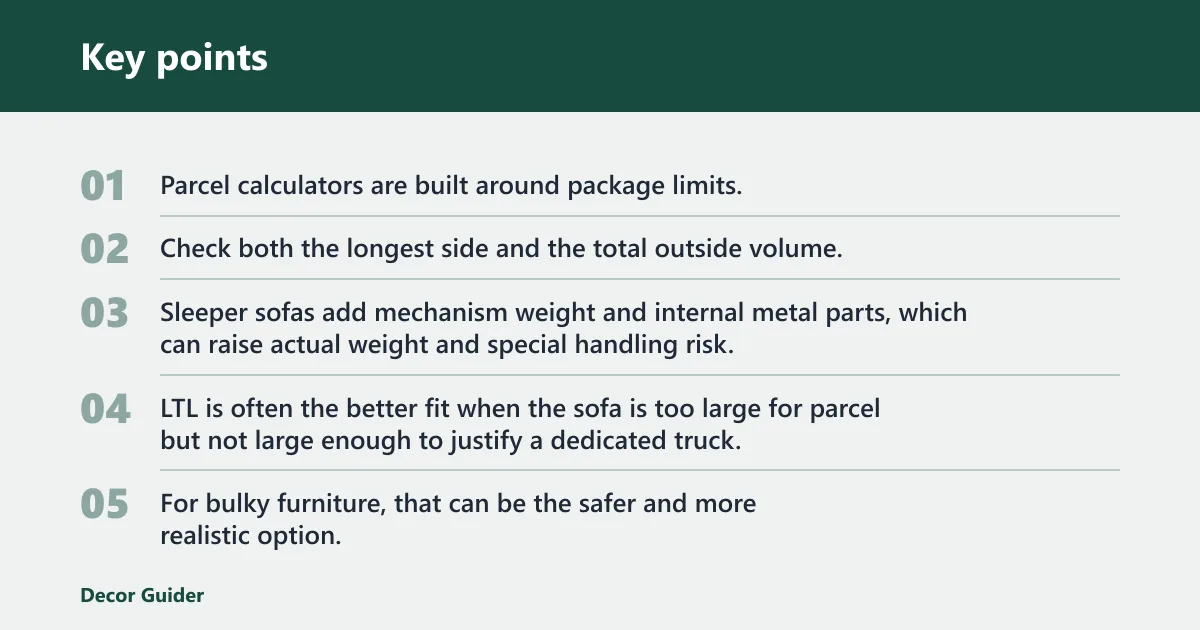
Parcel calculators are built around package limits. Once the packed sofa becomes too long, too bulky, or too heavy, the carrier may reclassify it into freight or reject the parcel quote entirely. That is why a seller should not rely on catalog dimensions alone.
Check both the longest side and the total outside volume. A low-slung sectional can be especially deceptive because it may look manageable by weight but fail on length or girth once wrapped.
Sectionals and sleeper sofas
Sectionals often need freight because the pieces create multiple packages, unusual angles, and larger combined dimensions. Sleeper sofas add mechanism weight and internal metal parts, which can raise actual weight and special handling risk. Those models can move the quote sharply even before fuel or residential fees are added.
When a sofa ships in more than one carton, price each carton separately and then check whether the carrier treats the move as one freight shipment or several parcels. The answer can change the total by a lot.
When LTL is the better fit
LTL is often the better fit when the sofa is too large for parcel but not large enough to justify a dedicated truck. It can also make sense when the shipment needs palletization, liftgate service, or better damage protection during long routes. For bulky furniture, that can be the safer and more realistic option.
The UPS Store’s calculator notes that larger items may need freight services, which is the right warning sign to use before booking. If a sofa quote looks low for a heavy sectional, compare it against LTL before you accept the price.
Sofa shipping estimate worksheet
This worksheet helps you sanity-check a sofa quote before you book it. Fill in the packed dimensions, actual weight, ZIP codes, delivery type, and service level, then compare the carrier’s billable weight and accessorials against your own estimate. Keep the packaging form the same when you compare quotes.
Parcel-vs-freight breakpoint guide: if the sofa stays within parcel size rules and the billable weight remains manageable, parcel may work. If the packed size is too large, the shipment approaches about 150–200 lb, or the move needs palletization, liftgate, or extra handling, freight or LTL is often the cleaner fit. Use the same packing method across quotes so the comparison stays fair.
Worked quote scenarios:
- Loveseat: A compact loveseat in a carton may stay in parcel pricing if the packed dimensions keep dimensional weight below the actual weight and the destination does not add residential or liftgate charges.
- Three-seat sofa: A 84 x 38 x 34 in packed sofa at 145 lb can be priced by dimensional weight if the carton is bulky enough, then adjusted for residential delivery and fuel.
- Sectional: Two cartons can push the total into freight territory even when each piece looks manageable on its own, especially if the shipment needs palletization or liftgate service.
- Sleeper sofa: A sleeper sofa can move higher on actual weight because of the metal mechanism, and the packed size may also trigger dimensional-weight pricing and special handling.
- Blanket-wrapped sofa: A wrapped sofa can cost more than a boxed version if the wrap adds enough bulk to raise dimensional weight or triggers extra handling.
| Sofa type | Packed dimensions | Actual weight | Origin ZIP | Destination ZIP | Residential delivery | Service level | Billable-weight and quote sanity-check |
|---|---|---|---|---|---|---|---|
| Three-seat sofa | 84 x 38 x 34 in | 145 lb | 30301 | 60601 | Yes | Ground | Compare dimensional weight against 145 lb; add residential and fuel charges if shown. |
| Sectional, 2 pieces | 2 cartons: 72 x 36 x 30 in and 68 x 34 x 30 in | 210 lb total | 75001 | 10001 | No | LTL freight | Likely freight territory; check pallet, liftgate, and special handling line items. |
| Sleeper sofa | 90 x 42 x 38 in | 185 lb | 90012 | 80202 | Yes | Freight | Mechanism weight may push actual weight up; verify if dimensional weight exceeds 185 lb. |
The worksheet is most useful when you compare at least two service levels with the same packing method. If one quote uses blanket wrap and another uses a carton, the billable weight may change enough that the service comparison is no longer apples to apples.
How can you compare sofa shipping options by cost?
Compare like-for-like service levels, the same packaging type, and the same delivery type before judging price. Then line up surcharge items such as fuel, residential delivery, and special handling. A lower base rate can be misleading if the total billable weight or accessorials are higher.
Compare like-for-like service levels
A ground quote should be compared with another ground quote, not with freight or air. The UPS Store includes UPS Ground among its supported services, but The UPS Store also notes actual UPS Ground rates may differ from the calculator. That means the calculator is a starting point, not the final number.
Use the same origin and destination ZIP codes, the same packed dimensions, and the same delivery type across all quotes. Otherwise, the carrier comparison is skewed before it begins.
Check surcharge line items
Look for fuel surcharge, residential delivery surcharge, liftgate, special handling, and any oversized-item fee. The same source says fuel costs can affect shipping rates, and special handling requirements can affect shipping rates. BackerKit also notes that UPS and FedEx may charge additional fees like fuel surcharges and residential delivery.
Those line items are often where the final total changes. A quote that appears competitive on the base rate can end up more expensive once the accessorials are added.
Use the worksheet to sanity-check quotes
Match the carrier quote against the worksheet fields before you book. If the quote ignores packaging, uses the wrong ZIP code, or assumes business delivery for a home address, the estimate is not reliable. A quote should explain the billable weight and the service level clearly enough that you can see why it prices where it does.
For sofa sellers, that check protects margin. For movers, it helps avoid surprise charges after pickup.
Frequently asked questions
How much to ship a couch?
There is no single sofa price because carriers price on route, size, weight, service level, and delivery type. A small boxed couch may stay in parcel pricing, while a larger or heavier couch can move into freight. Use billable weight plus surcharges to compare quotes on the same lane.
How much does shipping furniture cost?
Furniture shipping cost depends on how bulky the item is, how far it travels, and whether the destination is residential or commercial. Sofas often cost more than similar-weight boxes because their dimensions raise billable weight. Fuel, liftgate, and special handling can also change the final number.
How do I calculate shipping for a sofa?
Measure the packed sofa, weigh the complete shipment, and compare actual weight with dimensional weight. Then enter the origin ZIP code, destination ZIP code, and service level into a carrier calculator. The higher of actual or dimensional weight becomes the key pricing input.
What affects the cost to ship a couch?
The biggest drivers are packed dimensions, actual weight, route, service level, and delivery type. Packaging matters because it changes size, and residential delivery often costs more than business delivery. Fuel surcharge and special handling can add more after the base rate is set.
Does dimensional weight change sofa shipping prices?
Yes. The same source says dimensional weight or actual weight, whichever is greater, is used. That means a bulky but light sofa can be billed as if it weighed more than the scale shows. Box size, blanket wrap, and cushion packing can all raise that number.
Products related to this article
Sponsored / affiliate links. As an Amazon Associate I earn from qualifying purchases. I may earn additional commission from eligible campaigns.