Best Affordable Shipping Options for Heavy Household Items
For most heavy household items, the cheapest option is freight shipping for oversized furniture and appliances, parcel ground for compact dense items under carrier weight limits, and local delivery for irregular bulky goods. Pick the wrong service and you can pay oversized parcel surcharges, liftgate fees, or white-glove rates that can double the bill. This guide compares the lowest-cost shipping method by item type, dimensions, and service level so you can match the right service to each piece.
What makes heavy household items expensive to ship
Three things usually push the price up: actual weight, dimensional weight, and access fees. A dense 60-pound box of books can be cheaper to move than a much lighter but bulky lamp or cabinet, because carriers also price the space a package takes up. Delivery context matters too.
Actual weight vs dimensional weight
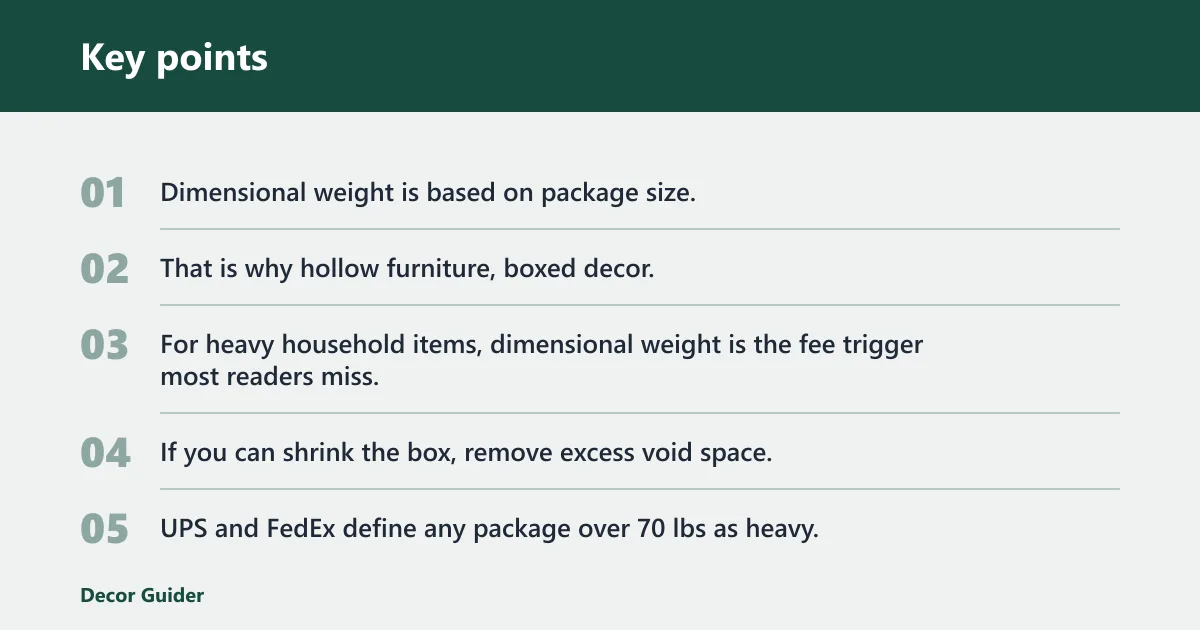
Actual weight is the number on the scale. Dimensional weight is based on package size, so a big box with a lot of empty air can price higher than a dense box of the same weight. That is why hollow furniture, boxed decor, and foam-packed items often cost more than their scale weight suggests.
For heavy household items, dimensional weight is the fee trigger most readers miss. If you can shrink the box, remove excess void space, or break the item into smaller cartons, you may lower the bill more than by shaving a pound or two.
Oversize rules and residential surcharges
UPS and FedEx define any package over 70 lbs as heavy. UPS Ground ships up to 150 lbs, and FedEx Ground ships up to 150 lbs as well. USPS cannot carry packages over 70 lbs, and USPS Priority Mail is capped at 70 lbs in the cited comparison.
Size can be a separate problem from weight. UPS and FedEx accept parcels up to 165 inches in combined length and girth. FedEx oversized charges apply over 96 inches long or 130 inches combined length and girth, while USPS Ground Advantage shipments have a maximum limit of 130 inches in combined length and girth. Packages over 150 pounds and 165 inches in combined length and girth are considered freight.
Pickup, liftgate, and insurance costs
The base rate is only part of the bill. Residential delivery, liftgate service, pickup, reconsignment, limited-access delivery, and insurance can add real cost, especially for furniture or appliances that cannot move through a standard dock. If the receiver cannot unload a pallet, liftgate service can matter more than the line-haul rate.
That hidden stack is why a low parcel quote can turn expensive at checkout. Add the base rate, fuel, residential delivery, liftgate, pickup, and oversize fees before you choose.
Which shipping method is cheapest by item type?
The cheapest method depends more on the item profile than the carrier name. Dense, boxable pieces often ship best by parcel ground. Awkward furniture usually crosses into freight sooner than people expect. Oversized items that cannot be boxed cleanly are usually cheaper on palletized freight or blanket-wrap service than on parcel networks.
Dense items under 70 lb
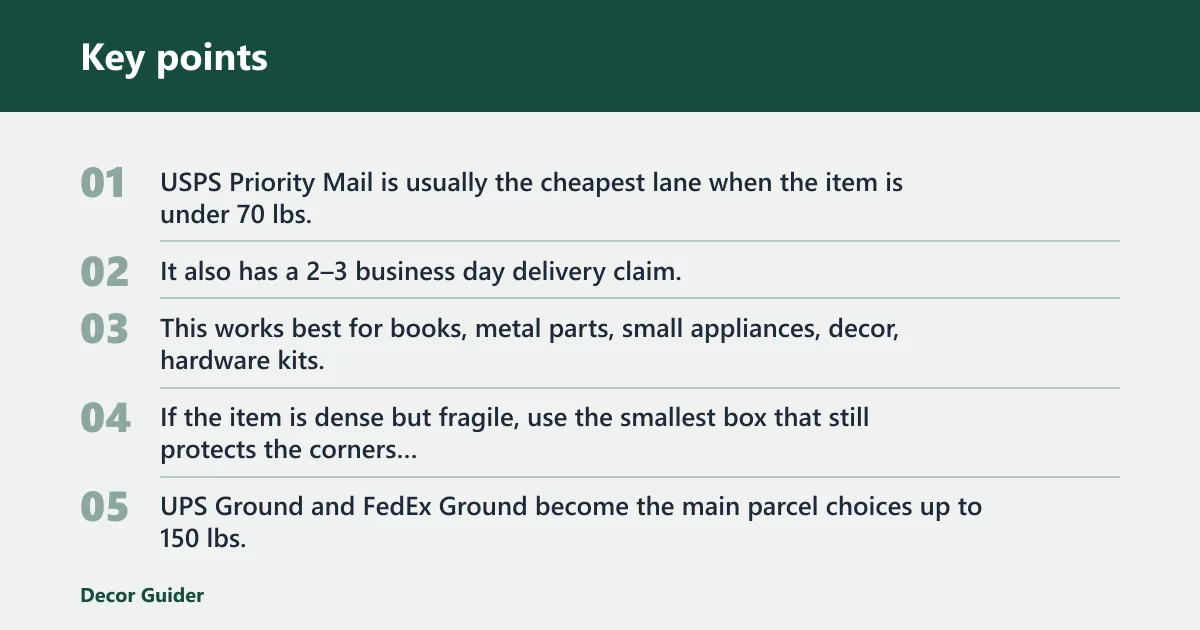
USPS Priority Mail is usually the cheapest lane when the item is under 70 lbs, fits a flat-rate box, or is dense enough that parcel dimensions stay modest. It also has a 2–3 business day delivery claim, which can be useful when you want speed without paying air-service pricing.
This works best for books, metal parts, small appliances, decor, hardware kits, and other compact household goods. If the item is dense but fragile, use the smallest box that still protects the corners and faces.
Heavy boxes from 70 to 150 lb
Once a parcel crosses 70 lbs, USPS is out. UPS Ground and FedEx Ground become the main parcel choices up to 150 lbs, and both are used for heavy boxes with nationwide coverage. UPS Ground is commonly listed at about 3–5 business days, while FedEx Ground is commonly listed at about 2–5 business days in the comparison table.
For a boxed chair base, a tool chest, or a packed lamp set, these services can still be cheaper than freight if the box stays within size limits and does not trigger oversize pricing. Tracking also matters here, especially if the shipment moves through more than one hub.
Oversized furniture and non-boxable pieces
Sofas, bed frames, dining tables, cabinets, and mattresses often stop making sense as parcel shipments before they hit the weight limit. Once the item is bulky, non-boxable, or above 150 lbs, LTL freight often becomes the cheaper route. For fragile or finished pieces, blanket-wrap freight can be the better fit because it reduces handling.
Picture a dining table that breaks down into a top and four legs. If the top is still too large for parcel pricing, palletized freight may be cheaper than trying to force the whole piece through a parcel network. If it can disassemble cleanly into manageable cartons, parcel may still work.
Household shipping decision table
| Item type | Typical parcel/freight threshold | Best cheap option | Likely fee triggers | When to disassemble |
|---|---|---|---|---|
| Books, cookware, tools, small appliances | Under 70 lbs; compact box | USPS Priority Mail if it fits; otherwise UPS Ground or FedEx Ground | Dimensional weight, retail packaging, insurance for breakables | Rarely needed; remove loose parts and wrap separately |
| Heavier boxed decor, lamp sets, hardware, media | 70–150 lbs; standard carton | UPS Ground or FedEx Ground | Heavy-package handling, residential delivery, oversize length | Yes, if the item can be split into two smaller boxes |
| Bed frame, chair set, console table | Bulky but boxable; size may matter more than weight | Parcel only if packed flat and within size limits; otherwise LTL freight | Dimensional weight, oversize charges, extra packing material | Usually yes; remove legs, rails, or hardware |
| Sofa, sectional, mattress | Often non-boxable or pallet-sized | LTL freight or blanket-wrap freight | Liftgate, residential delivery, limited access, reconsignment | Only if it reduces the footprint meaningfully |
| Cabinet, shelving unit, dresser | Large footprint; may exceed parcel girth before weight limit | LTL freight for assembled pieces; parcel if knocked down flat | Oversize charges, pallet fee, protection for finished surfaces | Yes, if drawers, doors, and shelves can be removed safely |
| Appliance parts, fixtures, dense replacement components | Dense but not fragile; usually under 150 lbs | UPS Ground or FedEx Ground | Heavy-package fee, signature service, insurance | Sometimes; remove trim, hoses, or accessories |
Is USPS cheaper than UPS or FedEx for heavy boxes?
USPS is cheaper only when the box stays under 70 lbs and fits within USPS size rules. For dense, compact household items, that can make USPS Priority Mail the lowest-cost option. Once the shipment grows past 70 lbs, UPS Ground and FedEx Ground usually become the relevant parcel choices.
USPS Priority Mail limits and flat-rate use cases
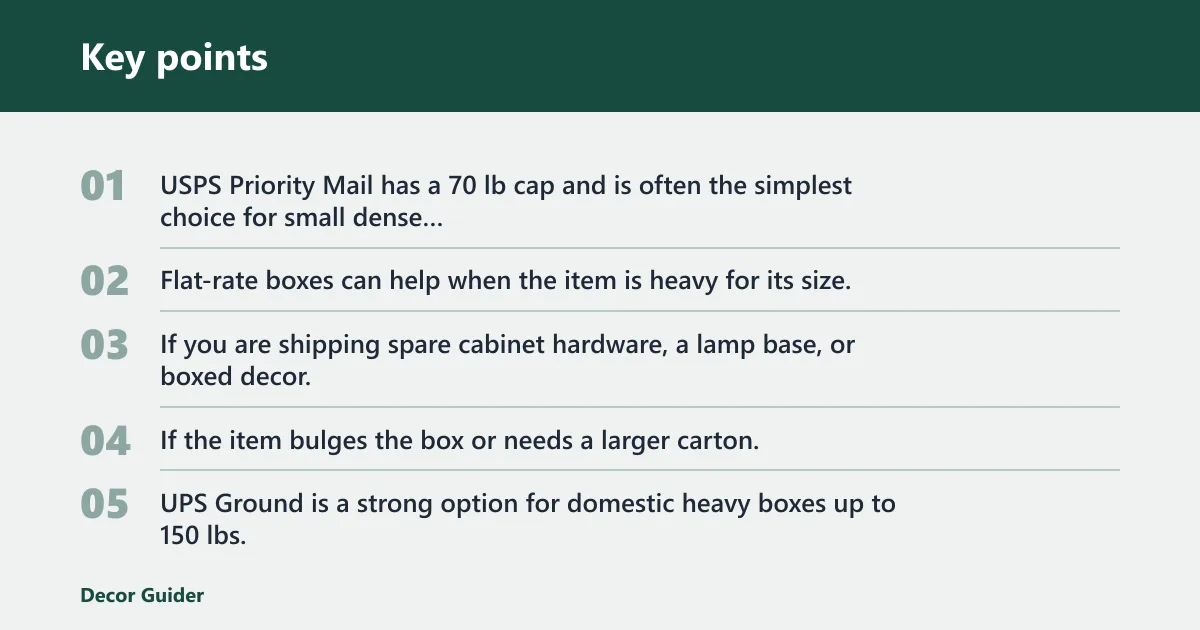
USPS Priority Mail has a 70 lb cap and is often the simplest choice for small dense household goods. Flat-rate boxes can help when the item is heavy for its size, because the price does not move with scale weight in the same way a standard parcel does. That only helps if the item truly fits.
If you are shipping spare cabinet hardware, a lamp base, or boxed decor, USPS can win on price and speed. If the item bulges the box or needs a larger carton, the flat-rate advantage disappears fast.
UPS Ground for heavy parcels up to 150 lb
UPS Ground is a strong option for domestic heavy boxes up to 150 lbs, especially when the shipment needs broad coverage and predictable tracking. It is often the practical middle ground between USPS and freight for boxed items that are too heavy for postal service but still packable as a parcel.
Use it when the item is dense, the box is square enough to avoid dimensional penalties, and the destination is not awkward enough to require pallet handling.
FedEx Ground for tracked domestic heavy shipments
FedEx Ground also ships up to 150 lbs and is competitive for heavy domestic shipments when tracking visibility matters. It is a common choice for boxed furniture parts, appliance accessories, and finished goods that need standard parcel handling without freight paperwork.
FedEx oversized charges apply over 96 inches long or 130 inches combined length and girth, so the size check matters early. A box can be under 150 lbs and still be expensive if it is too long.
When should you use freight instead of parcel shipping for furniture?
Use freight when the item is over 150 lbs, too large for parcel size limits, or too awkward to pack efficiently as a box. LTL freight is listed for 150+ lbs or palletized shipments, and consolidated freight providers consider items over 125 lbs to be heavy. For bulky furniture, freight often beats parcel once the box becomes oversized.
Blanket-wrap versus palletized freight
Blanket-wrap freight is better for finished furniture that should not be stacked with other freight or strapped tightly to a pallet. It costs more than basic pallet freight, but it can reduce damage on sofas, cabinets, and tables with exposed surfaces. Palletized freight is usually cheaper when the item can be strapped flat and protected with corner guards.
If the item has drawers, glass, or a delicate veneer, blanket-wrap can save money by avoiding repair claims that erase the initial savings from a cheaper service. If it is a durable frame or unassembled kit, pallet freight is often enough.
When freight becomes cheaper than parcel
Freight becomes the cheaper choice when parcel surcharges stack up faster than the line-haul rate. That often happens with wide furniture, long boxed items, or shipments that trigger oversize fees plus residential delivery. The tipping point is not only weight; it is the total of size, access, and handling.
Say your sofa ships as one long carton that pushes parcel girth too high. Even if the scale weight is manageable, the oversize pricing can make parcel more expensive than a pallet on LTL freight.
How can you lower the final shipping cost?
Lowering the final cost means reducing the parts carriers price separately: box size, access difficulty, handling time, and claim risk. The cheapest move is not always the smallest box. Sometimes it is the best-packed box with fewer surcharges and fewer touchpoints.
Right-size the box or remove excess packaging
Take out empty space, separate legs or shelves, and avoid oversized cartons that trigger dimensional weight. If the item ships in a factory box, use that only when it is structurally sound and not too large for the carrier’s pricing rules. Reinforced tape and corner protection can be cheaper than a damaged delivery claim.
A common first-timer mistake is to pack a hollow item in a huge box “for safety.” That can increase the bill more than the extra padding is worth.
Split shipments only when it lowers surcharges
Splitting a shipment is not automatically cheaper. It helps only when two smaller boxes avoid oversize or heavy-package fees that one large carton would trigger. For a bed frame or modular cabinet, splitting hardware, panels, and legs into separate parcels can reduce cost if the carrier charges less for each smaller piece.
Do not split simply to split. Compare one freight quote against the combined parcel total before you book.
Use regional carriers and 3PL fulfillment centers
Regional carriers can be cheaper for heavy household items when the destination sits inside their service area, because they often avoid some of the long-haul cost of national networks. The savings are route-dependent, so they are worth checking on nearby or regional lanes rather than assuming they will always win.
A 3PL fulfillment center can also lower cost by placing inventory closer to buyers, reducing zone cost, and improving pick-and-pack efficiency. That matters for sellers shipping repeated furniture parts, home accessories, or bulky decor from the same inventory pool.
How to compare quotes before you book
Use carrier shipping calculators with exact weight, dimensions, origin, and destination. Then compare the service level, estimated delivery window, and every fee line item. A lower base rate means little if the quote adds residential delivery, liftgate, or oversize charges at checkout.
- Measure the packed item, not just the product.
- Record actual weight and the box’s length, width, and height.
- Run the shipment through a carrier calculator for each service you are considering.
- Check whether the quote adds heavy-package, oversize, residential, or pickup fees.
- Compare the total landed cost, then choose the least expensive service that still fits the item safely.
Suppose a packed cabinet is within parcel weight but too long for a standard box. The calculator may show a low base parcel rate, then add oversize pricing that pushes it above an LTL quote. That is the point where freight wins, even if the item is not extremely heavy.
Frequently asked questions
What is the cheapest way to ship heavy household items?
The cheapest method depends on the item profile. Dense, compact goods under 70 lbs often fit USPS Priority Mail. Heavy boxed items up to 150 lbs usually fit UPS Ground or FedEx Ground. Oversized furniture and non-boxable pieces are often cheapest by LTL freight because parcel surcharges stack up quickly.
How much does it cost to ship a 70-pound or 100-pound item?
Cost depends on origin, destination, size, and service level, so a single universal price would be misleading. A 70-pound item may still fit parcel pricing if the box is compact, while a 100-pound item often needs UPS Ground or FedEx Ground. Oversize dimensions can change the quote more than the weight.
What shipping option is best for oversized household items?
LTL freight is usually best for oversized household items that are bulky, pallet-sized, or beyond parcel girth limits. If the item is finished furniture, blanket-wrap freight can reduce damage risk. If it can be broken down safely, parcel may still be cheaper, but only when the size stays inside the carrier’s rules.
How can I lower shipping costs for heavy furniture and appliances?
Right-size the carton, remove detachable parts, and compare parcel against freight before booking. Regional carriers can help on local lanes, and a 3PL fulfillment center can cut zone costs when the item ships often. The biggest savings usually come from avoiding oversize and heavy-package surcharges, not from chasing the lowest base rate.
What weight limit makes USPS stop being an option?
USPS stops being an option at 70 lbs. That is the key cutoff for heavy household items, including boxed decor, books, and small appliances. Above that point, you need to compare UPS Ground, FedEx Ground, or freight, depending on the item’s dimensions and how it packs.
Are regional carriers cheaper for heavy household items?
They can be, especially on short or regional lanes where the origin and destination fall inside the carrier’s network. That said, coverage is limited, so the cheapest quote from a regional carrier only matters if they serve both ends of the shipment. Always compare total cost, not only the quoted base rate.
Products related to this article
Sponsored / affiliate links. As an Amazon Associate I earn from qualifying purchases. I may earn additional commission from eligible campaigns.