Priority Mail vs Flat Rate for Mailing Home Decor
For most lightweight, boxy home decor, Priority Mail is cheaper than Flat Rate for Mailing Home Decor unless the item is heavy for its size or needs a box that fits Flat Rate exactly. Pick the wrong service and you pay for empty space, extra padding, or damage from a box that is too small or too loose. This guide compares cost, size limits, packing risk, and which USPS option fits common decor pieces.
| Decision factor | Priority Mail | Flat Rate for Mailing Home Decor | Winner |
|---|---|---|---|
| Postage pricing method | Priced by weight and zone, and the box can be your own. | Fixed price by USPS Flat Rate package size. | Priority Mail for light items; Flat Rate for heavier items that fit |
| Packing flexibility | More flexible for odd shapes, double boxing, and extra padding. | Works only if the item fits the Flat Rate box or envelope with cushioning. | Priority Mail |
| Long-distance value | Costs rise as zones get farther away. | Same price nationwide. | Flat Rate for Mailing Home Decor |
| Damage-control margin | Usually easier to size up the carton without changing to a fixed-size USPS box. | Can be a poor fit if the decor needs corner protectors or double boxing. | Priority Mail |
| Best fit for dense small decor | Works if the box stays compact and the zone is close. | Often better when the item is heavy but still small enough for Flat Rate packaging. | Flat Rate for Mailing Home Decor |
How pricing, speed, and fit drive the choice
Priority Mail and Priority Mail Flat Rate both travel through the USPS network, and both include tracking. Priority Mail usually includes up to $100 insurance with most shipments, and Priority Mail delivers in 2-3 days. The difference is pricing, standard Priority Mail uses weight, dimensions, and zone, while Flat Rate uses package type and size.
Core pricing difference
Standard Priority Mail lets you use your own box and pay by weight and zone. USPS Priority Mail Flat Rate requires standard-size USPS boxes or envelopes, and the price stays the same nationwide. That makes Flat Rate easier to predict, but only if your decor fits the box without awkward padding choices.
Speed, tracking, and insurance basics
The transit speed is similar because both services use the same USPS network. That means the decision is mostly about packaging and postage math, not delivery class. If you are comparing home decor shipments, the larger question is whether the item fits safely in a Flat Rate box or whether a standard Priority Mail carton gives you better protection.
When each option usually wins
Shippo’s 2026 comparison says flat rate saves more on heavy items going long distances, while Priority Mail in your own box usually costs less for light packages. That rule fits home decor well. A small but dense object can favor Flat Rate, while a light framed print often does better in a standard box.
Which USPS option is cheaper for home decor?
The cheaper USPS option depends on more than weight. For home decor, box shape, padding space, and destination zone can change the total enough that the lowest postage price is not the lowest total landed cost. A cheap-looking label can become expensive once you add corner protectors, a larger carton, or extra insurance for fragile pieces.
How weight, box size, and zone change the total
USPS prices standard Priority Mail by weight and zone, so nearby shipments in smaller cartons often cost less than long-distance shipments in larger ones. Flat Rate removes the zone variable, which is helpful when the decor piece is heavy enough that distance would otherwise push the price up. If the item is light, though, the fixed Flat Rate box can cost more than a standard carton.
Why fragile items can flip the result
Fragile decor often needs airspace, corner protection, or double boxing. That extra room can push a standard Priority Mail package into a larger size, but it can also make a Flat Rate box unusable if the item no longer fits safely. In that case, the cheapest postage is not the cheapest shipment because damage risk adds hidden cost.
What counts as total landed cost
Total landed cost is the postage plus the packaging that keeps the item intact. For home decor, that means the outer carton, filler, corner protectors, tape, and any insurance you decide to buy. If Flat Rate forces a tight fit, the label might be cheap while the real shipment becomes costly.
Home decor decision table
| Item type | Best USPS service | Safest box type | Likely padding needs | Dimensional-weight risk | Flat Rate crossover point |
|---|---|---|---|---|---|
| Mirrors | Priority Mail | Standard Priority Mail box, often double boxed | Corner guards, wrap, and clearance on all sides | High if the mirror is large and light | Only when the mirror is small enough to fit a Flat Rate box with padding left over |
| Picture frames | Priority Mail | Long standard box or flat carton | Frame corners, face protection, void fill | Moderate for larger light frames | Small, dense frames that fit the Small Flat Rate Box or Medium Flat Rate Box |
| Lamps | Priority Mail | Standard box with separate packed parts | Shade removal, base wrap, padding around harp and finial | Moderate to high because of bulky shape | Compact lamp parts only, not a fully assembled lamp |
| Wall art | Priority Mail | Long carton or custom box | Face protection, corner protection, immobilization | High for large lightweight art | Small framed art that fits a Flat Rate box without compression |
| Small decor parts | Flat Rate for Mailing Home Decor | Small Flat Rate Box | Minimal if the pieces are dense and well-wrapped | Low | As soon as the parts are heavy enough that zone-based pricing would rise |
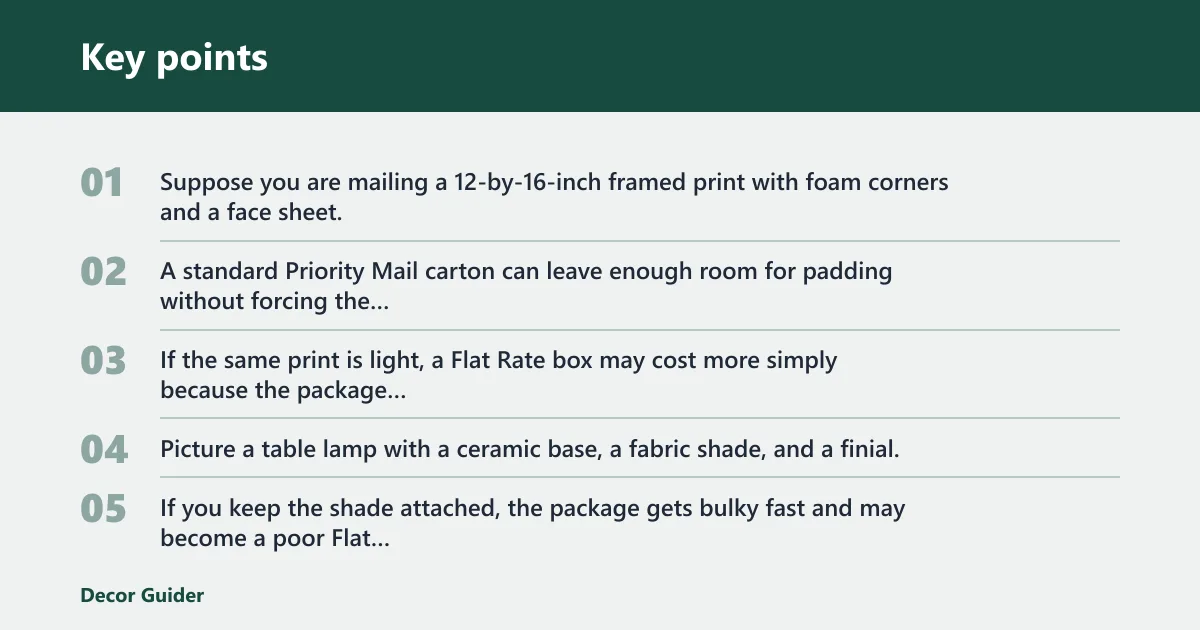
Suppose you are mailing a 12-by-16-inch framed print with foam corners and a face sheet. A standard Priority Mail carton can leave enough room for padding without forcing the print into a shorter fixed box. If the same print is light, a Flat Rate box may cost more simply because the package type is oversized for the item.
Picture a table lamp with a ceramic base, a fabric shade, and a finial. If you keep the shade attached, the package gets bulky fast and may become a poor Flat Rate fit. If you ship the base alone and pack the shade separately, Priority Mail usually gives you more control over the carton shape and padding.
When does Flat Rate win?
Flat Rate for Mailing Home Decor wins when the piece is heavy, compact, and fits the box with room for protective material. It also wins when the destination is farther away and standard Priority Mail would climb with zone-based pricing. If the item fits the fixed USPS box cleanly, the math can favor Flat Rate quickly.
Heavy small items
Small decor parts, metal accents, and dense hardware are the easiest Flat Rate wins. The package weight can be high without changing the price, up to 70 lbs. That matters when the item is tiny but dense enough to make weight-based pricing less attractive.
Long-distance shipments
Flat Rate removes the zone variable, which helps when the shipment crosses several domestic zones. For home decor, that can matter for gifts, resale pieces, or replacement parts going far from the sender. If the item is modest in size but the route is long, fixed pricing can be the cheaper route.
When the item fits with padding left over
Flat Rate only makes sense if the decor still has room for cushioning after wrap, foam, or paper are added. If the piece touches the box walls, the box is too small for fragile shipping, even if the postage is attractive. A tight fit can erase the savings if damage occurs.
When does Priority Mail win?
Priority Mail usually wins for lighter home decor, oversized-light pieces, and shipments that need a custom carton. It is also the safer choice when the item needs a larger box for padding or double boxing. In those cases, paying by weight and zone can be less expensive than forcing the item into a fixed-size Flat Rate box.
Light items in your own box
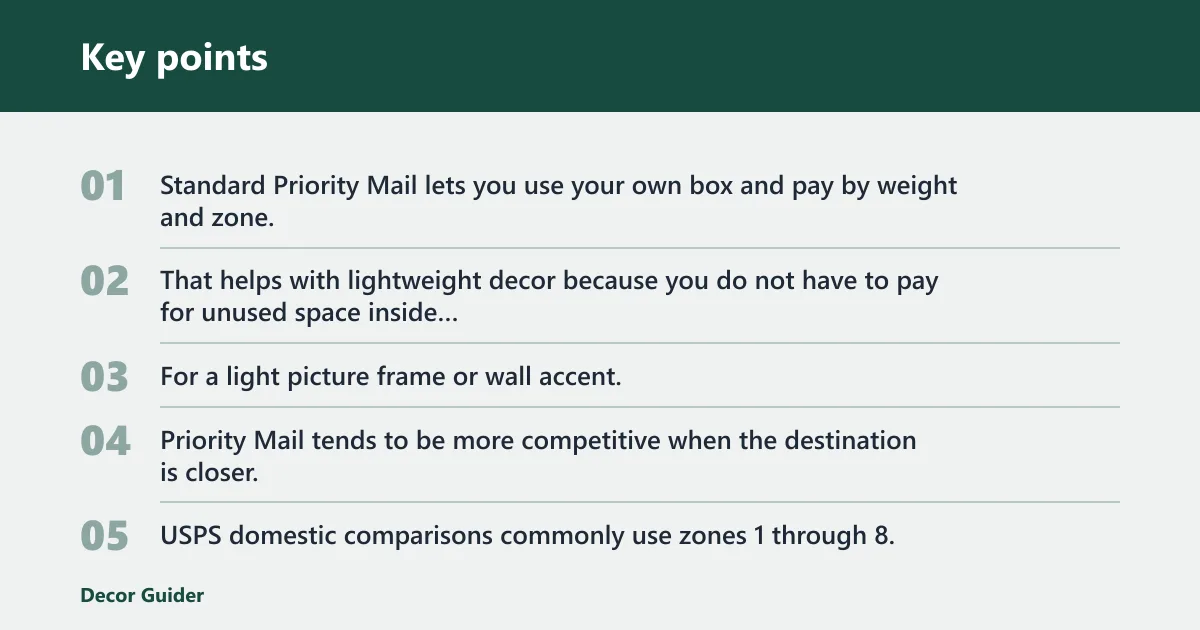
Standard Priority Mail lets you use your own box and pay by weight and zone. That helps with lightweight decor because you do not have to pay for unused space inside a fixed USPS box. For a light picture frame or wall accent, a right-sized carton can beat Flat Rate on price and fit.
Shorter-distance shipments
Priority Mail tends to be more competitive when the destination is closer. USPS domestic comparisons commonly use zones 1 through 8, with Zone 1 closest and Zone 8 farthest in continental U.S. examples. Shorter-zone shipments reduce the gap between weight-based pricing and fixed pricing.
Oversized-light decor and dimensional pricing risk
USPS says DIM weight applies when a package is larger than 1 cubic foot. USPS also says dimensional pricing rules vary by rate type, so you should not treat one divisor as universal. That matters for large lightweight decor such as mirrors and wall art, where the carton can become expensive even before the item gets heavy.
The same source says the maximum combined length and girth for regular Priority Mail is 108 inches. It also flags nonstandard fees for long, oversized, or unusual packages, including examples such as 22-30 inch length, over 30 inches, and over 2 cubic feet. Those charges can wipe out the savings on large decor shipments.
Can you use your own box with Priority Mail for home decor?
Yes. Standard Priority Mail lets you use your own box and pay by weight and zone. That is often the better choice for home decor because you can pick a carton that fits the item, protect fragile edges, and avoid paying for fixed-size USPS packaging you do not need. Flat Rate requires USPS Flat Rate packaging.
What standard Priority Mail allows
With regular Priority Mail, your carton can be custom-sized as long as it stays within USPS size rules. That flexibility is useful for frames, lamps, and wall art that need more room than a fixed box gives you. It is also helpful when you want to use a stronger outer box for a fragile piece.
Why Flat Rate requires USPS packaging
Flat Rate pricing depends on USPS-branded box or envelope sizes, so you cannot substitute a random carton and keep the same price. That fixed format is the tradeoff for nationwide pricing. If the decor needs a different shape, Flat Rate may stop being the cheapest option even before you add padding.
How box choice affects padding and damage risk
The safest box is the one that leaves room for immobilization. For mirrors and frames, that often means extra corner protection and a slightly larger carton. A box that looks cheap on postage can be expensive if it leaves the item loose or forces a crush fit.
USPS Priority Mail Flat Rate packaging includes a Flat Rate Envelope, Small Flat Rate Box, Medium Flat Rate Box, and Large Flat Rate Box. The Flat Rate Envelope is 12 1/2 x 9 1/2 inches and is best for thin decor items and documents. The Small Flat Rate Box is 8 11/16 x 5 7/16 x 1 3/4 inches and can work for small heavy items. The Medium Flat Rate Box comes in 11 1/4 x 8 3/4 x 6 inches top-loading or 14 x 12 x 3 1/2 inches side-loading, while the Large Flat Rate Box is 12 1/4 x 12 1/4 x 6 inches.
Choose Priority Mail if… / Choose Flat Rate for Mailing Home Decor if…
Choose Priority Mail if the decor is light, oddly shaped, or fragile enough to need a custom carton, extra corner protection, or double boxing. Choose Flat Rate for Mailing Home Decor if the item is compact, dense, and fits one of the USPS Flat Rate packages with cushioning left over.
Choose priority mail if…
- You need your own box for a mirror, frame, lamp part, or wall art.
- The item is light enough that zone-based pricing stays low.
- You need extra room for padding, dividers, or a second box.
- The carton would be large enough to trigger dimensional pricing concerns or nonstandard fee risk.
Choose Flat Rate for mailing home decor if…
- The item is heavy for its size.
- The decor fits the Flat Rate box or envelope without compression.
- The destination is far enough away that zone pricing would climb.
- You want a fixed nationwide price and the packaging shape is a good match.
Frequently asked questions
Is Priority Mail or Flat Rate cheaper for shipping home decor?
Priority Mail is usually cheaper for light home decor, especially when you can use your own box. Flat Rate for Mailing Home Decor often wins when the item is heavy and still fits safely in a USPS Flat Rate package. The cheapest answer changes when padding, box size, and damage risk are included.
When should I use a Flat Rate box for fragile decor?
Use Flat Rate only when the fragile item fits with room for wrap, corner protection, and a little movement control. If the decor touches the box walls or needs a larger outer carton, Flat Rate is the wrong choice. Fragile items need space for protection, not just a low postage number.
Can I use my own box with Priority Mail for home decor?
Yes. Standard Priority Mail lets you use your own box, which is often the safer option for frames, mirrors, wall art, and lamp parts. That flexibility helps you choose the right size and shape without being locked into a fixed USPS carton. Flat Rate does require USPS Flat Rate packaging.
What size Flat Rate box works for picture frames or wall art?
Small frames may fit the Small Flat Rate Box, but most framed decor does better in the Medium Flat Rate Box or a standard Priority Mail carton. Larger wall art often needs a custom box because the fixed Flat Rate shapes are too short or too tight once corner protection is added.
Does Priority Mail pricing change by zone for home decor shipments?
Yes. Standard Priority Mail is priced by weight and zone, so nearby shipments usually cost less than farther ones. That matters for home decor because a light item can still become expensive if it is traveling to a farther domestic zone. Flat Rate avoids that zone-based change.
How much can USPS Flat Rate boxes weigh?
USPS Priority Mail Flat Rate products can ship up to 70 lbs nationwide at one price. That high weight cap helps with dense home decor parts, hardware, and small heavy pieces. The box still has to close properly, and the decor still has to be protected from crushing or shifting.
Products related to this article
Sponsored / affiliate links. As an Amazon Associate I earn from qualifying purchases. I may earn additional commission from eligible campaigns.
 20PCS Home Decor Brick Hook, Metal Brick Wall Hanger for 2 - 1/4 to 2 - 2/5 Inch Bricks, No Drill Heavy Duty Alloy Steel Clip with 20 lbs Capacity for Indoor Outdoor Use20PCS Home Decor Brick Hook, Metal Brick Wall Hanger for 2 - 1/4 to 2 - 2/5 Inch Bricks, No Drill Heavy Duty Alloy Steel Clip with 20 lbs Capacity for Indoor Outdoor Use