Best Moving Straps for Carrying Furniture (2026): we compared
The best moving straps for carrying furniture are forearm or shoulder-to-shoulder lifting straps with adjustable length and a weight rating at least equal to the heaviest item; choose forearm straps for wide, boxy pieces and shoulder straps for tall, awkward loads. Bad strap choice changes the load path, so you can lose control, strain your back, or damage walls and furniture. This guide compares strap types and shows when straps are safer than dollies, sliders, or a hand truck.
This guide is part of our Ratchet straps and tie downs guide series.
Quick comparison
| Product | Badge | Best for | Price | ||
|---|---|---|---|---|---|
 |
2-Ply Lifting Sling Straps 2”x 6ft – 6200lbs VerticalKODIAK STRAPS | Upgrade pick | 2-ply polyester · 6200lbs basket hitch · 6ft | $36.72
Price as of 11 Oct 2026
|
View |
 |
Moving Straps Lifting(Padded) one Person 2-Person LiftingEPXXUDD | Budget pick | Padded harness · 1 or 2 person carry system | $25.99
Price as of 11 Oct 2026
|
View |
The right choice depends on shape first, not comfort claims. A strap that matches the furniture’s center of gravity, clearance, and carry path is safer than a stronger-sounding tool that fights the move.
Shoulder-style systems usually work better for bulky, two-person carries and stairs. Flat, rollable pieces often belong on a dolly instead.
How we chose
We compared each option against four practical filters: furniture shape, two-person control, clearance through doorways and stairs, and how well the load stays centered during the carry. We also weighed fit, strap adjustability, and whether the tool helps or hurts on tight turns.
The goal is not maximum advertised strength. It is the tool that keeps the item balanced while two people move with less twisting and fewer wall bumps.

Shoulder dolly moving straps: best for bulky furniture
- Padded straps reduce pressure on shoulders and wrists
- Adjustable fit accommodates two-person lifting configurations
- Versatile for moving mattresses, couches, and appliances
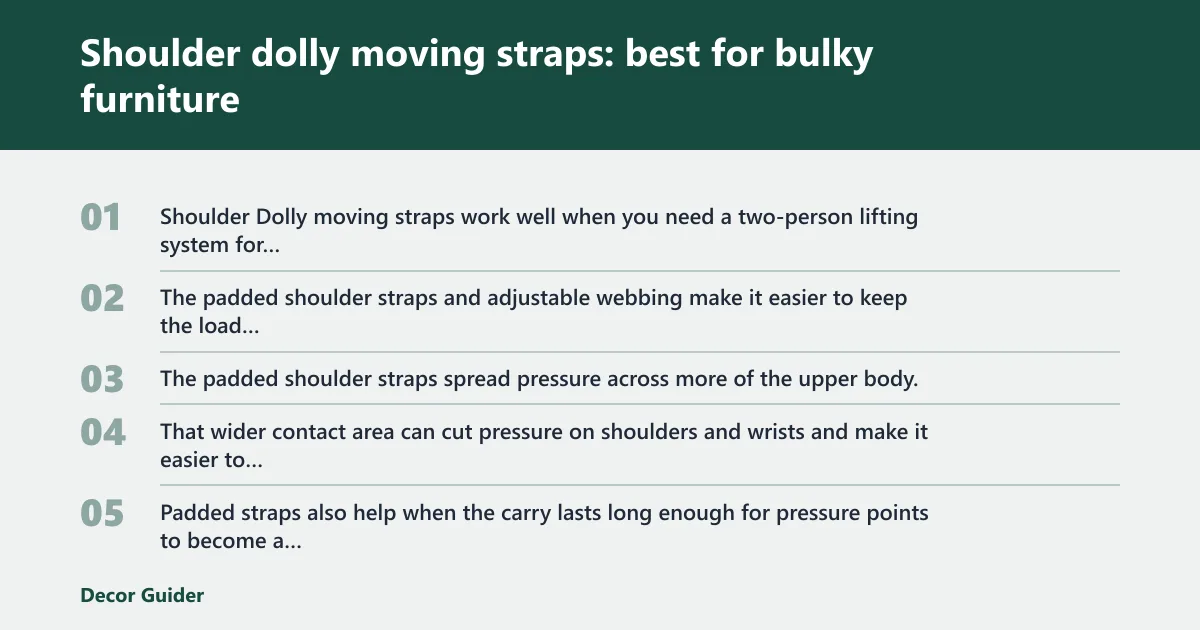
Shoulder Dolly moving straps work well when you need a two-person lifting system for bulky furniture, especially sofas, mattresses, and appliances. The padded shoulder straps and adjustable webbing make it easier to keep the load centered while both movers share the carry.
What the padded shoulder straps do
The padded shoulder straps spread pressure across more of the upper body, which matters when the item is awkward rather than simply heavy. That wider contact area can cut pressure on shoulders and wrists and make it easier to rely on core muscles and leg strength instead of pulling with the arms alone.
Padded straps also help when the carry lasts long enough for pressure points to become a problem. Fit matters, though: if the straps ride too high, slip off the shoulders, or dig into the neck, the system stops being useful very quickly.
Where adjustable webbing helps most
Adjustable webbing is what lets the strap routing match the item, not the other way around. That matters for bulky furniture with uneven depth, a mattress with a box spring, or a couch that needs a low carry angle to clear a doorway.
It also helps you manage tension between movers. Too much slack makes the item swing. Too little leaves the carry rigid and hard to correct on stairs or around a landing.
Best fit for stairs and doorways
This style works best when you need to keep the load close to the body and move in a straight path with small corrections. It is a strong choice for narrow staircases, but only if the turns are wide enough for the item’s length and the movers can keep even timing.
Drawback: shoulder systems are not a cure for bad clearance. If a sectional corner catches the wall or the stair turn is too tight, the strap will not fix the geometry.
Furniture moving straps: best for general DIY moves
- Polyester webbing offers low stretch and high strength
- 2-ply construction supports heavy vertical and choker loads
- Rated to 5:1 safety factor for reliable rigging
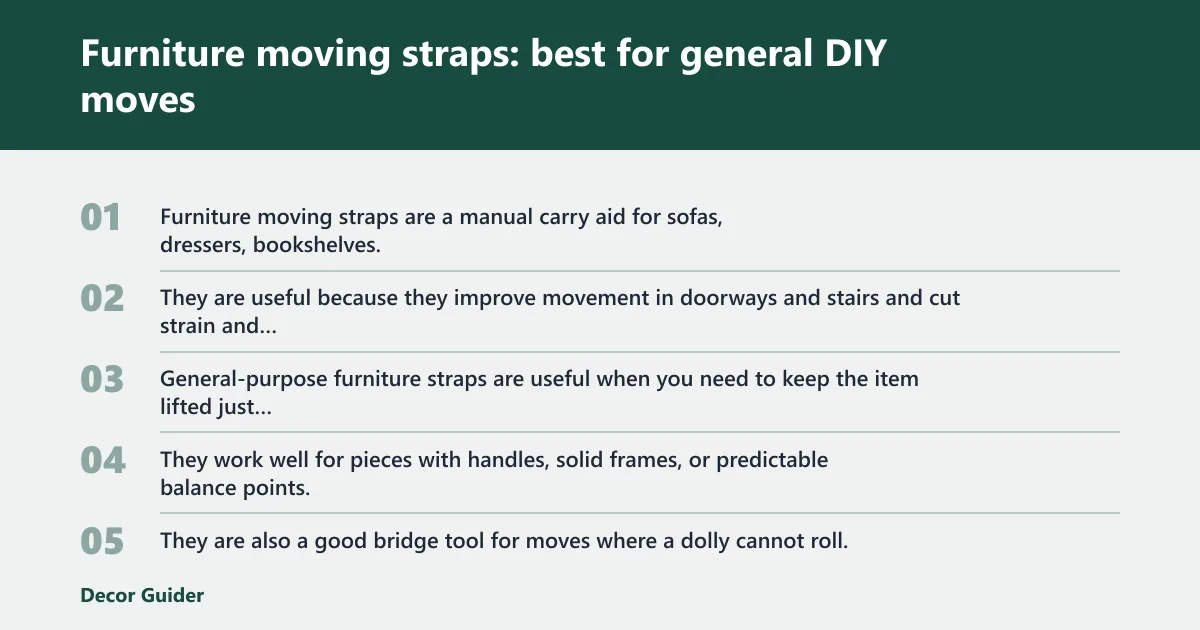
Furniture moving straps are a manual carry aid for sofas, dressers, bookshelves, and appliances when two people need better control than bare hands allow. They are useful because they improve movement in doorways and stairs and cut strain and injury risk when the load path stays stable.
What these straps are good at
General-purpose furniture straps are useful when you need to keep the item lifted just enough to clear a threshold or rotate through a hallway. They work well for pieces with handles, solid frames, or predictable balance points.
They are also a good bridge tool for moves where a dolly cannot roll, but the furniture is not so awkward that it needs a more specialized rigging setup.
Where they start to fail
These straps start to fail when the center of gravity shifts outside the movers’ control. That happens with tall armoires, loose drawers, slick flooring, or a sofa that wants to tilt as soon as one person steps higher than the other.
They also become less effective if the item is too wide for the movers’ reach or too heavy for the pair to keep level through a turn. A rated load only matters if the shape and balance still behave.
Two-person setup basics
The system is meant to be used as a two-person lifting system. One mover controls one end, the other mirrors the movement, and both keep the strap tension even while stepping together.
Simple form matters. Keep a straight back, straight arms, and lift with your legs. That is not a slogan; it is how you cut twisting and make the load path more predictable.
Drawback: these straps still depend on coordination. If one mover rushes a step or turns early, the other person may get a sudden pull across the shoulders or wrists.
Moving dollies: best for flat, rollable items
Moving dollies are better than straps when the item is flat, rigid, and can stay balanced on wheels. They are the better companion tool for cabinets, compact appliances on level floors, and other pieces that can roll without tipping.
When a dolly beats straps
Choose a dolly when you can keep the load on a flat surface and avoid lifting through the whole route. It reduces carrying distance and is often the better option for heavy but stable objects that do not need to be hugged to the body.
That is the key difference: dollies move load on the floor, while straps manage load in the air. If the route is mostly level and open, wheels usually win.
Why dollies struggle on stairs and tight corners
Dollies struggle when the path stops being flat. Stairs, narrow landings, and tight corners force the load into awkward angles, and the wheels stop solving the core problem.
That is why straps often beat a dolly in older homes with short landings or doors that open too close to the stair rail. A common first-timer mistake is trying to roll a dresser through a stair turn that has no real clearance; the item binds, then twists.
Furniture-to-strap decision table
This table is the practical filter most guides leave out. Match the shape first, then check the carry path, then decide whether straps are a better fit than a dolly or hand truck.
| Item | Best strap style | Two-person setup | Clearance needs | Key failure risks |
|---|---|---|---|---|
| Sofa or sectional | Shoulder-style moving straps with adjustable webbing | Yes; one mover at each end | Wide doorway, enough stair landing room for a turn | Center-of-gravity shift, armrest snagging, wall scuffs |
| Recliner | Shoulder straps or forearm-style carry straps | Usually yes | Clear path for the footrest and back frame | Unbalanced tilt, pinch points, slipping upholstery |
| Dresser or armoire | General furniture straps with strong adjustability | Yes for tall pieces | Door height, corner swing room, stair headroom | Drawer slide-out, top-heavy tipping, narrow-turn binding |
| Bookshelf | Forearm or shoulder straps, depending on height | Yes if the shelf is loaded or tall | Wall clearance and enough depth for the frame | Racking, shelf flex, sudden lean on uneven floors |
| Mattress and box spring | Shoulder straps with adjustable length | Yes, especially on stairs | Hallway width, stair turn radius, ceiling clearance | Flopping edge, sagging center, trapped corners |
| Appliance | Shoulder straps for carries; dolly for level rolling | Yes if it must be lifted, not rolled | Doorway width, floor traction, stair access | Sharp edges, slick flooring, weight shift from compressor or drum |
Which one should you buy
Choose by furniture shape first. Shoulder Dolly moving straps are the better pick for bulky furniture that needs a controlled two-person carry, while general furniture moving straps make sense if you want a broad-use setup for sofas, dressers, bookshelves, and appliances.
Choose by stair layout and doorway width next. If the move includes tight turns, narrow landings, or a short stair run, a shoulder-style system is usually the safer bet because it keeps the load closer to the body and easier to correct.
Choose by budget and shoulder fit last. A lower-priced strap is not helpful if the harness slides, pinches, or forces one mover higher than the other. The correct fit is the one that keeps tension even and the load path stable from start to finish.
If the item is flat and can roll without tipping, a moving dolly may be the better answer. Ratchet straps and cam buckles can secure cargo, but they do not replace a carry system when you still need to lift through stairs or around corners.
Say your sofa is 92 inches long and has to cross a narrow hallway before a U-shaped stair. Shoulder straps usually make more sense than a hand truck, because the load has to be carried and rotated, not simply rolled.
Suppose a 36-inch dresser must move across smooth flooring and through one wide doorway on level ground. A dolly may beat straps because the piece is rigid, rollable, and easier to control on wheels than in the air.
Are shoulder dolly straps better than ratchet straps for furniture?
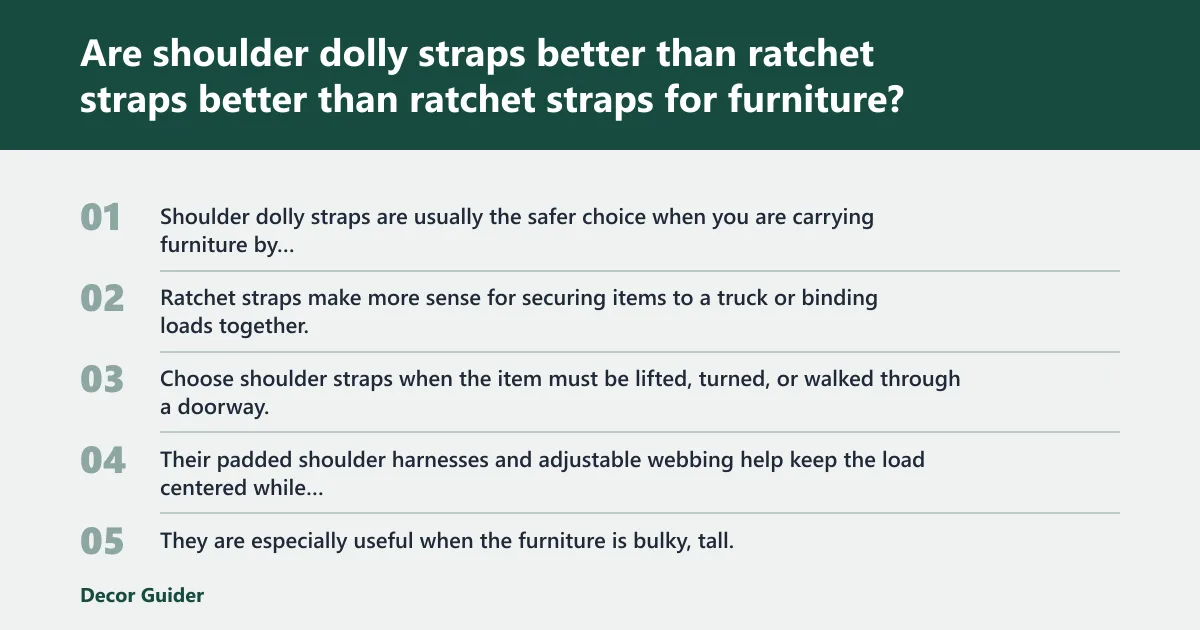
Shoulder dolly straps are usually the safer choice when you are carrying furniture by hand, because the harness and webbing are designed to distribute weight across two movers. Ratchet straps make more sense for securing items to a truck or binding loads together, not for balancing a live carry on stairs.
When shoulder straps are the safer choice
Choose shoulder straps when the item must be lifted, turned, or walked through a doorway. Their padded shoulder harnesses and adjustable webbing help keep the load centered while both movers coordinate each step.
They are especially useful when the furniture is bulky, tall, or awkward enough that one person cannot keep a stable grip.
When ratchet straps make more sense
Ratchet straps are better for tie-down work. They hold cargo tight, but they do not solve the problem of carrying weight on your body while moving through stairs or tight corners.
If the item is already on a truck or dolly and needs to stay put, ratchet straps may be the correct tool. If it still needs to be lifted, shoulder straps usually fit the job better.
Why load path matters more than price
The important question is where the weight travels. A strap that keeps the load line close to the movers’ legs and core is generally safer than a cheaper strap that shifts the force into the arms, shoulders, or lower back.
That is why the shape of the item matters as much as the price tag. A good strap for a sofa may be the wrong tool for a flat cabinet panel, and vice versa.
Can moving straps help carry furniture up stairs?
Yes, moving straps can help carry furniture up stairs when the stair width, landing size, and furniture shape all allow a controlled two-person lift. They are often better than a dolly on stairs because they let you keep the item closer to your body and adjust more easily through turns.
Stair clearance rules
Before the lift, measure stair width, landing depth, and the furniture’s longest edge. The item should fit the turn path with enough room to rotate without scraping the rail or ceiling.
If the stairwell forces a sharp pivot, straps can still help, but only if the movers can keep the load balanced and step together.
What can go wrong on turns and landings
The most common failure cases are center-of-gravity shifts, narrow stair turns, and slick flooring at the top or bottom of the stairs. A sofa can swing wide on a landing, while a dresser can tip backward if one mover steps higher too early.
That is why route planning matters. A strap does not remove the need to check corners, turn radius, and foot traction before the carry starts.
Two-person lifting technique
Keep a straight back and straight arms. Lift with your legs. Move at the same pace, count steps if needed, and pause before the turn so neither mover gets pulled off balance.
That coordination is part of the tool. Straps work best when both people keep tension even and communicate before each stair and landing change.
How do moving straps work for furniture?
Moving straps work by shifting some of the load to the movers’ core muscles and leg strength instead of concentrating it in the hands and lower back. The adjustable strap wraps around the object, and the padded shoulder harnesses help two people share the weight more evenly.
What the strap path is doing
The long webbing strap creates a load path between the movers and the furniture. When that path is centered correctly, the item feels more stable and less likely to twist as you walk.
If the strap is routed poorly, the load can swing or tip. That is why fit and routing matter more than simple comfort language.
Why shape changes the result
A boxy dresser behaves differently from a mattress or sectional. Flat surfaces are easier to balance, while rounded arms, loose cushions, or top-heavy frames can shift weight away from the intended center.
That means the same strap can work well on one item and badly on another. Load path matters more than the product name on the package.
What size moving strap do I need for furniture?
Choose a moving strap long enough to wrap the item with enough spare length for tension control, but not so long that the webbing becomes slack during the carry. The right size depends on furniture width, height, and how much room you need for routing around corners and stair rails.
Measure before you buy
Measure the furniture’s widest face, deepest face, and tallest point. Then measure the narrowest doorway, hallway, and stair landing on the route. The strap has to fit the item and the path at the same time.
- Measure the item at its widest and tallest points.
- Measure every doorway and stair landing on the route.
- Check whether the strap can wrap without crossing sharp edges.
- Confirm the harness can sit flat on both movers’ shoulders.
- Test the routing with the item stationary before lifting.
Fit guidance for different movers
Height differences between movers matter. If one person is much taller, the strap may tilt the load and force extra work from the shorter mover unless the webbing is adjusted before the lift.
Shoulder comfort matters too. A padded harness helps, but only if it sits in the right place and does not ride into the neck or slip toward the outer arm.
How much weight can furniture moving straps handle?
Furniture moving straps should be chosen by manufacturer-rated limit, and that limit must match both the item weight and the item shape. A higher rating is not useful if the furniture is awkward, top-heavy, or hard to keep centered during a turn.
What the rating does and does not tell you
The rating tells you the maximum supported load under the maker’s stated conditions. It does not tell you that any object of that weight will behave well in stairs, doorways, or narrow hallways.
A wide sofa and a compact cabinet of the same weight can feel very different because their load paths are different. Balance matters as much as raw weight.
Why shape changes the safe limit
Long items create more leverage. Tall items shift the center of gravity higher. Soft items compress and move while you carry them. Each of those changes can make a strap feel overloaded before the printed number is reached.
For that reason, the practical limit is often lower than the label once the route gets tight or the floor gets slick.
What furniture is too awkward or heavy for moving straps?
Furniture is too awkward for straps when it cannot stay balanced through the move, even with two people. Very top-heavy pieces, badly balanced sectionals, and items with shifting internal weight can move unpredictably and should be treated with caution.
Warning signs that straps are the wrong tool
If the item rocks when tilted, catches on the floor, or keeps forcing one mover to take most of the load, straps may be the wrong choice. The same is true when drawers slide open, doors swing, or the item twists on its own axis.
Those are signs that the load path is unstable. A dolly, sliders, disassembly, or professional help may be safer.
Common awkward cases
Sectionals with uneven weight distribution, armoires with high centers of gravity, and mattress bases that flex in the middle all deserve extra caution. They can look manageable on paper and still fail during a turn or stair landing.
If the route includes slick flooring, the risk rises again because the movers have less ability to correct a sudden lean.
How do you use moving straps without injuring your back?
Use moving straps without injuring your back by keeping the load close, maintaining a straight back and straight arms, and lifting with your legs rather than bending and twisting at the waist. Two-person coordination matters, because uneven steps and sudden turns can create the injury risk the strap is meant to reduce.
Pre-move checklist
Before lifting, confirm the item’s weight, shape, and widest dimensions. Then measure the route, including door clearances, stair width, landing turns, and any floor that may be slick or uneven.
Check the strap routing too. The webbing should wrap securely, the harness should sit flat, and both movers should agree on who leads through the doorway or stair turn.
Safe carry habits
Keep the item at a height both movers can control. Take short steps. Stop before any turn that forces the load to swing out. If either person loses footing or grip, set the piece down and reset.
The strap is a tool for control, not a way to skip planning. The best result comes from matching the tool to the furniture shape and the route, then moving slowly enough to stay balanced.
Frequently asked questions
What are the best moving straps for carrying furniture?
The best moving straps for carrying furniture are adjustable shoulder or forearm systems that match the item’s shape and weight rating. For bulky pieces, shoulder-style straps often work better because the load stays closer to the body and is easier for two movers to coordinate through stairs and doorways.
How do moving straps work for furniture?
Moving straps work by wrapping around the furniture and creating a shared lifting path between two people. The system shifts some of the effort to the core and legs, which can cut pressure on the arms and back when the strap is routed correctly and the movers stay in sync.
Are shoulder dolly straps better than ratchet straps for moving furniture?
Yes, for carrying furniture by hand, shoulder dolly straps are usually better than ratchet straps because they are built for live lifting, not tie-down work. Ratchet straps are more useful for securing cargo in a truck or on a dolly than for balancing a sofa on stairs.
What size moving strap do I need for furniture?
Choose a strap long enough to wrap the furniture and still leave room for tension control. The right size depends on width, height, and route clearance, so measure the piece and the narrowest doorway or stair turn before you buy.
Can moving straps help carry furniture up stairs?
Yes, moving straps can help on stairs if the furniture fits the stairwell and the movers can keep the load centered. They are most useful when the item must be carried, not rolled, and when the stair turns are wide enough for controlled repositioning.
How much weight can furniture moving straps handle?
Furniture moving straps should be used only within the manufacturer-rated limit, but the item’s shape matters as much as the number. A top-heavy dresser or long sectional can be harder to control than a shorter item of the same weight, especially on turns and landings.
Products related to this article
Sponsored / affiliate links. As an Amazon Associate I earn from qualifying purchases. I may earn additional commission from eligible campaigns.