Best Cargo Tie Downs for Home Moving (2026): We Compared
Best cargo tie downs for home moving depend on the load: ratchet straps are commonly used for appliances and heavy furniture, cam buckle straps for mattresses and boxes, and a common rule of thumb is to choose a working load limit of at least about 1.5 times the load weight. Wrong straps can crush furniture, shift loads, and cause damage or road hazards. This guide compares strap styles, anchor points, and load ratings for trucks, trailers, roof racks, and vans.
This guide is part of our Ratchet straps and tie downs guide series.
Quick comparison
| Product | Badge | Best for | Price | ||
|---|---|---|---|---|---|
 |
Jack Boss 1500 lbs Break Strength Ratchet Tie Down StrapsJack Boss | Our pick | 1" x 15′ · 1500 lbs break strength · Ratchet straps | $29.99
Price as of 17 Oct 2026
|
View |
 |
10 Pack Lashing Straps 16ft x 1" Tie Down Straps Cam BuckleLISHINE | Budget pick | 16ft x 1" · 600 lbs load strength · Cam buckle straps | $18.59
Price as of 17 Oct 2026
|
View |
Use this comparison to match the strap to the item before you shop. The right choice changes with furniture shape, surface finish, and how far the strap must reach to an anchor point.
For home moves, the biggest mistake is buying by break strength alone. WLL is the number to respect, because it is the usable rating for securement.
How we chose
These picks and rules focus on five things: working load limit, strap length, hook style, surface protection, and how much tightening control you need. That mix matters more for home moving than a generic cargo label.
We also separated break strength from WLL, because those numbers are not interchangeable. Break strength is the manufacturer maximum. WLL is the safety rating that should guide everyday use.
Finally, the recommendations account for common furniture and appliance shapes. A dresser, sofa, mattress, washer, and box stack each call for different routing and contact protection.
Home moving tie-down selector table
| Item | Recommended strap type | Minimum usable length | Hook style | Caution note |
|---|---|---|---|---|
| Dresser or tall case furniture | Ratchet strap for the main securement; soft loop where the strap touches legs or rails | 10 to 12 ft | Coated S hook or soft loop to anchor point | Keep the strap above drawer pulls. Do not cinch so hard that case panels bow or drawers bind. |
| Sofa or upholstered seating | Cam buckle strap for lighter sofas; ratchet strap only if the frame and anchor path need more tension control | 12 to 16 ft | Soft loop plus coated hook | Route over the base frame when possible. Avoid compressing armrests, cushions, or visible upholstery seams. |
| Mattress and box spring | Cam buckle strap | 12 to 16 ft | Soft loop preferred; coated S hook if the anchor point is smooth and secure | Do not fold or over-compress the mattress. Keep straps flat so they do not crease the surface. |
| Washer or other appliance | Ratchet strap for firm control, with soft loops if the strap must pass around corners or handles | 10 to 12 ft | Coated S hook or soft loop | Keep the machine upright unless the manufacturer allows another position. Avoid bearing on hoses, doors, or control panels. |
| Stacked boxes and bins | Cam buckle strap for light stacks; ratchet strap if the stack is tall, dense, or likely to shift | 8 to 12 ft | Coated hook for hard anchor points | Use a flat strap path across the stack. Do not crush carton edges, which can collapse the pile and loosen the load. |
Ratchet straps: best for heavier loads
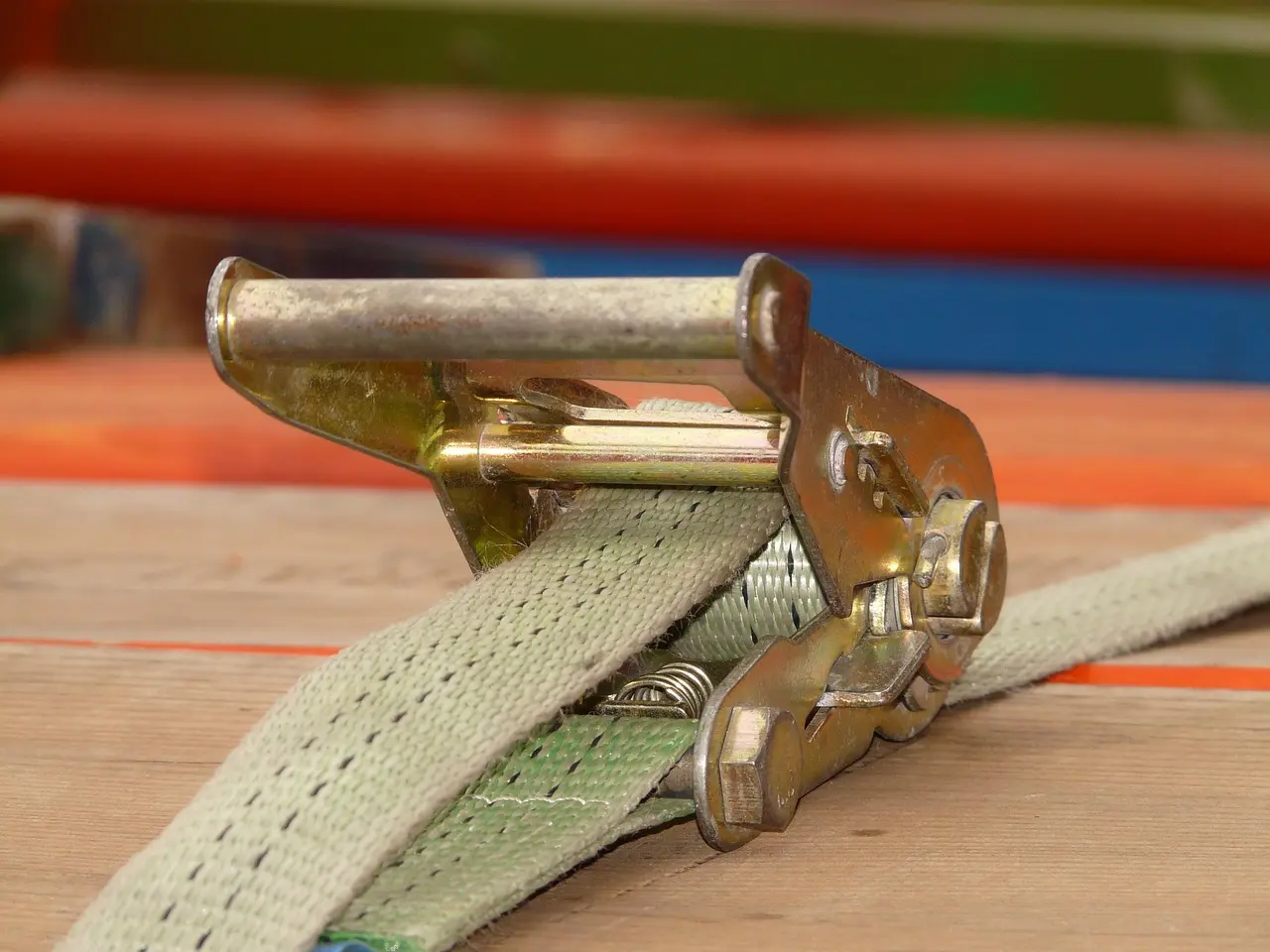
Ratchet straps give you higher tension control, so they are the better choice for heavier furniture and appliances that need firm restraint. The ratchet handle lets you tighten in small steps, which helps when the load must stay upright and tightly braced against a truck bed or trailer wall.
That control has a downside: ratchets can over-tighten fragile furniture, compress padding, or stress corners if you keep cranking after the load is already secure. Choose ratchet straps when the item is dense, tall, or likely to shift under braking.
Padded handles and controlled tightening
Padded handles make long tightening sessions easier on your hand and give you a steadier grip while you bring the strap up to tension. That matters when you need repeatable control around a refrigerator, dresser, or stacked appliance cart.
For home moving, the point is not maximum force. It is controlled force. Stop tightening once the item is stable, the strap is flat, and the contact points are not being crushed.
Release cautions and over-tightening risks
Ratchet straps require careful release. The handle can snap back if the load is still under tension, so keep fingers clear of the moving parts and release pressure slowly. If the strap is biting into wood veneer, soft upholstery, or cabinet edges, back off and reroute it.
A common failure case is over-tightening a dresser top or appliance corner. Another is forcing the strap across drawer faces, where pressure can jam slides or leave marks.
For the product data supplied here, Jack Boss is listed as offering a 1 inch by 15 foot ratchet strap set with coated S hooks and about 1,500 pounds of break strength. That break strength is not the same as WLL, so use it as a comparison point only, not as the number you should load to.
Jack Boss ratchet straps: best for heavier furniture and appliances
This set fits moving jobs where you need a firmer hold on a dresser, appliance, or bulky furniture piece. The 1 inch by 15 foot format gives you useful reach for truck beds and many trailers, while the coated S hooks help reduce scratch risk at the anchor point.
The main strength is the ratchet mechanism. It gives controlled tension, which is useful when a load needs to be pulled down without slipping. The drawback is the same feature that makes it strong: it can over-compress delicate surfaces if you keep tightening after the item is already stable.
Based on the published details, the break strength is 1,500 pounds. For home moving, the missing detail is WLL, so buyers should verify the usable rating before using it on heavier furniture or appliance transport.
Cam buckle straps: best for lighter furniture
Cam buckle straps are the safer default for lighter loads because they tighten by hand and are less likely to crush surfaces. They work well for mattresses, box springs, upholstered pieces, and stacks of boxes that need restraint more than hard compression.
These straps are also faster to adjust. If the load only needs to stop sliding, a cam buckle often gives enough hold with less risk of over-tightening. That makes it a better match for delicate finishes and soft goods.
Why hand-tightened control matters
A cam buckle lets you pull the strap snug and lock it without the extra mechanical advantage of a ratchet. That smaller tightening range helps protect softer furniture finishes, painted trim, and compressed foam.
It also makes inspection easier. If the strap starts to loosen, you can reset it quickly without fighting a ratchet release.
Limits for appliances and dense loads
Cam buckles are not the best choice for every moving job. For a heavy appliance or a tall, dense stack, hand tension may not be enough to hold the load against repeated bumps or braking forces.
Use them for lighter furniture and household items, then move to ratchet straps when the item is heavy enough that a loose strap would allow shifting.
For the supplied product data, LISHINE is listed as offering 16 foot by 1 inch cam buckle straps with about 600 pounds of load strength. That makes them a better fit for lighter moving tasks where control and surface care matter more than brute tension.
LISHINE cam buckle straps: best for lighter furniture and boxes
This set suits mattresses, box springs, sofas with softer frames, and stacked household boxes. The 16 foot length gives flexibility for wider loads and longer anchor routes, and the cam buckle layout is better when you want simple hand-tightened securement.
The strongest point is the lower risk of over-tightening. That helps with delicate surfaces and mixed household loads. The drawback is capacity: a cam buckle strap should not be treated like a ratchet strap for dense appliances or loads that need higher tension control.
Based on the published details, the load strength is 600 pounds. Buyers should still check the WLL, because break or load strength is not the same as the usable securement rating.
Soft loops and hooks: best for protecting surfaces
Soft loops are useful whenever the strap would otherwise rub directly on furniture legs, rails, frames, or appliance edges. They create a protected attachment point, which lowers abrasion risk and helps keep the strap from biting into finished wood or painted surfaces.
Hooks matter too. S hooks are common on cargo straps, and coated versions can reduce scratching where the hook meets a truck bed rail, trailer D-ring, or other anchor point. The key is that the anchor must be solid and the hook must sit fully engaged.
Soft loops around legs, rails, and frames
Use a soft loop around a sturdy furniture leg or frame rail, then connect the strap to the loop instead of the furniture itself. That is the cleanest way to avoid scuffing on chairs, tables, dressers, and some sofa frames.
Keep the loop on a structural piece. Do not wrap it around a loose panel, a removable back, or a decorative trim part that can shift under tension.
S hooks and coated hooks on secure anchors
Hook style should match the anchor point. A coated S hook can work well on truck bed tie-down points or trailer hardware if the fit is secure and the hook cannot bounce free. Plain metal hooks are more likely to mark paint or powder coat.
Do not clip a hook to a weak edge, a bent rail, or a point that can deform. If the anchor point moves, the whole securement system loses reliability.
Scratch risks at contact points
Most damage happens where the strap touches the load. Sharp corners can act like a cutting edge, and a strap that shifts during transit can leave polished rub marks or worse. Padding or a soft loop at the contact point is the simplest fix.
If the surface is already delicate, move the strap route, not the furniture finish. A better path beats more tension.
How do I use heavy duty tie downs for home moving?
Use heavy duty tie downs by matching the strap to the item, then routing it to a solid anchor point and tightening only until the load stops shifting. For home moving, that means a ratchet strap for heavier furniture or appliances, a cam buckle for lighter items, and WLL that exceeds expected load stress.
- Place the item against a flat, stable surface in the truck bed, trailer, or van.
- Choose a strap length that reaches the anchor point without running out of usable tail.
- Put soft loops on legs or rails when the strap would touch finished furniture.
- Route the strap across the strongest part of the item, not across drawers, doors, or knobs.
- Tighten until the item cannot slide, then stop before surfaces start to deform.
- Check the hook engagement and the strap path again after a short drive.
Say your dresser is in a pickup bed and the strap is crossing the top drawer. That route can jam the drawer and pull the face out of alignment. Move the strap lower, around the frame or through a soft loop, and keep the pressure off the drawer fronts.
Suppose a washer sits upright near the front wall of a trailer but the strap only touches one corner. That point load can scuff the cabinet and still allow side movement. A second strap or a better anchor path usually solves the problem.
What size strap should you buy?
Buy strap length based on the route, not the item alone. A short local move in a pickup bed may need only 10 to 12 feet, while a wider furniture load or trailer run often needs 12 to 16 feet so the strap can reach a proper anchor point without being stretched awkwardly.
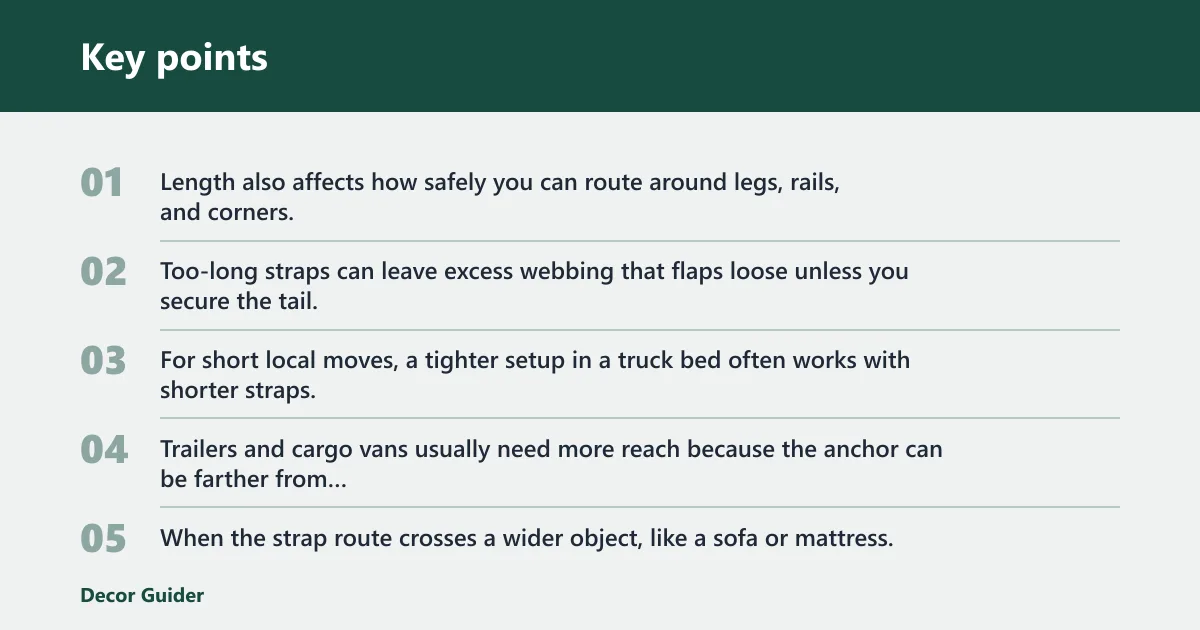
Length also affects how safely you can route around legs, rails, and corners. Too-short straps force bad angles. Too-long straps can leave excess webbing that flaps loose unless you secure the tail.
Short local moves versus longer trailer runs
For short local moves, a tighter setup in a truck bed often works with shorter straps, especially when the anchor points sit close to the load. Trailers and cargo vans usually need more reach because the anchor can be farther from the furniture footprint.
When the strap route crosses a wider object, like a sofa or mattress, step up the length so the hook and buckle do not sit in a stressed or awkward position.
Common 10 to 16 foot strap lengths
Common ratchet strap lengths for home moving are 10 to 16 feet. That range covers most furniture moves without forcing you into custom equipment. The 10 foot end works for compact truck bed securement, while 15 to 16 feet gives more routing room for larger loads.
If a strap barely reaches, do not force the hook to an unsafe point. A longer strap is cheaper than a damaged item.
When you need more than one strap per item
One strap can stop sliding, but many items need two points of restraint to stop rotation or tipping. Tall dressers, sofa frames, and appliance loads often need more than one strap so the item cannot pivot during braking or turns.
A practical rule is to use enough straps that the load cannot move in more than one direction. If one strap only controls side-to-side motion, add another to control forward motion or tipping.
How much working load do I need for moving appliances?
Use a WLL that is at least 1.5 times the expected load stress, then make sure the securement setup covers the appliance shape and anchor path. For appliances, that means respecting the rating, using more than one strap when needed, and avoiding pressure on doors, controls, and hoses.
WLL should be the buying standard. Break strength tells you the manufacturer maximum, but it is not the number to build around for daily use. If the appliance is heavy or awkward, spread the load across multiple straps and anchor points instead of relying on one strap alone.
What are the best tie down anchor points for a moving truck?
The best anchor points are the ones built for securement: truck bed tie-down points, trailer D-rings, floor anchors, and other reinforced tie locations. They should match the strap path, sit low and stable, and allow the strap to pull the load into place without a sharp bend.
In a pickup truck bed, use the built-in tie-downs if they are strong and positioned to hold the item from moving forward, backward, and sideways. In a trailer, floor anchors or D-rings are usually better because they offer more consistent routing for furniture and appliance loads.
A truck-bed anchor product in the source set is rated above 3,300 pounds break strength, with a working load limit of 1,071 pounds. Those numbers show why anchor hardware matters, but they do not replace the strap rating. The anchor, strap, and hook all need to work together.
Can tie downs be used in a pickup truck bed for moving?
Yes. A pickup truck bed is one of the most common places to use tie downs for home moving, as long as the anchors are secure and the strap path suits the load. The bed rails, factory tie-down points, and any rated anchor hardware all need to match the item’s size and weight.
In a pickup bed, shorter straps often work best for compact furniture, but larger pieces may need 12 to 16 feet to clear the bed width and still reach a solid anchor point. Always check that the hook sits fully engaged and that the strap does not rub a sharp edge.
The same truck-bed guide lists one strap option with a 1,209 pounds break strength and another with 1,823 pounds break strength. Those figures are useful for comparing products, but WLL remains the number that matters for actual securement decisions.
Which one should you buy?
Buy the ratchet strap if you are moving heavy furniture or appliances and need controlled tension. Buy the cam buckle strap if your load is lighter, delicate, or likely to be damaged by over-tightening. Use soft loops if the strap will contact finished surfaces.
If you are moving a mattress, box spring, or stacked boxes, the LISHINE cam buckle set is the cleaner fit because it is longer and gentler. If you are securing a dresser, washer, or another dense item, the Jack Boss ratchet set gives more tension control, but you need to watch release and over-compression.
If surface protection matters more than maximum tension, prioritize soft loops and coated hooks before chasing a higher rating. If your vehicle has limited anchor points, choose a strap length that lets you reach the existing hardware without a strained angle.
Frequently asked questions
How do I use tie downs without damaging furniture?
Use soft loops on legs or rails, keep straps off drawer fronts and door edges, and stop tightening once the item is stable. A strap should restrain the load, not crush it. If the webbing is biting into veneer, upholstery, or painted surfaces, reroute the strap and reduce tension.
What size cargo tie downs do I need for moving furniture?
Most furniture moves are covered by 10 to 16 foot straps, with shorter lengths fitting compact truck beds and longer lengths helping with sofas, mattresses, and wider trailer runs. Size the strap for the route, not just the item width, and leave enough room for a secure hook engagement.
Are ratchet straps or cam buckle straps better for moving?
Ratchet straps are better for heavier furniture and appliances because they allow firmer tension control. Cam buckle straps are better for lighter furniture, mattresses, and boxes because they are faster to set and less likely to over-tighten delicate surfaces. The item type should decide the strap type.
Products related to this article
Sponsored / affiliate links. As an Amazon Associate I earn from qualifying purchases. I may earn additional commission from eligible campaigns.
 Oykomuc Twin Box Spring Bed Base, 5 Inch Low Profile, 1500 LBS Heavy Duty Metal Mattress Foundation with Fabric Cover, Easy Assembly, Quiet Noise Free, Non Slip
 MouZie Heavy Duty Furniture Lifter & Moving Kit – Lift & Glide Couches, Beds, Appliances with Ease – 4 Roller Sliders (660 lbs Each), Adjustable Height Lifter, Carpet Adapters for All Floors