5 Best Heavy Duty Tarps for Patio Furniture (2026): based on specs
The best heavy-duty tarp for patio furniture is a reinforced polyethylene cover with UV resistance, tight grommet spacing, and enough overlap to tie down without stretching. That mix handles rain, wind, and seasonal storage better than bargain tarps, while still fitting over cushions and mixed-material sets without holding as much water.
This guide is part of our Ratchet straps and tie downs guide series.
Quick picks
- Best all-around wet-weather pick: SpacEver 10×12 ft 16 mil reversible tarp for smaller sets, stacked chairs, or a single sofa.
- Best value for a medium patio set: GUARD SHIELD 12×16 ft 10 mil poly tarp for frequent rain and better heat reflection.
- Best square fit for compact coverage: KING-A-MA-JIGS 10×10 ft 10 mil tarp for a chair stack, side table, or small bench.
- Best large coverage for winter storage: RUGGED RHINO 16×20 silver tarp for sectional groupings, multiple pieces, or long-term yard storage.
- Best breathable choice for cushions and wood: MERUYOO 6×8 canvas tarp for short covers where ventilation matters more than full rain shedding.
Quick comparison
| Product | Badge | Best for | Price | ||
|---|---|---|---|---|---|
 |
SpacEver 10×12 FT Tarp Waterproof, 16 Mil Tarps Heavy DutySpacEver | Our pick | 10×12 ft · 16 mil · Reversible | $26.99
Price as of 9 Oct 2026
|
View |
 |
GUARD SHIELD Heavy Duty Tarp 12×16 Feet Silver/Black MultiGUARD SHIELD | Upgrade pick | 12×16 ft · 10 mil · Silver/Black | $32.99
Price as of 9 Oct 2026
|
View |
 |
10×10 Tarps Heavy Duty Waterproof – Durable 10 Mil ThickKING-A-MA-JIGS | Budget pick | 10×10 ft · 10 mil · Square | $17.99
Price as of 9 Oct 2026
|
View |
 |
RUGGED RHINO Heavy Duty Waterproof Tarp 2 Pack, 16×20 SilverRUGGED RHINO | Also great | 2 Pack · 16×20 ft · 10mm | $57.95
Price as of 9 Oct 2026
|
View |
 |
Canvas Tarp 6×8, 350 GSM (12oz) Heavy Duty Canvas Tarps,MERUYOO | Pair with it | 6×8 ft · 350 GSM · Canvas | $20.39
Price as of 9 Oct 2026
|
View |
Use light-duty coverage for a short rain break, but move up to reinforced poly, canvas, or vinyl when the tarp stays outside for days or through winter. For cushions and wood, fit and airflow matter as much as waterproofing, because an oversized cover can trap condensation against fabric and finishes.
How we chose
We prioritized water shedding, reinforced edges, and tie-down compatibility over broad marketing claims. Also check practical mil ranges and weight class, because extra thickness helps in wind and abrasion, but can make a tarp harder to drape tightly over cushions, stacked chairs, and umbrella bases.
We favored options with UV resistance for outdoor storage, since sun breaks down low-grade poly faster than many buyers expect. Finally, we looked for grommet spacing, corner reinforcement, and seam construction that work with straps, bungee cords, clips, and anchor points.
What size tarp do you need for patio furniture?
Measure the full outer dimensions of the furniture, then add some extra allowance on each side for overlap, tie-downs, and edge drop. That extra margin helps the tarp reach anchor points without stretching and leaves enough material to resist wind lift around the lower edges.
Fit by furniture type
A single sofa usually needs a tarp that covers the seat, back, and arms with room to secure the corners below the frame. A dining set often needs a larger rectangle than the tabletop alone, because the chairs and table legs create gaps that can catch wind.
For stacked chairs, umbrella bases, or mixed sets, oversized coverage can work if you can still tension the edges. If the tarp hangs too loosely, water pools in the middle, and the extra slack rubs against armrests, rails, and table edges.
When oversized coverage helps
An oversized tarp makes sense for winter storage, irregular shapes, and sets that may shift slightly while covered. A custom-fit or closer-fit strategy works better for cushions and wood furniture, because you reduce pockets where condensation can sit overnight.
Best heavy duty tarps for patio furniture
The strongest all-around choice is a heavy-duty polyethylene tarp with reinforced corners, UV resistance, and grommets that line up with straps or clips. That blend gives you water resistance for rain, enough toughness for wind, and a fit that is easier to tension than thicker, stiffer covers.
Why this type leads for most patios
Poly tarp is a common option for wet weather because it sheds rain well and is often found in thicker mil ranges. In that range, you get a useful tradeoff: thicker fabric resists abrasion and tearing, while lighter poly drapes better over cushions and chair backs.
The main drawback is that cheap poly can age quickly in full sun and can flap loudly if it is not secured at enough points. On sharp metal corners, low-grade poly can also wear faster than canvas or vinyl.
Best poly tarp: best for wet weather
- High-density 16×16 weave for superior durability
- Reversible design offers two distinct weather-facing surfaces
- Reinforced corners with internal ropes prevent tearing
SpacEver 10×12 ft 16 mil tarp suits smaller patio groupings where you want a tougher poly sheet for rain, splash, and short outdoor storage. The 16 mil thickness and 16×16 weave give it more body than thin utility covers, and the reversible sides add flexibility for changing exposure.
It stands out for reinforced corners with internal ropes, which help reduce tearing where tension concentrates around tie points. That matters on patio furniture, where a tarp often pulls hardest at the corners over arms, table edges, or stacked chair legs.
The drawback is fit. A 10×12 tarp can be too small for a full dining set, and a thicker sheet can be harder to tuck tightly around irregular furniture without leaving slack that catches wind.
Best canvas or vinyl tarp: best for long storage
- Breathable canvas weave reduces mildew on cushions
- Tight stitching resists tearing when stretched
- Rustproof metal grommets suit garden applications
MERUYOO 6×8 canvas tarp is the better call when airflow matters more than absolute rain shedding, especially for cushions, wood slats, or a smaller piece that you want to keep covered without sealing in damp air. A 350 GSM, 12 oz canvas tarp is generally more breathable than typical poly.
That breathability can help reduce mildew risk on cushions and painted wood during shorter cover periods or under a porch. Rustproof metal grommets also make it easier to tie off with cords or clips.
The tradeoff is plain: canvas is not the first choice for prolonged, exposed rain or snow. It also needs more care in wet conditions, since a breathable cover does not shed standing water as aggressively as poly or vinyl.
What is the best heavy duty tarp for outdoor furniture?
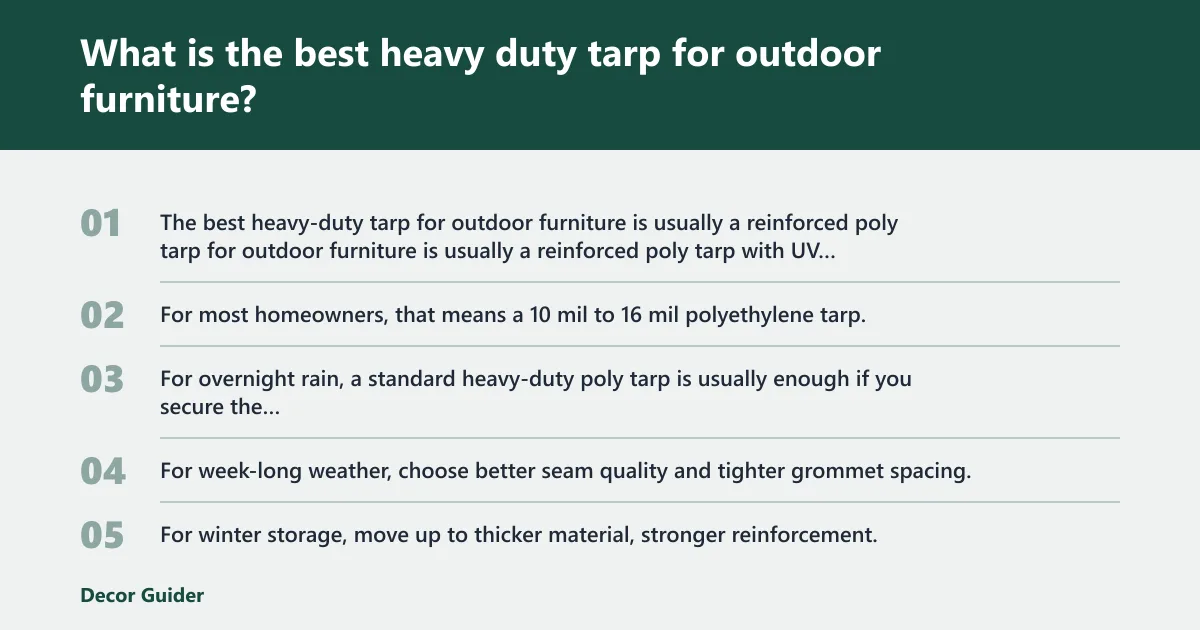
The best heavy-duty tarp for outdoor furniture is usually a reinforced poly tarp with UV resistance, strong corners, and grommets spaced often enough to keep the cover from lifting. For most homeowners, that means a 10 mil to 16 mil polyethylene tarp, sized so it can be tied below the furniture line.
Match the tarp to the storage period
For overnight rain, a standard heavy-duty poly tarp is usually enough if you secure the edges. For week-long weather, choose better seam quality and tighter grommet spacing. For winter storage, move up to thicker material, stronger reinforcement, and a fit that limits pooling and wind abrasion.
Material matters by furniture type
Wicker and cushions benefit from a cover that blocks rain but still allows some air movement. Metal frames need abrasion resistance at contact points. Wood needs protection from both water and trapped moisture, because repeated wet-dry cycles can stress finishes.
Best waterproof poly tarp: best for rain and short-term storage

- Heat-sealed seams and rope-in-hem construction
- Rustproof aluminum grommets every 3 feet
- Reflective silver coating resists solar heat buildup
GUARD SHIELD 12×16 ft 10 mil tarp is a strong pick for wet weather because it balances size, water shedding, and easier handling than a much thicker sheet. Heat-sealed seams and rope-in-hem construction help it handle rain better than generic bargain tarps.
Aluminum grommets spaced at regular intervals can make tie-downs more flexible, and a reflective silver coating may help limit heat buildup in the sun. That is useful for furniture left in an open patio area where midday sun can cook the air under the cover.
The drawback is that 10 mil is still a middleweight option, so it is less forgiving than 16 mil material in hard wind or around sharp metal edges. It also needs careful fitting, since an oversized 12×16 tarp can pool water if the center is not supported.
What tarp thickness is best for outdoor furniture protection?
For most patio furniture, 10 mil to 16 mil is the practical outdoor range, with 12 mil often landing in the middle for balance. Thicker tarps usually last longer and resist tears better, but they can be stiffer, harder to fold, and less able to contour around arms, cushions, and stacked pieces.
How to think about mil rating
A mil is one-thousandth of an inch. Higher mil numbers usually mean more material and more abrasion resistance, though construction quality matters just as much as thickness. A well-made 10 mil tarp can outperform a flimsy thicker one if the corners, hems, and grommets are better built.
Durability versus flexibility
If you need frequent setup and removal, a lighter heavy-duty tarp may be easier to work with. If the cover stays out through wind and snow, the extra stiffness of a thicker tarp can help it resist rubbing and tearing, even if it takes more effort to secure cleanly.
How do you keep a tarp from blowing off patio furniture?
You keep a tarp from blowing off by using enough anchor points, tight corner tension, and a tie-down method that matches the furniture shape. Straps give the most control, bungee cords add stretch for gusts, and clips are useful for quick attachment to reinforced edges.
Use the right hardware
Straps work best when you can run them under a table base, around chair legs, or to fixed patio anchors. Bungees are helpful when the load may shift slightly, but they can allow more movement. Tarp clips are useful where grommets do not line up with the furniture layout.
Loose edges fail first in wind. That is why corner reinforcement and grommet spacing matter: the force should spread across the hem, not concentrate on one weak point. Keep the tarp from rubbing against sharp metal tubes, table corners, and chair arms, since abrasion often starts there.
Common mistake to avoid
Picture a 12×16 tarp thrown over a four-chair set with no lower tie points. The center stays put for a while, but the sides flap, catch gusts, and slowly work free. Tightening the lower edge and using multiple anchors usually solves the problem before the first storm.
Best square tarp: best for compact coverage
- Heavier build than standard cheap tarps
- Capped reinforced corners extend fabric life
- Metal grommets spaced every 18 inches for secure tying
KING-A-MA-JIGS 10×10 ft 10 mil tarp fits compact setups where square coverage is easier to manage than a long rectangle. It is useful for a small loveseat, a pair of chairs with a side table, or a stack of seats that needs straightforward tie-down points.
The 18-inch grommet spacing is the key strength here. Closer spacing gives you more options for tensioning around awkward shapes, which helps when you need to keep a cover low and stable in a windy spot.
The drawback is size. A 10×10 tarp is too small for many full dining sets, and square tarps can leave awkward corners or exposed legs if the furniture footprint is long and narrow.
Best large tarp: best for winter storage
- 5mm thick material for extreme weather protection
- Two large tarps included for versatile coverage
- Aluminum grommets resist rust in humid environments
RUGGED RHINO 16×20 silver tarp is aimed at larger storage jobs where coverage area matters more than compact handling. The pair format is useful if you need one tarp for a sectional and another for a table or stacked chairs, and the aluminum grommets resist rust in humid conditions.
This type is better suited to winter storage, especially when you want to cover several pieces at once or protect furniture left on an open patio through repeated weather swings. Larger tarps reduce exposed seams between items.
The drawback is weight and handling. Large tarps can be cumbersome, and if you do not manage the center well, the extra fabric can form a pocket that collects water or sagging snow.
Are waterproof tarps better than poly tarps for patio furniture?
Waterproof tarps are not automatically better than poly tarps for patio furniture, because “waterproof” alone does not solve wind, fit, or condensation. Heavy-duty poly is usually the best starting point for rain, while canvas or vinyl can be better in specific situations where ventilation or longer wear matters more.
Water shedding versus trapped moisture
A truly waterproof tarp should shed rain, but the seams and overlap still matter. Poorly placed seams can channel water into low spots, and an oversized tarp can pool rain or meltwater in the middle. That standing moisture is what often leads to mildew on cushions and corrosion on metal frames.
When breathability helps
Canvas can be a better call for dry, covered, or partly covered storage where condensation is the bigger problem than rain. For a porch or garage opening, a breathable cover may protect fabric and wood better than a fully sealed sheet that keeps humid air trapped underneath.
Should you cover patio furniture with a tarp for winter storage?
Yes, a tarp can help for winter storage, but it has to be sized and secured correctly. In snow, humidity, and freeze-thaw cycles, the wrong cover can trap wet air, sag under load, and rub the finish. For winter, use stronger reinforcement, better tie-downs, and a fit that sheds weight.
Winter-specific risks
Snow load can stretch weak material, and thawed water can refreeze at low spots. That is why a flatter roofline, a little airflow, and enough tension to prevent pockets are more important than simply choosing the thickest sheet you can find.
Suppose a wicker sectional sits on an open patio through January. A tarp that hangs too low can seal in damp air under the cushions, while one that is too small can expose corners to ice and wind. The middle path is a slightly oversized tarp with controlled tension and a few vent points.
Best reversible tarp: best for flexible weather exposure
SpacEver 10×12 ft reversible tarp also works well when you want one cover for changing conditions. The reversible design gives you two weather-facing surfaces, which can be helpful if one side gets more sun exposure or grime over time.
It is a reasonable choice for homeowners who want a tougher poly tarp without moving all the way to a large winter-storage sheet. The internal ropes in the corners are the main durability cue for furniture use.
The drawback is still the same one that comes with a compact 10×12 size: it is best for smaller pieces, and it can become awkward over large sectionals or wide dining sets.
How long does a heavy duty tarp last outside?
A heavy-duty tarp can last for multiple seasons outside, but life span depends on sun exposure, wind, tension, and how often it gets folded and refitted. UV resistance slows breakdown, yet a tarp stored in full sun and hard wind will wear faster than one used on a covered porch.
What shortens service life
Repeated folding at the same lines can weaken the fabric over time. So can abrasion at grommets and corners, especially where the tarp rubs against metal frames or rough wood. Heat buildup under dark covers may also speed wear on lower-quality poly.
What helps it last longer
Choose reinforced edges, better grommets, and a size that does not need extreme stretching. Let wet tarps dry before storage if possible, and avoid leaving water or snow sitting in the center. Those habits matter as much as the listed material.
Can I use a utility tarp instead of a furniture cover?
Yes, you can use a utility tarp instead of a furniture cover, but only if you account for fit, ventilation, and tie-down points. A utility tarp is usually fine for short-term rain protection, while a furniture-specific cover shape may work better for cushions, odd angles, and cleaner airflow.
When a utility tarp is enough
For a quick overnight cover, a utility tarp with solid grommets and strong seams is often sufficient. It becomes less ideal when the furniture has soft cushions, painted wood, or a complex footprint that leaves excess material flapping in the wind.
When a furniture cover strategy is better
Use a more tailored approach when the set includes sectionals, umbrella bases, or stacked chairs. Those shapes create dead air spaces and snag points, so a tarp that is simply “bigger” is not always better. Better fit usually means less pooling, less rubbing, and less mildew.
Which one should you buy?
Start with heavy-duty poly if you want the lowest-cost protection for rain and short storage. Move to a larger, stronger sheet if the tarp stays outside through sun and wind, and choose breathable canvas when cushions or wood need more airflow than full waterproof sealing.
Decision rules by need
If your patio is exposed and you need quick rain protection, choose the GUARD SHIELD or SpacEver. If you are covering a large set for winter, the RUGGED RHINO gives you more area. If the furniture is compact and square, the KING-A-MA-JIGS is easier to tension.
For wicker and cushions, avoid loose oversized coverage unless you can keep the tarp well supported and ventilated. For metal frames, prioritize abrasion resistance and grommet strength. For wood, avoid trapping moisture for long periods, because a tight waterproof shell without airflow can create the very damage you are trying to prevent.
Scenario-based tarp selection table
| Furniture and weather scenario | Recommended material | Thickness / weight class | Size allowance | Tie-down method | Why this fits the job |
|---|---|---|---|---|---|
| Single sofa, overnight rain, open patio | Heavy-duty polyethylene | 10 to 12 mil | 12 to 18 inches beyond footprint | Straps or tarp clips to corner anchors | Fast water shedding and enough flexibility to contour around cushions without excess slack |
| Dining set with chairs, week-long storm watch | Reinforced polyethylene | 12 to 16 mil | 18 to 24 inches beyond footprint | Straps plus grommeted corner ties | Better wind resistance and more secure edges for a wider footprint with chair legs underneath |
| Stacked chairs and umbrella base, windy corner lot | Poly with reinforced corners | 12 to 16 mil | Moderate oversize, not excessive | Bungees for tension, plus clips on side grommets | Mixed shapes need flexible tension and frequent attachment points to reduce flapping |
| Wicker sectional, winter storage, humid climate | Canvas or ventilated poly cover strategy | Canvas 350 GSM or heavier reinforced poly | Enough for full drop, not loose drape | Straps to fixed anchors, plus vents if available | Humidity control matters as much as rain shedding, especially for cushion mildew prevention |
| Wood dining set on covered porch, seasonal storage | Canvas or breathable tarp | Midweight canvas | Closer fit with small overlap | Soft ties or straps that avoid rubbing edges | Breathability helps reduce trapped moisture on wood finishes |
| Metal frames left in full sun and rain | UV-resistant polyethylene or vinyl | 12 to 16 mil | 18 inches or more beyond frame line | Straps with corner reinforcement | Metal tolerates tighter covers, but the tarp must resist sun breakdown and wind abrasion |
How do you keep a tarp from blowing off patio furniture?
To keep a tarp from blowing off, use enough anchor points, reinforce the corners, and tension the tarp low enough that wind cannot get under it. Straps are best for firm control, bungee cords add give, and clips help when grommets do not line up cleanly with the furniture shape.
Secure the weak points first
Start at the corners, then work the long sides. If the tarp has generous grommet spacing, add more tie-downs where the wind hits hardest. On sharp frame edges, pad the contact point or reroute the strap to reduce abrasion.
A common first-timer mistake is tying only the top corners. That leaves a loose skirt below the furniture, and the skirt becomes a sail in the first strong gust. Lower ties usually do more to stabilize the cover than extra tension at the top.
What material is best for sun, rain, and snow?
For combined sun, rain, and snow exposure, reinforced UV-resistant polyethylene is usually the best starting point. Vinyl can be tougher for long wear in wet conditions, while canvas is better when airflow matters more than full water shedding. The best choice depends on whether rain, sun, or moisture control is the main threat.
Best use by material
Poly handles rain well and is easy to tension, which makes it the standard choice for most patios. Vinyl is better when you want a more durable shell for repeated exposure, though it can be heavier and less forgiving around odd shapes. Canvas helps with ventilation, but it is not the strongest match for snow or pooled water.
For mixed weather, pick the material that matches the worst condition you expect, not the average one. If winter snow is part of the plan, prioritize strength and drainage. If the furniture sits under a roof edge, you may value breathability and UV resistance more than raw waterproofing.
Do I need tarp straps or bungee cords to secure patio furniture?
Yes, you need some form of tie-down hardware, and the right choice depends on how fixed the furniture is and how much movement you can tolerate. Straps hold the most securely, bungee cords allow more flex in wind, and clips are useful for quick attachment to reinforced edges and grommets.
Choose hardware by setup
Use straps when you can anchor to legs, rails, fence posts, or patio anchors. Use bungees when the tarp needs a little motion to stay under tension through gusts. Use clips where the tarp edge needs help gripping a frame without tearing the hem.
For heavier tarps, pair the hardware with reinforced grommets and corners. That connection point matters as much as the fabric itself, because wind damage usually starts where the load concentrates.
What tarp thickness is best for outdoor furniture protection?
For outdoor furniture, 10 mil is the minimum practical heavy-duty range, 12 mil is a balanced middle choice, and 16 mil is better for harsher weather or longer storage. Thicker material lasts longer, but it becomes less flexible and can be harder to fit tightly around cushions and irregular shapes.
Pick thickness by storage plan
Use 10 mil for short-term weather cover, especially on a covered porch or for a smaller set. Use 12 mil when you want a better durability-to-handling balance. Use 16 mil when wind, abrasion, or long outdoor exposure is the main concern.
What is the best heavy duty tarp for outdoor furniture?
The best heavy-duty tarp for outdoor furniture is a reinforced, UV-resistant poly tarp with good grommet spacing and enough size allowance to secure below the furniture footprint. That setup protects against rain and wind without creating the slack that leads to pooling, mildew, and abrasion.
Best match by common use
For most homeowners, that means a 12 mil to 16 mil polyethylene tarp. If the furniture is cushioned, add enough overlap to keep the tarp from pressing tightly into the fabric. If the set is metal or exposed to hard wind, prioritize stronger corners and more tie points.
Are waterproof tarps better than poly tarps for patio furniture?
Not always. A waterproof tarp is useful only if it also fits well, sheds water, and stays secure in wind. Heavy-duty poly tarps already cover most patio furniture needs, while canvas can be better for breathability and vinyl can be better for repeated harsh exposure.
What matters more than the label
Check seam behavior, grommets, and corner reinforcement before the waterproof claim. A tarp that is technically waterproof but pools water, traps humidity, or tears at the hem will protect less effectively than a well-fitted poly tarp with better hardware.
How long does a heavy duty tarp last outside?
A heavy-duty tarp can last several seasons outside, but service life depends on sun, wind, and how often it is tensioned and refolded. UV-resistant material, reinforced edges, and careful tie-downs can slow wear, while constant flapping, pooling, and sharp-edge contact shorten it quickly.
How to make it last longer
Dry the tarp before storage if possible. Keep it out of standing water. Avoid overtightening around sharp corners. Those basic steps do more for lifespan than chasing the thickest number alone.
Can I use a utility tarp instead of a furniture cover?
Yes, but only for the right job. A utility tarp is fine for short rain protection, yet a furniture cover strategy is better when you need airflow for cushions, cleaner fit over awkward shapes, and less rubbing on wood, wicker, or painted metal.
When to choose each
Choose a utility tarp for quick cover-ups and temporary storage. Choose a more tailored, better-ventilated approach when the set stays outside through damp weather, because the cover must control both water and trapped moisture.
Frequently asked questions
What size tarp do I need for patio furniture?
Measure the full outer dimensions of the furniture, then add 12 to 24 inches on each side for overlap and tie-downs. That extra room helps the tarp secure below the frame without stretching, which reduces tearing, water pooling, and wind lift.
What is the best heavy duty tarp for outdoor furniture?
A reinforced polyethylene tarp with UV resistance and strong grommets is the best all-around choice for most outdoor furniture. It sheds rain well, handles wind better than bargain tarps, and is usually easier to fit than heavier canvas or vinyl covers.
Are waterproof tarps better than poly tarps for patio furniture?
Not necessarily. Waterproofing helps with rain, but the tarp also has to fit, breathe enough to limit condensation, and stay anchored in wind. Heavy-duty poly is often the better practical choice unless you have a specific ventilation or long-wear need.
How do I keep a tarp from blowing off patio furniture?
Use straps for the tightest control, bungee cords for flexible tension, and clips where needed for extra attachment points. Keep the tarp low, secure the corners first, and add anchor points along the sides so wind cannot catch loose edges.
Should I cover patio furniture with a tarp for winter storage?
Yes, if you choose the right material, size, and tie-downs. Winter storage needs enough coverage to shed snow and meltwater, but not so much slack that the cover pools water or traps humidity against cushions and wood.
What tarp thickness is best for outdoor furniture protection?
Most homeowners do well with 10 mil to 16 mil. Use 10 mil for lighter, shorter coverage, 12 mil for balanced durability, and 16 mil for harsher wind, more frequent handling, or longer outdoor storage.
Products related to this article
Sponsored / affiliate links. As an Amazon Associate I earn from qualifying purchases. I may earn additional commission from eligible campaigns.