
How Much Does It Cost to Ship a TV Stand? Pricing Guide
Shipping a TV stand usually costs about $40 to $150 by parcel and more by freight, with size and weight helping determine the break point. Guessing wrong can lead to oversized-package surcharges, higher packing fees, or a freight quote that wipes out the deal. This guide shows how material, dimensions, weight, and service type change the price so you can compare parcel and freight before you book.
how much does it cost to ship a tv stand
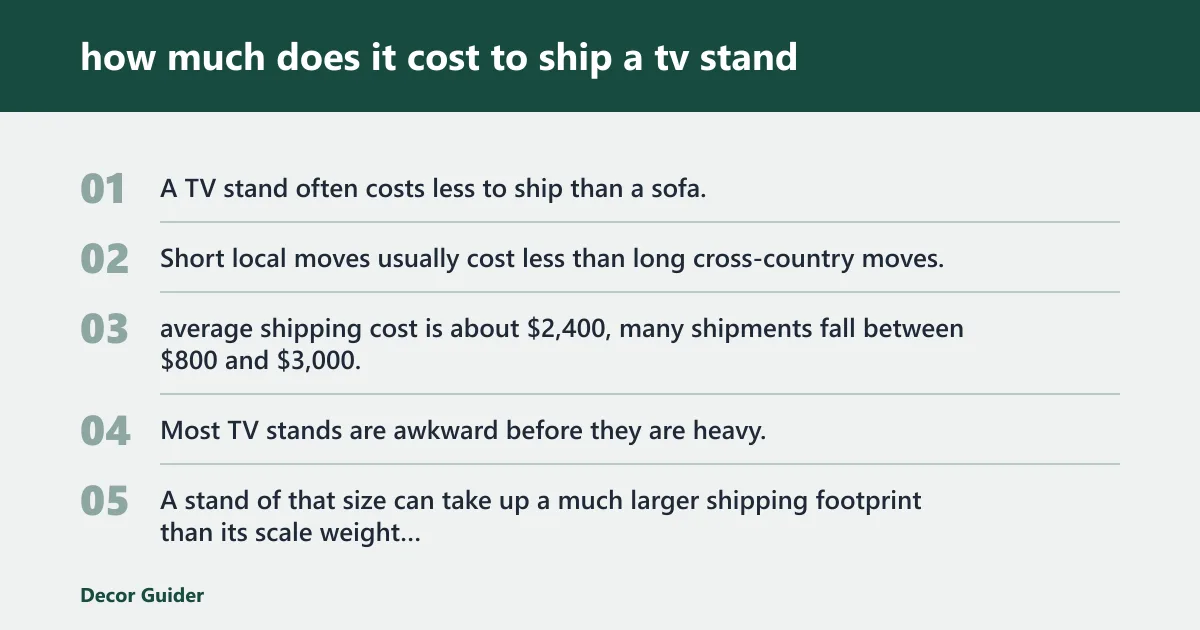
A TV stand often costs less to ship than a sofa, but more than a small boxed item because its long, flat shape can trigger dimensional pricing before it gets heavy. Short local moves usually cost less than long cross-country moves. For furniture in general, the U.S. average shipping cost is about $2,400, many shipments fall between $800 and $3,000, and single-piece cross-country moves may cost $300 to $2,000.
Why TV stands often price more by size than by weight
Most TV stands are awkward before they are heavy. A stand of that size can take up a much larger shipping footprint than its scale weight suggests, especially after padding and a box are added. That outer size can push the shipment into a higher tier even when the actual weight stays modest.
That is why package dimensions matter as much as weight for furniture shipping. Carriers also use dimensional weight, or DIM weight, for large lightweight items. They calculate it from length × width × height divided by a divisor, then bill the greater of actual weight or DIM weight.
When a quote starts to jump because of oversize handling
A quote often climbs when the packed length crosses a carrier threshold, when the box becomes bulky enough for DIM weight to exceed actual weight, or when the item needs special handling. Longer sides are especially important for TV stands because a few extra inches can move the shipment into a higher category. Oversized-package surcharges and minimum charges can add more than the base line-haul cost.
Suppose a stand is lightweight but ships in a long, rigid carton with fixed glass doors. The carrier may price it as a large parcel rather than by its true weight. That is why the box size matters before anything else.
📊 U.S. average furniture shipping cost is about $2,400. Source: Furniture Shipping Cost Calculator: 2026 Pricing Guide.
what affects the cost to ship a tv stand
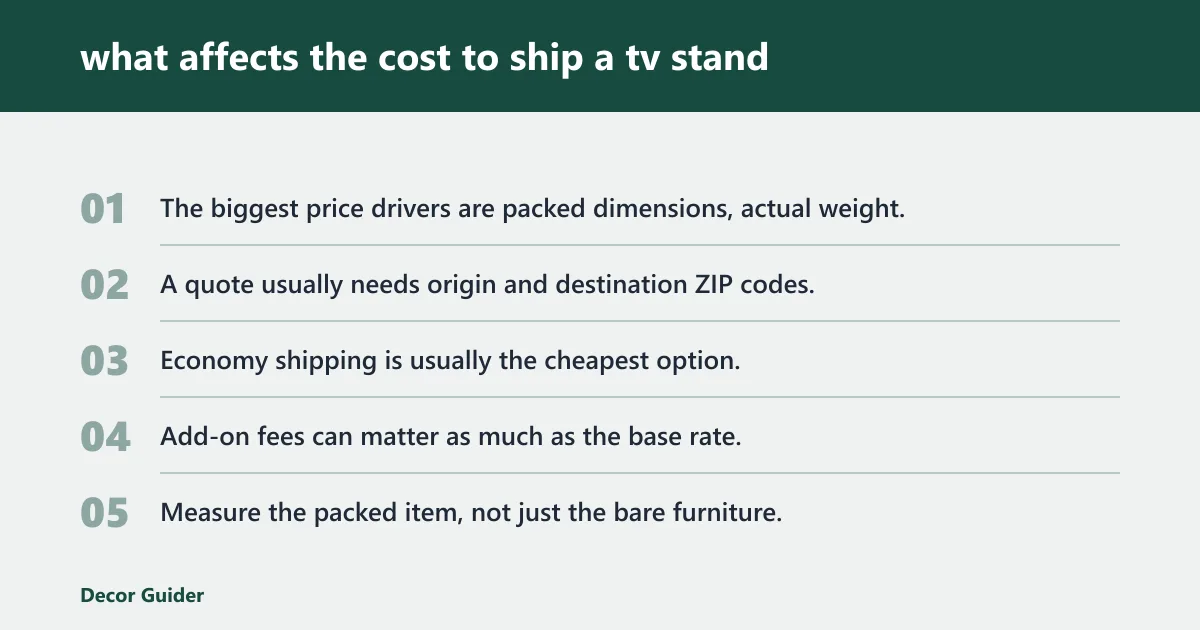
The biggest price drivers are packed dimensions, actual weight, distance between ZIP codes, material type, and service level. A quote usually needs origin and destination ZIP codes. Economy shipping is usually the cheapest option, while expedited or air shipping is much faster but can cost several times more. Add-on fees can matter as much as the base rate.
Packed dimensions and dimensional weight
Measure the packed item, not just the bare furniture. The outer carton or crate decides the billable size. Major carriers changed their divisor from 166 to 139, which increased dimensional weight by about 16%. That change makes bulky, lightweight furniture more expensive to ship than the real pounds suggest.
Actual weight and carrier rounding rules
Carriers round up dimensions and weight. A shipment weighing 50.2 pounds is billed as 51 pounds, and 48.5 inches is billed as 49 inches. That rounding sounds small, but it can affect a TV stand that sits near a pricing threshold. Rounded measurements should be treated as the starting point for any quote.
Shipping zones and distance
Short local moves usually cost less than longer moves, and coast-to-coast shipments usually cost more than regional ones. Shipping zones are based on the origin ZIP code and destination ZIP code. The farther the move travels, the more likely it is to hit a higher zone price, longer transit time, and a larger fuel or residential surcharge.
Material type, breakability, and packing needs
Material changes both risk and packaging cost. Solid wood stands are sturdier but heavier, so actual weight may rise. Engineered wood can be lighter but more prone to edge damage. Glass-door TV stands need more padding, corner protection, and careful boxing, which can increase outer dimensions and DIM weight.
A common first-timer mistake is treating all TV stands the same. A modular MDF stand with removable shelves does not need the same crate or padding as a glass-front media cabinet. Packaging should match the material, or the quote can miss both the risk and the true packed size.

how much does it cost to ship a tv
Shipping a TV is often priced differently from a TV stand because the screen is fragile, flat, and more break-prone. That usually raises packing and handling costs even when the box weighs less. A TV stand may be cheaper than a television to ship, but its length and bulky shape can still trigger oversize pricing.
Why the comparison matters
People often compare a TV stand to a TV because both are large home-electronics items. The price logic is not the same. A television tends to need more protective packing, while a stand tends to create more dimensional weight. The cheaper shipment is not always the lighter one.
how do I calculate shipping cost for a tv stand
Start with the packed dimensions, then compare actual weight with DIM weight, then add zone, service level, and accessorial fees. Measure the carton or pallet after packing, round up each dimension, and use the greater of actual or dimensional weight. That gives you the number carriers are most likely to price against.
- Measure the packed length, width, and height in inches.
- Round each measurement up to the next whole inch.
- Weigh the packed item and round up to the next pound.
- Calculate DIM weight with length × width × height divided by the carrier divisor.
- Use the higher of actual weight or DIM weight.
- Add the zone created by the origin and destination ZIP codes.
- Check for liftgate, inside delivery, oversized-package, residential, or special handling fees.
Simple calculation example
Picture a packed stand that measures 54 × 20 × 10 inches and weighs 38 pounds. A carrier will compare 38 pounds against the DIM calculation. If DIM weight comes out higher, the freight or parcel quote will follow the higher figure, not the lower one. That is why a light stand in a large box can cost more than expected.
should a tv stand ship by parcel or freight

A TV stand can ship by parcel when it is compact, well packed, and stays under the carrier’s size limits. Freight starts to make more sense when the stand is long, awkward, or too large for economical parcel pricing. The right choice depends on the packed footprint, not the furniture category alone.
When parcel shipping usually fits
Parcel often works best for smaller TV stands, knockdown units, and modular pieces that pack tightly. If the carton stays manageable, the item is not unusually fragile, and the billable weight remains moderate, parcel can be the lower-cost path. Economy service is usually the cheapest option.
When freight starts to make more sense
Freight may be the better answer when the stand is long enough that parcel surcharges stack up, when it needs a pallet, or when the shipment needs extra protection. Freight can also make sense for heavier solid-wood pieces or combined shipments with multiple furniture parts. It is not always cheaper, but it can be more practical.
A parcel-vs-freight checkpoint
Use parcel if the packed stand is reasonably compact, single-boxable, and the quote stays free of oversize fees. Move to freight if the packed length, width, or height pushes the piece into an oversized tier, if the stand needs a pallet, or if accessorial fees make parcel more expensive than palletized transport.
is it cheaper to disassemble a tv stand before shipping
Often yes, if safe parts can be removed without creating new damage risk. Taking off legs, shelves, doors, or detachable hardware can lower packed dimensions and sometimes lower the quoted rate. The savings depend on whether the smaller box offsets the labor, extra wrapping, and added risk of loose parts.
Which parts are usually safe to remove
Removable legs, floating shelves, detachable doors, and hardware bags are usually the first parts to separate, provided the design allows it. Keep screws, brackets, and hinges labeled. If the piece relies on hidden alignment pins or fragile composite joints, disassembly may do more harm than good.
How disassembly can cut cost
Smaller outer dimensions can reduce DIM weight and sometimes avoid oversize-package surcharges. That matters more for a long, shallow TV stand than for a short, dense one. A few inches removed from the longest side can change the tier more than shaving a pound or two off the actual weight.
When disassembly is not worth it
If the stand has glass panels, delicate veneer, or a construction style that weakens after teardown, the savings may disappear in packaging and breakage risk. Reassembly time also matters. If the piece cannot be packed tightly after disassembly, the quote may not improve.
what packing materials do I need for a tv stand
You need materials that control movement and keep the outer size as small as possible. Use a box or crate that fits the packed parts closely, plus padding, edge protection, and hardware bags. The goal is to prevent damage without bloating the carton enough to raise dimensional weight.
Core packing materials
- Heavy-duty outer box or crate sized to the packed parts
- Corner protectors or edge guards
- Foam, bubble wrap, or paper padding
- Stretch wrap for grouped parts
- Hardware bags and labels for screws and brackets
- Strong tape rated for shipping cartons
How packing affects the quote
Better packing is not only about protection. It can reduce the outside dimensions enough to lower DIM weight. A tighter box, fewer voids, and efficient nesting of shelves or legs can all improve the quote. Loose packing does the opposite and can add cost before the item ever leaves the dock.
what size and weight make tv stand shipping expensive
Shipping gets expensive when the packed item is large enough that DIM weight outruns actual weight, or when the stand is heavy enough to move into a higher parcel or freight class. For TV stands, long side length is often the first cost trigger, followed by total packed volume and accessorial fees.
Size thresholds that usually hurt pricing
Length is the most important dimension for many TV stands because it can push the item into a higher shipping tier even when the other sides stay moderate. A long, narrow carton may still price high if the carrier sees it as space-intensive. Once a stand becomes bulky, parcel fees and freight minimums can both rise fast.
Weight thresholds that matter less than size
TV stands are often not very heavy compared with sofas or dressers, so weight is not always the main problem. That is exactly why DIM weight matters. A lightweight stand in a large box can cost more than a denser, smaller piece that fits tighter and ships in a lower tier.
Use this TV stand shipping cost worksheet
This worksheet helps you estimate the real quote drivers before you request rates. Fill it in with the packed size, rounded weight, material type, distance zone, and any add-on fees. It also gives a simple parcel-vs-freight checkpoint for awkward but not especially heavy TV stands.
| Quote input | What to write down | Why it matters |
|---|---|---|
| Packed length | ________ in. | Longer sides can push the item into a higher shipping tier. |
| Packed width | ________ in. | Drives DIM weight and carton size. |
| Packed height | ________ in. | Affects total cube and quote size. |
| Actual packed weight | ________ lb | Carriers round up by pound. |
| Material type | Solid wood / engineered wood / glass-door / modular | Changes breakage risk and packing needs. |
| Origin ZIP | ________ | Needed for zone pricing. |
| Destination ZIP | ________ | Needed for zone pricing. |
| Shipping method | Parcel / freight / pallet | Changes base rate and handling fees. |
| Likely add-on fees | Liftgate / residential / inside delivery / special handling | These can change the final bill fast. |
Parcel-vs-freight decision checkpoint
If the packed stand is compact, under common parcel size limits, and free of heavy accessorials, parcel is usually the first quote to request. If the carton is long, fragile, pallet-ready, or exposed to oversize fees, freight may be the better comparison. The cheapest option is the one with the fewest hidden charges.
how can you avoid surprise charges?
Disclose liftgate, residential, inside delivery, and special handling needs before booking. Measure and round up the packed size, compare actual weight against DIM weight, and pack to the smallest safe outer size. Matching the service level to the deadline helps too, because faster options can cost several times more.
Disclose accessorials upfront
Liftgate service, inside delivery, and special handling fees should never be left out of the quote request. If the shipper or receiver cannot handle a heavy carton at curbside, the carrier may add charges later. Clear disclosures reduce re-bills and last-minute rate changes.
Use accurate packing numbers
Measure the final carton, not the furniture drawing. Round up every number before asking for rates. That habit avoids small underquotes that become large surcharges after the carrier remeasures the shipment.
Match the service to the deadline
Economy shipping is the cheapest option. Expedited or air shipping is much faster but can cost several times more. If the TV stand is not urgent, slower service usually offers the best price-to-speed balance.
Frequently asked questions
how much does it cost to ship a tv stand
Shipping a TV stand usually costs $40 to $150 by parcel and $150 to $400+ by freight. The final price depends on packed size, actual weight, zone distance, and service level. Oversize fees or special handling can move the total higher quickly.
how much does it cost to ship a tv
A TV often costs more to pack and protect than a TV stand because the screen is fragile. Price depends on screen size, packaging, service level, and distance. A television and its stand should be priced separately, since each has different risk and dimensional weight drivers.
what affects the cost to ship a tv stand
Packed dimensions, actual weight, DIM weight, shipping zones, and service level do most of the work. Material type matters too. Solid wood, engineered wood, and glass-door TV stands need different packing, which can change both the quote and the chance of damage.
is it cheaper to disassemble a tv stand before shipping
Often yes, because removing legs, shelves, or doors can reduce the packed footprint and lower DIM weight. That savings only holds if the parts can be removed safely and repacked tightly. If disassembly creates weak joints or extra breakage risk, the cheaper quote may not be the better deal.
should a tv stand ship by parcel or freight
Parcel works best for compact, well-boxed stands that stay clear of oversize pricing. Freight makes more sense when the stand is long, fragile, pallet-ready, or likely to trigger parcel surcharges. The right choice depends on the packed size and the final handling fees, not the furniture type alone.
what size and weight make tv stand shipping expensive
Shipping gets expensive when the packed size is large enough for DIM weight to exceed actual weight, or when the longest side pushes the item into an oversize tier. TV stands often hit the size problem first. Weight matters, but bulk usually changes the quote more than pounds do.
Products related to this article
Sponsored / affiliate links. As an Amazon Associate I earn from qualifying purchases. I may earn additional commission from eligible campaigns.