Best Corner Protectors for Shipping (2026): We Compared
The best corner protectors for furniture shipping match the failure mode: molded pulp or foam for crush, felt or polyethylene for scratches, water-resistant plastic for moisture, and quick-slip sleeves when packing speed matters. Wrong corners lead to chipped veneer, dented frames, warped packaging, and costly claims. This guide compares materials, load limits, fit, and packing speed so you can pick the right style for furniture, artwork, and fragile freight.
Quick comparison
| Product | Badge | Best for | Price | ||
|---|---|---|---|---|---|
 |
IDL Packaging 2” x 2” x 12” Cardboard Edge Protector (PackIDL Packaging | Our pick | 12" edge · 2" wide · Cardboard | $13.49
Price as of 21 Oct 2026
|
View |
 |
Paclord 48" x 2" x 2" Reinforced Cardboard Edge Protectors,Paclord | Upgrade pick | 48" edge · 2" wide · Heavy-Duty | $96.40
Price as of 21 Oct 2026
|
View |
 |
ZENFUN 200 Pcs Packaging Edge Protectors, Plastic HeavyZENFUN | Also great | 2.4" cube · Plastic · 200 Pcs | $17.99
Price as of 21 Oct 2026
|
View |
 |
12PACK Foam Corner Protectors,Protectors for Shippingmicarini | Budget pick | 3.94" foam · Cushioning · 12 Pcs | $7.49
Price as of 21 Oct 2026
|
View |
Use this comparison to match the protector to the failure mode first, then size and attachment method. Interior corner guards and exterior edge protectors solve different problems, so the right choice depends on whether you need corner cushioning, edge reinforcement, or both.
How we chose
The picks below are based on published specifications, fit range, pack count, and how each design behaves under crush, scratch, moisture, and packing-speed pressure. We also weighed whether the protector works for furniture, frames, cartons, or palletized freight.
We prioritized products with clear dimensions, because corner fit is where most shipping mistakes start. Pack size matters too: a 12-pack suits occasional movers, while a 200-piece carton makes more sense for repeat dispatches.
Attachment method was the final filter. If a corner guard needs tape, stretch wrap, staples, or strapping to stay put, that tradeoff should be obvious before you buy.
IDL Packaging 2” x 2” x 12” cardboard edge protector: best for lightweight furniture corners
- Reinforced protection prevents packaging shifting and damage during transit.
- Customizable lengths, easily cut to size for specific needs.
- Eco-friendly and durable, made from 100% recyclable cardboard.
Use this for light-duty corner protection on table legs, shelf corners, frames, and boxed furniture parts when you want a recyclable option with a snug, cut-to-length fit. The 2” x 2” x 12” size works well when the corner geometry is simple and the risk is more about rubbing and edge dings than heavy compression.
What stands out is the adjustable use case: you can trim it for specific lengths, and the cardboard format works with stretch wrap, tape, staples, and strapping. That makes it a practical default for furniture shipping protection when you need corner impact prevention without adding much bulk.
The drawback is limits under heavier crush or wet storage. Cardboard protectors are light and common in shipping, but they are not the best choice when humidity, warehouse dampness, or repeated handling are likely to soften the edge.
Paclord 48\” x 2\” x 2\” reinforced cardboard edge protectors: best for long loads
- Heavy-duty reinforcement designed to maintain vertical stability.
- Made in USA, ensuring quality and durable protection.
- Versatile for pallets, furniture, and inside boxes.
This is a better fit for pallets, long tabletops, cabinet panels, and other extended loads that need edge stabilization more than a small corner cap. The 48-inch length is useful when the load needs a continuous line of reinforcement across a long edge.
It stands out for vertical stability and for the fact that it can be used inside boxes or on larger furniture loads. For freight packers, the advantage is fewer weak points along the edge and less shifting during strapping or wrap application.
The tradeoff is packing time. Long reinforced pieces take more layout care, and they are overkill for small frames or short furniture corners where a shorter guard would be faster and cheaper.
ZENFUN 200 pcs plastic edge protectors: best for moisture and reuse
- High-quality plastic with smooth edges and high hardness.
- Durable and chemically resistant for professional logistics use.
- Includes 200 pieces, suitable for various product packaging.
Choose this style when moisture resistance matters more than padding, such as humid storage, cross-country transit, or repeated warehouse handling. The 2.4-inch cube format and 200-piece count make it a strong fit for high-volume box, carton, and furniture protection.
Plastic protects well when you need a reusable design that can live inside or outside the box. It is also useful where cardboard would soften, such as in damp docks, mixed freight, or long dwell times before delivery.
The drawback is cost efficiency on light-duty jobs. Plastic adds little cushioning, so if the main risk is crush or sharp corner abrasion, you may still need foam or cardboard underlayer protection to do the real work.
Micarini 12PACK foam corner protectors: best for shock and delicate edges
- High-quality EPE foam provides ideal buffering and shock absorption.
- Easy installation with right-angle design, no tools required.
- Suitable for furniture, photo mirrors, and TV frames.
Use foam when the problem is shock absorption on TVs, mirrors, frames, or finished furniture edges. Foam compresses around the corner and helps reduce impact transfer, which makes it useful for delicate surfaces that chip or scuff easily.
It is also the easiest option for fast setup on oddly shaped edges. The right-angle form keeps packing simple, and the light weight helps when you are protecting several corners on one item.
The drawback is retention. Foam may need tape to stay in place, especially on slick finished wood or on pieces that will be moved several times before final shipment.
Which one should you buy?
The best choice depends on the furniture and the transit risk. For wood tables and cabinets, start with cardboard or reinforced edge protectors if the issue is crush or edge alignment, then move to plastic if moisture is a real concern. For frames and artwork, snug adjustable guards are usually the cleaner fit.
For long-distance freight or humid storage, plastic usually beats cardboard on retention and moisture resistance. For movers packing at speed, foam or adjustable sleeves can reduce setup time, especially when the load has mixed corner sizes.
A common first-timer mistake is buying one protector style for everything. A 60-inch cabinet panel, a framed print, and a veneered coffee table do not fail the same way, so the corners should not be protected the same way either.
Furniture corner decision matrix
This matrix ties furniture type, distance, and handling risk to the right material, size range, and attachment method. Use it before ordering bulk packs, because the wrong format can cost more in labor and replacement damage than the guard itself.
| Furniture or freight type | Shipping distance | Main risk | Best protector material | Size range or format | Attachment method |
|---|---|---|---|---|---|
| Wood table corners | Local move | Abrasion and corner dings | Cardboard | Short, cut-to-fit edge guard | Tape or stretch wrap |
| Veneered cabinet panels | Regional freight | Crush and edge scuffing | Reinforced cardboard | Long edge protector, 36-inch or 48-inch class | Strapping plus wrap |
| Framed art | Any distance | Snagging and corner impact | Adjustable cardboard | Fits about 1 to 2.2 inches thickness | Slip-on, then tape if needed |
| Mirror or TV edges | Long-haul | Shock and surface chipping | Foam | Edge bumper or corner sleeve | Tape for secure placement |
| Cartons and boxed furniture parts | Warehouse to customer | Moisture and repeated handling | Plastic | Small cube or corner cap | Inside or outside box use |
| Palletized long loads | Freight linehaul | Compression and shifting | Reinforced cardboard | 36-inch or 48-inch lengths | Strapping with wrap |
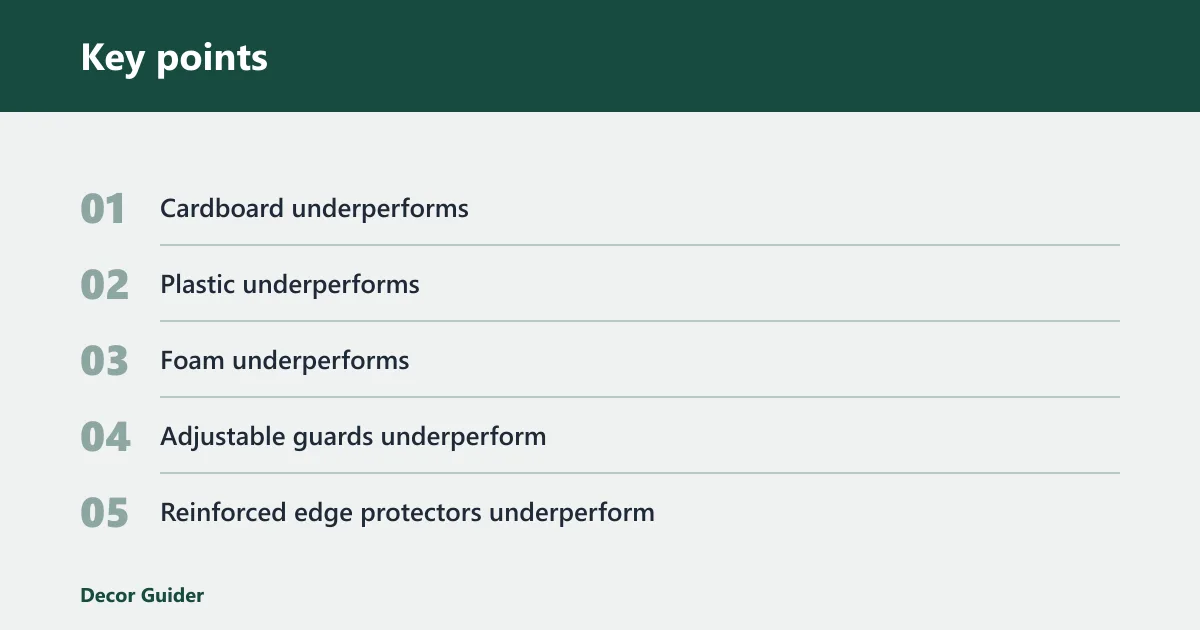
Corner protectors checklist
- Cardboard underperforms when humidity is high, the load will sit in storage, or the corner needs real moisture resistance.
- Plastic underperforms when the corner needs cushioning, because hard shells resist moisture better than they absorb shock.
- Foam underperforms when the item will be stacked tightly or strapped hard, since soft material can shift if it is not secured.
- Adjustable guards underperform when the frame thickness is outside the fit range or the corner is too irregular for a snug seat.
- Reinforced edge protectors underperform when the load is short and the edge length wastes material or adds setup time without added protection.
Cardboard corner protectors: best for light, recyclable packing
Cardboard is the best default when your main risk is abrasion, light corner impact, or shifting during wrap application. It is light, commonly recyclable, and often used on frames, furniture legs, cartons, and storage moves where the corner shape is predictable.
Many cardboard protectors are built for adjustable fit on frames and similar rectangular items. A common thickness is around 0.12 inches, which gives basic edge reinforcement without adding much size to the shipment.
When cardboard is the right default
Use cardboard for light furniture, framed art, and short moves where the corners need a clean barrier more than deep cushioning. It also suits mixed packing lines, because it is easy to cut and quick to stack.
If you are sending one cabinet top or a few framed pieces, cardboard is often the simplest balance of cost and protection. It works especially well when paired with stretch wrap or tape to stop migration.
Where cardboard underperforms
Cardboard can fail early under moisture, repeated handoffs, or compression from strapping and pallet stacking. It also gives less shock absorption than foam, so it is not the first choice for delicate glass, polished veneer, or fragile corners that chip easily.
Plastic corner protectors: best for moisture and reuse
Plastic corner protectors are the better choice when humidity, wet docks, or repeated reuse are part of the job. They work inside or outside the box, and they suit boxes, cartons, and furniture where moisture resistance matters as much as corner coverage.
They are also useful for high-volume shipping because the same piece can often be moved through multiple packing cycles. In large-volume workflows, that can reduce replacement frequency even if the per-piece cost is higher than cardboard.
Inside and outside box use
Plastic guards can sit inside a carton to keep the corner aligned or outside to absorb rubbing from straps and wrap. That flexibility helps when the shipment moves through different handling stages before final delivery.
For cabinets and assembled furniture, plastic works well where a rigid corner cap is needed to hold shape during transit. It is less about cushioning and more about keeping the corner intact through contact and moisture.
When plastic beats cardboard
Plastic wins when the package may sit in damp storage, cross a wet loading dock, or be reused many times. It also makes sense when the shipment is moving through a lot of handling touches and the protector must hold its form.
Pack counts can go to 200 pieces, which is useful for fulfillment centers and warehouse lines that move the same style of corner repeatedly.
When plastic adds cost without much gain
If the main problem is a soft impact, plastic may not add enough cushioning on its own. In those cases, the hard shell may protect shape but still leave the surface exposed to denting or abrasion unless a softer layer is added.
Foam corner protectors: best for shock and delicate edges
Foam corner protectors are the better option when the failure mode is impact shock rather than humidity or load-bearing stability. They are commonly used for TVs, mirrors, and furniture edges because they cushion contact and reduce sharp-edge transfer.
They are also the lightest-feeling option in the set, which helps when you are padding several fragile corners without adding much shipping mass. For finished furniture, that can be the difference between a protected edge and a chipped one.
Best for TVs, mirrors, and finished furniture edges
Foam is a strong fit for glossy or fragile surfaces that show damage quickly. It absorbs contact better than rigid cardboard, so it is often the better first layer on pieces with exposed corners or glass-adjacent edges.
Box City lists foam corners among its packing supplies, and U-Haul Ready-Mover guards use high-density foam. Those listings reflect the same practical idea: foam belongs where cushioning matters more than structure.
When tape is needed to keep them in place
Foam can slip on slick wood, laminate, or painted surfaces, so tape is often needed for secure placement. If the shipment will be handled several times, do not rely on friction alone.
Use tape only after the corner is seated fully. If the foam is misaligned, the tape can lock in the wrong position and leave part of the edge exposed.
What size corner protectors do I need for furniture corners?
The right size depends on corner thickness, edge length, and whether the protector must grip a frame, cabinet, or tabletop. For mixed-size frames, adjustable corner guards are the safer bet because they are built to tolerate thickness variation instead of forcing a single rigid fit.
For furniture corners, check both the exposed leg or edge width and the depth of the corner contact. A protector that is too loose will migrate; one that is too tight can split, pop off, or deform during strapping.
Adjustable fits for mixed-size frames
Zipcase adjustable protectors fit corners from 1 to 2.2 inches thick, and Mr. Pen adjustable protectors fit corners from 1 to 2.1 inches. That range is useful when one shipment includes different frame depths or when the exact corner thickness varies slightly from piece to piece.
Adjustable three-tab slot designs are especially useful for artwork and frame packing, where snug corner fit matters more than thick padding. In that use case, cardboard protectors are often the better default.
Thickness and fit rules
A good rule is to match the protector to the narrowest dimension that still gives full coverage. If the protector is designed for a 1-inch minimum but your edge is thinner, add a wrap layer or choose a smaller profile.
For furniture with wide or rounded corners, a rigid corner cap may sit poorly even when the nominal size looks right. In those cases, edge protectors or foam sleeves usually behave better than a tight corner insert.
Should I use cardboard or plastic corner protectors for shipping?
Use cardboard when you want light, recyclable protection and the shipment is dry, short, or only moderately handled. Use plastic when the corner must resist moisture, repeated handling, or reuse across multiple shipments. Neither is universally better.
Cardboard usually wins on speed and disposability. Plastic usually wins on moisture resistance and durability. The best choice depends on which failure mode would cost more to repair.
What changes the answer
If the item is going from a climate-controlled warehouse to a local customer, cardboard is often enough. If the same item will sit in a humid depot or be reused on multiple return cycles, plastic tends to be the safer choice.
For furniture with sharp veneer edges, cardboard can be paired with wrap to reduce abrasion. For boxes and cartons that need a reusable corner, plastic is usually the more practical cap.
What thickness should shipping corner protectors be?
Thickness should be chosen by the kind of load, not by a universal rule. Light cardboard guards commonly sit around 0.12 inches thick, while some reinforced options list 0.16 inches. Plastic and foam solve different problems, so thickness alone does not tell the full story.
For crush risk, you want enough section depth to keep the corner from collapsing under wrap or stack pressure. For scratch risk, a thinner, smoother guard can be enough if it stays in place.
Why thickness is not the only metric
A thick protector that slips is worse than a thinner one that stays put. Fit, contact area, and attachment method often matter more than raw thickness on furniture shipping protection.
That is why the size range and the way the guard attaches should be checked before ordering in bulk.
How do I attach corner protectors to furniture for shipping?
Attach corner protectors so they cannot slide during lifting, stacking, or strapping. The common options are tape, staples, stretch wrap, and strapping, and the right method depends on whether the protector is cardboard, foam, plastic, or a reinforced edge guard.
For furniture, the goal is load stabilization as much as corner protection. If the guard shifts, the exposed edge can still take the hit.
- Seat the guard squarely on the corner before adding any fastener.
- Use tape for light cardboard or foam that needs a simple hold.
- Use stretch wrap when you want the guard to stay aligned across a whole bundle.
- Use staples only where the surface and material can accept them safely.
- Use strapping on long loads or pallets, especially with reinforced edge protectors.
For a long cabinet panel, a reinforced edge protector plus wrap and strapping is usually more stable than a loose corner cap. For framed art, a snug adjustable protector and tape are often enough.
Can corner protectors be reused for multiple shipments?
Yes, but reuse depends on material and wear. Plastic is the easiest to reuse because it resists moisture and keeps its shape. Thicker cardboard can sometimes be reused, but it is more likely to crush, crease, or absorb damage after one rough trip.
Foam can also be reused if it stays clean and does not tear, but it may lose its fit or grip after repeated compressions. Reuse is a real advantage only when the protector still seats correctly on the corner.
When bulk buying makes sense
Pack sizes can reach 200 pieces, which is useful for high-volume shippers who want a lower per-unit cost and fewer reorder interruptions. Smaller packs, such as the 12-pack format used by some foam options, fit one-off movers or occasional packing jobs better.
If you ship the same furniture style every week, bulk count matters almost as much as material choice. If you move once and store the rest, it matters much less.
Do plastic corner protectors work for furniture and cabinets?
Yes, plastic corner protectors work well for furniture and cabinets when the main concern is moisture, repeated handling, or maintaining corner shape. They are especially useful on boxy items with predictable corner geometry and on packed cartons that may sit in storage before final delivery.
They are less useful when cushioning is the top priority. A rigid plastic cap can help with corner retention, but it does not absorb impact as well as foam.
What corner protectors work best for frames and artwork?
For frames and artwork, adjustable corner protectors are usually the best fit because they give a snug corner without forcing a one-size profile. Cardboard is often the default when you want a light, clean barrier that is easy to pair with paper wrap or stretch wrap.
That matters because frames fail at the corners first, not in the middle of the panel. A snug fit keeps the edges from rubbing inside the carton and helps stop point impact at the four corners.
Where can I buy furniture corner protectors?
You can buy them from packing-supply brands, furniture-moving suppliers, warehouse vendors, and general shipping marketplaces. The better question is not where to buy, but which spec to check first: fit range, pack count, material, and whether the guard is a corner cap or an edge protector.
For quick purchases, compare the published dimensions and the attachment method before checking price. A cheap guard that does not fit the load correctly is expensive once damage claims start.
Frequently asked questions
What are the best corner protectors for furniture shipping?
The best corner protectors depend on the failure mode. Use cardboard for light, recyclable protection; plastic for moisture and reuse; foam for shock absorption; and adjustable guards for mixed-size frames. For long loads and pallets, reinforced edge protectors are usually the better match than small corner caps.
Are foam corner protectors better than cardboard protectors?
Foam is better when shock absorption matters most, such as for TVs, mirrors, and finished edges. Cardboard is better when you want a lighter, recyclable option and the risk is mostly abrasion or light impact. Foam may also need tape to stay in place on smooth surfaces.
Products related to this article
Sponsored / affiliate links. As an Amazon Associate I earn from qualifying purchases. I may earn additional commission from eligible campaigns.