Ratchet Straps vs Cam Buckle Straps
For furniture, use Cam Buckle Straps when finish protection and low crush risk matter; use Ratchet Straps when you need higher tension and the load can tolerate it. Over-tightening can dent frames, pinch joints, and warp softwood or laminate. This guide compares Ratchet Straps vs Cam Buckle Straps for furniture, light hauling, and DOT-style cargo securement so you can choose the safer tie-down.
| Decision factor | Ratchet Straps | Cam Buckle Straps | Winner |
|---|---|---|---|
| Tension control | Mechanical ratcheting mechanism gives higher tension and finer incremental tightening. | Spring-loaded cam mechanism tightens by hand and tops out at gentler tension. | Ratchet Straps |
| Finish and crush risk | More likely to crush soft edges, compress pads, or mark delicate finishes if over-tightened. | Lower clamping force makes it better for painted, laminated, veneered, or lightly framed furniture. | Cam Buckle Straps |
| Road-stability on heavier loads | Better for dense, heavy, or regulated cargo where higher tension helps resist vibration and shift. | Better for lighter loads that do not need aggressive clamping force. | Ratchet Straps |
| One-person use | Can be controlled solo, but the mechanism makes overtightening easier if you rush. | Quick to tension and release by hand, with less chance of over-clamping fragile cargo. | Cam Buckle Straps |
| Best furniture fit | Heavy appliances, stable filing cabinets, and dense items that can tolerate compression. | Mattresses, dressers, bookshelves, chairs, headboards, and finish-sensitive pieces. | Cam Buckle Straps |
Choosing tension for fragile furniture surfaces
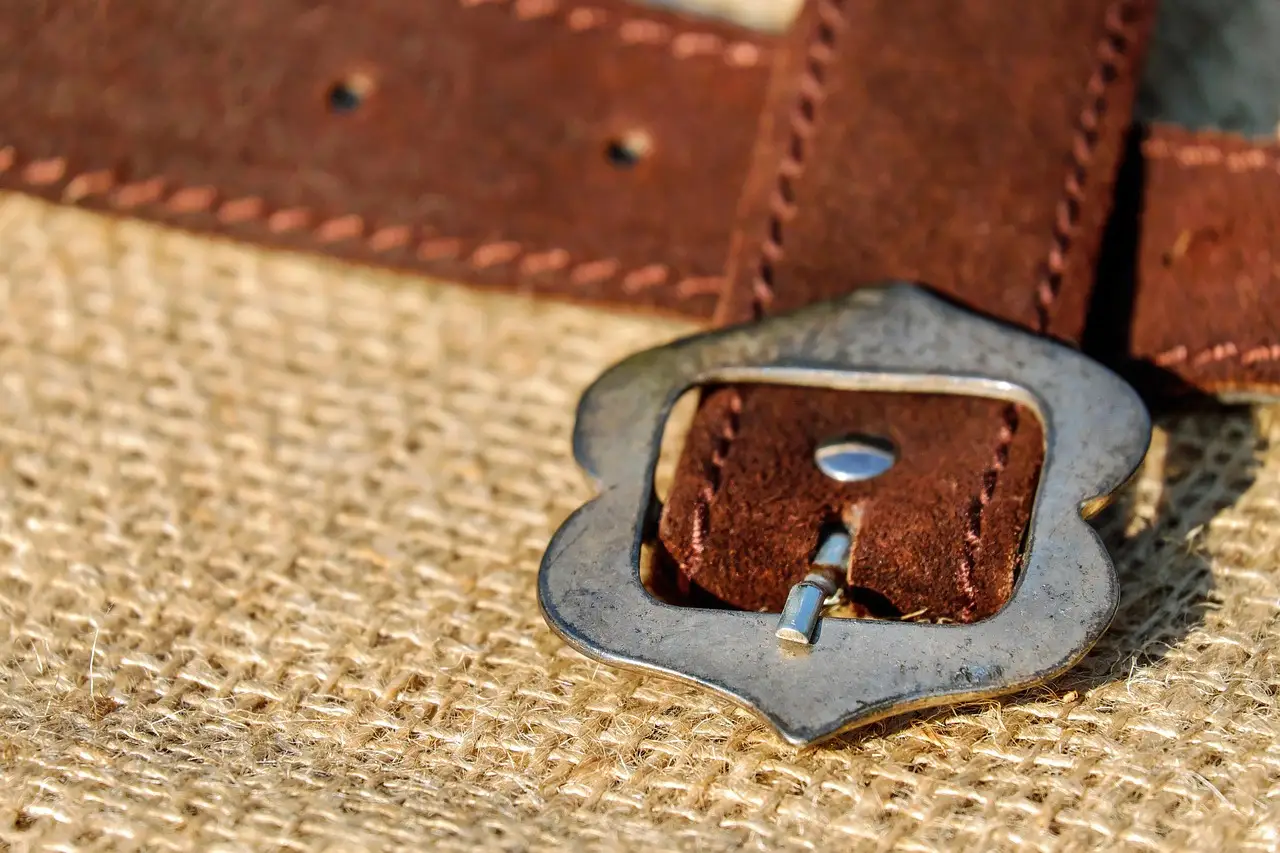
Ratchet Straps build more tension and suit heavier or road-stable cargo. Cam Buckle Straps are hand-tightened and gentler on furniture surfaces. For household moves, the right choice comes down to crush risk, finish damage, and load shift.
Furniture changes the answer because many pieces fail by deformation, not by breaking loose weight limits. A dresser can rack at the frame, a bookshelf can bow, and a mattress can get distorted if you clamp too hard. Load weight matters, but so do surface fragility and how much vibration the trip adds.
Tension and hold
Ratchet Straps use a geared ratcheting mechanism, so you can build more tension with more control. That makes them useful for denser loads and for road transport where vibration can work a loose tie-down free over time. Cam Buckle Straps are tightened by hand, so they usually stop short of damaging pressure.
For furniture, more tension is not automatically better. Softwood frames, laminate panels, and veneered edges can dent before a strap ever reaches its useful limit. Check the strap label and the anchor-point rating before you rely on either one.
Speed of setup and release
Cam Buckle Straps are usually faster to route, snug, and release. That helps when you are working around a hallway corner, a liftgate, or a tight truck bed. Ratchet Straps take more steps, but the mechanism gives more control when the load needs a firmer hold.
A common first-timer mistake is cranking until the webbing feels “safe.” That can flatten moving pads and transfer force into a drawer front or cabinet rail. With fragile cargo, the better goal is snug, not crushed.
Best fit for furniture and appliances
Cam Buckle Straps are usually the first choice for mattresses, upholstered pieces, painted case goods, and other items that can dent or scuff. Ratchet Straps are the stronger match for heavier appliances, dense filing cabinets, and other items that can tolerate more compression without cosmetic damage.
Suppose you are securing a tall bookshelf and a box of lamps in the same truck. Use the gentler strap on the bookshelf if the finish is soft, then secure the boxed items separately. Mixed loads often do better when the main furniture piece gets the safer strap and the accessory load gets the firmer one.
One-person use and overtightening risk
One person can use either strap type, but the risk profile is different. Cam Buckle Straps are easier to judge by feel, which helps solo movers stop before the load is clamped too hard. Ratchet Straps give more mechanical control, yet that same added force makes it easier to overtighten with one hand on a moving cart or tailgate.
If you are working alone, choose the strap that matches the item’s weakest point, not the one that feels strongest. On a fragile dresser, that usually means cam buckles. On a stable appliance, ratchets can be the better fit if the label and anchors support the load.
How does a cam buckle strap work?
A cam buckle strap uses a spring-loaded cam mechanism that grips the webbing when tension is applied. You tighten it by hand, so the force you apply is usually lower than with a ratchet. That makes it a strong option for light or delicate cargo that needs restraint without hard clamping.
Hand-tightened tension and quick release
Because the strap is tightened by hand, you get less mechanical force and less risk of crushing soft cargo. Release is also straightforward: once the cam is lifted, the webbing slides free. That makes cam buckles practical when you need to unload furniture quickly without fighting the hardware.
Typical widths and common use cases
Cam-buckle straps are typically 1 inch and 2 inch wide. They are commonly described as ideal for furniture and appliances when the item is light enough, finish-sensitive, or easily marked. Their WLLs are lower than those of ratchet straps in general, and the exact rating depends on the strap label.
That range does not replace the label on the strap you hold in your hand. It only shows why cam buckles are usually the gentler choice, not the stronger one.
How does a ratchet strap work?
A ratchet strap uses a mechanical ratcheting mechanism to build tension in small steps. The gear-driven action gives more force than hand-tightening alone, which is why ratchets are common for heavier cargo and road securement. Use the strap label, anchor ratings, and the load shape to decide whether that extra tension is appropriate.
Mechanical advantage and higher tension
The ratchet handle multiplies the input force, so the strap can hold a dense load more firmly than a cam buckle. Ratchet strap WLLs can be higher than cam buckle ratings, and the exact capacity depends on the strap label and construction.
The same added force that helps on a heavy load can punish a fragile one. If the item has thin rails, soft corners, or a finish that dents easily, use padding and stop well before the strap feels “maxed out.”
Where ratchets fit best in furniture hauling
Ratchets are the better fit when the furniture is dense, stable, and not prone to surface damage. Think heavy appliances, sturdy filing cabinets, and other pieces that need stronger resistance to road vibration and shifting. For mixed household loads, ratchets can hold the stable item while a softer strap protects the fragile one.
Check the manufacturer’s instructions and the anchor-point ratings before you tighten anything. Never exceed the vehicle’s rated roof, hitch, or tow limit, keep items out of airbag zones and the driver’s view, and check local laws.
Furniture strap decision table
Use this table as a furniture-specific shortcut. It favors finish protection, crush risk, and road vibration first, then tension and WLL second. If the strap label or anchor points do not support the plan, step down to a gentler setup or choose a different anchor method.
| Furniture item | Recommended strap type | Safe tension level | Strap width | Failure risk notes |
|---|---|---|---|---|
| Dresser | Cam Buckle Straps | Snug only; stop before drawer fronts compress or seams shift | 1 inch or 2 inch | Drawer migration, frame racking, and finish scuffing if over-tightened |
| Mattress | Cam Buckle Straps | Light tension; enough to prevent slide, not enough to distort foam or springs | 1 inch or 2 inch | Compression marks and edge distortion if clamped too hard |
| Sectional | Cam Buckle Straps | Low to moderate tension with corner padding and separated sections | 2 inch | Fabric marking, frame twist, and cushion crush if tension is uneven |
| Filing cabinet | Ratchet Straps | Moderate to firm tension if the cabinet is loaded and structurally sound | 2 inch | Drawer slide bind, cabinet wall bowing, or tipping if not restrained at a stable point |
| Appliance | Ratchet Straps | Firm but controlled tension; use padding where contact points are hard | 2 inch or 3 inch | Panel denting, hose or cord pinch, and surface impact if the load shifts |
| Bookshelf | Cam Buckle Straps | Light tension with padding and bracing | 1 inch or 2 inch | Shelf bowing, corner crush, and veneer damage if squeezed too hard |
| TV stand | Cam Buckle Straps | Low tension only; protect corners and glass or trim areas | 1 inch or 2 inch | Finish marks, glass stress, and drawer or door movement |
| Headboard | Cam Buckle Straps | Light tension; keep pads between the strap and decorative edges | 1 inch | Edge crush, paint abrasion, and split risk on thin rails |
| Chair | Cam Buckle Straps | Very light tension; secure legs and keep pressure off joints | 1 inch | Joint stress and finish wear if the strap crosses delicate arms or backs |
| Table | Cam Buckle Straps | Light to moderate tension depending on top material and leg structure | 1 inch or 2 inch | Top warp, edge denting, and leg racking if the force is uneven |
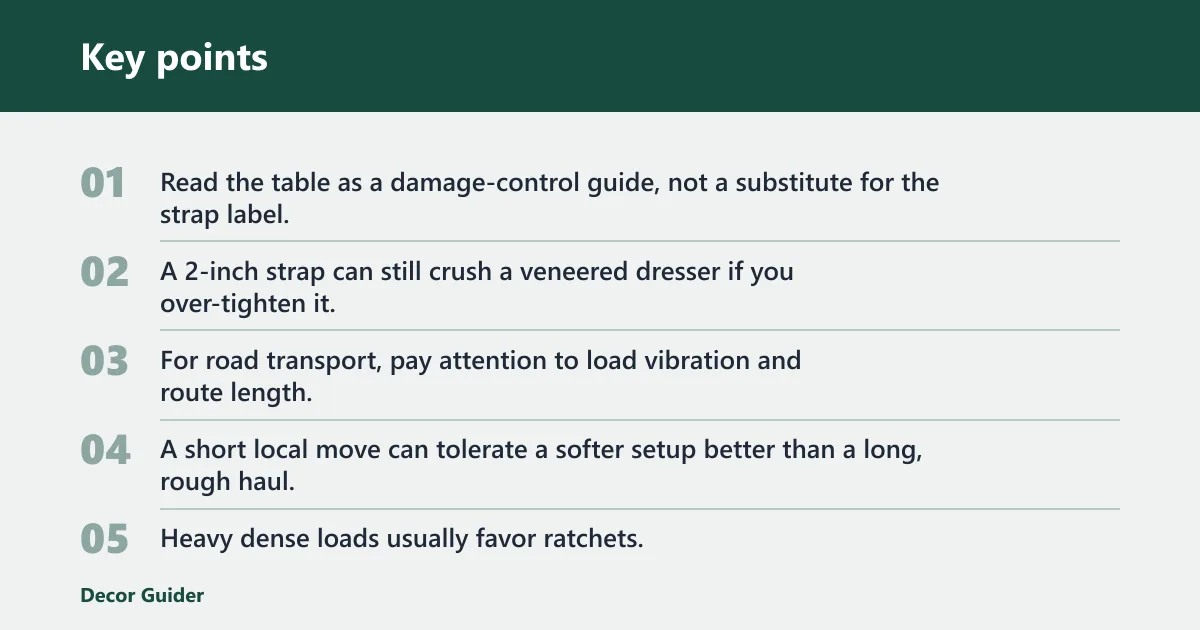
Read the table as a damage-control guide, not a substitute for the strap label. A 2-inch strap can still crush a veneered dresser if you over-tighten it, while a 1-inch strap can be enough for a chair if the goal is only to stop movement. The item’s weakest part decides the setting.
For road transport, pay attention to load vibration and route length. A short local move can tolerate a softer setup better than a long, rough haul, where loose straps may settle and shift. Heavy dense loads usually favor ratchets; delicate or crushable pieces usually favor cam buckles.
What WLL and break strength mean
Working Load Limit, or WLL, is the number to plan around. It is the maximum safe load rating for the strap in normal use, and it should be checked on the strap label before you trust the tie-down. Break strength is different: it is the failure force, not the safe target.
Why WLL is the planning number
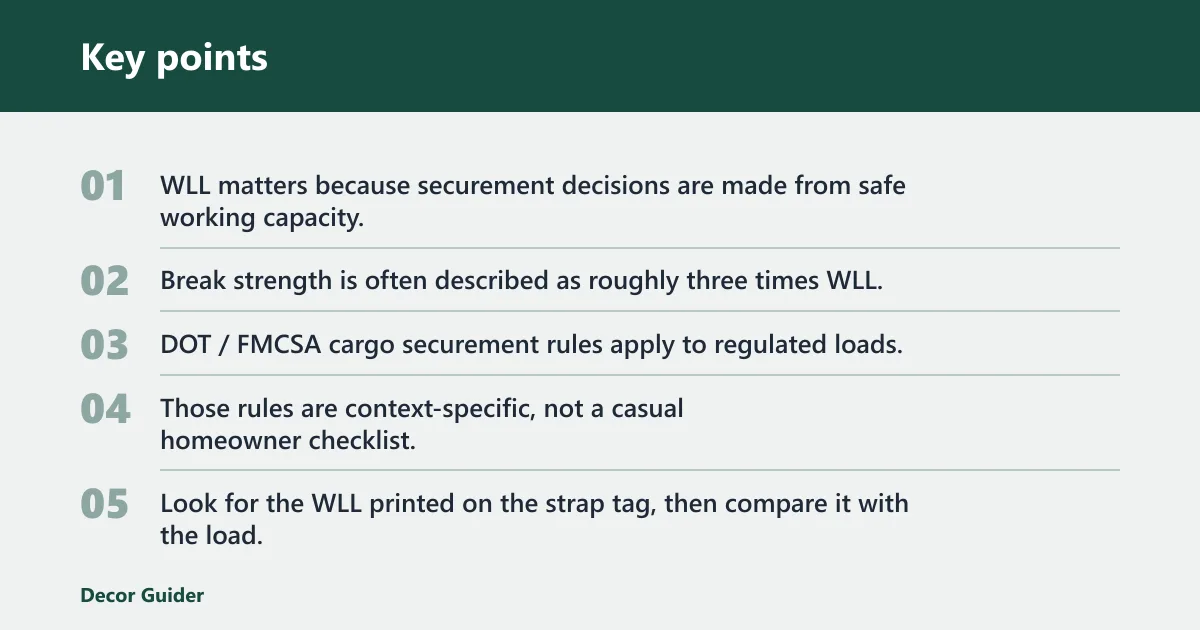
WLL matters because securement decisions are made from safe working capacity, not from the point where the strap finally fails. Break strength is often described as roughly three times WLL, which is why it is commonly confused with usable capacity. Do not plan around break strength.
That matters even more on public roads. DOT / FMCSA cargo securement rules apply to regulated loads, and compliance decisions commonly rely on WLL-based ratings for tie-down force. Those rules are context-specific, not a casual homeowner checklist.
What to check on the strap label
Look for the WLL printed on the strap tag, then compare it with the load, the anchor-point ratings, and the manufacturer’s instructions. If the vehicle or trailer anchors are the weak link, a stronger strap does not solve the problem. The securement system is only as reliable as its lowest-rated part.
For mixed cargo, do not assume capacities add up in a simple way. Load angles, the way the straps share force, and how the furniture settles all matter. Use the label values and the actual layout, not a rough sum.
Choose Ratchet Straps if… / Choose Cam Buckle Straps if…
Choose Ratchet Straps if the furniture is heavy, dense, and stable enough to tolerate firm tension. Choose them when you need better resistance to vibration, when the haul is long or rough, or when the load is closer to regulated road securement than to a simple household move. Use the strap label and anchor-point ratings as the limit.
Choose Cam Buckle Straps if the item is light, finish-sensitive, or easy to crush. Choose them for dressers, mattresses, bookshelves, chairs, headboards, and similar pieces where low pressure matters more than maximum hold. If a load mixes fragile furniture with heavier accessories, use the gentler strap on the primary item and reserve ratchets for the stable pieces that can take them.
- Confirm the strap WLL on the label and match it to the cargo plan.
- Check the anchor-point ratings and the vehicle or trailer limits.
- Protect corners, edges, and finishes with moving pads where needed.
- Keep straps off sharp hardware and away from airbag zones and the driver’s view.
- Snug the load, then stop before pads compress or frames deform.
- Recheck the setup after the first stretch of road or after the load settles.


Frequently asked questions
Ratchet straps vs cam buckle straps: which should I use?
Use Cam Buckle Straps for light, delicate, or finish-sensitive furniture. Use Ratchet Straps for heavier or road-stable loads that need more tension. The deciding factor is not only weight; it is how much crush, scuff, and vibration the item can tolerate without damage.
Can I use cam buckle straps for furniture?
Yes. Cam Buckle Straps are often a better fit for furniture because they are hand-tightened and less likely to crush frames, dent corners, or compress cushions. They are especially useful on dressers, mattresses, bookshelves, chairs, and headboards where gentle securement matters more than high tension.
Are ratchet straps too strong for furniture?
They can be. Ratchet Straps are useful for heavier furniture and appliances, but they can over-tighten soft cargo and leave marks, warped panels, or crushed edges. If the piece is fragile, use padding and stop at snug rather than firm clamping force.
What working load limit should I look for?
Look for the WLL printed on the strap label, then match it to the load and the securement layout. Cam buckle strap WLLs depend on the strap, while ratchet strap WLLs also vary by label and construction. Do not use break strength as your planning number.
Can cam buckle straps meet DOT requirements?
Sometimes, depending on the load, the vehicle, the route, and the exact rating on the label. DOT / FMCSA cargo securement rules apply to regulated loads on public roads, so the answer depends on WLL, anchor points, and the specific securement setup. Check the manufacturer’s instructions and the applicable rules for your load.
How do I avoid overtightening with ratchet straps?
Apply tension slowly, keep padding under the strap where needed, and stop as soon as the load is secure without visible compression or frame movement. If the item is thin, painted, or hollow, consider Cam Buckle Straps instead. The safest setup is the one that restrains the load without deforming it.
Products related to this article
Sponsored / affiliate links. As an Amazon Associate I earn from qualifying purchases. I may earn additional commission from eligible campaigns.