How to Secure a Tarp Over Patio Furniture
Use a tarp that reaches about 2 feet beyond the furniture on every side. Then anchor all four corners and add a center support so wind cannot lift the edges and rain cannot collect in the middle. A loose or flat tarp can tear in gusts, and pooled water can stretch fabric, bend frames, and soak cushions. This guide shows the setup sequence and size-and-anchor choices for sofas, tables, stacked chairs, and awkward patio layouts.
Why patio tarps fail outdoors


Wind, water, and abrasion cause most failures. A loose tarp acts like a sail, a flat tarp holds water in low spots, and tight fabric can rub through on chair arms, table corners, grill knobs, or umbrella hardware.
That is why tarp choice matters as much as tie-down choice. Clear patio tarps are commonly sold in polyethylene, PVC, or vinyl constructions, with thickness and reinforcement varying by brand and intended use. Rather than relying on a single minimum spec, compare the manufacturer’s published weight, thickness, seam reinforcement, UV treatment, and grommet details against the exposure level on your patio.
For short-term outdoor coverage, a tarp works well. For long storage or exposed conditions, a fitted furniture cover is usually the better choice because it holds shape with less slack, less flapping, and less pooling.
What goes wrong first
Wind usually lifts the lowest edge first, especially on the side facing the prevailing gust. Water then settles in that same loose area and stretches the fabric farther. Once the tarp sags, it can scrape against corners and tear near grommets or along the hem.
What you’ll need
- A UV-resistant tarp sized for the full furniture footprint
- Bungee cords for quick, light-to-moderate hold
- Rope or tie-down cord for tighter adjustment and better wind stability
- Tarp clips if the tarp has no grommets or uneven edges
- Weights, legs, rails, or other low anchor points
- Padding for sharp corners, armrests, or metal edges
- A tape measure
Choose polyethylene or PVC/vinyl based on exposure. Polyethylene is common for temporary use. PVC or vinyl is better when you need more water resistance and a stiffer cover. If the tarp stays outdoors, look for UV resistance, reinforced seams, and edge construction that resists fraying. The right material matters more than chasing a single thickness number.
If you also need hold-down hardware, use bungee cords for light-to-moderate hold when the patio is sheltered or when you want quick removal. Choose rope or tie-down cord when you need more precise tension, especially on open patios where gusts are frequent.
What size tarp do you need?
Measure the top footprint first, then add the furniture height on all sides, and leave about 1 to 2 feet of extra overlap for tying. That gives you enough material to drape past the lowest point without leaving the corners bare, while still leaving room for tie points and a slight crown.
Use this sizing method
- Measure the full top length and width of the furniture layout.
- Measure the highest point that the tarp must clear.
- Add that height on every side so the tarp reaches below the frame.
- Add 1 to 2 feet more for overlap, knots, and anchor slack.
- Choose the next larger tarp if the furniture is stacked, sectional, or irregular.
Say your dining set measures 6 feet by 4 feet and the chairs add 3 feet of height at the highest point. You need enough coverage to drop past the seat line and still tie under the legs. A 10 ft. x 12 ft. tarp may fit a compact set, while a 16 ft. x 20 ft. tarp may suit larger dining sets or a table with chairs left in place.
For small sofas or benches, 10 ft. x 12 ft. or 12 ft. x 14 ft. is often the practical range. If the layout includes stacked chairs, offset table legs, an umbrella base, or a grill beside the set, go larger rather than forcing the tarp to bridge awkward gaps.
How do you secure the tarp step by step?
Center the tarp over the furniture, drape it past the lowest point on all sides, and anchor opposite corners first. Then add mid-edge tie points if the span is long. The goal is even tension, not a drum-tight wrap. When the furniture is sectional or the patio has no low anchor points, use more tie points and weight the lower edge instead of stretching the tarp tight.
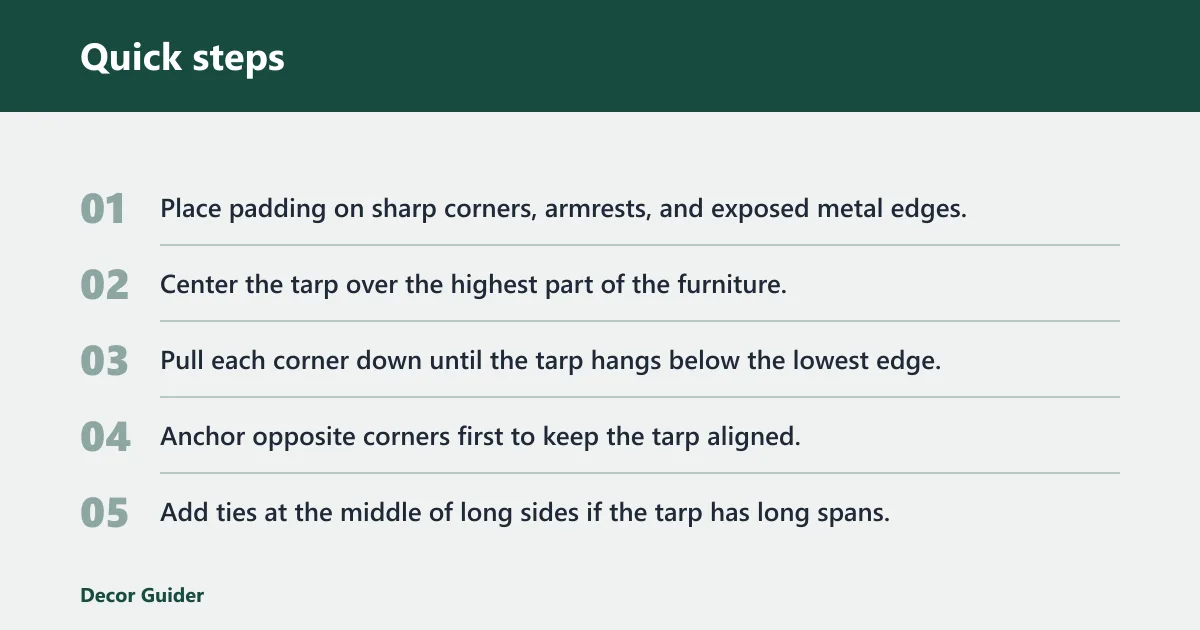
Setup sequence
- Place padding on sharp corners, armrests, and exposed metal edges.
- Center the tarp over the highest part of the furniture.
- Pull each corner down until the tarp hangs below the lowest edge.
- Anchor opposite corners first to keep the tarp aligned.
- Add ties at the middle of long sides if the tarp has long spans.
- Leave a slight crown at the top so water sheds off the center.
- Recheck each corner after the first pull and adjust for slack.
Suppose a sofa and two chairs sit in a U-shape on a patio. If you tie only the outer corners, the open center can catch wind and balloon upward. Add one tie at each side midpoint so the tarp stays low and the center does not form a pocket for rain. If the patio has no low rail, seat leg, or other anchor point, use weighted anchors or a second layer of tie-down cord routed to stable fixed points.
How to keep water from pooling
Build a slight slope or crown instead of leaving a flat top. A small rise at the center lets rain run toward the edges. After wet weather, check for sag, because a tarp that looked fine when dry may collect water after the first storm. If pooling starts, raise the center support or shorten the side ties before the fabric stretches.
Which tie-down method should you use?
Use bungee cords for light-to-moderate hold and quick attachment, rope or tie-down cord when you need tighter adjustment and better wind stability, and tarp clips when the tarp lacks grommets or has uneven edges. Match the method to the furniture shape, the number of anchor points, and how often you expect to remove the cover.
Compare the options
- Bungee cords: Best for quick setup and light-to-moderate hold. Elastic tension helps absorb movement, but overtightening can stretch the tarp and stress grommets.
- Rope or tie-down cord: Best for adjustable tension and firmer wind control. A simple knot can hold better in gusts, and you can fine-tune each tie point.
- Tarp clips: Useful when the tarp has no grommets or when the edge is uneven. They grip the tarp edge directly, but they are usually a temporary fix, not a long-term answer.
Grommets matter because they are the anchor and tension points. Better tarps usually reinforce the edge and place grommets at regular intervals, but the ideal spacing depends on the tarp size, hem strength, and wind exposure. If the holes sit too far apart for the load, the tarp can bow between them, which increases flutter and failure risk.
Use rope when the patio gets more wind, because the line can be tightened more precisely than elastic. Use bungees when the setup changes often and you need faster removal. Use clips when the tarp edge is irregular or a corner lacks a grommet. If you have slick metal frames, wrap the contact point with padding first so the tie does not slip and the finish does not wear through.
Patio tarp checklist
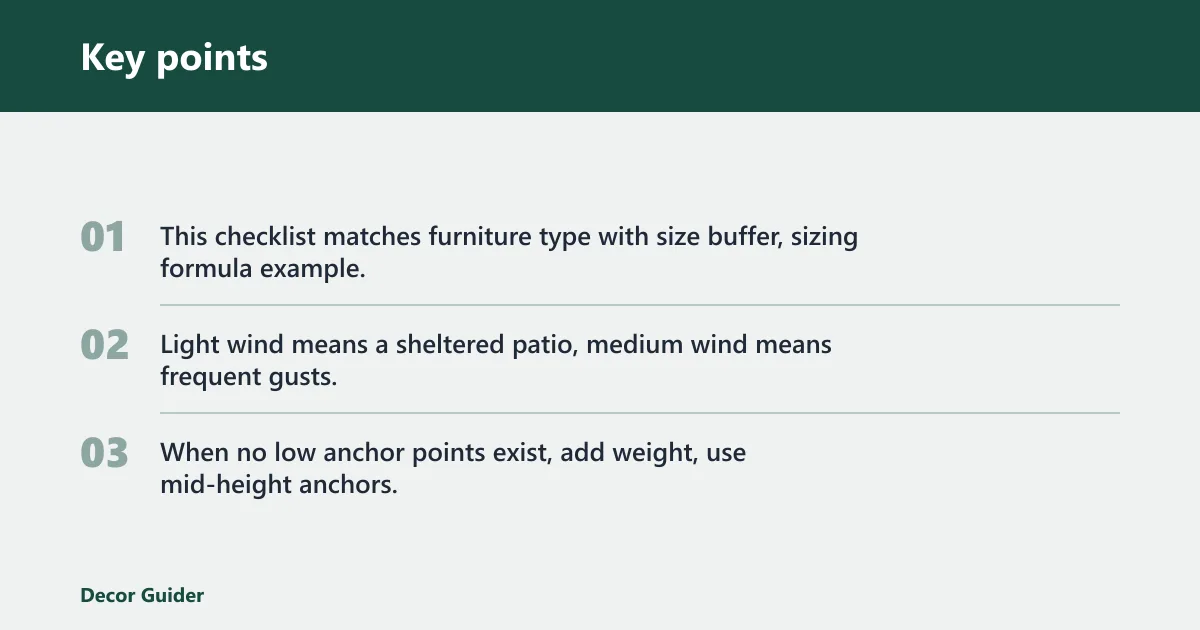
This checklist matches furniture type with size buffer, sizing formula example, preferred anchor point location, tie-point count, wind tier, pooling trigger, and removal cadence. Light wind means a sheltered patio, medium wind means frequent gusts, and high wind means exposed or storm-prone conditions. When no low anchor points exist, add weight, use mid-height anchors, or switch to a fitted cover.
| Furniture type | Recommended tarp size buffer | Exact sizing formula example | Preferred anchor point location | Recommended tie-point count | Wind tier | Pooling trigger | Inspection/removal cadence |
|---|---|---|---|---|---|---|---|
| Two chairs | At least 2 feet beyond all sides | Chair footprint + chair height + 1 to 2 feet overlap | Low legs, lower frame rails, or weighted corner points | 4 corners, plus 2 mid-edge ties if exposed | Low to medium | Seat gap or armrest dip starts to hold water | Check after each rain; remove during high wind |
| Sofa or bench | 2 feet to 3 feet beyond all sides | Sofa length and depth + back height + overlap allowance | Lower legs and side rails, not the top of the backrest | 4 corners and 2 side ties; add more if the span is wide | Medium | Center span begins to bow between support points | Check daily in wet weather; remove during high wind |
| Dining set | 2 feet beyond the full table-and-chair footprint | Tabletop size + chair clearance + height clearance + overlap | Chair legs, table base, or weighted lower edge points | 4 corners plus mid-side ties on the long runs | Medium to high | Tabletop cannot shed water without a crown | Check after storms; remove if heavy rain continues |
| Grill | 1 foot to 2 feet beyond the widest points | Grill width and depth + lid height + tie allowance | Lower cart frame, wheels, or other stable base points | 4 corners, with side ties if the lid or shelf creates slack | Low to medium | Lid shape or side shelves create a pocket | Check weekly; remove in high wind |
| Stacked items | 3 feet or more beyond the tallest stacked point | Stack height + widest footprint + extra slack for uneven edges | Lowest stable points, not the top of the stack | 4 corners plus extra mid-side ties for stability | Medium to high | Top-heavy stack creates a deep sag | Check after every storm; remove in high wind |
| Sectional seating | 2 feet to 3 feet beyond the full L- or U-shape footprint | Longest side + shortest return + back height + overlap | Inside corner legs and outer lower rails | At least 6 ties, more if the open center is exposed | Medium to high | Open inside corner starts to fill with rain | Inspect after gusts and after every rain event |
Common mistakes
Using a tarp that is too small leaves the sides and tie points exposed. Pulling the cover too tight can rub through on chair arms or sharp corners. Deep sags invite pooling, and a flat tarp can trap water even when the fabric itself is waterproof.
Worn grommets are another weak point. Strong edge reinforcement helps, but spacing still matters. If the holes are too far apart for the load, the tarp flexes between them and the edge works loose. Frayed edges and weak seams should be replaced before the next stretch of wet weather.
A common first-timer mistake is tying the tarp to the highest points only. That leaves the lower edge free to flap. Anchor low, keep the tension even, and avoid long loose corners that can whip in gusts. If the furniture is stacked or the patio is exposed, add tie points rather than forcing one corner to carry the load.
Do not cinch rope hard against a dining chair arm or grill handle. Add padding first, then tighten just enough to stop flutter. If the tarp shifts after one tug, add a second tie point instead of over-tightening the first one. Cushions left on can increase height and create more pooling, so remove them when you need a lower, flatter profile or when storage will last more than a short weather event.
Umbrellas, stacked chairs, and slick metal frames deserve extra care. Remove umbrella canopies or secure the pole separately, stack chairs only if the pile is stable, and pad smooth metal so the tie points do not slide. If you have no low anchor points, use weighted corners, sandbag-style hold-downs, or a fitted cover that can grip the shape without relying on external anchors.
How to use tarp to cover patio furniture
Measure the full footprint, choose a tarp that extends at least 2 feet beyond every side, pad sharp edges, then anchor opposite corners first and add mid-edge ties on long spans. Finish by shaping a slight crown so rain runs off instead of sitting in the middle. For sectional sets or stacked chairs, size up and increase the number of tie points.
Can I use a tarp to cover patio furniture?
Yes, if the cover is temporary and you secure it against wind and pooling. A tarp is practical for seasonal weather protection, but for long storage or open, windy exposure, a fitted furniture cover usually stays put with less flapping and less abrasion. Cushions left on can be fine for a quick cover, but removing them usually reduces height and helps the tarp shed water better.
How do I secure a tarp over patio furniture so wind doesn’t lift it?
Anchor the tarp low on the legs, rails, or weighted points, then tie the four corners before adding side ties. Rope gives the most adjustment, while bungees work for lighter hold. If the patio gets frequent gusts or the frame is slick metal, use more tie points, padding, and a stable low anchor strategy instead of pulling the cover tighter.
What size tarp do I need to cover patio furniture?
Start with the top length and width, add the furniture height on all sides, then leave 1 to 2 feet for overlap and tying. A small sofa may fit 10 ft. x 12 ft. or 12 ft. x 14 ft., while a larger dining set may need 16 ft. x 20 ft. Sectionals and stacked chairs usually need the next size up because the footprint is irregular.
Should I use bungee cords, rope, or tarp clips to hold a patio tarp down?
Use bungees for fast setup and lighter weather, rope or tie-down cord for stronger adjustment and wind stability, and tarp clips when the tarp has no grommets or uneven edges. If the patio gets frequent gusts, rope usually gives the firmest hold. When no low anchor points are available, combine clips with weighted corners or switch to a more fitted cover.
How do I keep water from pooling on a tarp over patio furniture?
Do not stretch the tarp flat. Build a slight crown, keep the center a bit higher than the edges, and check the cover after rain or snow. If a low spot forms, add a center support or move the tie points so the fabric sheds water instead of holding it. Removing cushions can also reduce high spots that trap water.
What tarp material is best for outdoor furniture cover use?
Polyethylene is a common temporary choice, while PVC or vinyl is better when you want more water resistance and longer outdoor exposure. Look for UV resistance, reinforced edges, and grommets that are spaced consistently. Thickness helps, but it should match the exposure level rather than be maximized by default. For patios with sharp corners or metal frames, durability at the seams and hems matters as much as the sheet material.
Can a tarp damage patio furniture if it’s tied too tightly?
Yes. Over-tightening can rub finish off chair arms, press hard against corners, and stress the tarp around grommets and seams. Leave enough slack for a slight crown, use padding on hard edges, and add more tie points instead of cranking one point tighter. On slick metal frames, use a protective wrap at the contact point so the line does not slide and saw into the finish.
How long can a tarp safely stay on patio furniture outdoors?
That depends on the weather. In light, dry conditions, a tarp can stay on longer with regular checks, but wet, snowy, or high-wind periods call for faster inspection and more frequent removal. If the tarp starts to sag, fray, or trap water, take it off and reset it before reuse. For covered patios, the tarp can usually stay in place longer than on exposed decks or open yards.
Products related to this article
Sponsored / affiliate links. As an Amazon Associate I earn from qualifying purchases. I may earn additional commission from eligible campaigns.