Cabinet Shipping Cost Problems
Cabinet shipping costs usually come from the delivered bill: freight, packing, liftgate or inside delivery, accessorial charges, and damage claims can push a “cheap” order far above the quote. Ignore those items and you can pay more in fees, delays, and replacements than for the cabinets themselves. This guide shows which order variables move the invoice, where hidden charges appear, and how to compare quotes on true delivered cost.
Why cabinet shipping costs jump
Cabinet shipping often costs more because the goods are bulky, heavy, and need extra packing. The bill also changes with size, piece count, destination, and delivery method, so two orders with the same product price can land very differently. For larger orders, freight is more common than parcel service.
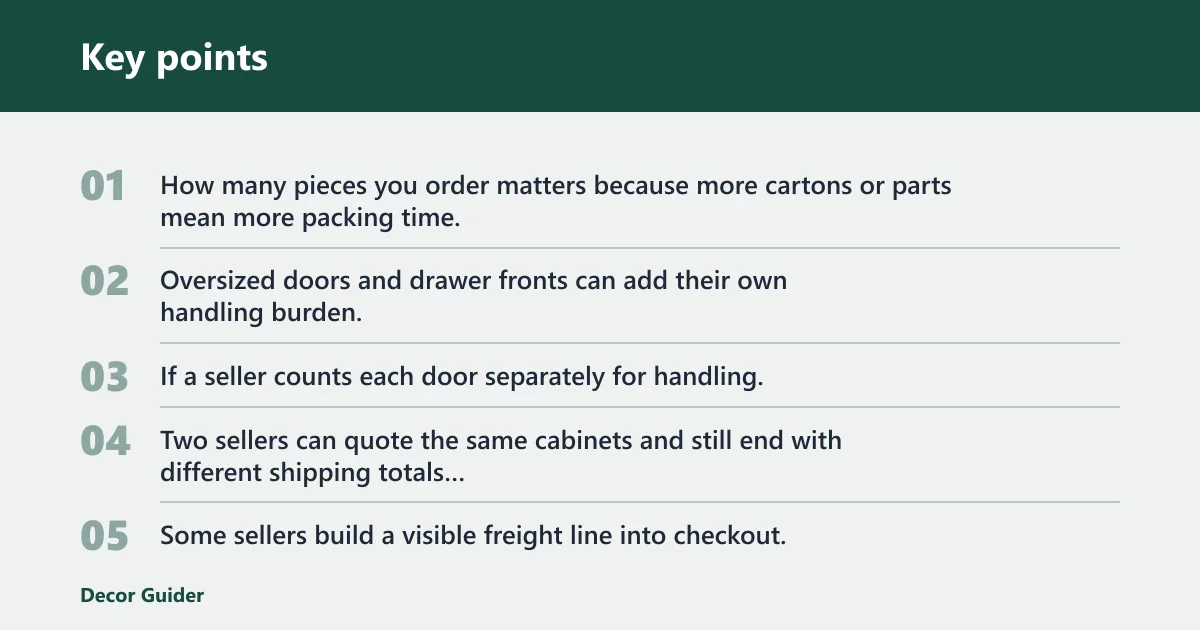
How many pieces you order matters because more cartons or parts mean more packing time, more handling, and more space on the truck. Oversized doors and drawer fronts can add their own handling burden, even when the cabinet boxes themselves are modest. If a seller counts each door separately for handling, the invoice can rise faster than expected.
Why quotes vary by seller
Two sellers can quote the same cabinets and still end with different shipping totals because each quote can treat packing, handling, delivery responsibility, and minimum invoice rules differently. Some sellers build a visible freight line into checkout. Others reveal charges only after order review. Ask what is included before you compare the total.
Say your order is one wall cabinet and a pair of matching doors. A carrier may treat the cabinet as one item and the pair of doors as two items for handling, which can move the shipping bill even though the finished project looks small.
How are cabinets priced?

Cabinets are priced as a product line first and a delivered order second. The shelf price may look acceptable, but the invoice can still change once packing materials, handling, freight, fuel surcharge, and delivery responsibility are added. The real number to compare is the landed cost, not the sticker price alone.
Product price versus delivered price
Product price covers the cabinets themselves. Delivered price adds the cost to get them to your address, which may include parcel or freight service, packaging materials, warehouse handling, and any accessorial fee tied to your site. If the seller charges separately for these items, the final total can differ from the checkout subtotal.
A common first-timer mistake is to compare only cabinet price and forget delivery. A quote that looks cheaper by a small amount can end up more expensive once packing, fuel surcharge, and an extra delivery attempt are added.
What should appear on the quote?
Check for four lines or clear notes: product price, packing materials, handling, and delivery responsibility. Also look for fuel surcharge, minimum invoice charge, and whether the quote covers residential delivery, liftgate service, or curbside drop. If those items are not listed, ask for them in writing before you pay.
| Problem type | Likely cause | What the quote should include | What to ask the seller | Most cost-effective fix |
|---|---|---|---|---|
| Small parcel order | Few cartons, lower weight, standard box sizes | Parcel carrier, packing materials, handling, delivery responsibility | Which carrier will you use, and is the handling charge per item or per order? | Keep the order compact and ship all needed parts together |
| Oversized door or drawer fronts | Long or wide parts need special packing | Oversize handling, protective packing, any dimensional-charge note | Are oversized fronts charged separately from the cabinet boxes? | Combine replacements in one shipment rather than splitting them |
| Freight delivery | Large order that exceeds practical parcel handling | Freight mode, curbside or terminal delivery, accessorials | Is freight the base service, and does it include liftgate if needed? | Plan for freight from the start instead of forcing parcel service |
| Fuel surcharge | Carrier or seller adds a delivery fuel line | Fuel surcharge amount or rule, plus the delivery method it applies to | Does the fuel surcharge apply to each delivery or to the whole order? | Ask for the surcharge before checkout and compare total delivered price |
| Minimum invoice charge | Order total is too small for the seller’s floor | Minimum invoice charge and any order threshold | Will the minimum invoice charge still apply if I remove items? | Bundle parts into one order to clear the floor |
| Alaska and Hawaii | Extra transit time and remote-destination charge | Remote-destination fee, transit estimate, delivery mode | Are there additional shipping charges for Hawaii or Alaska? | Expect a separate quote and allow more time |
| Failed delivery attempt | Site access problem, no one available, or unloading limits | Redelivery rules and any extra delivery attempt charge | What counts as a failed attempt, and what does a second attempt cost? | Confirm the delivery window and unloading access before dispatch |
| Damage claim on arrival | Outer carton or product damage during transit | Claim process, photo request, packaging retention rule, carrier notice steps | What photos and documents do you need for a replacement request? | Inspect on arrival, document damage immediately, and save all packing |
Which delivery method fits your order?
Smaller cabinet shipments usually travel by parcel carrier, while larger orders often move by freight. Parcel is better for compact orders with manageable weight and size. Freight is the better fit when the order is large enough that cartons, palletizing, or special unloading make parcel service impractical.
UPS, FedEx, and OnTrac for smaller shipments
Some sellers ship smaller cabinet orders with FedEx, UPS, OnTrac, or other carriers. That works best when the order is boxed for parcel movement and can travel without pallet freight. For the buyer, the key question is whether the carrier choice changes the handling charge or the delivery promise.
When freight is the better fit
Freight is more common for large orders, boxed cabinet runs, and orders with many doors or drawer fronts. It often makes more sense when the shipment needs pallet handling or when the size and count would create too many parcel cartons. Freight can also bring liftgate or residential delivery charges if the site needs them.
Access limits and delivery appointments
Access conditions can change the bill. If the truck cannot unload at your site without extra help, or if the delivery needs a special appointment, the seller or carrier may add a charge. Additional delivery attempts may also create extra charges, so the delivery window matters as much as the shipping mode.
What should you confirm before checkout?
Before you pay, confirm the charges that commonly hide inside cabinet shipping: handling fees, fuel surcharge, residential delivery, liftgate service, re-delivery, and any minimum invoice charge. Also check lead time. Shipping time can slip without changing the product price, especially when production or carrier schedules shift.
Handling fees and fuel surcharge
Some sellers apply a handling charge to all orders. CabinetNow states that it applies a standard handling charge to all orders, counts each door as an item for handling, sets a minimum invoice charge of $25.00, and says fuel surcharge may apply to each delivery. That is the sort of rule that can change a small order quickly.
CabinetNow also offers free shipping on orders over $1500, ships orders via FedEx, UPS, OnTrac, or other carriers, and says additional delivery attempts may create extra charges. Those details matter because a shipping quote can look simple until the order, the carrier, and the delivery site are all added together.
Lead time and backorder risk
Lead time includes production time and shipping time. A seller may quote weeks, business days, or a longer window if the order is delayed beyond its control. For remote destinations, CabinetNow warns that large orders to Hawaii or Alaska can take 2-3 weeks and will have additional shipping charges.
That does not mean the product is overpriced. It means the landed cost includes time as well as freight. A fast cabinet quote can still arrive late if production runs behind or the delivery method is limited by distance.
How do you limit damage and claim delays?
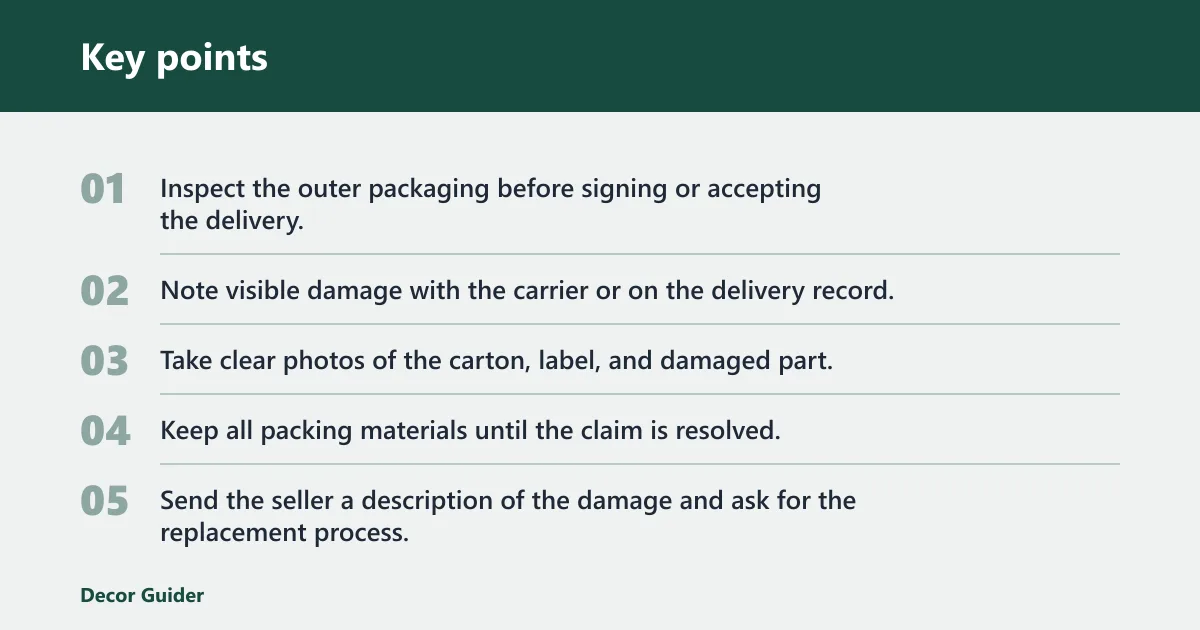
Start with the carton, not the cabinet face. On arrival, inspect outer packaging before you sign or accept the shipment. If the packaging is damaged, note it right away and bring it to the carrier. If you wait, the claim becomes harder to support and a replacement can take longer.
Outer carton inspection on arrival
Look for crushed corners, punctures, wet spots, torn wrap, and broken banding. If any outer packaging damage is visible, note it on the delivery receipt or tell the carrier before the truck leaves. The same source says damage to outer packaging must be noted and brought to the carrier.
Photos, carrier notice, and saved packaging
Save all packaging material for claims. CabinetNow instructs customers to save all packaging material and to send photos and a description for damaged-item claims. That includes cartons, inserts, corner protection, and pallet parts if the shipment used them. Without that evidence, replacement requests can slow down.
Picture a base cabinet of about that size that arrives with a crushed top corner and a torn carton. The most practical response is simple: note the damage immediately, photograph the carton before opening it, keep the packing, and contact the seller for the claim steps before disposing of anything.
Replacement request steps
- Inspect the outer packaging before signing or accepting the delivery.
- Note visible damage with the carrier or on the delivery record.
- Take clear photos of the carton, label, and damaged part.
- Keep all packing materials until the claim is resolved.
- Send the seller a description of the damage and ask for the replacement process.
What changes for imported cabinet orders?
Imported cabinet orders need a landed-cost check, not just a freight quote. You need to know who pays for packing, who pays freight, and where responsibility changes hands. If customs is involved, confirm broker handling before the order ships so the invoice does not change after departure.
Landed cost and freight responsibility
Landed cost should cover product price, packing, freight, and any import charges that apply. For imported cabinets, the shipment may also need a customs broker or clearance support. If the order is large, a small difference in freight responsibility can have a bigger effect than a small item discount.
Where Incoterms fit and where they do not
Incoterms 2020 matter when a buyer and seller are setting delivery responsibility for a cross-border shipment. They do not describe every domestic cabinet order, and they do not erase the need to confirm packing, freight, or broker responsibility. Use them only when the seller actually uses an Incoterms term on the quote.
If the order is imported, ask three questions before checkout: who pays for packing, who pays for freight, and who confirms customs or broker handling. Those answers often matter more than a small product discount.
Frequently asked questions
Why are kitchen cabinets so expensive?
Kitchen cabinets cost more because they are built from multiple parts, need careful packing, and often ship as bulky freight. The product price is only part of the total. Delivery, handling, fuel surcharge, and damage risk can raise the final invoice, especially on larger or remote orders.
Why does shipping cost so much?
Shipping costs rise when a cabinet order takes more space, needs more packing, or must move by freight instead of parcel. Delivery access also matters. If the site needs a liftgate, an appointment, or redelivery, those service needs can add cost beyond the base shipping line.
Why are shipping costs so high?
Cabinets are awkward to move compared with smaller goods. They may require palletizing, extra carton protection, and more handling at each handoff. Remote destinations, oversized fronts, and failed delivery attempts can push the bill higher, so the quoted shipping price may not reflect the full delivered cost.
Why are cabinets so expensive?
Cabinets are expensive because the price includes more than wood or box material. Construction, packing, handling, and transit protection all affect the total. If the order is large, oversized, or shipped to a harder-to-reach address, the delivered price can climb well above the product subtotal.
Products related to this article
Sponsored / affiliate links. As an Amazon Associate I earn from qualifying purchases. I may earn additional commission from eligible campaigns.