What Does White Glove Delivery Cost for Furniture?
White glove delivery for furniture is commonly reported at about $100 to $300 for standard items, with heavier or assembly-heavy pieces often running about $200 to $600 or more. Retailers and delivery programs commonly price these services by access, assembly, and haul-away rather than a flat national rate. Miss the add-ons, and the final bill can jump fast. This guide lays out delivery, assembly, room placement, stair carry, and disposal so you can compare a fair quote with curbside or threshold service.
What white glove delivery includes
White glove delivery typically moves furniture into the home, places it where you want it, unpacks it, and removes packaging before the crew leaves. It also often includes assembly or installation, a scheduled delivery window, and a two-person crew for bulky or fragile pieces.
That service covers more than a drop-off. It is for furniture that is hard to maneuver, easy to damage, or awkward to assemble after delivery.
Room-of-choice placement
Room-of-choice placement means the crew brings the item past the front door and into the room you specify. A sofa goes to the living room. A bed frame goes to the bedroom. A dining table goes to the dining area, not just the entryway.
Unpacking and debris removal
Per the service definition, white glove delivery includes unpacking the item and removing packaging materials before the team departs. That usually means cardboard, foam, plastic wrap, and other shipping debris from the item itself.
Assembly or installation
Furniture white glove delivery also includes assembly or installation for many items, and the team checks features before leaving. That matters for bed frames, sectionals with modular pieces, power recliners, and large tables that need leveling or configuration.
Scheduled delivery windows and two-person crews
Premium delivery is usually appointment-based rather than a broad drop-off day. The two-person crew matters because large furniture often cannot be safely carried, turned, or placed by one person.
Furniture delivery cost worksheet

This worksheet helps you judge a quote before checkout. Use it as a yes/no checklist, then add the fees that apply to your order. If the total is close to curbside service plus a separate installer, the quote may still be fair. If several add-ons stack up, ask for an itemized breakdown.
As a pricing sanity check, compare the quote with what retailers and carriers disclose on their delivery pages: many furniture stores separate room-of-choice service, assembly, stairs, and haul-away into distinct line items, while freight carriers publish accessorial charges for liftgate, residential delivery, inside pickup/delivery, and limited access. That structure is why the same sofa can price very differently from one address to another.
| Line item | Yes/no check | What to ask for | Estimate note |
|---|---|---|---|
| Base delivery fee | __ yes / __ no | Standard last-mile delivery charge | Start with the quoted delivery charge |
| Room-of-choice access | __ yes / __ no | Inside placement beyond the doorway | Often bundled in white glove service |
| Stairs or elevator carry | __ yes / __ no | Number of flights, elevator availability, building rules | Common add-on for upper floors or long carries |
| Assembly or installation | __ yes / __ no | Bed frame build, sectional setup, table leveling, recliner hookup | Usually higher for complex items |
| Haul-away service | __ yes / __ no | Removal of an old sofa, mattress, or similar item | Usually optional and priced separately |
| Distance surcharge | __ yes / __ no | Extra mileage or remote-area fee | More common outside core metro zones |
- Check whether the quote already includes room-of-choice placement.
- Ask if stairs, an elevator carry, or a long hallway adds a fee.
- Confirm whether assembly is included for each item, not just some of them.
- Separate packaging removal from old-item haul-away.
- Look for distance charges if the delivery address is outside a standard zone.
- Add the line items together before you compare it with curbside or threshold delivery.
How much does white glove delivery cost for furniture?

For most shoppers, the cost depends less on a single national rate than on the delivery bundle around the item. The final total usually reflects item type, access conditions, and the labor needed on site.
That spread comes from item type, access conditions, and the labor needed on site. A sofa on the first floor is one thing. A sectional for a third-floor apartment with a narrow turn is another.
Retailer programs and freight accessorial schedules are usually the best way to verify those bands: a store’s delivery page may price threshold, room-of-choice, and setup separately, while freight carriers publish charges for residential service, liftgate, limited access, appointment delivery, and inside delivery. If a quote is much lower than those components imply, ask what is missing.
Cost drivers by item type
Big, heavy, and fragile pieces take more labor and more time. Bed frames, sectionals, power recliners, and large tables often need assembly, positioning, and feature checks before the crew leaves, which pushes the quote upward.
Cost drivers by access conditions
Stairs, elevators, tight corners, door clearances, and building access rules can all raise the price. A straight walk to the room is simple. A protected lobby, freight elevator booking, or a tight stairwell adds time and handling risk.
Why larger or more complex items cost more
Larger pieces often need two people, more padding, and more careful maneuvering. If the item must be leveled, wired, or fitted together on site, labor becomes part of the delivery cost instead of a minor add-on.
Say your order is a power recliner for a townhouse with one narrow flight of stairs. The base fee may look reasonable, but stair carry and installation can move the final total well above curbside delivery. The quote is still fair if those services are itemized clearly.
What fees can increase the quote?
Extra fees usually come from access, labor, and disposal. The most common add-ons are stair or elevator carry, multiple-item handling, assembly complexity, and old-item removal. If your checkout page is vague about any of those, the final invoice can end up higher than expected.
Stairs, elevators, and tight corners
Stairs and elevators change how long the crew spends on site. Tight hallways, small landings, and sharp turns can also slow the move and raise the price because the item may need to be rotated, lifted, or partly disassembled.
Multiple-item orders and oversized pieces
A set of pieces can cost more than one large item if each piece needs placement or assembly. Oversized sectionals, king beds, and large dining tables often take more coordination than a single boxed chair or small cabinet.
Assembly complexity and installation time
Simple bolt-on legs are not the same as a multi-piece bed frame or a powered recliner that needs setup and testing. The more steps required, the more likely the service fee will rise.
Old-item removal and haul-away
Haul-away service removes an old sofa, mattress, or other item from the home. It is usually optional and often costs extra because the crew has to move the old item out, load it, and dispose of it separately from the new delivery.
White glove vs curbside vs threshold delivery
These services are not interchangeable. Curbside delivery is the cheapest baseline. Threshold delivery goes just inside the first doorway. White glove delivery is the full in-home option with placement, unpacking, and usually assembly. If you need setup or debris removal, white glove is the relevant comparison.
Curbside delivery
Curbside delivery is a doorstep or loading-dock drop-off. It does not include unpacking, assembly, or room placement, and the customer handles setup. It is the lowest-cost alternative when you can move and assemble the furniture yourself.
Threshold delivery
Threshold delivery brings the item inside the first doorway only. It is not room-of-choice service, and it does not normally include assembly. It is easy to confuse with white glove, but the scope is much smaller.
White glove delivery
White glove delivery includes in-home placement, unpacking, packaging removal, and often assembly or installation. That wider scope is why it costs more. It is the right comparison when you want the item delivered ready for use.
Is white glove delivery worth it for your furniture?
It is worth paying for when the furniture is large, heavy, fragile, or difficult to assemble, or when your building makes delivery hard. It is often too much for simple items that can be dropped at the door and assembled easily by one person with basic tools.
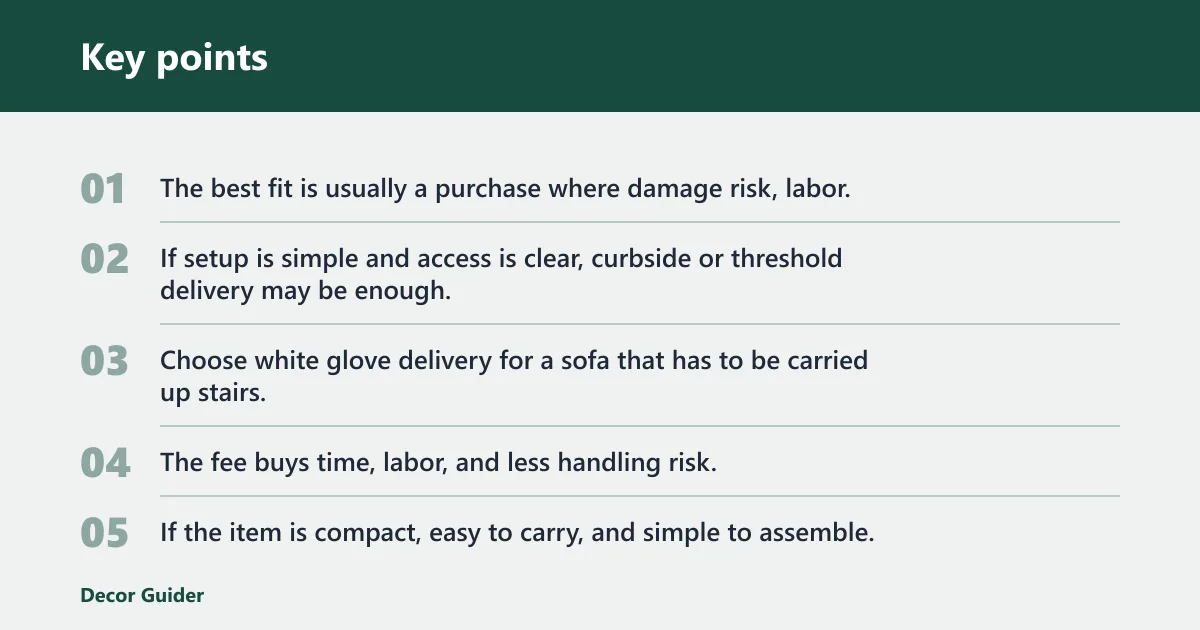
The best fit is usually a purchase where damage risk, labor, or building access would make a basic delivery frustrating. If setup is simple and access is clear, curbside or threshold delivery may be enough.
When it is worth paying
Choose white glove delivery for a sofa that has to be carried up stairs, a bed frame that needs assembly, or a large table that must be leveled and placed in a specific room. The fee buys time, labor, and less handling risk.
When curbside or threshold is enough
If the item is compact, easy to carry, and simple to assemble, the premium may not pay off. A boxed side table or a straightforward chair may not justify room-of-choice placement, debris removal, and a two-person crew.
Best-fit cases for sofas, beds, and large tables
A common first-time mistake is ordering a sectional for a small apartment without measuring the turns, elevator, and doorway widths first. Suppose the sofa fits the room but not the stair bend; the delivery can stall before placement, and the quote may need to be revised.
For beds, the value often comes from assembly and placement. For large tables, it comes from careful moving and leveling. For sofas and recliners, it often comes from the mix of size, weight, and packaging cleanup.
What to confirm before you book
Before checkout, ask exactly what the quote includes, where the crew will carry the item, whether assembly and debris removal are covered, and whether haul-away costs extra. Also confirm appointment rules and damage-claim steps in case the furniture arrives damaged or cannot fit.
What the quote includes
Ask for a line-item price that separates base delivery, room-of-choice access, stairs or elevator carry, assembly, distance, and haul-away. If the seller only gives one lump sum, you may not know what changed when the final invoice arrives.
Delivery access details to confirm
Measure doorways, stair turns, elevator size, and any building restrictions before ordering. A missing freight elevator booking, a strict loading window, or a tight corner can turn an ordinary delivery into a special-access job.
Assembly, debris removal, and haul-away terms
Do not assume packaging removal includes old-item removal. Those are separate services. Packaging removal clears the boxes and foam from the new delivery. Haul-away removes the old sofa, mattress, or other item from the home.
Damage claims and appointment rules
Confirm how damage is noted at delivery, how long you have to report an issue, and whether the crew must refuse a delivery if access is unsafe or the item will not fit. Those details matter more than a glossy service name.
Picture a dining table that arrives with a four-legged base and a separate top. White glove service can make sense if the table must be carried through a narrow hallway, assembled, and leveled in place. If the room is open and assembly is minimal, the premium may be hard to justify.
Frequently asked questions
What does white glove delivery include for furniture?
It typically includes in-home delivery, room-of-choice placement, unpacking, packaging removal, and assembly or installation when required. Furniture white glove delivery also includes feature testing before the crew leaves. That makes it very different from curbside drop-off or threshold delivery.
Is white glove delivery worth it for a sofa or bed frame?
Yes, often. A sofa or bed frame usually justifies white glove service when it needs stairs, a tight turn, or full assembly. If the item is simple to move and set up, curbside or threshold delivery may be enough and less expensive.
Why is white glove delivery more expensive than curbside delivery?
White glove delivery costs more because the crew brings the item inside, places it in the room, unpacks it, removes packaging, and often assembles it. Curbside delivery stops at the door or dock and leaves all setup to you, so the labor is much lower.
What extra fees can increase white glove delivery cost?
Common add-ons include stairs, elevator carry, tight corners, multiple-item handling, installation time, distance surcharges, and haul-away service. These fees reflect the time and labor needed to move the item safely and complete setup. Ask for each charge separately.
How long does furniture white glove delivery take on site?
The on-site time depends on the item and access conditions. A simple placement may be quick, while a bed frame, sectional, or power recliner can take longer because assembly, positioning, and feature checks are part of the service. Building access can add more time.
Sources
Retail delivery pages and freight carrier accessorial schedules reviewed for service definitions and pricing structure: Wayfair delivery information, Ashley Furniture delivery and service information, Saia accessorial charges, XPO accessorial charges, and RL Carriers accessorial services. These sources are commonly used to compare delivery scope, access fees, and setup-related charges across furniture and freight shipments.
Products related to this article
Sponsored / affiliate links. As an Amazon Associate I earn from qualifying purchases. I may earn additional commission from eligible campaigns.