Can You Ship a Bookshelf Cheaply?
Shipping a bookshelf can be relatively inexpensive if it is flat-pack, weighs under about 40 lb, and is sent by parcel service; it may run roughly $30 to $120, while large assembled units often cost about $150 to $400 or more to move. Poor packing can trigger damage claims, dimensional surcharges, and return costs. This guide compares carrier prices, shows when local sale beats shipping, and maps the cheapest safe method by bookshelf type and packing style.
Shipping cost factors for bookshelves
Yes, but only when the packed carton stays compact, the weight stays moderate, and the service stays on ground. A flat-packed bookcase ships best because carriers price by size and weight together. If the packed box grows long, wide, or bulky, the label price can jump even when the scale weight stays the same.
The cheapest choice is usually to disassemble the bookshelf, pack the panels flat, and send it by ground. That often keeps the shipment in parcel territory instead of pushing it into oversized pricing or freight. If the bookshelf is particleboard or MDF and the finish is plain, shipping can still be cheaper than replacing it; if it is heavy solid wood or antique, local sale often wins.
| Bookshelf type | Packed dimensions | Likely carrier class | Cheapest practical service | Common surcharge risk | Worth shipping vs buying locally? |
|---|---|---|---|---|---|
| Flat-packed bookcase | About 50 × 32 × 8 in | Heavy parcel | UPS Ground | Dimensional weight, seam bulge, residential delivery | Yes, often worth it for good-condition units |
| Assembled particleboard shelf | Varies, often bulky and awkward | Heavy parcel or oversized parcel | UPS Ground if it fits parcel limits | Dimensional weight, oversize fees, corner crush | Sometimes, if replacement cost is low |
| Solid wood case | Varies, often dense and tall | Heavy parcel or freight-style quote | Ground only if dimensions stay within limits | Weight, dimensional weight, declared value, damage risk | Usually only if the unit is valuable |
| Glass-front or antique cabinet | Varies, often larger than standard cartons | Oversized parcel or freight | Usually not the cheapest option | Glass breakage, veneer failure, higher packing cost | Often no, unless the item has high resale value |
What makes bookshelf shipping expensive?
Size and weight drive the price. Carriers bill the higher of actual weight or dimensional weight, so a light but bulky carton can cost more than a dense one. Route length matters too: longer lanes cost more, and air service costs much more than ground.
Dimensional weight in plain terms
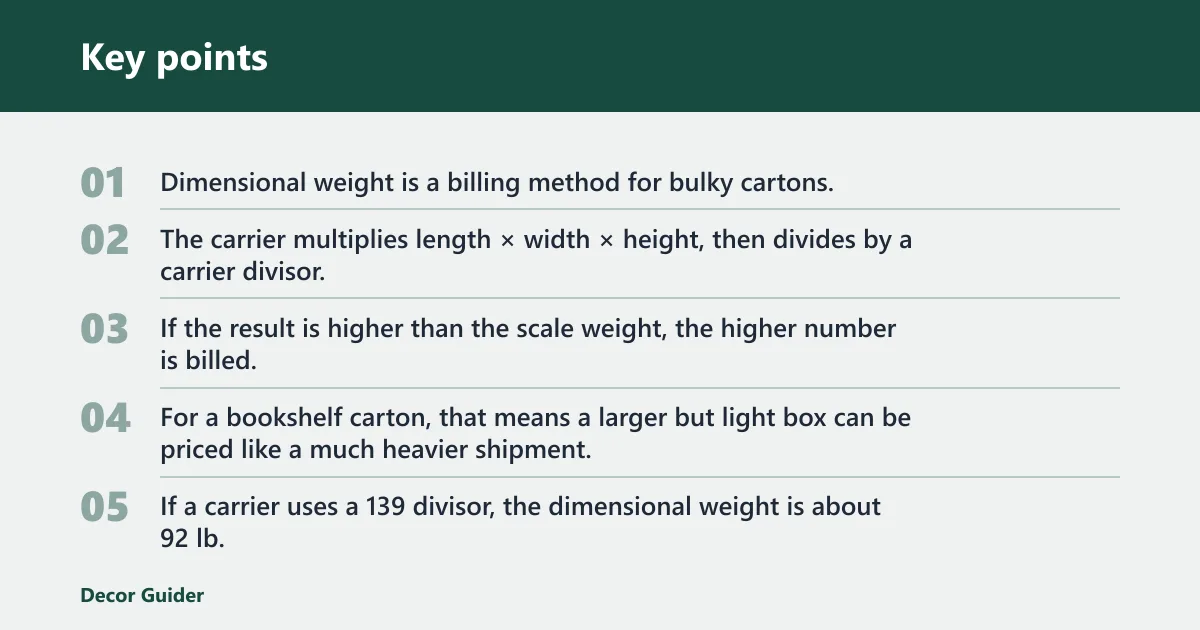
Dimensional weight is a billing method for bulky cartons. The carrier multiplies length × width × height, then divides by a carrier divisor. If the result is higher than the scale weight, the higher number is billed. For a bookshelf carton, that means a larger but light box can be priced like a much heavier shipment.
Suppose a carton is 50 × 32 × 8 inches. The volume is 12,800 cubic inches. If a carrier uses a 139 divisor, the dimensional weight is about 92 lb. If the actual weight is 40 lb, the bill may be based on about 92 lb rather than 40 lb.
Route, service level, and ZIP code effects
Origin and destination ZIP codes change price. The example lane from Seattle, WA 98101 to Miami, FL 33130 shows how a long cross-country shipment can still move by parcel, but the price rises with distance and service level. UPS Ground in that lane was $139.48 and took 8-9 business days.
Air services cost substantially more. In the same lane, FedEx Ground was $221.51, UPS 3Day Select was $263.04, and UPS 2nd Day Air was $376.06. The gap shows why ground is the cheap option when the carton can travel safely by truck.
Extra fees that can change the total
Several fees can change the final bill. Residential delivery, oversized surcharges, and declared value can add cost. Declared value is not the same as included coverage, and each carrier handles it differently. If the bookshelf is fragile or valuable, that line item deserves attention before you buy the label.
A common first-timer mistake is measuring the bare shelf instead of the packed carton. Always measure after the box, padding, tape, and strapping are in place. A carton that looks manageable on the floor can cross a billing threshold once it is sealed.
Which bookshelf type is cheapest to send?
Flat-packed bookshelves are cheapest to send because they ship as a heavy parcel instead of as a bulky assembled cabinet. Assembled particleboard can still be economical if the box stays within parcel limits, but solid wood, glass-front, and antique cases raise risk fast. The item’s construction matters as much as its size.
Flat-packed bookshelves
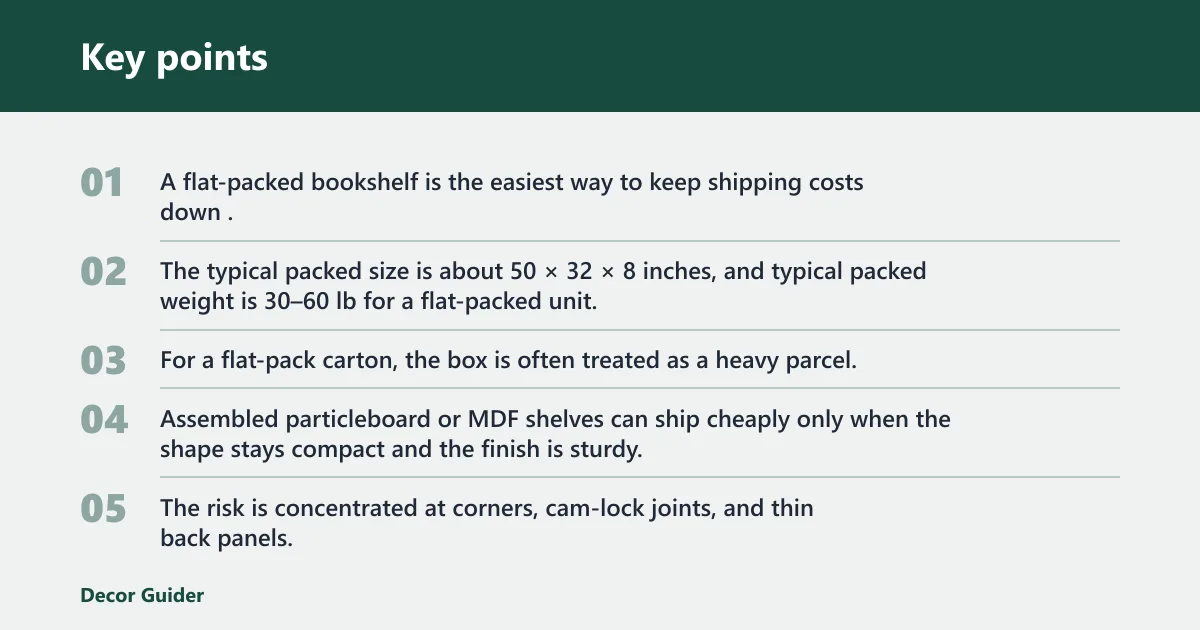
A flat-packed bookshelf is the easiest way to keep shipping costs down. The typical packed size is about 50 × 32 × 8 inches, and typical packed weight is 30–60 lb for a flat-packed unit. That is why flat-packed shipping is usually cheaper than assembled shipping.
For a flat-pack carton, the box is often treated as a heavy parcel. That keeps it in the normal ground network and avoids the jump to freight pricing. It also leaves room to protect the panels without building a giant custom crate.
Assembled particleboard or MDF shelves
Assembled particleboard or MDF shelves can ship cheaply only when the shape stays compact and the finish is sturdy. The risk is concentrated at corners, cam-lock joints, and thin back panels. If the bookcase has to be wrapped in a large carton, dimensional weight can erase the savings.
Solid wood, glass-front, and antique cases
Solid wood cases are denser and often heavier, so parcel rates climb faster. Glass doors add breakage risk and require more padding, which adds size. Antique pieces are the least forgiving because veneer failure, loose joinery, and corner damage can make shipping cost more than the item is worth.
Picture a 5-shelf particleboard bookcase with fixed shelves and a thin backing panel. If you ship it assembled, the back panel can flex in transit and the corners can crush. If you disassemble it and pack the shelves flat, the same piece often fits a cheaper parcel class.
How do you pack a bookshelf for parcel shipping?
Pack the bookshelf flat, keep the box tight, and protect the edges that fail first. Cardboard between panels, foam or cardboard edge guards, a hardware bag taped inside the box, and tight strapping or banding all help reduce damage and keep the carton shape under control. Good packing also helps avoid dimensional-weight surprises.
-
Remove shelves and hardware. Take out adjustable shelves first, then separate fixed panels only if the design allows safe disassembly. Bag screws, pins, and shelf clips together so nothing rattles loose or disappears in transit.
- Use one labeled bag for the full hardware set.
- Tape the bag inside the carton, not loose in the box.
-
Place cardboard between panels. Stack flat panels with cardboard in between so veneer does not rub through during vibration. This matters most for laminate and veneer edges, which fail quickly when they slide against each other.
-
Protect corners and edges. Fit foam or cardboard edge guards on all exposed corners. Extra protection is worth it on solid wood, stained veneer, and any piece with glass doors, because corner crush is one of the fastest ways to ruin a bookshelf in transit.
-
Keep backing panels flat. Backing panels are thin and bend easily, so keep them behind stiffer parts or sandwich them between sheets of cardboard. If a shelf has a thin backer, do not leave it exposed at the outside of the carton.
-
Strap the bundle tightly. Band the whole stack so the panels do not shift inside the carton. Tight banding helps prevent bulging seams, which can push a box over a carrier size limit.
-
Seal the carton cleanly. Tape all seams and reinforce the ends. A cleanly sealed box is easier to measure and less likely to open at the seam when handlers lift it by the long side.
Say your shelf is a 50 × 32 × 8 flat-pack unit with a backing panel and a small hardware bag. If the bag is left loose and the panels are not separated by cardboard, the corners can rub and the finish can scuff. If the bag is taped inside and the stack is banded tightly, the same shipment is much less likely to arrive damaged.
Can USPS, UPS, or FedEx carry it?
Yes, but carrier fit matters. USPS has stricter size limits than UPS and FedEx, so some bookshelves that parcel-shipment companies can accept will still fail USPS rules. UPS Ground is the lowest-priced example service here, and FedEx Ground is the main comparison. Air service is much more expensive than ground for this kind of carton.
USPS size and weight limits
USPS has a length-plus-girth ceiling of 130 inches. A 50 × 32 × 8 carton lands exactly on that ceiling on paper, which leaves no slack for bulging seams or a sloppy wrap. If the box swells even a little, it can cross the limit.
That is why a bookshelf carton that looks fine on the workbench can still become nonmailable after packing. USPS can work for some disassembled shelves, but the carton must stay within the size ceiling and the weight limit for the chosen class.
UPS Ground as a low-cost baseline
UPS Ground is a practical starting point for large heavy cartons. In the quoted Seattle-to-Miami lane, UPS Ground was $139.48, which was lower than the FedEx Ground example and far below the air options. The same lane also shows that service level matters as much as box shape.
FedEx Ground as the main comparison
FedEx Ground is a direct comparison service for bookshelf shipping. In the example lane, it priced at $221.51, which was higher than UPS Ground in the same shipment. That gap makes it worth checking both before booking, especially on long routes where one carrier may price dimensional weight more aggressively.
Bookshelf shipping decision table
Use this table to decide whether to ship, sell locally, or replace. The safest cheap option is usually a flat-pack or disassembled parcel that stays within ground-service limits. Once the shelf is large, fragile, or antique, the cost and risk can exceed the value of local replacement.
| Bookshelf type | Pack size signal | Cheapest practical move | Typical risk | Ship or buy locally? |
|---|---|---|---|---|
| Flat-pack, standard size | About 50 × 32 × 8 in | Parcel ground, tightly packed | Dimensional weight if the carton swells | Ship if the unit is worth keeping |
| Disassembled particleboard | Flat panels, moderate weight | Parcel ground with cardboard separators | Chip-out at edges and cam-lock holes | Often yes, if replacement would cost more |
| Assembled solid wood | Large, dense, awkward | Ground only if parcel limits still fit | Corner crush, higher dimensional bill | Usually local sale is cheaper |
| Glass-front antique | Fragile, irregular, oversized | Special packing or non-parcel handling | Glass breakage, veneer failure, declared value cost | Often better to sell locally |
Should you disassemble a bookshelf before shipping? Usually yes. Disassembly lowers cost because the box gets smaller and lighter, and those two numbers drive the label price. It also makes the carton easier to brace, which reduces damage risk on veneer, corners, and backing panels.
Frequently asked questions
Can you ship a bookshelf cheaply?
Yes, if the bookshelf is flat-pack or can be disassembled into flat panels, and if the packed carton stays within parcel limits. Ground service is the cheapest path in most cases. Cheap shipping falls apart when the box gets bulky, the route gets long, or the piece needs heavy protection.
What is the cheapest way to ship a bookshelf?
The cheapest way is to disassemble it, keep the carton tight, and send it by ground service such as UPS Ground. Use cardboard between panels, edge guards, and a taped hardware bag. That keeps the shipment closer to the actual weight price instead of a dimensional-weight price.
Is it cheaper to ship a bookshelf assembled or flat-packed?
Flat-packed is usually cheaper. A flat-packed bookcase ships best, and the typical packed size is about 50 × 32 × 8 inches with a typical packed weight of 30–60 lb. An assembled unit is more likely to trigger dimensional weight, oversize fees, and damage risk.
Can I ship a bookshelf with USPS?
Sometimes. USPS has a length-plus-girth ceiling of 130 inches, and a 50 × 32 × 8 carton lands exactly on that ceiling on paper. That leaves no room for bulging seams, so many bookshelf cartons are safer with UPS or FedEx ground service.
What box size do I need to ship a bookshelf?
Use a carton that fits the disassembled panels with padding but does not leave empty space that inflates size. A typical flat-packed bookshelf ships around 50 × 32 × 8 inches. Measure the finished carton before buying a label, because carriers bill the packed box, not the bare shelf.
How much does it cost to ship a bookshelf?
Cost varies by route, size, and service level. That spread shows why ground is the cheapest practical choice for many bookshelves.
Products related to this article
Sponsored / affiliate links. As an Amazon Associate I earn from qualifying purchases. I may earn additional commission from eligible campaigns.