What Size Tarp Do You Need for a Queen Mattress?
For a queen mattress, choose a tarp at least 9 by 12 feet; if you want full wrap with overlap, step up to 10 by 12 or 10 by 14 feet. A tarp that is too small can leave corners exposed, which invites dirt, moisture, and tearing during a move or in storage. This guide explains the sizing formula, the tradeoffs by tarp type, and when a mattress bag is the safer choice.
This guide is part of our Ratchet straps and tie downs guide series.
Queen mattress size basics
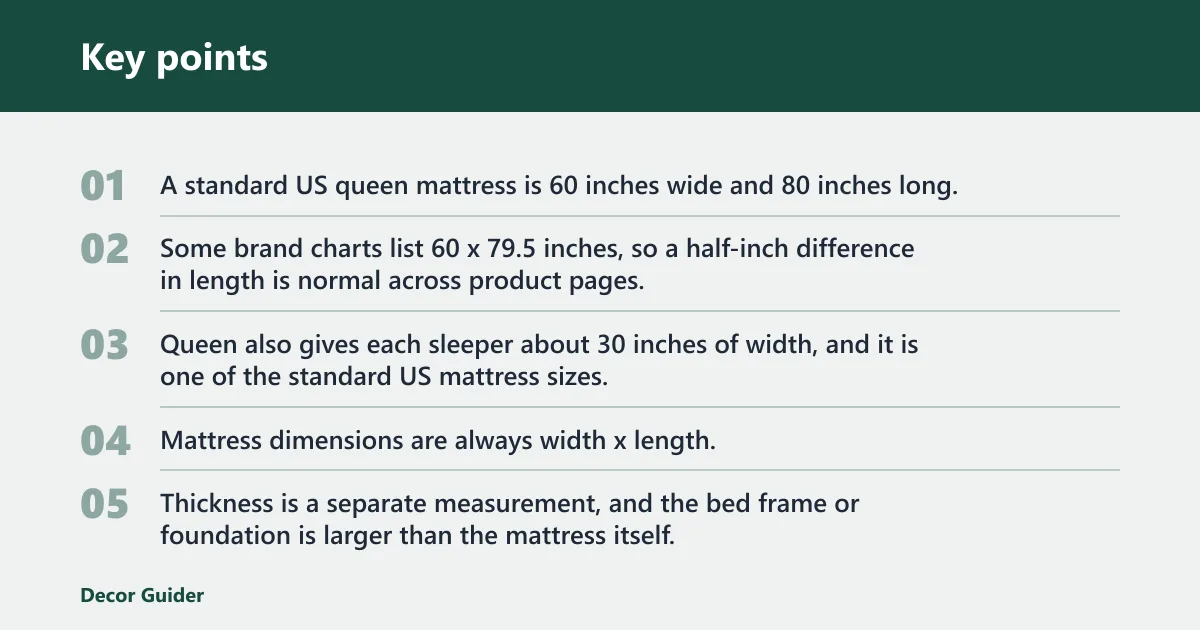


A standard US queen mattress is 60 inches wide and 80 inches long. Some brand charts list 60 x 79.5 inches, so a half-inch difference in length is normal across product pages. Queen also gives each sleeper about 30 inches of width, and it is one of the standard US mattress sizes.
Mattress dimensions are always width x length. Thickness is a separate measurement, and the bed frame or foundation is larger than the mattress itself. That matters here because a tarp sized only to the mattress face can run short once you fold under the edges and secure the corners.
Where queen sits in the bed-size chart
Queen sits between full and king. In practical sizing terms, full is smaller and easier to cover, king is wider and usually needs more material, and California king shifts the proportions again with added length. Queen is the middle ground that most often drives the tarp-or-bag decision because it is large enough to need real overlap, but still small enough that a properly chosen cover remains practical.
That size range matters for moving and storage, too. A queen is large enough to need real overlap, but still small enough that a properly chosen tarp or bag is practical.
What size tarp do you need?
For flat coverage, a tarp around 9 by 12 feet is usually the minimum useful size for a queen mattress because it gives you room to cover the 60 x 80 inch surface and still fold under the edges. For a full wrap, 10 by 12 feet is the safer floor, and 10 by 14 feet is better if the mattress is thick or you want more slack for tape and knots.
The basic sizing formula is simple: mattress width plus twice the overlap allowance, and mattress length plus twice the overlap allowance. For a queen, that means you need to add enough material for folding under the mattress, then add more if you plan to tie, tape, or knot the tarp around the load.
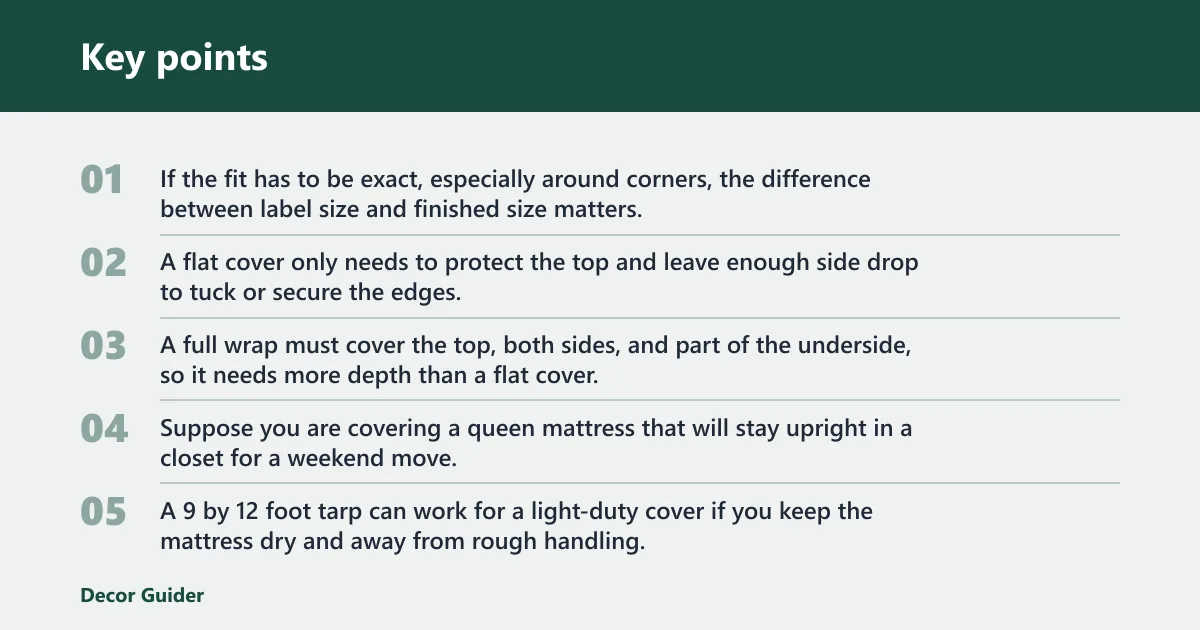
When you compare tarp labels, remember that a tarp’s labeled size is usually its cut size, not always the finished size you actually get after hems, seams, or reinforced edges. That is why a 9 x 12 label can behave more like a slightly smaller working cover once you account for the usable area. If the fit has to be exact, especially around corners, the difference between label size and finished size matters.
Flat cover versus full wrap
A flat cover only needs to protect the top and leave enough side drop to tuck or secure the edges. A full wrap must cover the top, both sides, and part of the underside, so it needs more depth than a flat cover. That is why the same queen mattress can fit one tarp size for simple dust protection and a larger one for transport.
Suppose you are covering a queen mattress that will stay upright in a closet for a weekend move. A 9 by 12 foot tarp can work for a light-duty cover if you keep the mattress dry and away from rough handling. If that same mattress is going into a truck with straps, a 10 by 12 or 10 by 14 foot tarp is the better call.
Worked sizing logic helps here:
– Flat cover: queen mattress face = 60 x 80 inches.
Add overlap on both sides of the width and length for tuck-in. If the cover only needs to drape and protect the top, the minimum can stay near 9 x 12 feet.
– Full wrap: queen mattress face = 60 x 80 inches.
Add overlap on all sides so the tarp can go under the mattress and still secure at the corners. This usually pushes the choice to 10 x 12 feet or larger.
– Moving wrap: queen mattress face = 60 x 80 inches.
Add extra slack for tape, knots, and handling so the wrap does not pull tight in transit. That is where 10 x 14 feet becomes the safer option.
Why overlap and tie-down slack change the size
Overlap is the extra material beyond the mattress width and length. You need it because the tarp has to fold under the mattress, then still leave room for tying, taping, or securing corners. If you skip that slack, the tarp may fit flat but fail as soon as you move it.
A common first-timer mistake is buying by the mattress face alone. A queen mattress may look like a simple 60 x 80 inch rectangle, but the wrap adds real depth, and that depth grows once you secure the corners.
How mattress thickness affects the final choice
Thickness does not change the queen’s width and length. It does change the tarp depth you need for a full wrap. A thinner mattress is easier to cover with less slack, while a thicker mattress pushes you toward the larger end of the size range, especially if you want the tarp to close cleanly underneath.
For wrapped transport, thickness matters more than for a quick dust cover. If the mattress is close to the thickness limit listed on a moving bag or if it has a plush top, a bigger tarp or a mattress bag is the safer path.
Using the queen’s 60 x 80 inch size as the starting point, thickness changes the wrap like this:
– 10-inch mattress: the wrap is easier to close, so the lower end of the tarp range is more realistic.
– 12-inch mattress: the added side depth makes a 10 x 12 foot tarp more comfortable for full wrap.
– 14-inch mattress: the side walls take up more fabric, so 10 x 14 feet is the safer choice for a cleaner closure.
What size tarp table
| Use case | Mattress size | Minimum tarp dimensions | Recommended extra allowance for overlap and tie-down | Thin vs thick mattress note |
|---|---|---|---|---|
| Flat cover | 60 x 80 inches | 9 x 12 feet | Allow at least 12 to 18 inches beyond the mattress on each side | Thin mattresses fit more easily; thicker ones need more side drop |
| Full wrap | 60 x 80 inches | 10 x 12 feet | Allow about 18 inches or more for folding under and securing corners | Better for thinner mattresses; thick mattresses often need 10 x 14 feet |
| Moving wrap | 60 x 80 inches | 10 x 14 feet | Allow extra slack for tape, knots, and handling during loading | Best for thicker mattresses and rougher transport conditions |
This table is built for the actual decision, not just the mattress label. If you only need dust protection, the smaller end can work. If you need wrap and tie-down, the safer size jumps fast.
How much extra tarp do you need?
Plan on extra material for three things: folding under the mattress, securing the corners, and leaving slack for tape or knots. For a queen, that usually means adding at least 12 to 18 inches on each side for a flat cover, and more when the tarp has to close underneath.
The practical rule is to size for the job, not just the mattress. A queen’s 60 x 80 inch face is only the starting point. Once you add wrap depth, the needed tarp size often moves up to the next standard retail size.
Overlap for folding under the mattress
Overlap keeps the mattress from riding bare at the edges. Without it, the tarp can slip off when you move the bed or shift it into storage. For a queen, folding under the mattress is the part that separates a loose cover from real protection.
If the mattress will lie flat on a dolly or in a storage unit, a little more overlap is worth it. The underside is the first place dirt and scuffs show up when a tarp is too tight.
Slack for taping, tying, or knotting corners
Tie-down slack is not optional if the mattress is moving in a truck or van. You need enough extra material to secure corners without pulling the tarp so tight that it tears at the seams or exposes the sides. That is why 10 x 12 feet is a better starting point than 8 x 10 feet for most wrap jobs.
Picture a queen mattress loaded sideways in a moving van. A tarp that only barely covers the face may stay in place for a minute, then shift when the truck turns. A larger tarp gives you room to fasten the corners without stretching the cover thin.
Thicker mattresses and deeper wrap needs
Thicker mattresses need more depth because the side walls take up more fabric. That is why products sold as moving bags often list a thickness limit. If a bag or tarp is built for a thicker mattress, the wrap closes more cleanly and is less likely to pop open at the corners.
Some moving bag listings use a size like 92 x 60 x 10 inches for a queen, which shows the extra length and thickness allowance built into that style of cover. Other bags are made for mattresses up to 14 inches thick. Those examples show why thickness belongs in the sizing decision, not as an afterthought.
When a mattress bag is the better choice
A mattress bag is usually the safer choice for moving and storage because it is made for full enclosure. A queen moving bag gives you a clearer fit target than a general tarp. If you want cleaner protection and less guesswork, a bag is the better tool.
A tarp still has a place for rough cover jobs, but a mattress bag is easier when you want predictable coverage on all sides. That matters most if you need to protect against dust, moisture, and scuffs during transport or long-term storage.
Compare tarp sizing with bag sizing
A queen mattress bag already matches the mattress shape more closely than a tarp does. The listed 92 x 60 x 10 inch size shows the extra length and thickness allowance built into some moving bags, and the 14-inch thickness fit on some products gives you a clearer ceiling than a loose tarp estimate.
Use the tarp when you need a temporary cover and already have the right size on hand. Use the bag when the mattress is being sealed for storage or moved in a way that could rub, drag, or pinch the edges.
What should you measure before buying?
Measure width, length, and thickness separately. Do not treat thickness as part of the mattress’s width and length, and do not assume the frame size is the same as the mattress size. The bed frame or foundation is larger, so the mattress itself is the number that matters for the cover.
You should also check room and route clearance before the move. A queen sits between full and king in the usual bed-size lineup, so the mattress size alone does not tell you whether the route will be easy. Measure the mattress first, then confirm that the tarp or bag still leaves room for handling.
-
Measure the mattress face.
Check width and length only: for a standard queen, that is 60 x 80 inches. If the brand chart lists 60 x 79.5 inches, use the larger practical wrap allowance so the cover does not end up short. -
Measure the thickness.
Write down the mattress depth separately. Thickness changes whether a flat cover will hold, and it becomes more important if you plan to fully wrap the mattress or secure it for transport. -
Check the handling route.
Measure doors, stairs, and hall turns before choosing a tarp or bag. A mattress that fits the room can still be awkward to turn if the route is tight. -
Choose the protection type.
Pick a tarp for temporary coverage or a mattress bag for storage and moving. If you need full wrap and tie-down, choose the larger size rather than the smallest one that might barely fit.
Frequently asked questions
What size tarp do I need to cover a queen size mattress?
A queen mattress usually needs at least a 9 by 12 foot tarp for basic cover, and 10 by 12 feet is the safer choice if you want full wrap or corner tie-down. That gives you room for folding under the mattress and for handling slack during a move.
How big is a queen mattress in inches?
A standard US queen mattress is 60 inches wide and 80 inches long. Some brand charts list 60 x 79.5 inches, so slight variation can appear between manufacturers. Thickness is separate, and it should be measured on its own before you buy a cover.
Do I need to account for mattress thickness when choosing a tarp?
Yes. Thickness does not change the queen’s width and length, but it does change how much side depth you need for a wrap. A thicker mattress needs more tarp for folding under and for securing corners, especially if you want the cover to stay closed during transport.
What tarp size works if I need to wrap and tie down a queen mattress?
For wrap-and-tie use, 10 by 12 feet is the practical minimum for many queen mattresses, and 10 by 14 feet is better for thicker beds or rougher handling. The extra length and width give you slack for knots, tape, and a more secure closure.
Is a mattress bag better than a tarp for moving a queen mattress?
Yes, if you want the safer and simpler option for storage or transport. A queen mattress bag is made for full enclosure, and some queen moving bags are sold with dimensions that include extra thickness allowance, such as 92 x 60 x 10 inches, with others built for mattresses up to 14 inches thick.
What should I measure besides the mattress itself?
Measure the room, the bed frame or foundation clearance, and the moving path through doors and stairs. Queen is larger than full and smaller than king, so the mattress size alone does not tell you whether the route will be easy. Check those spaces before you choose the cover size.
Products related to this article
Sponsored / affiliate links. As an Amazon Associate I earn from qualifying purchases. I may earn additional commission from eligible campaigns.