How to Ship a Bookshelf Without Damage
Ship a bookshelf by matching the method to the build: flat-pack it if possible, wrap solid wood shelves and frame pieces separately, and use a crate or double-wall carton for glass or veneer.
What makes a bookshelf hard to ship?


The hardest units are long, narrow, heavy, or top-heavy. Those shapes rack more easily, crack at the corners, or crush at the edges. Material matters too: solid wood handles impact better than brittle veneer or particleboard, while open-back frames and glass doors need more restraint than a simple closed box.
Material and construction risk
Solid wood can split at joints if the frame flexes, but it usually handles compression better than engineered wood. Particleboard and MDF chip more easily at edges and strip at fasteners. Open-back bookcases twist more easily because they have less rear bracing, and closed-back units resist that twist better.
Fixed shelves, adjustable shelves, and removable parts change the packing plan. Fixed shelves often mean a heavier one-piece load. Remove adjustable shelves and wrap them separately so the shelf pins do not punch through the side panels during transit.
Size, weight, and center of gravity
Standard bookcases can sometimes move in a reinforced carton, but larger units usually need a pallet or crate. Tall, narrow cases can tip during handling even when they are not very heavy. A high center of gravity can make corner crush and frame twist more likely, especially if the load shifts inside the package.
How should you prep a bookshelf before shipping?
Empty the unit fully, take off loose parts, and record the condition before any padding goes on. Decide whether the bookshelf should travel assembled, partly disassembled, or fully broken down into panels and hardware. That choice depends on the build, the finish, and how much flex the frame can tolerate.
Measure and document the condition
Measure height, width, and depth with a tape measure, then note the weight if the label or maker’s data gives it. Photograph every side, plus corners, joints, shelves, and any pre-existing chips. Those photos matter for insurance and for any claim if the load arrives damaged.
Remove hardware and loose parts
- Empty the shelves. Remove books, decor, clips, and cord pass-through accessories. Loose items become impact loads inside the box or crate.
- Bag the hardware. Put screws, shelf pins, cams, and brackets in a labeled bag. Tape the bag to a disassembled panel only if the tape never touches finished surfaces.
- Separate fragile parts. Take off glass doors, trim, loose shelves, and detachable back panels. Wrap each part on its own so one hard edge does not strike another.
Shipping checklist
- Empty and inspect. Clear every shelf and photograph corners, joints, and any existing wear.
- Remove what can move. Take off loose shelves, hardware, glass doors, trim, and detachable back panels.
- Wrap the finish. Cover the piece with moving blankets before cardboard or stretch wrap goes on.
- Protect corners and edges. Add corner protectors and corrugated edge guards where impacts are most likely.
- Block all voids. Fill empty space so shelves, pins, and trim cannot shift in transit.
- Choose the right base. Use a reinforced carton for flat-pack units and a pallet or crate for larger or fragile pieces.
When to remove glass doors
Remove glass doors whenever the design allows it. Glass should not carry the same compression or vibration as the frame, and hinge points are common failure spots. If the doors stay on, the package needs rigid face protection, full corner support, and freight handling rather than casual parcel treatment.
What box or crate to use by size and material
Use a double-wall carton for flat-pack pieces, removable panels, and lighter engineered-wood parts that can stay flat. Use a palletized crate for solid wood, oversized units, antiques, and glass-door cases. The more the piece can flex, the more structure the shipping container should provide.
How to measure for freight class or a quote
Measure the packed length, width, and height at the widest points, then confirm the final weight after padding and outer packaging are added. Use those packed dimensions when asking for a quote, because the shipping cost is driven by the outer carton or crate, not the bare bookshelf.
Decision table
| Bookshelf type, size, material | Safest shipping method | Prep sequence | Required packing materials | Likely failure risks | Assembled or disassembled | Minimum padding thickness | Parcel or LTL threshold | Glass-door handling | Exact failure points |
|---|---|---|---|---|---|---|---|---|---|
| Flat-pack unit, under 48 in. wide, engineered wood | Parcel in reinforced carton | Empty it; remove loose shelves; keep panels flat; tape hardware bag to an inner board; box with edge blocks | Double-wall carton, foam corner protectors, packing tape, single-wall divider sheets, stretch wrap over carton | Edge crush, puncture, panel scuffing, fastener tear-through | Disassembled | At least 2 inches around exposed edges | Parcel unless the packed shape becomes bulky or rigid | Remove if present and pack separately | Carton corners, fastener holes, exposed panel edges |
| Solid-wood bookcase, 48-72 in. wide, fixed shelves | LTL freight on pallet | Remove trim and shelves if possible; wrap each section; band to pallet; add corner blocks; keep upright | Quilted moving blankets, double-wall corrugated, corner protectors, stretch wrap, pallet, tape | Corner split, rack, corner-to-floor damage, finish scuffing | Partly disassembled if possible | Enough to keep wood off hard surfaces and off the pallet edge | LTL once the piece needs pallet support or becomes too awkward for parcel handling | Remove if possible | Feet, lower corners, rail joints, projecting trim |
| Open-back bookcase, tall and narrow, mixed wood | LTL freight with crate or reinforced carton | Brace the back; remove shelves; pad the frame; block the base; wrap in blankets before carton or crate | Moving blankets, corrugated cardboard edge guards, foam corner protectors, stretch wrap, pallet or crate | Frame twist, rear flex, shelf slip, top-heavy tip damage | Partly disassembled | Padding thick enough to stop back-panel flex and side rub | LTL when the height makes the case unstable in parcel transit | Remove if present and ship separately | Back panel, upper corners, side rails, shelf slots |
| Glass-door bookcase, any size with glazed panels | Crate or specialty freight | Remove glass doors and pack them separately; immobilize hinges; label fragile faces; keep glass off hard edges | Foam corner protectors, double-wall corrugated, custom crate, blanket wrap, packing tape | Glass breakage, hinge punch-through, face abrasion, corner crush | Disassembled whenever possible | Use rigid separation, not compressive wrap against glass | LTL or specialty freight once glass panels are involved | Remove and isolate every panel | Hinge side, glass edges, face contact points, door corners |
| Antique solid-wood case, oversized or high value | Custom crate with liftgate delivery | Document condition; disassemble only if needed; isolate carvings; suspend the piece from the crate floor; secure against vibration | Moving blankets, custom corrugated inserts, foam or cardboard corner protectors, crate, stretch wrap, tape | Finish wear, joint failure, carving impact, compression damage | Keep assembled unless disassembly is safer | Padding should separate carvings and finish from every hard contact point | LTL with crate and liftgate for large or fragile antique pieces | Remove and wrap separately if the design has them | Carvings, joints, feet, decorative edges, crate contact points |
| Long, narrow, top-heavy case, over 72 in. tall | LTL freight, palletized upright | Lower the center of gravity if possible; remove shelves and doors; strap to pallet; add top and side blocking | Double-wall corrugated, corner protectors, moving blankets, stretch wrap, pallet, reinforced tape | Tip-over, rack, top corner crush, base split | Partly disassembled if the design allows it | Enough to stop side sway and protect the upper section | LTL once height and balance make parcel handling unsafe | Remove if present | Top rail, base, rear bracing, upper corners |
What packing materials protect a bookshelf best?
The best materials depend on the surface and the weak points. Moving blankets protect the finish, stretch wrap holds the load together, corrugated cardboard protects edges and panels, and corner protectors absorb impact at the most common damage points. Tape keeps the package closed, but it should never sit directly on a finished surface.
Moving blankets and quilted padding
Quilted moving blankets are the first layer for scratch protection. They cover broad faces, cushion trim, and reduce rub marks during loading. They also work well around corners when the blanket is folded back on itself, which adds extra padding where impacts usually land.
Stretch wrap without surface damage
Stretch wrap stabilizes the load and helps keep blankets in place. Use overlap on each pass so the wrap grips itself and stays tight around the shape. Do not apply stretch wrap directly to lacquer, veneer, or another finished surface; place a blanket or slip sheet between the finish and the film first.
Corrugated cardboard and corner protectors
Corrugated cardboard is best for edge guards, face panels, and custom fillers. Double-wall board generally gives more compression resistance than single-wall board, which matters for corners and long edges under stack pressure. Foam or cardboard corner protectors keep the sharpest points off the floor and off the carton wall.
Packing tape and box closure
Use packing tape for box sealing strength and reinforced seams, not as a surface wrapper. Tape should close the carton, secure folded flaps, and lock around the seams. Keep it off wood veneer, paint, lacquer, and other finished surfaces because adhesive can pull finish or leave residue.
Suppose a 60-inch wide oak bookcase has a shallow chip on one lower corner. Pad that chip before wrapping, because even a small flaw can widen when the carton shifts on a pallet edge or when liftgate handling sets the corner down first.
How do you package different bookshelf types?
Start with the type of shelf, then choose the container. Flat-pack units may fit a reinforced box. Solid-wood and antique pieces usually need a pallet or crate. Glass-door units need separate protection for the panels, and oversized or top-heavy cases should be treated as freight even if the weight seems moderate.
Flat-pack and ready-to-assemble bookshelves
- Break the kit down. Separate panels, shelves, and hardware. Keep each group flat so the load does not bow inside the carton.
- Guard the edges. Add corrugated edge strips and foam corners to the longest sides. That keeps the panel from punching through the box wall.
- Seal the carton. Use a double-wall box when the panel stack is dense or heavy. Reinforce seams with packing tape and add a second tape pass across the bottom.
Solid-wood and antique bookcases
- Pad every face. Wrap the whole piece in moving blankets before any cardboard goes on. This keeps abrasion off older finishes and carved trim.
- Block the weak points. Put corner protectors on feet, arms, and projecting moldings. Those parts fail first when a load gets dropped or set down hard.
- Choose freight protection. Place the wrapped piece on a pallet or inside a crate. Freight handling reduces the chance of corner-to-floor damage compared with loose parcel handling.
Glass-door and closed-back bookcases
Glass doors should usually be removed and packed separately. If the doors stay on, the panel needs rigid face protection and clear spacing so pressure does not bear on the glass. Closed-back designs are less prone to twist, but the back panel can still crease if the carton bows.
Oversized or top-heavy units
Oversized pieces are the ones most likely to move from parcel to freight. A tall, narrow unit with a heavy top should be palletized upright and secured so the center of gravity stays inside the footprint. If the package leans, the frame can rack even before the carrier moves it.
Should you use parcel shipping or freight?
Parcel works only when the bookshelf fits within carrier limits for size, weight, and carton shape. Once the unit becomes long, dense, or awkwardly balanced, LTL freight is safer because it allows palletization, better load control, and liftgate delivery for heavier pieces. Cubic size affects price as much as weight.
When parcel limits become a problem
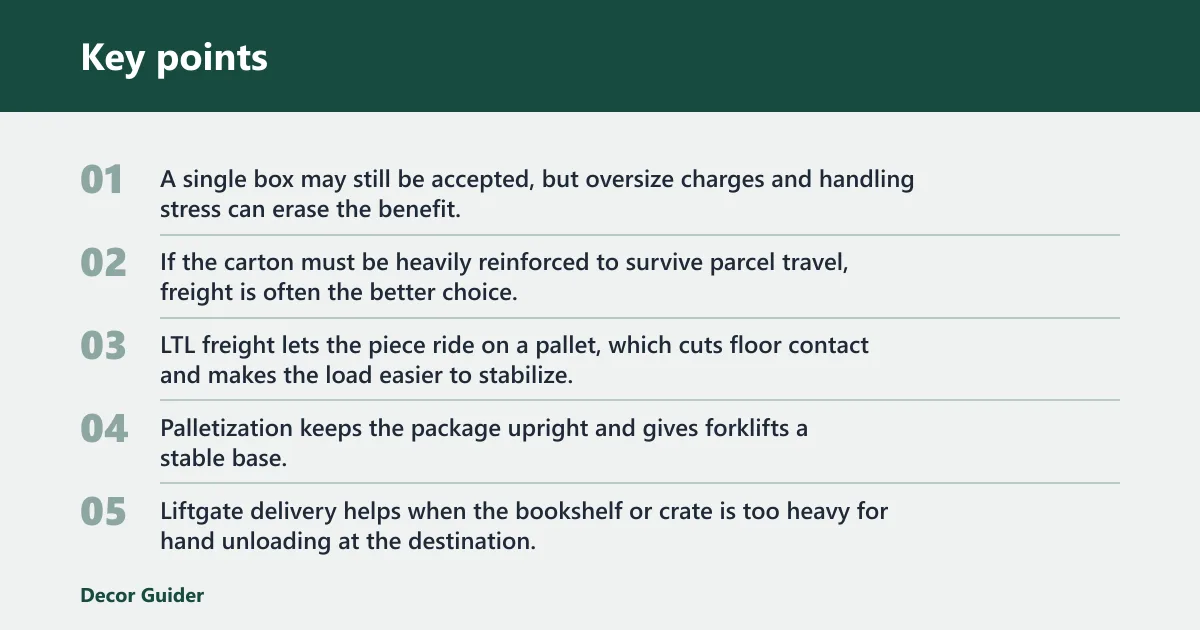
Parcel is a poor fit for long bookcases, heavy solid-wood frames, and anything that needs a pallet or crate to stay square. A single box may still be accepted, but oversize charges and handling stress can erase the benefit. If the carton must be heavily reinforced to survive parcel travel, freight is often the better choice.
Why LTL freight is safer for large units
LTL freight lets the piece ride on a pallet, which cuts floor contact and makes the load easier to stabilize. It also supports larger cartons and custom crates. That matters for open-back units, antique cases, and bookcases with glass doors, where side pressure and corner impact are the main failure points.
Palletization and liftgate delivery
Palletization keeps the package upright and gives forklifts a stable base. Liftgate delivery helps when the bookshelf or crate is too heavy for hand unloading at the destination. If the destination has no dock, liftgate service can lower the chance of a drop at curb level.
How cubic size affects shipping cost
Shipping cost rises with dimensional weight, pallet footprint, and service level. A bulky but light crate can cost more than a denser box because it consumes more trailer space. Distance matters too, but the biggest cost drivers are usually total cubic size, weight class, and whether the shipment needs palletized freight or liftgate service.
Picture a 72-inch tall bookcase that weighs 65 pounds but measures 18 by 14 by 72 inches once packed. The carton volume, not the weight alone, can move it into freight pricing territory because the carrier has to reserve floor space and handle a long, awkward shape.
How do you prevent the most common damage?
Most shipping damage comes from corner crush, edge splits, frame twist, and loose parts moving inside the package. You prevent those failures by stabilizing the shape, padding the edges, blocking voids, and keeping the load from sliding. Dust and moisture matter too, especially on finished wood and veneer.
Corner crush and edge splits
Use foam or cardboard corner protectors on every exposed corner, then reinforce the edges with corrugated strips. For a finished piece, place a moving blanket under the corner protector so the protector does not rub the surface. Corners fail when impact is concentrated in a small point, so spread the load across a wider area.
Shelf rack and frame twist
Rack happens when the rectangle becomes a parallelogram under load. To stop that, remove loose shelves, brace the back, and keep the piece strapped upright on a pallet or inside a crate. A tight wrap around bare finished wood does not solve rack if the frame can still flex inside the package.
Moisture, dust, and scuff damage
Stretch wrap helps as a dust and moisture barrier, but only after the finish is protected by a blanket or sheet. Cartons should close fully and stay dry. If the shipment may sit in transit for more than a day, sealed outer packaging matters more than a quick wrap because humidity and grime can mark the finish.
Loose hardware and shifting contents
- Separate every loose part. Shelves, pins, glass doors, and trim should travel in their own wrapped bundle or compartment.
- Fill the voids. Use corrugated filler, foam blocks, or crumpled kraft paper where parts could slide. Empty space lets hardware become impact debris.
- Lock the bundle closed. Close the outer carton or crate with reinforced seams and tape that never touches the finish. That keeps the load from opening under vibration.
Mistakes checklist
- Do not ship loose shelves, trim, or hardware inside the main cavity.
- Do not let tape touch veneer, lacquer, paint, or other finished surfaces.
- Do not leave voids that allow the frame or hardware to shift.
- Do not rely on stretch wrap alone for corner or edge protection.
- Do not treat a tall or glass-fronted case like a simple parcel if it needs pallet support.
- Do not skip photos before packing, especially on older or high-value pieces.
Frequently asked questions
How do I ship a bookshelf without damaging it?
Choose the service by build first. Empty the unit, remove loose parts, pad the finish with moving blankets, protect corners, and use a crate or pallet for large or fragile pieces. If the shelf is tall, heavy, or glass-fronted, freight is usually safer than parcel.
Do I need to disassemble a bookshelf before shipping?
Disassemble removable parts whenever the design allows it. Loose shelves, doors, trim, and hardware should travel separately so they do not stress the frame or punch through a box. Keep fixed-shelf units intact only when disassembly would weaken the structure more than it would help.
What is the best way to wrap a bookshelf for shipping?
Wrap the finished surface in quilted moving blankets first, then use stretch wrap over the blankets to hold everything in place. Add corrugated edge guards and corner protectors where needed. Avoid direct tape or plastic contact with veneer, lacquer, or painted wood.
How much padding should go around a bookshelf in a box?
Use enough padding to keep the bookcase from touching the carton wall under normal handling. For a light flat-pack unit, that often means at least 2 inches of cushioning around exposed edges. For heavier or fragile units, use thicker custom inserts, not extra empty space.
Should I ship a bookshelf with or without glass doors?
Ship glass doors separately whenever possible. Glass should not bear the same pressure as the frame, and doors can break at the hinge edge if the package flexes. If they must stay attached, use rigid face protection, full corner support, and freight handling instead of parcel.
How do I calculate shipping cost for a large bookshelf?
Start with the packed dimensions, weight, and service type. Then add the cost effects of palletization, crate size, liftgate delivery, and distance. A large but light crate can cost more than a smaller heavy carton because carriers price on cubic space as well as weight class.
What if my search is about storing books or crafting a bookshelf?
That is outside this shipping guide. This article is focused on packing, protecting, and moving an existing bookshelf safely through parcel or freight shipping.
Products related to this article
Sponsored / affiliate links. As an Amazon Associate I earn from qualifying purchases. I may earn additional commission from eligible campaigns.