Flat Hooks vs S Hooks: Which Fits Your Job?
Flat hooks hold tarp and strap hardware more securely on flat anchor points. S hooks clip faster, but they are easier to knock loose when tension shifts or the load moves. Pick the wrong shape and straps slip, tarps flap, and you spend time retying loads on the road or in the yard. This guide compares retention, clearance, and attachment speed for flat hooks vs S hooks in tarp, strap, and light tie-down use.
| Decision factor | Flat Hooks | S Hooks | Winner |
|---|---|---|---|
| Retention on anchor | Seated, low-profile contact on loops, rails, and slots | Open curve can lift off if the load shifts | Flat Hooks |
| Clearance needed | Works better in tight anchor spaces | Needs more room to hook and stay oriented | Flat Hooks |
| Attachment speed | Needs more deliberate placement | Quick to clip on and off | S Hooks |
| Slip risk under movement | Lower when matched to the right anchor | Higher if tension changes or rotation starts | Flat Hooks |
| Best fit use case | Tarp tie-downs, cargo straps, moving loads | Light-duty hanging, garage organization, quick changes | Flat Hooks |
Flat hooks vs S hooks: the real trade-off


The trade-off is retention versus speed. Flat hooks sit flatter against an anchor and are harder to bump free. S hooks install faster because their open shape needs less exact seating.
That difference shows up fast when a load shifts. A strap on a trailer, tarp edge, or furniture item moves differently than a static hanger in a garage.
Where hook geometry matters most
Geometry changes how the hook touches the anchor point. A flat hook spreads contact across a loop, rail, or slot, which improves seating and cuts side-to-side twist. An S hook depends on curvature alone, so a bump, bounce, or angle change can unseat it.
Anchor shape matters just as much. A ring, loop, rail, grommet, or slot gives different clearance and rotation space, and that decides whether the hook stays put or slides.
Quick note on why anchor shape decides the winner more than the hook alone
A flat hook on the wrong anchor still fails. So does an S hook on a strong anchor if the opening is too wide or the load can rotate through it.
Good fit depends on the mounting geometry, not the label on the hardware.
What is the difference between flat hooks and S hooks?
Flat hooks have a low-profile shape that sits against strap webbing and anchors with more surface contact. S hooks use a double-curved open form that clips on quickly but holds less positively. In strap and tarp work, that shape difference decides whether the hardware stays seated or needs frequent checking.
Flat hook shape, mounting style, and typical strap use
Flat hooks are common in tarp and cargo tie-downs because they work well with strap webbing and tighter anchor points. They usually need matching geometry, such as a loop, rail, slot, or ring that lets the hook sit flat instead of hang loosely.
S hook shape, open retention, and common general-purpose use
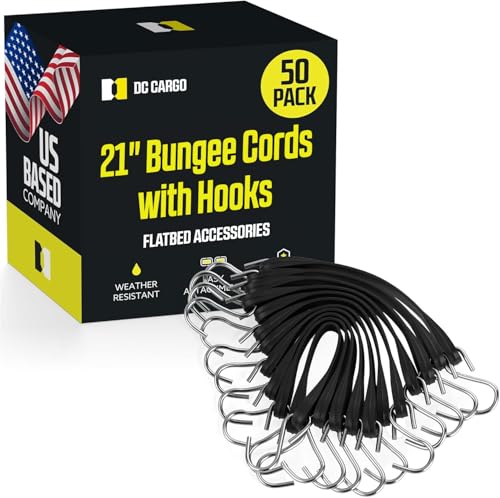
S hooks are common in hanging tasks and light fastening because they attach quickly. The open form is handy, but it does not lock in place. If the load shifts or the anchor rotates, the hook can walk out.
Why the same hook can feel secure on one anchor and loose on another
A hook that feels solid on a closed loop may feel sloppy on a large ring or rail. Clearance, rotation space, and the way the strap pulls all change how much of the hook actually bears load.
That is why shape matching matters more than habit.
Which hook is better for tarp tie-downs?
Flat hooks are often a better tarp tie-down choice because they tend to seat securely at grommets, slots, and edge anchors. S hooks can work on light-duty tarps when the attachment point is controlled and the risk of lift-off is low.
Tarp grommet fit and point-loading risk
A tarp grommet is a reinforced hole, but it still dislikes point loading. An S hook can concentrate force on a smaller contact area if it pulls at an angle, which raises edge stress and tear risk over time.
A flat hook often spreads contact more evenly and keeps the tarp edge calmer under tension.
When a low-profile flat hook helps keep the tarp edge calmer
When wind shakes a cover or a tie-down vibrates in transit, a flatter seated hook is less likely to twist. That matters on temporary outdoor covers, trailer tarps, and any tarp that gets moved or adjusted often.
When an S hook is acceptable only for light-duty, low-risk attachment points
An S hook can be acceptable when the tarp is small, the pull is light, and the anchor is controlled, such as a calm garage cover or a short-term cover that is checked often. It is a poor choice when the tarp will see repeated motion, road vibration, or long outdoor exposure.
Can you use S hooks for moving furniture straps?
S hooks are often a poor choice for moving furniture straps because moving loads need secure retention and predictable seating. Furniture shifts during lifts, turns, and stops, and that motion can roll an open hook off an anchor or change its angle enough to reduce holding security.
Why moving loads demand positive retention and predictable seating
Moving straps should stay put when a couch, dresser, or appliance bounces. A hook that has to be watched every few minutes adds avoidable risk, especially on stairs, dollies, or truck beds where sudden movement is normal.
How strap motion, shifting, and vibration affect an open hook
Vibration can work an S hook upward or sideways. Once the load settles at a new angle, the hook may sit partly engaged instead of fully captured.
That makes re-checking necessary, and re-checking takes time you may not have during a move.
When flat hooks or ratchet strap end fittings are the safer fit
For moving furniture, flat hooks or strap end fittings designed for ratchet strap hardware are usually the safer fit. The end fitting should match the anchor and the tensioning method so release behavior is predictable when the job is done.
Decision table: flat hooks vs S hooks in real use
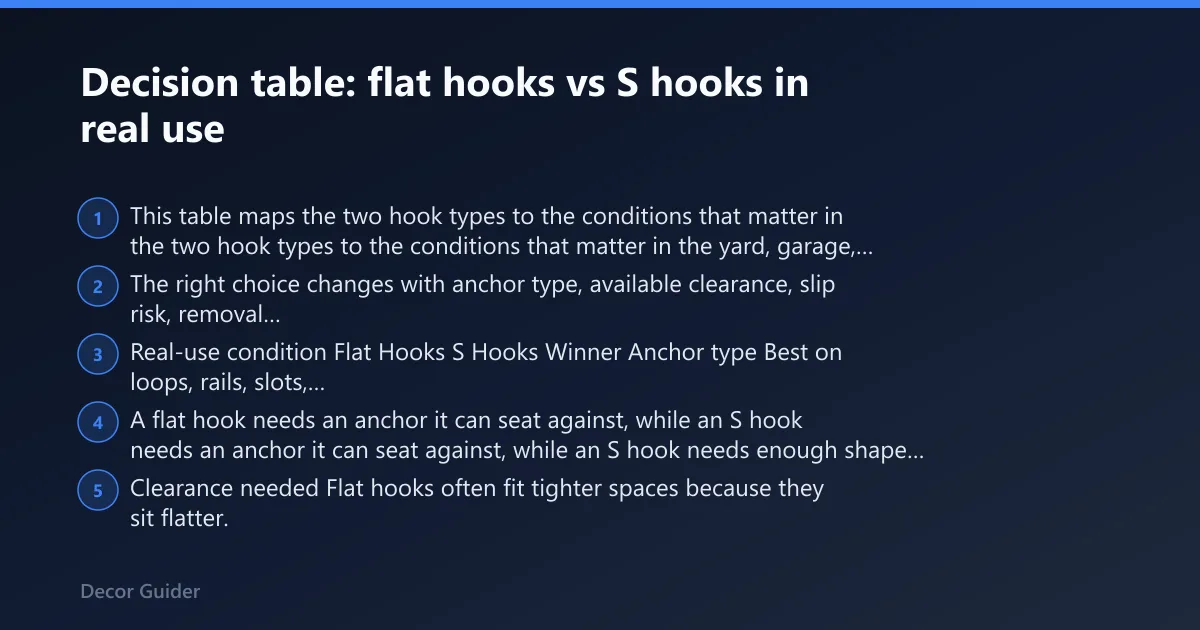
This table maps the two hook types to the conditions that matter in the yard, garage, and moving truck. The right choice changes with anchor type, available clearance, slip risk, removal speed, and whether the load is a tarp, furniture strap, or general storage item.
| Real-use condition | Flat Hooks | S Hooks | Winner |
|---|---|---|---|
| Anchor type | Best on loops, rails, slots, and some rings | Best on open rings and simple hanging points | Flat Hooks for strap anchors; S Hooks for hanging points |
| Clearance needed | Works in tighter spaces | Needs more room for safe seating | Flat Hooks |
| Slip risk | Lower when the hook sits flat and centered | Higher when the load pulls sideways or rotates | Flat Hooks |
| Removal speed | Slower and more deliberate | Fast on / fast off | S Hooks |
| Best application | Tarp tie-downs, moving furniture straps, cargo straps | Garage organization, light-duty storage, quick hanging | Depends on job |
Anchor type
Loops, rings, rails, grommets, and slots can behave differently. A flat hook needs an anchor it can seat against, while an S hook needs enough shape control that the open curve cannot slide free.
Clearance needed
Flat hooks often fit tighter spaces because they sit flatter. If the anchor area is crowded by webbing, a tarp hem, or another strap, the lower profile helps.
Slip risk
Slip risk rises when tension changes direction. That is where the open geometry of an S hook is a problem, especially on outdoor covers and moving loads.
Removal speed
S hooks win when the strap must come off several times a day. Flat hooks take a bit more care, and that is the cost of better retention.
Best application
Patio furniture storage and garage organization often reward speed. Moving furniture and temporary outdoor covers reward retention, because the load or weather can change during use.
How load rating and strap compatibility change the choice
Working load limit matters more than hook shape alone. The working load limit is the recommended safe load rating for use, and it is not the same as breaking strength. A hook can fit well and still be the wrong choice if the strap webbing, anchor point, or tensioning method exceeds the system rating.
Working load limit versus breaking strength
Breaking strength is the point where a part fails in a test. Working load limit is the rated safe use level, and it is the number that should guide strap selection.
If the hook, webbing, or ratchet hardware is underrated, the whole setup becomes suspect even if the geometry looks right.
Matching hook width to strap webbing width
Strap webbing should match the hook width and the mounting path. A webbing strap that is too narrow can bunch and twist, which can increase abrasion and side loading at the hook throat.
Too wide, and it may not seat cleanly in the hardware or may rub against the anchor point.
How abrasion and side loading can shorten hardware life
A hook that rubs against a sharp edge wears faster. Side loading also stresses the bend in the hook and the stitched end of the strap, which can shorten hardware life long before the strap looks worn.
Where ratchet strap hardware changes the decision
Ratchet strap hardware often dictates the end fitting style. If the ratchet and end fitting are designed for flat hooks, swapping to S hooks can change release behavior and reduce retention. The safest choice is the one that matches the whole system, not just the visible hook.
Choose Flat Hooks if… / Choose S Hooks if…
Choose flat hooks when the anchor is a loop, rail, slot, or reinforced tarp point, when clearance is tight, or when the load can move or vibrate. Choose S hooks when the attachment is light-duty, the anchor is simple, and the hardware must come off quickly and often.
Choose flat hooks if you need tighter anchor fit
Pick flat hooks for tarp grommets, cargo tie-downs, moving furniture straps, and most outdoor cover jobs. They are the better answer when retention matters more than clip speed.
Choose flat hooks if slip would be costly
If a loosened strap would let a tarp flap, a load shift, or a cover tear, flat hooks are the safer shape. That is especially true when the job will sit outside for days or ride in a moving vehicle.
Choose S hooks if speed and light duty matter most
Pick S hooks for garage organization, quick hanging, and other light-duty fastening where the load is not expected to shift. They are easiest to remove and rehang, which matters when the setup changes often.
Simple checklist for choosing the right hook on the first try
- Identify the anchor point: loop, ring, rail, grommet, or slot.
- Check whether the load can move, bounce, or rotate.
- Match the hook to the strap webbing width and hardware style.
- Verify the working load limit for the full strap-and-hook system.
- Choose flat hooks if retention matters more than speed.
- Choose S hooks only if removal speed and light duty matter more than retention.
Frequently asked questions
Are flat hooks stronger than S hooks?
Not automatically. Strength depends on the working load limit, the strap webbing, the anchor point, and how the hook is loaded. Flat hooks usually perform better in real tie-down use because they retain their position more reliably, not because the shape alone is stronger.
Do flat hooks fit standard anchor points?
They fit many standard anchor points, but only when the geometry matches. Loops, rails, slots, and some rings work well, while oversized or rotating anchors can reduce retention. Always check clearance and seating before loading the strap.
Are S hooks safe for outdoor storage tarps?
Only for light-duty, low-risk setups that are checked often. Outdoor tarps see wind, movement, and changing tension, which can unseat an open hook. For long-term cover use, flat hooks are often the more reliable choice.
What hook type is easier to install and remove?
S hooks are often easier to install and remove because they clip on quickly with less exact seating. That convenience is useful for garage organization and other light-duty tasks, but it comes with higher slip risk when the load can move or rotate.
Products related to this article
Sponsored / affiliate links. As an Amazon Associate I earn from qualifying purchases. I may earn additional commission from eligible campaigns.