What Size Strap Do I Need for Moving Furniture?
Choose moving straps that are at least as long as the furniture’s widest point plus the clearance you need for stairs, doorways, and turns; for many sofas, dressers, and appliances, that means about 6 to 10 feet per strap, with longer straps often used for two-person carries. Too-short straps slip into awkward angles, strain your back, and can make a lift fail in a tight hall or on a landing. This guide shows how to size strap length by furniture width, route clearance, and helper count, and when to pick shoulder straps versus forearm straps.
What you’ll need


- Tape measure.
- Pen and paper or a notes app.
- Measurements for the furniture: height, width, depth, and diagonal.
- Measurements for the route: doorway width, hallway width, stair width, and landing clearance.
- Moving blankets.
- Shrink wrap for loose drawers, doors, or cushions.
- Sturdy shoes and clothes that let you move freely.
- One helper for lighter bulky pieces, or two helpers for larger furniture.
What size strap do you need for moving furniture?

Start with the widest point of the item, then add the clearance needed to keep the strap angled safely through the route. Moving straps spread the load, lower the item’s center of gravity, and make the carry easier when the fit is right. If the route is tight, size up rather than gamble on a short strap.
How strap length should track the route
- Measure the furniture width at its widest point.
- Measure the tightest doorway, hallway, or stair turn it must pass.
- Add enough length for the strap to stay level while two people lift.
- If the item must pivot through a corner, choose a longer strap or a different tool.
A common mistake is choosing a strap size based only on the couch’s length instead of the load’s weight and how far it has to be carried. Say your sofa is 84 inches wide and the hallway pinch point is 31 inches; a short strap may bind at the turn even if the sofa itself is not especially heavy. The width and the route both matter.
How helper count changes the decision
One helper can manage lighter bulky pieces, but a true two-person lifting system is the better fit for most shoulder straps and larger items. This Old House describes moving straps as a two-person lifting system with a long webbing strap and padded shoulder harnesses. If the item needs to turn, climb, or stay level for a long carry, plan on two helpers before you buy.
How do you measure the furniture?
Measure height, width, depth, and diagonal before you compare straps. Width tells you the strap span you need. Diagonal tells you whether the item can tilt through a doorway or landing. Depth and height help you see where hands, shoulders, or forearms will actually fit on the load.
Measure the widest and tallest points
- Measure the widest point from outside edge to outside edge.
- Measure the tallest point, including feet, arms, or protruding trim.
- Measure depth from front to back.
- Measure the diagonal from one lower corner to the opposite upper corner.
Write down any parts that stick out: sofa arms, dresser knobs, mattress handles, or bookcase trim. Those details decide whether the strap can wrap cleanly or whether the item needs a different carry angle.
Find the shape that changes the fit
Round chairs, boxy dressers, deep mattresses, and tall bookcases each behave differently under load. The item’s shape affects where the weight sits, where the strap can grip, and how much room the helpers need to turn without scraping a wall or catching a corner.
How do you measure the route?
Measure the tightest clearance point first: doorways, hallways, stair turns, and landings. Route clearance can rule out a strap that is otherwise long enough. If a door must come off its hinges to create the needed opening, note that before you buy the straps.
Check the stop-points before the move
- Measure every doorway on the route.
- Measure hallway width at the narrowest point.
- Measure stair width and any landing where the item must pivot.
- Check whether a door removal will create the extra room you need.
Picture a dresser that fits through the front door but catches at the stair landing because the landing is narrower than the dresser’s diagonal. In that case, a longer strap may not solve the problem. The route, not the furniture, is the limit.
Use the tightest clearance point as the rule
Doorways, hallways, and staircases are the points that decide fit. If one of them is tight, use that measurement as the sizing anchor. A strap that works in a wide hallway may still be wrong for a narrow corner or a steep stair turn.
What strap type fits the job?
Choose shoulder moving straps for stairs and larger furniture, especially when two people need to share the load and keep the piece stable through turns. Choose forearm moving straps for lighter or smaller bulky items. Use a dolly or appliance dolly when the route is flat or the item must stay upright more than it must be carried.
Shoulder moving straps
Shoulder straps are the better fit for larger furniture, stair carries, and awkward route changes. They use padded shoulder harnesses and an adjustable webbing strap, and they spread the load across the shoulders while helping keep the item lower and easier to control. Shoulder straps start at $40.
Forearm moving straps
Forearm straps are the lower-cost option at about $25. They work well for lighter bulky items, shorter carries, and jobs where the load can be shared through the forearms without forcing a tall lift. They are less suited to long stair runs or oversized pieces that need more control.
Dolly and appliance dolly
A moving dolly is often better on flat surfaces than straps, especially for items that roll cleanly and do not need to be carried. It is not ideal for stairs. An appliance dolly keeps tall heavy items upright and is useful for wardrobes and safes, though stairs may require extra helpers. Straps and dollies often work together.
What size strap do you need for each item?
Use the matrix below to match item type to minimum strap length, helper count, and red-flag dimensions. The goal is not just to pick a length that reaches around the item. It is to choose a strap that still works when the furniture turns, climbs, or clears a doorway.
| Furniture category | Recommended minimum strap length | Ideal helper count | Red-flag dimensions |
|---|---|---|---|
| Chair | At least 6 feet | 1 to 2 | Wide arms, fixed legs, or a diagonal that exceeds the doorway opening |
| Loveseat | At least 8 feet | 2 | Arm-to-arm width that leaves less than a few inches at the tightest door |
| Sofa | 8 to 10 feet | 2 | Wide sectionals, deep seats, or stair turns that force a sharp pivot |
| Dresser | At least 8 feet | 2 | Knobs, mirror tops, or a height that blocks the landing or hallway turn |
| Mattress | 8 to 10 feet | 2 | Oversize mattresses, thick pillow tops, or a hallway too narrow to keep it flat |
| Bookcase | At least 8 feet | 2 | Tall, narrow frames that can tip, or shelves that catch on corners |
| Appliance | 10 feet or longer | 2 to 3 | Refrigerators, washing machines, and other tall items that must stay upright |
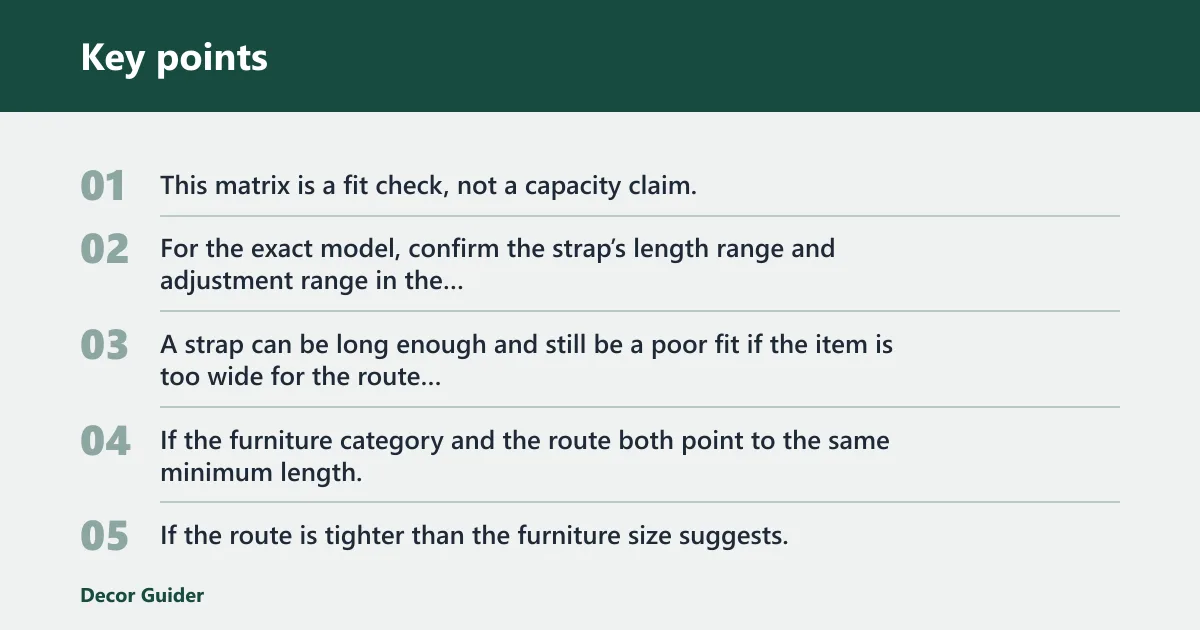
This matrix is a fit check, not a capacity claim. For the exact model, confirm the strap’s length range and adjustment range in the manufacturer’s listing. A strap can be long enough and still be a poor fit if the item is too wide for the route or too tall for a safe carry angle.
How to read the matrix fast
If the furniture category and the route both point to the same minimum length, that is the better starting point. If the route is tighter than the furniture size suggests, move up one length tier or switch tools. If the item must stay upright, the appliance dolly becomes the safer first choice.
How much weight can moving straps handle?
Moving straps handle weight through load distribution and body mechanics, not by strap length alone. A longer strap does not automatically mean a stronger carry. What matters is how the weight sits between the helpers, how low the center of gravity stays, and whether the item remains balanced enough to move without jerking.
What changes the load in practice
A dresser with drawers removed may move more cleanly than a loaded one. A sofa with loose cushions may shift differently from a boxed appliance. The same strap can feel manageable on one item and awkward on another if the weight is off-center or the shape forces a bad grip.
Safety basics that still matter
Read the manufacturer instructions before use. Wear sturdy shoes and clothes that let you move freely. Keep a neutral lifting posture with bent knees and a straight back. These basics do not replace good sizing, but they reduce the chance that a well-chosen strap becomes a bad lift because of poor body position.
Are moving straps better than a dolly for stairs?
For stairs, shoulder moving straps are often the better tool because they let two people share the load while keeping the item controllable on each step. A moving dolly is better on flat surfaces, and an appliance dolly is better when the item must stay upright. On stairs, a dolly may need extra helpers or a different plan.
Moving straps are useful for washing machines, file cabinets, dressers, and sofas, and they are inexpensive compared with professional movers or a hand truck. That does not make them universal. If the item is tall, narrow, and unstable, the appliance dolly may control it better than straps alone.
When to leave the dolly in the plan
Use a dolly to handle the flat run to the stairs, then switch to straps for the carry itself. That split approach often works better than forcing one tool to do everything. On long, straight hallways, a dolly may also beat straps if the furniture rolls securely and does not need constant balancing.
Common mistakes
Most strap problems come from measuring the wrong thing or choosing the wrong tool for the route. The fix is to treat width, diagonal, and clearance as one sizing decision instead of separate chores.
- Buying before measuring doorways and stair turns.
- Choosing a strap that is too short for a wide sofa or sectional.
- Using forearm straps for a move that really needs shoulder support.
- Trying to carry a tall appliance with straps when an appliance dolly would keep it steadier.
- Skipping moving blankets or shrink wrap and then scraping finished surfaces.
- Ignoring the tightest stop-point on the route, such as a landing or corner.
Suppose a mattress measures 60 inches wide and the hallway narrows sharply at one turn. A longer strap can help the lift, but it will not fix a bend that is too tight for the mattress to pass without tilting. In that case, remeasure the turn before you buy anything.
Prevention: measure the route first, then buy the strap length that clears the tightest point with room for the turn.
Frequently asked questions
How long should moving straps be for a couch?
Most couches commonly need about 8 to 10 feet per strap so two people can keep the load level while turning through a hallway or stair landing. Wide sectionals often need the longer end of that range. If the couch must pivot sharply, a short strap is more likely to bind.
What width moving strap is best for heavy furniture?
Width by itself is not the main sizing rule. Length and adjustability matter more because the strap has to clear the furniture and the route. For heavy furniture, check that the strap model is designed for two-person lifting and matches the item’s width and turn clearance.
Do I need shoulder straps or forearm straps for moving furniture?
Use shoulder straps for stairs, larger furniture, and longer carries where two helpers need better control. Use forearm straps for lighter bulky pieces and shorter moves. If the item is tall, awkward, or must stay upright, compare straps with an appliance dolly before you decide.
Can moving straps fit around a dresser or mattress?
Yes, if the strap length and the route clearance match the item size. Dressers and mattresses are common strap uses, but the dresser’s knobs, trim, and height can create fit problems, while a thick mattress may need more room to stay flat. Measure the diagonal as well as the width.
How do I measure furniture before buying moving straps?
Measure width, height, depth, and diagonal at the widest points, then measure the narrowest doorway, hallway, stair, and landing on the route. Use the tighter of the two sets of measurements as your guide. If a door must be removed to create clearance, note that before choosing a strap length.
Products related to this article
Sponsored / affiliate links. As an Amazon Associate I earn from qualifying purchases. I may earn additional commission from eligible campaigns.