
Why Is Furniture Shipping So Expensive?
Furniture shipping is expensive because bulky, heavy items take truck space, need extra handling, and carry higher damage risk. Local curbside delivery can start around $150, while long-distance or white-glove service may run roughly $300 to $500 or more. Ignore those costs, and you may face surprise fees, missed delivery windows, or damage claims that are harder to resolve. This guide breaks down the real cost stack: size, weight, service level, distance, handling, and risk.
Why furniture shipping costs so much

Furniture shipping fees rise because sellers and carriers price the whole shipment, not a simple add-on to the product price. Large-item freight delivery needs more handling than parcel shipping, and the carrier has to account for truck space, route planning, and the chance of damage during loading, transit, and delivery.
The short answer: size, weight, and handling
Big items cost more to move because they use more cubic space and often need more than one person to load, unload, and place them. A sofa, bed, or dining table may also need protective wrap, corner protection, or a freight pallet, which raises the total before the truck even leaves the dock.
Why freight and delivery labor add up
Parcel shipping is built for boxed goods that can move through a sortation network. Furniture often cannot. That means more manual touchpoints, from warehouse preparation to final delivery, and those labor minutes show up in the fee. If the order needs threshold delivery, room placement, or stair carry, the labor cost climbs again.
Why damage risk is priced into the fee
Furniture has a higher breakage exposure than many household goods. Corners crush, fabric snags, glass chips, and wood finishes scratch. Carriers and retailers build a damage buffer into the price because a damaged return can cost more than the original shipment, especially when the item is oversized or hard to restock.
Start with the cheapest acceptable delivery method, then compare service levels before you pay for extras you do not need. Click & Collect is a no-fee pickup option when available, and it can cut delivery cost sharply. You can also save by bundling items, choosing standard freight over white-glove service, or picking up in person.
Choose pickup or Click & Collect when available
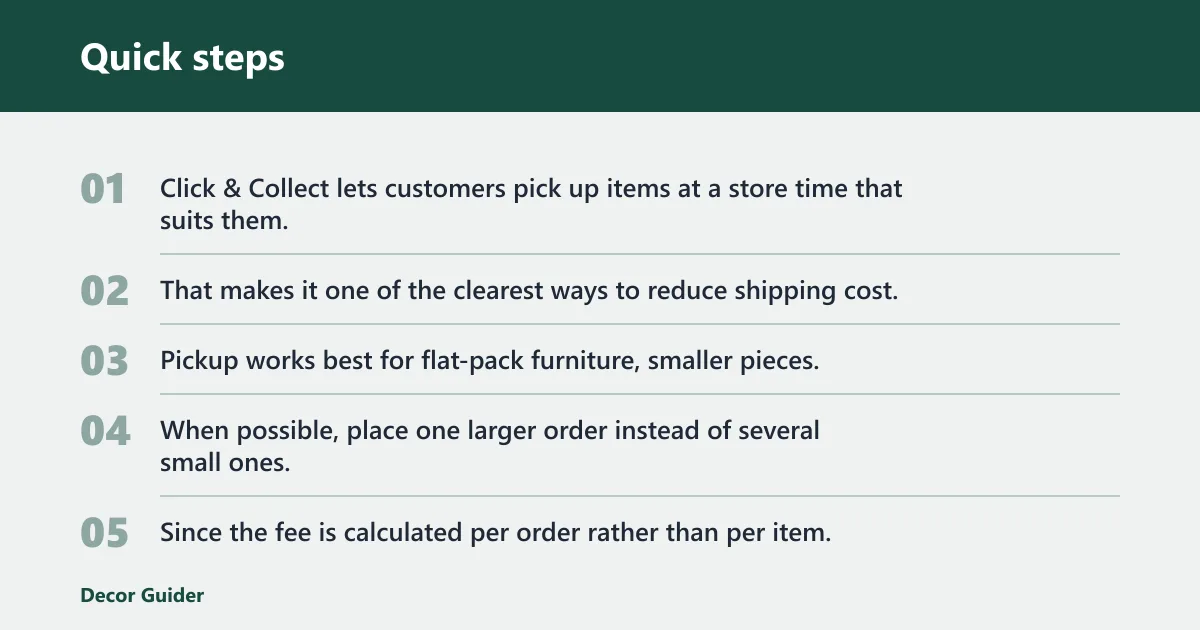
Click & Collect lets customers pick up items at a store time that suits them, and it can be a no-fee option. That makes it one of the clearest ways to reduce shipping cost. Pickup works best for flat-pack furniture, smaller pieces, and orders you can transport safely without home delivery.
Bundle items from the same seller
When possible, place one larger order instead of several small ones. Since the fee is calculated per order rather than per item, you may spread the shipping cost across more products. That helps most when the seller offers a flat-rate shipping cap or an order-level freight charge.
Compare standard delivery with freight and white-glove service
Do not pay for white-glove delivery unless you need it. Standard curbside or threshold delivery is usually cheaper because it skips in-room placement, unpacking, and assembly. If the product is already assembled or easy to carry, standard freight may cover the job at a lower cost.
Check whether assembly or disassembly changes the fee
Assembly status matters. A fully assembled item is harder to protect and may need a larger box or crate. A disassembled chair, bed frame, or table can sometimes ship more cheaply because it fits better in a freight system. Check whether the seller charges more for preassembly, protective packaging, or home setup.
Suppose you are choosing between two versions of the same bed frame: one ships assembled and one ships flat-pack. The flat-pack version may cost less to ship because it packs tighter and reduces damage risk. The assembled version can cost more even if the product price is the same.
How furniture shipping is priced at checkout
Furniture shipping is often priced per order rather than per item, and that matters. The checkout total can stay the same for one item or several if they fit within the same shipment bracket. Some retailers also use a flat-rate shipping cap, which limits how high the delivery fee can go for an order.
Per-order pricing versus per-item pricing
At checkout, the system may look at the full cart instead of each piece alone. That is why shipping can seem odd: one furniture item can cost the same as five items at checkout. In that setup, weight and dimensions still matter, but they are folded into a single shipment price rather than separate line items.
Where packaging and freight class enter the total
Packaging changes the bill more than many shoppers expect. A flat-pack box is cheaper to stage than a fully assembled cabinet, while a sofa needs protective wrap, corner guards, and often a larger handling footprint. Freight class also matters for bulky shipments because carriers price by space, handling difficulty, and loss exposure, not weight alone.
Why some retailers cap delivery fees
A cap can protect the buyer from open-ended freight charges. IKEA shipping can be capped at $49 for most metro locations, while rural areas can face a $249 shipping cap. That kind of ceiling can make checkout more predictable, but the cap still reflects the cost of moving a large order through different delivery zones.
Furniture shipping cost table
The table below shows a practical breakdown of common cost drivers. These are estimates to help you compare service types, not quotes. Totals are before taxes and any optional assembly charges. The point is to show where the money goes: packaging, freight, labor, accessorials, distance, and damage buffer.
| Scenario | Packaging | Freight | Labor | Accessorials | Distance | Damage buffer | Estimated total | When this gets expensive |
|---|---|---|---|---|---|---|---|---|
| Parcel-sized accessory | $3 to $8 | $5 to $12 | $2 to $5 | $0 | $0 to $8 | $2 to $4 | $12 to $37 | Costs rise if the item is oddly shaped or needs oversized boxing. |
| Flat-pack item | $8 to $18 | $12 to $30 | $6 to $15 | $0 to $10 | $5 to $20 | $4 to $8 | $35 to $101 | Expensive when the carton is long, heavy, or needs a second handling pass. |
| Upholstered sofa | $20 to $45 | $40 to $90 | $25 to $60 | $15 to $75 | $20 to $80 | $15 to $35 | $135 to $385 | Gets costly with stairs, long carries, liftgate use, or room-of-choice service. |
| Solid-wood table | $18 to $40 | $35 to $80 | $20 to $50 | $10 to $50 | $20 to $75 | $12 to $30 | $115 to $325 | Costs more when disassembly, crating, or extra protection is needed for the top and legs. |
| White-glove delivery | $25 to $60 | $50 to $110 | $60 to $150 | $50 to $150 | $30 to $100 | $20 to $50 | $235 to $620 | Most expensive when the route includes stairs, assembly, removal of packaging, or narrow access. |
What makes delivery fees rise

Delivery fees rise when the item is heavier, larger, farther away, or harder to place. A furniture shipping fee can also change because of the delivery option selected at checkout, such as curbside drop-off, threshold delivery, room placement, or store pickup. Each layer adds handling time or transport cost.
Weight and dimensions
Shipping cost increases as the weight of the order increases. That is especially true for mixed-item carts, where a small accessory shares checkout with a much heavier piece. Long cartons, wide sofas, and dense wood tables can trigger higher freight charges because they occupy more truck space and require more care in handling.
Distance from the warehouse
Distance is a direct cost driver. Costs rise when the house is farther from a distribution center, because the route takes longer and uses more fuel, labor, and truck time. This is one reason a city delivery and a cross-country delivery can land in very different price bands even for similar furniture.
Accessorials such as stairs, liftgate, or room placement
Accessorial fees are added services. A liftgate helps move heavy freight from truck height to ground level. Stairs, long carries, and room-of-choice placement take more labor and more time. These charges often appear only at checkout or at scheduling, which is why the fee can feel higher than the base shipping rate.
Packaging, protection, and return risk
Protection materials cost money, and so does the possibility of a damaged return. Retailers and carriers have to account for scratch repair, repacking, disposal of damaged cartons, and the labor needed to resend a replacement. That reserve is built into the final price, especially for glossy finishes, glass, and upholstery.
Say your order includes a 72-inch table and two dining chairs. If the chairs could ship as parcels but the table needs freight, the checkout total may jump because the whole order has to move on the freight network. A common first-timer mistake is to compare the chair price alone and ignore the table’s handling class.
Is it cheaper to ship furniture in one order?
Often, yes, because consolidation can lower the per-item cost when the seller prices by order rather than by piece. But the savings are not automatic. If the combined cart pushes the shipment into a larger freight bracket, adds accessorials, or crosses a distance threshold, the total can climb instead of drop.
When consolidation lowers the cost per item
Ordering in bulk can make shipping more cost-effective. That is because the truck, route, and dispatch costs are shared across more merchandise. If the items ship from the same warehouse and fit the same service level, the per-item burden can fall even when the order total looks large.
When mixed carts trigger higher freight or accessorial fees
Mixed carts can create a new problem: one oversized item can pull the entire order into a higher delivery class. That is how a lamp, side table, and sofa can end up on the same freight ticket, with a higher fee than expected. The order may also need liftgate delivery or a larger delivery window.
When a flat-rate cap changes the math
A flat-rate shipping cap changes the decision quickly. If the order hits the maximum amount, adding one more item may not increase shipping at all. If the cart is still below the cap, consolidation can be the smartest move because the fixed fee gets spread across more products.
Why rural delivery costs more
Rural delivery usually costs more because there are fewer distribution points, longer line-haul miles, and more limited delivery frequency. Carriers often price remote zones differently because they cannot combine as many stops on one route. Rural delivery surcharge amounts can be significant when the address sits far from the main freight network.
Fewer distribution points
Metro areas usually have more warehouses, hubs, and daily routes. Rural areas have fewer. That means the shipment may need to travel farther before it reaches a local delivery carrier, which adds time and cost before the final mile even begins.
Longer line-haul miles
The line-haul portion is the long middle stretch between origin and local delivery. More miles mean more fuel, more driver time, and more exposure to delays. That is why cross-country furniture shipping often costs more than the same item moving within a regional zone.
Why remote zones can add surcharges
Remote addresses may require special routing or a higher minimum service charge. A checkout example for Idaho showed $249 for three large furniture items, which illustrates how quickly remote delivery can move toward a capped or premium rate. The farther the house sits from a distribution center, the more likely a surcharge becomes.
Frequently asked questions
How expensive is it to ship furniture?
Furniture shipping can range from a low-cost parcel fee to several hundred dollars for freight or white-glove service. Smaller accessories may stay near parcel pricing, while sofas, tables, and beds often move into freight pricing because of size, weight, and handling needs. Distance and delivery access can raise the final total.
How much does shipping furniture cost?
The cost depends on the order, the delivery method, and the address. A small item can start at $5, while larger furniture orders may sit in much higher brackets. Metro deliveries can be capped, but rural locations and premium service levels can move the bill into the hundreds.
Why is furniture shipping so expensive?
Furniture shipping is expensive because bulky items consume truck space, take more labor to move, and are more likely to be damaged in transit. Packaging, freight class, accessorials, and return risk all get built into the fee. The farther the delivery point is from the warehouse, the more the cost can rise.
What factors make furniture shipping cost more?
Weight, size, distance, delivery type, and accessorials are the main drivers. Stairs, liftgate service, room placement, and assembly can add more. Packaging and protection materials also matter, especially for glass, upholstery, and finished wood. Rural delivery surcharges can push the price higher outside metro areas.
Is pickup cheaper than furniture delivery?
Usually, yes, when pickup or Click & Collect is available. Pickup can avoid freight, last-mile delivery, and accessorial fees, which is why it often costs less at checkout. It is not always available for large or assembled items, and it still depends on whether you can transport the furniture safely.
Products related to this article
Sponsored / affiliate links. As an Amazon Associate I earn from qualifying purchases. I may earn additional commission from eligible campaigns.