How to Pack a Chair for Shipping: Fit and Protect It
Pack a chair for shipping by matching the wrap and box to the chair type: disassemble what you can, pad all corners, use a double-wall box for wood and upholstered chairs, and add rigid edge guards for fragile or antique pieces. Poor packing leads to scuffs, broken legs, torn fabric, and claims that carriers may deny. This guide shows how to choose the right method for dining, office, accent, and antique chairs, plus what to do for parcel, freight, and moving shipments.
What you’ll need


- New corrugated cardboard box in the right size
- Double-wall box for heavier or more valuable parts
- Bubble wrap
- Plastic bags for cushions and small parts
- Packing tape
- Cushioning materials such as paper cushioning, air pillows, moulded fibre inserts, or packing peanuts
- Moving blankets for pallet or van transport
- Stretch foil for pallet loads
- Labels and customs documents for international shipments
- Marker for part labels
- Scissors or a box cutter
Which packing method suits your chair?
The best method depends on the chair’s shape, material, and how far it needs to travel. A simple dining chair may fit in a box after partial disassembly, while a rocking chair, vintage chair, or bulky swivel base may be safer on a pallet or in a custom crate.
Office chairs
Office chairs usually pack best after you remove the base, arms, and gas lift if the design allows it. Wrap the base and armrests in bubble wrap, bag the screws, and use a double-wall box if the chair is heavy or has a wide seat plate. Swivel parts can shift inside the carton if you leave too much open space.
Dining chairs
Dining chairs often work well in a standard parcel box if the legs are sturdy and the back is not unusually tall or carved. Use a new corrugated cardboard box, wrap each leg and rail, and add cushioning around the top rail and corners. If the chair is ornate or weak at the joints, move to pallet transport or a custom crate.
Rocking chairs
Rocking chairs are awkward because of their curved runners and long footprint. Eurosender says pallet transport is ideal for rocking chairs, and that is the safer choice when the runners cannot be removed cleanly. Cover the chair with moving blankets, then secure the load with stretch foil after padding is in place.
Upholstered and vintage chairs
Upholstered chairs need more surface protection because fabric, trim, and tufting can snag easily. Vintage chairs can also have brittle joints, loose veneers, or decorative parts that should not flex inside a box. A custom crate is often safer for upholstered or vintage chairs, especially when the frame is fragile or the finish is valuable.
Swivel chairs and bases
Swivel chairs should be treated as a chair plus a moving base, not as one rigid block. Remove the seat from the base when possible, wrap the base separately, and protect any exposed hardware. If the base is oversized, pallet delivery is often a better fit than parcel shipping because the geometry increases handling risk and can raise dimensional weight.
Do you need to disassemble the chair?
Yes, disassemble the chair as much as possible, but stop if a joint, screw, or glued connection looks likely to crack. The goal is fewer loose protrusions and less movement in transit, not forced breakdown of the frame. If the chair cannot come apart cleanly, protect it as one unit and move to a pallet or crate if needed.
- Remove the detachable parts. Take off arms, bases, cushions, feet, and other loose components that the chair design allows. Eurosender advises disassembling a chair as much as possible before packing, and that reduces pressure points in the box.
- Bag the small hardware. Put screws, bolts, and washers in labeled plastic bags, then tape the bag to the part they belong to. Eurosender recommends taping screws to the items they belong to so hardware does not vanish in transit.
- Wrap each piece. Use bubble wrap on individual chair parts such as arms, base pieces, cushions, feet, or other loose components. Add extra wrap around corners and edges, because those areas take the first hit when a box is dropped.
- Box the grouped parts. Place the wrapped parts in a new corrugated cardboard box with cushioning materials on every side. DHL recommends a new, high-quality corrugated cardboard box, and a double-wall box is better for heavier or more valuable items.
- Seal the carton well. Close the top and bottom with packing tape using the H-tape method on all seams. Several layers of tape help keep the box shut when the chair shifts during lifting.
Pack the chair parts for shipment
Use the two-box method for fragile, valuable, sharp, or irregularly shaped items. That means an inner box around the part and an outer box with about 6 cm of cushioning on every side. The second box gives the package more protection if the outer carton gets crushed or punctured.
- Group by risk. Keep soft parts, hardware, and rigid parts separate so you can pad each one correctly. A common first-timer mistake is mixing a cushion, screws, and a leg in the same open carton.
- Bag soft components. Put cushions in plastic bags so they stay clean and grouped together. This also keeps dust and loose fibres from catching on fabric or finish.
- Add void fill. Use paper cushioning, air pillows, moulded fibre inserts, or packing peanuts to stop movement inside the package. Fill gaps until the parts no longer shift when you tilt the box.
- Use the two-box method. For a carved back, a sharp bracket, or a delicate vintage arm, pack the item in an inner box first, then center that box inside a larger one with at least 6 cm of cushioning on every side.
- Recheck the fit. Close the box and shake it gently. If movement is heard, add more cushioning in about 1 to 2 cm layers and check again until the contents stay fixed.
Say your dining chair has a removable back, four legs, and a loose seat pad. Pack the back and legs separately, bag the screws, and use a single-wall box only if the pieces are light and the carton is snug. If the same chair has thick carved rails or a heavy solid-wood frame, move up to a double-wall box or a pallet.
| Chair type | Packing method | Disassembly level | Outer packaging | Void fill | Use box, pallet, or crate when |
|---|---|---|---|---|---|
| Office | Wrap parts separately and box grouped pieces | High, remove base and arms if possible | Single-wall box for lighter sets, double-wall for heavier ones | Paper cushioning or air pillows | Box for standard builds; pallet if the base is oversized or heavy |
| Dining | Wrap legs, rails, and seat area | Moderate to high | New corrugated cardboard box | Packing peanuts or moulded fibre inserts | Box for straight, sturdy chairs; pallet for ornate or long chairs |
| Rocking | Blanket wrap and secure as one unit | Low to moderate | Pallet with blankets and stretch foil | Foam wrap plus blankets | Pallet is usually safer; crate if runners or joints are fragile |
| Upholstered | Protect fabric, arms, and feet | Moderate | Double-wall box or custom crate | Paper cushioning and foam wrap | Crate when the fabric, trim, or frame is delicate |
| Vintage | Use two-box method and rigid corner protection | Low, only if safe | Custom crate | At least 6 cm cushioning on every side | Crate when the finish, joints, or shape are high risk |
| Swivel | Separate seat and base if possible | High for removable parts | Double-wall box or pallet | Air pillows or paper cushioning | Box for compact seats; pallet for wide or heavy bases |
What shipping method fits a bulky chair?
Bulky chairs are often better suited to pallet delivery, van delivery, or a custom crate than to standard parcel shipping. Chair size, weight, and geometry affect handling and can increase dimensional weight, so a chair that looks “light” can still price and ship like an oversized item.
Standard parcel shipping
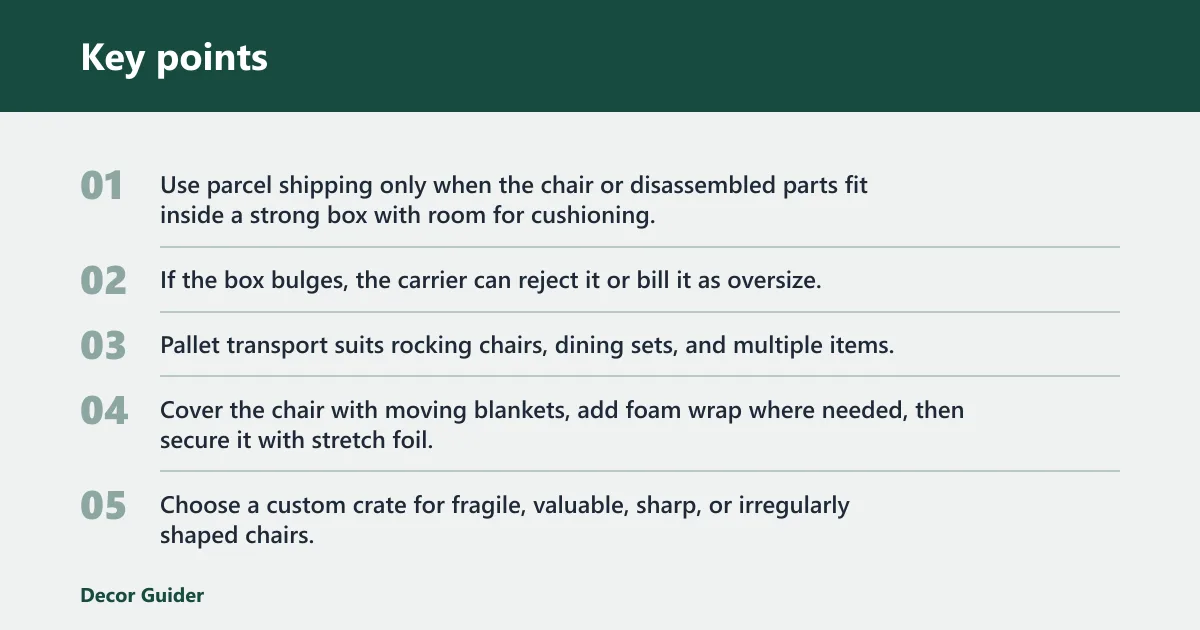
Use parcel shipping only when the chair or disassembled parts fit inside a strong box with room for cushioning. This works best for lighter office chairs, simple dining chairs, and smaller components. If the box bulges, the carrier can reject it or bill it as oversize.
Pallet delivery
Pallet transport suits rocking chairs, dining sets, and multiple items. Cover the chair with moving blankets, add foam wrap where needed, then secure it with stretch foil. Eurosender also says to strap pallets in all possible directions and several times, which matters because tall furniture can shift during loading.
Custom crate delivery
Choose a custom crate for fragile, valuable, sharp, or irregularly shaped chairs. A crate is also the safer choice when the chair cannot be disassembled without damage, or when the frame flexes too much for a carton. That extra structure lowers the chance of crushed corners and broken joints.
Cross-country and international shipments
For cross-country delivery, compare parcel, freight, individual offer, and van delivery options. The same source notes that chairs can be shipped as standard shipping, freight shipping, individual offer, or van delivery, and checking dimensions before choosing a service is the right first filter. For international shipments, keep labels readable and include the commercial invoice and air waybill where required.
How do you label and seal a chair shipment properly?
Seal every seam with packing tape, then keep barcodes visible on the outside of the package or pallet wrap. For international shipping, labels and customs documentation should sit where handlers can read them without stripping away the protection layer. Insurance and tracking are basic safeguards, so do not bury the shipment reference under foam or blankets.
- Apply H-tape seams. Run packing tape across the center seam and down both edge seams on the top and bottom. This H-tape method helps the box stay closed when the contents shift.
- Keep labels clear. Place shipping labels on a flat outer surface, and leave barcodes readable. If you use stretch foil on a pallet, put the label on a visible outer panel or label pouch.
- Add documents. For international shipments, include the commercial invoice and air waybill where required. Put copies where the carrier can access them without opening the protection layers.
- Photograph the load. Take clear photos of the chair and its packaging before pickup. Eurosender advises photographing both the chair and its packaging before shipping, which helps if you need proof of condition.
Common mistakes
The most common failure is treating every chair like a standard box job. A rocking chair or vintage chair can need a pallet or crate, and forcing it into a carton often leads to broken runners, crushed arms, or torn fabric.
- Using reused or flimsy outer packaging. Choose a new corrugated cardboard box, and move to double-wall when the chair is heavier or more valuable.
- Leaving hardware loose. Put screws and small parts in labeled bags and tape them to the correct item.
- Skipping void fill. Empty space lets the chair move, which turns a minor bump into a cracked leg or split rail.
- Wrapping without structure. Bubble wrap helps protect parts, but it does not replace a box, pallet, or crate.
- Ignoring size and geometry. Long arms, curved runners, or wide swivel bases can push a shipment into oversize handling and higher cost.
Suppose a swivel chair seat fits in a box, but the base sticks out too far. Do not force the whole chair into one carton. Separate the base, pack it on its own, and if the combined pieces still create awkward dimensions, choose pallet delivery instead.
Frequently asked questions
How do I pack a chair for shipping?
Disassemble what you can, wrap each part in bubble wrap, bag the screws, and place the pieces in a new corrugated cardboard box with cushioning materials on all sides. Use a double-wall box for heavier or more valuable parts, then seal every seam with packing tape.
How do I ship a chair across country?
Start by measuring the chair and checking its dimensions against the available service. For a bulky or fragile chair, compare parcel shipping with freight, van delivery, or pallet transport. Insurance and tracking should be included, and cross-country loads often need more protection than local moves.
What is the best way to ship a chair?
The best method depends on the chair type. A light dining chair may fit in a box, while a rocking chair, vintage chair, or oversized swivel base is often safer on a pallet or in a custom crate. Choose the method that matches the risk, not the cheapest carton.
Do I need to disassemble a chair before shipping it?
Usually yes, as far as the chair safely allows. Remove loose parts, arms, feet, and cushions if possible, but stop before a joint or finish starts to crack. If the frame cannot come apart cleanly, protect the chair as one unit and use a more secure shipping method.
How much bubble wrap do I need for chair shipping?
Use enough bubble wrap to cover each loose part with overlapping layers, especially around corners, arms, bases, and feet. The right amount is the amount that keeps the piece from touching the box wall directly. After wrapping, shake the package; if anything moves, add more cushioning.
How do I pack an office chair for shipping?
Take off the base, arms, and any removable wheels or cushions if the design allows it. Wrap each piece in bubble wrap, place screws in labeled plastic bags, and pack the parts in a double-wall box if the chair is heavy or has a wide base. Seal with H-tape.
Can I ship a rocking chair or dining chair?
Yes, but the packing method should match the shape. Dining chairs often work in a box if they are sturdy and not oversized. Rocking chairs usually do better on a pallet with moving blankets and stretch foil because the curved runners and long footprint are harder to protect in a carton.
How do I protect screws and small parts when shipping a chair?
Place each hardware set in a labeled plastic bag, then tape the bag to the chair part it belongs to. That keeps the screws with the correct piece and prevents loss during unpacking. Do not leave loose hardware in the box, where it can scratch finishes or disappear.
Products related to this article
Sponsored / affiliate links. As an Amazon Associate I earn from qualifying purchases. I may earn additional commission from eligible campaigns.