Does Shipping Furniture Usually Include Insurance?
Usually no: furniture shipping typically includes only limited carrier liability, often capped by weight or a declared value, so you usually need extra insurance for high-value or fragile pieces. If you skip that check, a damaged sofa, table, or cabinet can leave you with a payout far below replacement cost. This guide explains default coverage, common exclusions, and when buying extra insurance makes sense.
Does furniture shipping usually include insurance?
Usually not. Shipping insurance is optional, not automatic, and furniture shipments often move under carrier liability terms instead of full insurance. That matters because a sofa, bed frame, or cabinet can be worth far more than the standard payout after transit damage, theft, or loss.
Before you decide, weigh four things: shipment value, fragility, packing quality, and number of handoffs. If the item is modest in value, packed well, and moving through fewer transfers, default liability may be enough. If the piece is expensive, delicate, poorly protected, or changing hands often, optional insurance is usually worth buying.
Furniture freight shipment is handled differently from small parcel shipping because the items are bulky, heavy, or delicate. The route can include packing, loading, warehouse handling, customs checks, and other handoffs, so the risk profile is often higher than for a boxed household item.
Optional insurance versus carrier liability
Do not treat carrier liability and shipping insurance as the same thing. Carrier liability depends on the carrier’s terms and declared value rules, and it may not cover full replacement value. Shipping insurance is a separate paid service that can reimburse loss, theft, or damage in transit.
That difference matters for furniture because damage is often visible only after unpacking. Scratches, dents, broken legs, moisture swelling, and crushed corners can happen during loading or at a transfer point, and a limited liability amount may not come close to the cost of repair or replacement.
What coverage is usually included by default?
Default coverage is usually limited carrier liability or declared value coverage, not full shipping insurance. The payout depends on the carrier’s terms, the value you declared, and any cap written into the contract. For furniture, that default often falls short when the item is expensive or fragile.
Carrier terms, limits, and exclusions
Declared value coverage can help, but it is not a promise of full reimbursement. Some carriers limit claims by weight, route, shipment class, handling method, or filing window, and the claim process can be strict. Check the booking terms before pickup so you know what is included and what is excluded.
Insurance cost is generally linked to shipment value, so a higher declared value often means a higher premium or fee. That matters for furniture: a $2,000 dining table exposes you to more financial risk than a basic chair, and the same claim rules may apply to both.
What furniture shipping insurance covers and excludes
Furniture shipping insurance usually covers loss, theft, or damage in transit. Some carriers also mention delays, but that depends on the policy language. The key point is that coverage is tied to the shipment terms, the stated value, and proof that the item was properly packed and handed off.
Covered risks
- Loss of the furniture shipment during transport.
- Theft from the shipping chain or storage point.
- Transit damage such as scratches, dents, broken parts, or impact damage.
- Some policies may address delays, depending on the carrier terms.
Common exclusions
Insufficient or unsuitable packing is a common reason for denial. That includes weak wrapping, poor cushioning, and packaging that cannot protect the item during a freight move. Moisture exposure can also be disputed if the furniture was not prepared for the route, especially on longer warehouse transfers or shipments exposed to changing conditions.
Owner-packed versus carrier-packed shipments can also affect outcomes. If the shipper packs the item, the carrier may point to packaging choices when reviewing a claim. If the carrier packs or crates the furniture, the dispute may focus more on handling and transit damage. Either way, documentation matters.
Late claims are another problem. DHL says claims must be submitted within 30 days of acceptance, and DHL expects an update on claim findings approximately 3 days later. Other carriers may set different deadlines, so check the notice window before the shipment moves.
Concealed damage can create another issue. A cabinet might arrive with no visible box damage, then show a cracked shelf, split leg, or loose joinery only after unpacking. If you document the packaging, unpacking condition, and item condition right away, you are in a better position to show the damage happened in transit.
When should you buy extra coverage?
Buy extra coverage when the item value is high enough that a limited payout would hurt, when the furniture is fragile or hard to pack, or when the route has multiple handoffs. High-value furniture is a stronger candidate for insurance because the financial exposure rises with the shipment value.
High-value pieces
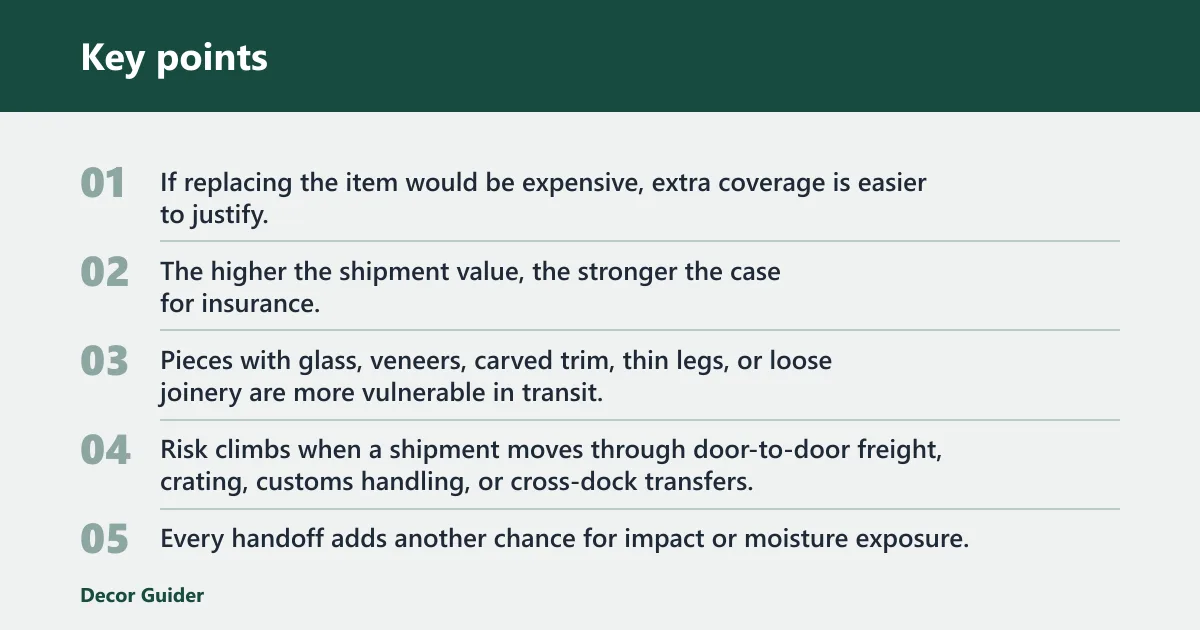
If replacing the item would be expensive, extra coverage is easier to justify. A designer cabinet, antique table, or custom bed frame can cost much more than standard carrier liability would return after a claim. The higher the shipment value, the stronger the case for insurance.
Fragile or hard-to-pack items
Pieces with glass, veneers, carved trim, thin legs, or loose joinery are more vulnerable in transit. Poor packing raises the risk of scratches, dents, and breakage, and many denials trace back to packaging that was not strong enough for a furniture freight shipment.
Freight moves with multiple handoffs
Risk climbs when a shipment moves through door-to-door freight, crating, customs handling, or cross-dock transfers. Every handoff adds another chance for impact or moisture exposure. More transfers also make paperwork more important, because the claim file has to show where the problem likely occurred.
Suppose a bed frame is shipped across borders with crating, pallet loading, and a customs check. The item may be well protected, but the number of transfers still raises the odds of damage compared with a simple local pickup, so extra insurance becomes a practical buy rather than a guess.
Furniture shipping insurance decision table
This table gives a furniture-specific rule of thumb. It separates likely default coverage from the action that makes sense for each item type, based on value, fragility, and handling risk.
| Shipment type | Likely coverage included by default | Recommended action |
|---|---|---|
| Sofa | Limited carrier liability or declared value coverage | Buy extra insurance if it is upholstered, custom-made, or expensive to replace. |
| Bed frame | Limited carrier liability, often based on shipment terms | Use extra coverage if the frame is large, disassembled, or made from fragile wood. |
| Dining table | Declared value coverage may apply, but payout can be capped | Insure it if the top is glass, veneer, marble, or high value. |
| Chair | Basic carrier liability may be all that is included | Skip extra insurance only if replacement cost is modest and packing is strong. |
| Coffee table | Limited liability unless a higher value is declared | Buy coverage for glass, thin legs, or designer pieces. |
| Cabinet | Declared value coverage, with handling and packing conditions | Choose extra insurance for antiques, heavy wood cabinets, or shipments with several handoffs. |
How to reduce damage risk before pickup
Good packing lowers the chance of transit damage, and it can also support a claim if damage still happens. Use protective wrapping, foam, blankets, straps, and, where required, wooden crating. Label the shipment clearly and keep inventory records so every piece can be matched at delivery.
-
Wrap vulnerable surfaces.
Use protective wrapping and blankets on corners, tabletops, and edges. Shipixy says blankets, foam, and straps are used to reduce damage risk, and that matters most for furniture with legs, veneer, or glass parts. -
Break down large parts.
Take apart bed frames, tables, or cabinets when the design allows it. Shipixy recommends packing tables, beds, or cabinets into large parts, and it also says bed frames should be broken down and mattresses wrapped safely. -
Choose the right container.
Use boxes, crates, or pallets based on the item and route. Shipixy says furniture can be packed in boxes, crates, or pallets, and crating is often the safer choice when the item has exposed corners or a high declared value. -
Secure and label everything.
Strap the load so it cannot shift, then label each part and keep an inventory list. Clear labeling helps with handoff checks, and inventory documentation gives you proof if a piece goes missing or arrives with visible damage.
How to file a claim for damaged furniture
Claims work best when you report the problem immediately, photograph the item before moving it again, and keep the shipment paperwork. Most carriers require prompt notice, and deadlines can be short. The claim file should show what was shipped, how it was packed, and when the damage was found.
-
Inspect at delivery.
Check the outside packaging before you sign anything. If the crate, pallet, or box is crushed, torn, wet, or punctured, note it on the delivery record right away. -
Photograph all damage.
Take wide shots and close-ups of the packing, the furniture, and any labels or seals. Photos are one of the strongest forms of evidence when the claim turns on transit damage or poor handling. -
Save shipment documents.
Keep the bill of lading, declared value record, item list, and any email or portal confirmation. These papers show what the carrier accepted and help connect the damage to the exact shipment. -
Report before deadlines expire.
File the notice as soon as the issue is found. DHL says claims must be submitted within 30 days of acceptance, and other carriers may use shorter or different windows, so do not wait to collect the evidence.
Shipping furniture usually include checklist
| Item to collect | Why it matters |
|---|---|
| Photos | Shows the condition of the furniture, the packaging, and visible impact points. |
| Declared value | Shows the amount tied to carrier liability or insurance coverage. |
| Packing method | Helps prove whether blankets, foam, crating, or straps were used. |
| Bill of lading | Confirms the shipment terms and what the carrier accepted. |
| Damage-notice deadline | Keeps the claim within the carrier’s filing window. |
Frequently asked questions
Is furniture shipping insurance included by default?
Usually not. Shipping insurance is optional, and the cost is generally linked to shipment value. If you want broader protection, check the booking terms before pickup and confirm whether the carrier’s default coverage is only declared value coverage or a separate insurance add-on.
What does shipping insurance cover for furniture?
Furniture shipping insurance can reimburse loss, theft, or damage in transit. Some carriers also mention delays, but that depends on the policy. Coverage usually works only when the item was packed and documented properly, and when the claim is filed within the carrier’s deadline.
What is not covered by furniture shipping insurance?
Common exclusions include damage caused by unsuitable packing, moisture exposure that was not properly managed, and claims filed too late. Carriers may also deny coverage if the furniture was not protected with blankets, foam, straps, or crating when the route required stronger packing.
Should I buy insurance when shipping a sofa or bed frame?
Often yes, especially if the sofa or bed frame is expensive, custom-made, or hard to replace. These items are bulky and can be damaged during loading, handoffs, or customs checks. If the replacement cost is high, extra insurance is usually easier to justify than relying on limited liability.
How do I file a claim if my furniture arrives damaged?
Inspect the shipment at delivery, photograph the damage, and keep the bill of lading and other shipment details. Report the issue promptly, because deadlines can be short. The same source says claims must be submitted within 30 days of acceptance, and some carriers may require even faster notice.
Products related to this article
Sponsored / affiliate links. As an Amazon Associate I earn from qualifying purchases. I may earn additional commission from eligible campaigns.