Best Tie Downs for Weekend DIY Projects (2026): We Compared
For most weekend DIY hauls, start with the Everest Premium Ratchet Tie Down. It lists a 3333 lbs working load, so you get a clear safe-use number instead of a cheap strap that only advertises break strength. If you need several straps for one project, the LISHINE 4-pack gives better value per strap, but the Everest model is the cleaner first buy when you want a specific load rating for a single strap.
Quick comparison
| Product | Badge | Best for | Price | ||
|---|---|---|---|---|---|
 |
4 Pack 2 Inch Ratchet Straps Heavy Duty 20ft Tie DownLISHINE | Our pick | 4 Pack 2" × 20ft · 10,000 lb break | $42.59
Price as of 27 Oct 2026
|
View |
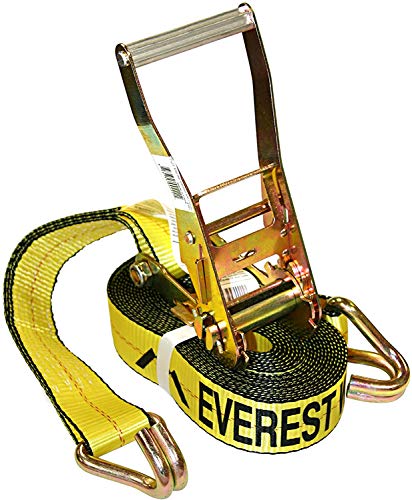 |
Everest Premium Ratchet Tie Down – 1 PK – 2 IN – 27 FT –EVEREST | Budget pick | 2" × 27ft · double J-hook · 10,000 lb break | $9.76
Price as of 27 Oct 2026
|
View |
Two things separate a good budget strap from a risky one: the working load limit you can actually use, and the hardware that still works after wet weekends and rough storage. The picks below cover the lowest-cost single strap and the better-value pack.
How we chose
The shortlist is built around four buying checks: working load limit first, then strap type and hardware, then length and width, then outdoor durability and corrosion resistance. That order matters because break strength alone does not tell you what the strap can safely carry.
WLL is the safe operating rating. Break strength is the force at failure. They are not the same number, and you should not shop as if they are interchangeable.
We also favored common weekend sizes. Strap width and length should match the job without forcing you into oversized webbing.
Finally, we looked at ownership costs that buyers often miss: fraying, corrosion, replacement frequency, and whether the hardware is kind to painted or finished surfaces.
Weekend DIY tie-down decision matrix
| Weekend DIY job | Minimum safe strap type | Minimum WLL band | Suggested length | Hook style | Main failure risk |
|---|---|---|---|---|---|
| Lumber run | Ratchet strap | 300 lb WLL or higher | 12 to 16 ft | J-hook or coated S-hook that fits the anchor | Uneven boards can settle and loosen the strap |
| Tool haul | Cam buckle or ratchet strap | 200 to 300 lb WLL | 10 to 12 ft | Coated S-hook | Edge wear from metal cases and hard corners |
| Patio furniture move | Cam buckle strap | 200 lb WLL or higher | 10 to 16 ft | Coated S-hook | Over-tightening can crush frames or cushions |
| Roof rack cargo | Cam buckle strap | 300 lb WLL or higher | 12 to 16 ft | Coated S-hook or rack-compatible hook | Low-angle anchoring can let the load shift |
| Small trailer load | Ratchet strap | 300 lb WLL or higher | 12 to 16 ft | J-hook for proper anchor points | Vibration can loosen a poorly routed strap |
| Outdoor storage | Ratchet or cam buckle strap with corrosion-resistant hardware | 200 to 300 lb WLL | 10 to 16 ft | Coated S-hook | Rust, UV wear, and wet storage shorten strap life |
This matrix is for weekend DIY use, not a substitute for the vehicle, trailer, or product manual. Follow the manual, never exceed the vehicle’s rated roof, hitch, or tow limit, keep items out of airbag zones and the driver’s view, never work under a vehicle held only by a jack, and check local laws before you haul.
LISHINE 4-pack: best for multi-strap weekend hauls
- Four straps in one pack gives best value per unit
- Double J-hooks fit narrow trailer ears
- Heavy-duty steel ratchet mechanism
The LISHINE 4-pack fits buyers who need several tie-downs at once for moving day, a trailer run, or repeated weekend projects. It gives you 2 inches by 20 feet, 10000 lbs break strength, and double J-hooks, so it suits narrow trailer ears and other compatible anchor points.
Its main advantage is value per strap. Four straps in one pack can cost less per unit than buying single pieces one at a time, and the 20-foot length helps with bulkier cargo, such as stacked boxes or awkward patio items.
The drawback is simple: the listing gives a break-strength claim, but no working load limit in the supplied product data. That means you should verify the WLL on the actual packaging or listing before you treat it as a safe buy for heavier work. For corrosion resistance, hardware material details are not provided here, so check the seller’s listing if the straps will live outdoors.
Everest Premium Ratchet Tie Down: best for the cheapest safe single strap
- Lowest price at $9.76 per strap
- Edge guard reduces webbing abrasion
- Aluminum handle resists corrosion
The Everest Premium Ratchet Tie Down is the clearer budget pick if you want one strap and want the rating question settled up front. It is 2 inches by 27 feet, has a 3333 lbs working load, and lists 10000 lbs break strength, which makes the safe-use number easy to compare against the job.
It also has a double J-hook, an aluminum handle that resists corrosion, and an edge guard that helps reduce webbing abrasion. That combination is useful for moving appliances, lawn equipment, and motorcycles, especially when the load needs a longer reach.
The main drawback is size. A 27-foot strap is longer than many simple home jobs need, so it can feel bulky for short cargo. It is also a single strap, so the upfront price is low, but the per-project value changes if you need a full set.
Which one should you buy?
If you want the lowest-cost safe single strap, buy the Everest model first. Its published working load limit gives you a clearer safety baseline than a strap that only advertises break strength, and the price is low enough for one-off use.
If you need multiple straps for one move, choose the LISHINE pack. Four straps matter more than a slightly lower price on one piece, especially when you are securing several loose items or using redundant tie-down points.
For a short roof-rack run or small trailer load, the Everest strap is the better fit because its longer length gives extra routing room around bulky cargo. For general home storage or lighter weekend chores, a shorter strap would be easier to manage, but between these two, the Everest still gives the better safety signal because the WLL is stated plainly.
WLL versus break strength
Use working load limit for your buying decision. That is the safe operating number. Break strength is only the point where failure occurs under extreme force, so it is not the number you should plan around.
Hardware and surface protection
S-hooks are common on consumer tie-downs and often come coated to protect paint and plated surfaces. J-hooks are a better match when you have compatible anchor points and want a more secure connection.
Corrosion-resistant hardware matters more than many budget buyers expect. Zinc-plated or coated metal is worth paying for if the straps will sit in a damp garage, an open trailer, or a wet truck bed.
Length and width
1-inch webbing is a common budget size because it spreads load better than thinner strap material without making the strap hard to manage. 10 to 16 feet covers most small cargo, roof-rack work, and many trailer tasks. Longer straps help when the item is wide, awkward, or padded.
A common first-timer mistake is buying the cheapest short strap and then trying to reach around a tall load with a bad angle. The strap may fit, but the hardware ends up pulling in a direction that encourages slip.
Four checks before you buy
- Check the WLL first, then compare it with the load and the setup.
- Confirm the hook style matches the anchor point before you buy the pack.
- Pick a length that lets the strap sit flat without forcing a sharp angle.
- Look for corrosion-resistant hardware and inspect the webbing for fraying before every use.
Should you choose cam buckle or ratchet straps?
Choose a cam buckle strap when you want quick adjustment, lighter-duty control, and less risk of over-tightening. Choose a ratchet strap when the load is heavier, vibration is more of a concern, or the cargo needs stronger tension to stay put during transport.
For weekend DIY use, cam buckles are often better for patio furniture, small storage loads, and short moves. Ratchets are usually safer for lumber, trailer cargo, and anything that can bounce or settle during the trip.
When cam buckle straps make sense
Cam buckles are practical when the load is light and the risk is more about shift than bounce. They are also a good choice for fast setup because the strap adjusts quickly without much force.
If you are tying down patio chairs or a box of tools, cam buckles reduce the chance of crushing the item or distorting a frame. They are less aggressive than ratchets, which is useful when the load is delicate.
When ratchet straps are the safer choice
Ratchets are better when you need more tension to keep the load from moving, especially on trailers and roof racks. Their higher tension helps with vibration, road movement, and load settling.
That extra force is also the drawback. It can be too much for soft furniture, lightweight frames, or any item that can bend under pressure. Tighten only until the load is secure.
Over-tightening and slippage risks
Over-tightening can damage the cargo, stretch the webbing, or distort the anchor point. Slippage is more likely when the strap runs at a poor angle, crosses uneven surfaces, or sits on a smooth, round load without enough friction.
Picture a small trailer load of boxed tile with a strap run too low across the front edge. The strap can look tight at the driveway, then loosen after the first bump because the load settles and the angle gets worse.
What strap length and width do you need?
For most home projects and small cargo, 10 to 16 feet covers the useful middle ground. A 10-foot strap is easier to manage on compact loads, while 12 to 16 feet gives you more room for roof racks, trailers, and bulky items with odd shapes.
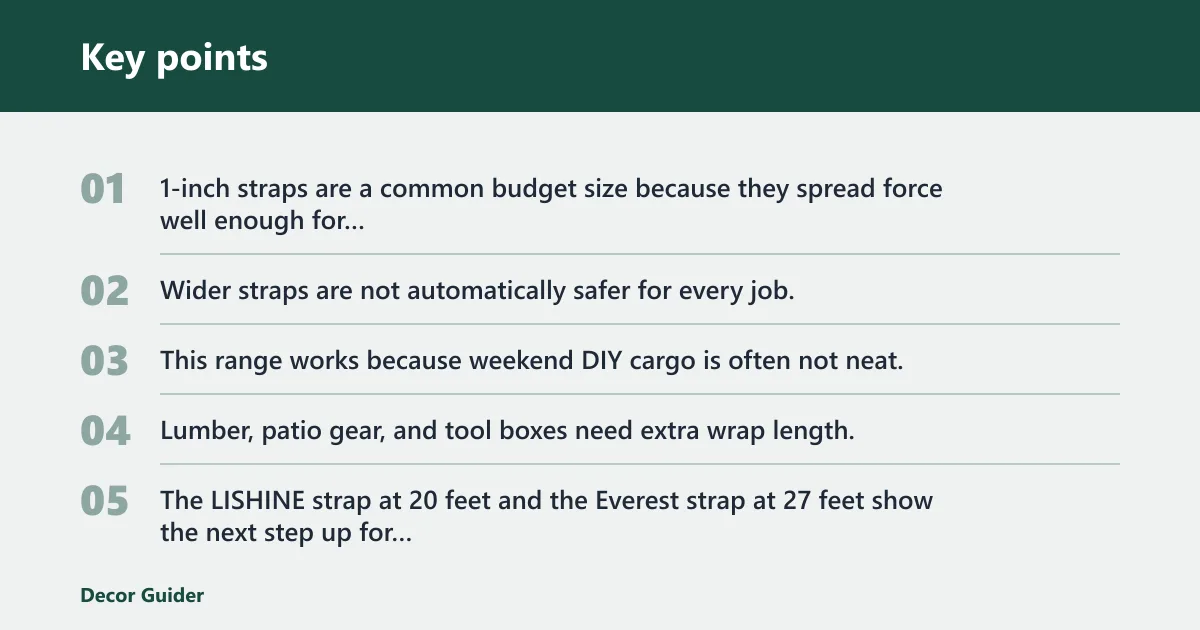
1-inch straps are a common budget size because they spread force well enough for consumer use and stay easy to route through hooks and anchors. Wider straps are not automatically safer for every job, and narrower ones can be too thin for reliable everyday hauling.
Why 10 to 16 feet covers many weekend jobs
This range works because weekend DIY cargo is often not neat. Lumber, patio gear, and tool boxes need extra wrap length, especially if you want the strap to sit flat and keep a good pull angle.
The LISHINE strap at 20 feet and the Everest strap at 27 feet show the next step up for bigger or more awkward loads. Those lengths help when you need more routing distance, but they are more than many light indoor chores require.
When 1-inch webbing is enough
One-inch webbing is enough for many consumer loads when the WLL is correct and the hardware fits the anchor. It is a common budget size because it keeps the strap manageable while still spreading the load better than thinner webbing.
A 1-inch strap is a good starting point for small cargo, patio pieces, and short hauls. If the load is sharp-edged or unusually heavy, move up based on WLL and hardware, not just width.
When a longer strap saves time
A longer strap saves time when the load is tall, bulky, or hard to reach around. It can also help if the tie-down point sits lower than the top of the cargo, because you need more length to keep the strap path safe.
Long straps are especially useful for roof racks and trailer work. They are less convenient for small boxes, but they reduce the chance that you will run out of length and create a bad angle just to make the strap fit.
How much working load limit do you need?
Start with the actual job, not a price tag. For light weekend hauling, a strap with a clear WLL in the low hundreds can be enough, while larger cargo, trailers, and vibration-prone loads need more margin and better hardware. The safest budget buy is the cheapest strap whose WLL and anchor setup match the task.
WLL versus break strength: break strength is the maximum
Break strength is the maximum force before failure. WLL is the safe operating capacity. Budget listings often make the break-strength number look impressive, but that figure does not tell you what the strap should be asked to carry in normal use.
The Everest listing gives both numbers, which helps. The LISHINE listing gives a break strength claim, but the supplied product data does not state WLL, so you should not use break strength alone as the buying rule.
How to read the label before you buy
Look for the working load limit first. Then check strap width, length, and hook style. After that, look for corrosion-resistant hardware if the strap will live in a garage, trailer, or truck bed.
If the product page only gives a break-strength number, stop and verify the WLL on the actual label or manufacturer listing. That extra step can prevent a cheap but risky buy.
When to move up a size
Move up a size when the load is uneven, the route includes vibration, or the strap angle is poor. You should also move up if the hardware is not a perfect match for the anchor point.
A common first-timer mistake is choosing the cheapest pack and then compensating by tightening harder. That does not fix a weak WLL, and it can make the load more likely to shift or the cargo more likely to get damaged.
Frequently asked questions
What are the best budget tie downs for weekend DIY projects?
The best budget choice is the cheapest strap that still gives you a clear WLL, the right length, and compatible hardware. For the products here, the Everest strap is the safer single-strap buy because its WLL is stated plainly, while the LISHINE pack is better if you need several straps at once.
Should I choose cam buckle straps or ratchet straps for DIY use?
Choose cam buckles for lighter, faster jobs where over-tightening is a concern. Choose ratchets for heavier cargo, trailer work, or any load that can bounce during transport. The safer choice depends on the job, not just the price.
What strap length do I need for home projects and small cargo?
Most home projects fit in the 10- to 16-foot range. Shorter straps are easier to handle, but longer straps are useful for roof racks, trailers, and bulky cargo. If the strap barely reaches, it is the wrong length.
How much working load limit do I need for light DIY hauling?
Light DIY hauling often needs a WLL in the low hundreds, but the exact number depends on the load shape, anchor points, and transport setup. The safe move is to pick a strap whose WLL is clearly stated and comfortably fits the job, not just the price.
What’s the difference between break strength and working load limit?
Break strength is the force at which the strap fails. Working load limit is the safe operating rating. They are not interchangeable, and budget shoppers should use WLL as the real decision number.
How do I keep tie down straps from slipping on a load?
Use a strap length that lets the webbing lie flat, keep the angle as direct as the setup allows, and choose hardware that fits the anchor point. For smooth or uneven cargo, add protection where the strap contacts the load and recheck tension after the first short drive.
Products related to this article
Sponsored / affiliate links. As an Amazon Associate I earn from qualifying purchases. I may earn additional commission from eligible campaigns.