Why Is Shipping a Cabinet So Expensive?
Cabinet shipping gets expensive when size pushes the shipment into oversize freight, then packaging, freight class, lift gate service, inside delivery, and residential fees stack onto the base rate. Miss one charge, and the quote can jump by hundreds or arrive with add-ons later. This guide breaks down the rate drivers, how carriers price cabinets, and which changes lower the bill.
Why cabinet shipping gets expensive
Cabinets cost more to ship because they are bulky, often awkward to handle, and easy to damage. A finished box with doors, handles, shelves, and trim can take up more space than its empty weight suggests, so carriers price the shipment by size, handling risk, and service level instead of weight alone.
Cabinet shipping cost driver table
| Cabinet type | Typical packaging state | Likely shipping mode | Common surcharge triggers | What to change to lower the quote |
|---|---|---|---|---|
| Flat-pack kitchen cabinet | Boxed, double-wall corrugate, corner protected | Parcel or LTL if the box is oversized | Dimensional weight, oversize fee, residential delivery | Flatten the pack, remove loose hardware, compare parcel against LTL |
| Assembled upper cabinet | Wrapped, corner protected, often palletized | LTL freight | Lift gate, inside delivery, appointment fee, handling class | Ship on a pallet, reduce protrusions, avoid inside delivery if possible |
| Base cabinet with toe kick | Wrapped and palletized | LTL freight | Oversize length, limited access, residential delivery | Measure the loaded pallet, confirm access, keep the delivery address commercial if allowed |
| Bathroom vanity | Boxed or wrapped, often with sink cutout protection | Parcel for smaller units, LTL for larger units | Fragile surface, dimensional weight, declared value | Use stronger packaging and compare shipping with and without the top attached |
| Built-in cabinet section | Custom crated or palletized | LTL freight or white-glove | Oversize freight, appointment fee, inside delivery, fragile item premium | Disassemble safe parts, keep glass separate, request curbside delivery if practical |
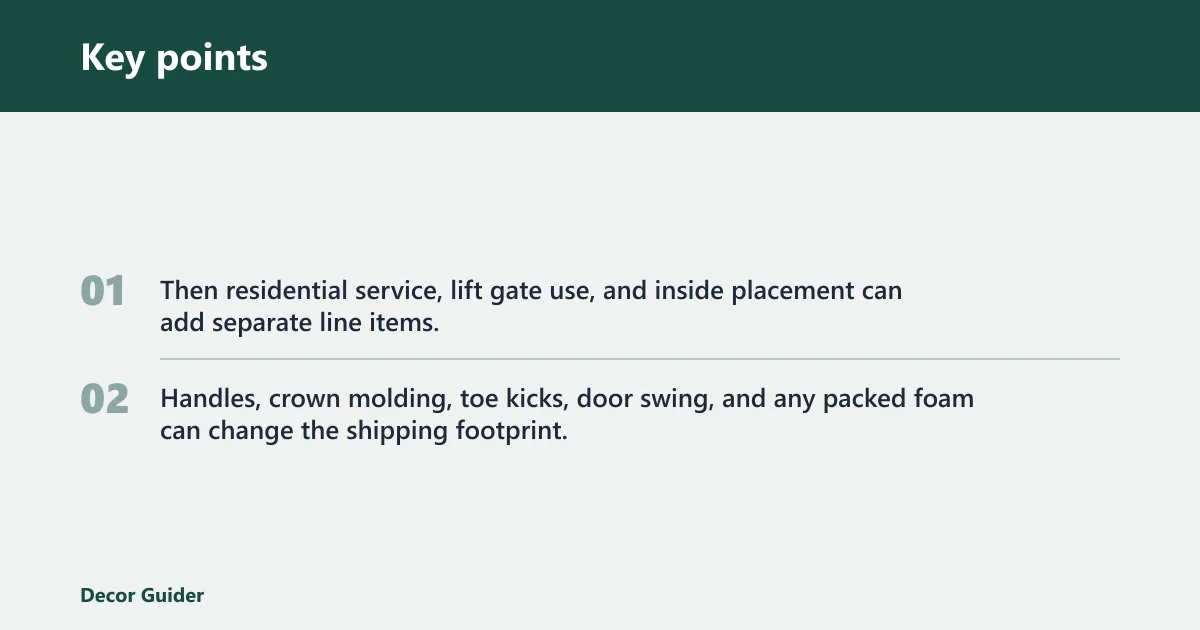
Most quotes jump for one of two reasons: the cabinet becomes too large for parcel rules, or the carrier adds accessorial fees after the base rate is set. Size can trigger dimensional pricing first. Then residential service, lift gate use, and inside placement can add separate line items.
A common first-timer mistake is ignoring the extra space needed for protective packaging and palletizing when shipping a cabinet. Handles, crown molding, toe kicks, door swing, and any packed foam can change the shipping footprint. That extra inch or two matters when a box is near an oversize threshold.
How size changes the rate
Cabinet shipping often changes price when the package moves from a standard parcel footprint into oversized or freight pricing. Height, width, depth, and how the cabinet is packed all matter. Assembled cabinets usually cost more to move than flat-pack boxes because they are harder to stack, protect, and sort.
Assembled cabinets versus flat-pack boxes
A flat-pack cabinet can sometimes stay in parcel territory if the box is still within carrier limits. An assembled cabinet usually cannot. Once doors, face frames, and shelves are fixed in place, the package becomes harder to compress and more likely to hit the carrier’s size rules.
Suppose a flat-pack bathroom vanity ships in a 28 x 22 x 8 inch box. That is often easier to rate than a fully assembled unit that is roughly 30 x 24 x 34 inches after wrapping and palletizing. The second shipment usually leaves parcel pricing and moves into freight because the loaded footprint is too large and too awkward for standard parcels.
Oversize thresholds and dimensional weight
Carriers compare a package’s actual weight with its dimensional weight. Dimensional weight comes from length x width x height divided by a carrier-specific divisor, then rounded up. If the dimensional weight is higher, that becomes the billable weight.
That is why a light cabinet can still cost a lot to ship. A large but lightweight upper cabinet can be priced as if it weighs far more than the scale shows, because it occupies space on the truck or in the parcel network.
Why door handles, protrusions, and deep bases change billable size
Handles, knobs, decorative trim, and uneven weight distribution can force the package into a larger carton or pallet. Even if the cabinet body is compact, the shipped dimensions must cover the widest safe points. Deep base cabinets also consume more cubic space, which pushes up dimensional weight and can trigger oversize surcharges.
-
Measure the loaded package. Use the longest, widest, and tallest points after wrapping, corner protection, and pallet placement. Measure in inches, because that is how most parcel and freight quotes are built.
-
Compare actual and dimensional weight. Use the carrier’s divisor for the service you are considering. If the dimensional weight is higher, that is the billable weight and the quote will follow it.
-
Check oversize limits first. A cabinet that crosses the parcel size rules should be priced as freight from the start. That avoids a false low quote that later changes at checkout.
Why does freight pricing jump?
Freight pricing jumps because the carrier is pricing more than movement. It is pricing pallet space, handling risk, and the chance of damage on a finished surface. Once a cabinet leaves parcel shipping, the quote can change based on freight class, density, and whether the shipper accepts curbside or needs more handling.
Parcel versus LTL freight
Parcel works best for smaller, tightly boxed cabinets. LTL freight is more common when the cabinet is too large for parcel networks or needs pallet support. LTL can be cheaper than parcel for oversized cabinets, but the final price often rises after accessorial fees are added.
Parcel is usually simpler. LTL adds more variables. If the cabinet is large, fragile, or already palletized, the freight quote may still be the better fit, but only if you account for the extra services up front.
Freight class and NMFC classification
Carriers use density-based freight class and NMFC-style classification to group freight by space, weight, handling difficulty, and damage risk. A dense, compact cabinet can rate better than a very bulky one with the same actual weight. A fragile finished cabinet can also end up in a less favorable class because it is harder to move safely.
That matters because two cabinets with the same scale weight can ship at very different prices. One compact base cabinet on a tight pallet can rate lower than a wide built-in unit with loose packaging and more air space.
How density and damage risk affect the quote
Density lowers the price when the cabinet uses less cubic space per pound. Damage risk pushes it up when the finish is delicate, the glass inserts are exposed, or the package can shift inside the carton. Carriers may use a higher class or add handling rules when the item is hard to stack or easy to crush.
For cabinets, damage risk is not abstract. A scratched face frame or chipped edge can turn a cheap shipment into a costly claim. That is why carriers and brokers often price finished goods more cautiously than raw boxes or knock-down parts.
What charges add up at checkout?
Checkout charges rise when the shipment needs more than linehaul transport. Residential delivery, lift gate service, inside delivery, limited access, and appointment fees can stack on the base rate. Declared value also changes the price because higher coverage usually means a higher premium or tighter claim rules.
Residential delivery and limited access
Residential delivery often costs more than commercial delivery because the truck must stop at a home, a driveway, or a neighborhood with less efficient routing. Limited access can add more if the address has stairs, a gated entry, a narrow street, or no easy loading dock.
Suppose a cabinet is shipped to a house with no dock and no dock-high receiving area. Even if the base freight rate looks reasonable, the residential and limited-access charges can make the final quote much higher than expected.
Lift gate, inside delivery, and appointment fees
Lift gate service is used when the truck needs help getting the pallet to ground level. Inside delivery moves the cabinet beyond the curb or threshold, which costs more because the driver handles more labor and risk. Appointment fees can apply when the receiver must schedule a delivery window.
These fees often stack. A residential lift-gate delivery with an appointment can cost far more than a plain terminal pickup, even before any insurance is added.
Declared value and insurance
Declared value coverage is tied to the shipment’s replacement cost and the carrier’s claim rules. It is not the same as blanket protection. A fragile cabinet with a painted finish, glass insert, or specialty hardware may need more protection than the base policy allows, and the premium can rise with the declared value.
That matters because cabinets are finished goods. If damage occurs, a claim can be limited by packaging standards, packaging photos, or carrier liability caps. Stronger packing helps the claim outcome, but it does not erase the need to price coverage honestly.
Packaging that changes the quote
Packaging can lower or raise the bill. Double-wall corrugate, corner protectors, foam wrap, and palletization all improve protection, but they also add weight and size. The goal is to package just enough to avoid damage without creating unnecessary dimensional weight.
Double-wall corrugate and corner protection
Double-wall corrugate is a common choice for cabinet boxes because it resists crush better than lighter cartons. Corner protectors matter when the cabinet has painted or veneered edges. They reduce scuffs and help the carton survive stacking pressure.
Foam wrap, glass inserts, and palletization
Foam wrap is useful for finished surfaces, especially around doors and face frames. If the cabinet includes glass inserts, those panes should be immobilized so they do not rattle or crack in transit. Palletization can improve handling on LTL freight, but it also increases the package footprint and may change the rate class.
Packaging should match the shipping mode. A parcel box needs tight internal fill. A palletized freight shipment needs stable stacking, clear fork access, and enough wrap to prevent the cabinet from shifting across the deck.
How to lower cabinet shipping costs

You lower cabinet shipping costs by matching the service to the cabinet condition, then removing avoidable charges. The biggest savings usually come from choosing the right mode, shrinking the shipped footprint, and avoiding accessorials that are not needed for the actual delivery address.
-
Pick the right service. Use parcel only when the packed cabinet fits carrier limits. Switch to LTL freight when the box becomes oversized, and use white-glove or threshold delivery only when the receiver truly needs placement inside the home.
-
Remove what can travel separately. Take off loose shelves, knobs, handles, and other protrusions if the cabinet can be shipped safely without them. A smaller carton or cleaner pallet often lowers both dimensional weight and damage risk.
-
Flatten or disassemble when safe. Flat-pack cabinet boxes often ship cheaper than assembled units. If the design allows safe knock-down shipping, confirm the manufacturer’s listing or assembly instructions before you separate parts.
-
Compare three quotes on the same terms. Ask for parcel, LTL, and local delivery using the same dimensions, weight, pickup address, and delivery type. A quote looks cheaper only if the assumptions match.
-
Strip out avoidable accessorials. If the address is commercial, use that instead of residential. If the receiver can unload, skip lift gate. If delivery can be curbside, avoid inside delivery and appointment fees.
One useful comparison method is to line up the same cabinet three ways: parcel box, palletized LTL, and local courier or moving company delivery. Then add the accessorials that actually apply. The lowest base rate is not always the lowest final bill.
For a small flat-pack upper cabinet, parcel may win if the box stays under oversize rules. For a larger base cabinet, LTL can be cheaper once dimensional weight and oversize surcharges are included. For a finished cabinet going a short distance, local delivery may cost more upfront but less than LTL after lift gate and residential fees are added.
How much does it cost to ship a cabinet?
For a small flat-pack cabinet, parcel pricing can land in the rough range of $30 to $120 when the box stays within standard size rules and the address is straightforward. A palletized cabinet shipped by LTL freight often lands in the rough range of $150 to $600, while white-glove or inside delivery can run higher.
Those are broad ranges, not fixed rates. The final price depends on distance, size, weight, packaging, and whether the quote includes residential delivery, lift gate service, or declared value coverage. A cabinet that looks small on paper can still price high if the box is long, deep, or awkwardly packaged.
A quick worked example helps. As an example, a cabinet shipping as a roughly 48 x 24 x 36 inch palletized unit with a moderate freight rate may also need residential delivery, lift gate, and appointment service. The total can move from a mid-range freight quote into a much higher final bill once the accessorials are included.
Frequently asked questions
Why is shipping a cabinet so expensive?
Cabinet shipping gets expensive because the item is large, awkward to handle, and easy to damage. Once it crosses into oversized or freight pricing, the carrier may add dimensional weight, packaging, lift gate, residential, and inside delivery charges. The base rate is only part of the final bill.
Why is shipping so expensive for bulky furniture?
Bulky furniture takes up more space on the truck than its weight suggests. That makes dimensional weight and oversize rules matter more than scale weight alone. Furniture also needs more packaging and more careful handling, which raises the chance of accessorial fees and damage-related premiums.
What makes cabinet freight more expensive than parcel shipping?
Freight becomes more expensive when the shipment needs pallet space, special handling, or extra delivery services. A cabinet can move from parcel to freight after it crosses oversize thresholds, then freight class, residential delivery, lift gate use, and inside placement can push the total higher than expected.
How are cabinets priced for delivery?
Cabinets are priced by a mix of dimensions, actual weight, dimensional weight, freight class, packaging, and delivery access. Carriers also look at whether the shipment is parcel or LTL, whether it is residential, and whether the driver must use a lift gate or make an appointment.
Can a cabinet be shipped fully assembled?
Yes, but fully assembled cabinets usually cost more to ship because they are harder to protect and more likely to hit oversize rules. If the cabinet can be safely flattened or broken down without harming the finish or structure, that often lowers the quote. Check the manufacturer’s listing for model-specific assembly guidance.
What size or weight makes cabinet shipping switch to freight?
The switch happens when the packed cabinet no longer fits parcel limits or when dimensional weight becomes too high for parcel pricing. There is no single universal cutoff, because carriers use different formulas and oversize rules. Once the box is long, deep, or palletized, freight often becomes the better fit.
How do I lower the cost to ship a cabinet?
Start by comparing parcel, LTL, and local delivery using the same dimensions and delivery conditions. Then remove loose parts, flatten the cabinet if safe, and avoid residential, lift-gate, and inside-delivery fees unless they are truly needed. Better packaging can also reduce damage risk and claim problems.
Why are cabinets so expensive?
Cabinets are expensive to ship because they are bulky, fragile, and often finished on every exposed face. Carriers price for the space they use, the risk of scratches or chips, and the extra handling needed to move them safely. Large cabinets can also cross into freight pricing very quickly.
Why are kitchen cabinets so expensive?
Kitchen cabinets are often shipped in multiple pieces or in oversized boxes, which increases carton count, cubic volume, and handling time. Painted surfaces, door hardware, and face frames also need more protection than plain boxed goods. That combination makes the shipping quote rise faster than the actual weight might suggest.
Why is shipping so expensive?
Shipping gets expensive when the package is large, heavy, hard to sort, or difficult to deliver. Cabinets hit several of those at once. They may require dimensional pricing, freight class adjustments, palletization, and added delivery services, which is why the total can climb quickly at checkout.
Why does shipping cost so much?
Shipping costs so much when the carrier must reserve more space, spend more labor, or take on more damage risk. Cabinets do all three. A finished cabinet can require oversized handling, stronger packaging, and residential delivery fees, so the quote rises even if the cabinet itself is not especially heavy.
Products related to this article
Sponsored / affiliate links. As an Amazon Associate I earn from qualifying purchases. I may earn additional commission from eligible campaigns.