What Size Shower Curtain Do You Need?
A properly sized shower curtain usually gives you opening width plus about 6 to 12 inches of side coverage, with the hem stopping about 1 to 2 inches above the tub rim or floor. Labels like 70 x 72 or 54 x 78 are only starting points, and sellers sometimes use different naming conventions for the same fit. Rod placement, ring drop, and liner length all affect the final hang. This guide shows how to measure tubs, stalls, curved rods, and tall setups so you can pick the exact size.
Shower curtain sizing worksheet


Use this table as a quick sizing check before you buy. Width depends on the opening and rod style. Height depends on rod-to-floor distance, then you trim for about 1 to 2 inches of floor clearance. For a standard tub-shower combo, common manufacturer guidance and retail sizing references still center on a 72 x 72 curtain, a roughly 60-inch tub opening, and a rod height around 75 to 77 inches from the floor.
| Opening width | Rod height from floor | Rod style | Recommended curtain width | Recommended curtain length | Warning flags |
|---|---|---|---|---|---|
| About 60 inches tub opening | 75 to 77 inches | Straight rod, inside mount | 72 inches | 72 inches | Standard tub-shower combo; check for 1 to 2 inches of floor clearance |
| About 60 inches tub opening | 75 to 77 inches | Straight rod, outside mount | 72 to 84 inches | 72 inches | Extra side overlap may help if the rod sits outside the tub edge |
| 60 to 66 inches opening | Over 77 inches | Straight rod, high-mounted | 84 inches | 84 inches | Extra-tall rod; standard length may hang too short |
| 36 to 54 inches stall opening | About 75 to 77 inches | Straight rod, compact stall | 54 inches | 78 inches | Stall shower; standard tub curtain will look too wide |
| Wide, curved, or doorless opening | 75 to 77 inches | Curved rod | 84 or 108 inches | 72 to 84 inches | Curved rod needs extra side coverage; watch for corner gaps |
| Deep alcove tub | 75 to 77 inches | Straight rod with deep setback | 72 to 84 inches | 72 to 78 inches | Standard curtain may clear the opening but miss the tub edge |
Simple formula: measure opening width, then add 6 to 12 inches for overlap. For height, measure rod-to-floor distance and subtract 1 to 2 inches for hem clearance. If the measurement falls between sizes, choose the longer length for height and the wider option for width when you need more splash protection; choose the smaller option only when extra fabric would crowd the tub or stall.
Decision tree: if the opening is a standard tub and the rod is straight, start with 72 x 72. If the rod is high, move to a longer length before changing width. If the shower is a stall, use a narrower stall size. If the rod is curved or the opening is wide or doorless, prioritize extra width before adding length.
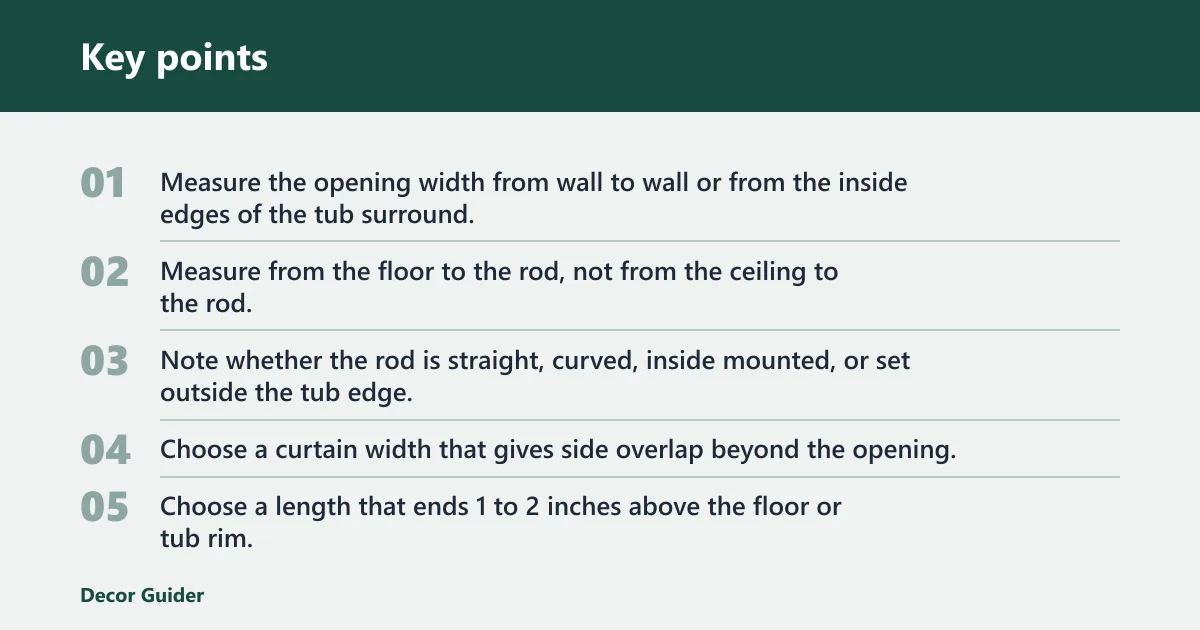
- Measure the opening width from wall to wall or from the inside edges of the tub surround.
- Measure from the floor to the rod, not from the ceiling to the rod.
- Note whether the rod is straight, curved, inside mounted, or set outside the tub edge.
- Choose a curtain width that gives side overlap beyond the opening.
- Choose a length that ends 1 to 2 inches above the floor or tub rim.
What is the standard shower curtain size?
The most common standard shower curtain size is 72 x 72 inches, though some product pages list 70 x 72 or even 70 x 70 as standard. Sellers group sizes differently, so the label is not always identical from brand to brand. For most tub-shower combos, the square 72 x 72 format is the practical standard. Major bath fixture references and manufacturer sizing guides also center on that size for a typical tub opening.
Why 70 x 72 and 72 x 72 both appear
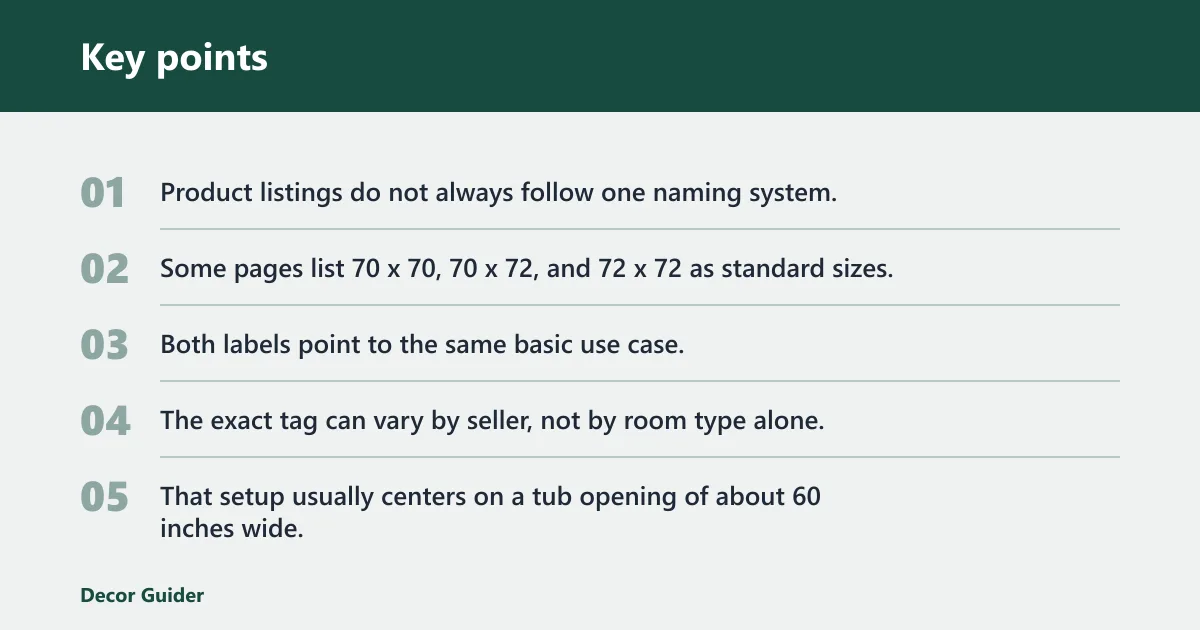
Product listings do not always follow one naming system. Some pages list 70 x 70, 70 x 72, and 72 x 72 as standard sizes, while others call 72 x 72 the universal standard. Both labels point to the same basic use case, a curtain for a typical residential tub-shower setup. The exact tag can vary by seller, not by room type alone.
That setup usually centers on a tub opening of about 60 inches wide. The curtain needs extra width for side coverage, so the number on the package is only a starting point. The rod height matters just as much as the label, and the final hang also changes with ring drop and whether the rod sits inside or outside the tub edge.
What fits most tub-shower combos
For most homes, a standard tub-shower combo works best with a 72 x 72 curtain. Some listings call this the standard size for most residential bathtubs. A common rule is to add about 12 inches to the shower width so the curtain covers the opening and overlaps the sides. Kohler, Moen, and other major bath fixture references use the same basic idea: a tub setup generally needs a curtain wider than the opening so it can overlap both sides and reduce splash.
That overlap matters. A 60-inch tub opening with a 72-inch curtain gives side coverage that helps keep spray in the tub. If the curtain barely matches the opening, the edges can gap when the fabric shifts.
How wide should your shower curtain be?
Start with the opening width, then add side coverage. A standard 60-inch tub opening usually points to a 72-inch curtain, while wider, curved, or doorless showers often need 84 or 108 inches. Width is about coverage, not matching the wall span exactly.
Measure the opening, then add side coverage
Measure the shower opening first. Go wall to wall across the opening, or measure the span the curtain must cover if the rod sits outside the tub edge. Then add side coverage so the curtain overlaps the opening and cuts down splash at the corners. If you are comparing curtain vs door options, the deciding factor is usually whether you want flexible overlap and easier installation or a rigid enclosure that seals the opening differently.
Simple width formula: opening width plus 6 to 12 inches. Little Upgrades specifically recommends adding 12 inches to shower width, which is a practical target for most standard tub-shower combos.
When 72 inches is enough
Seventy-two inches is usually enough for a standard tub-shower combo with a straight rod. It also fits many residential bathtubs that use a typical 60-inch opening. If the rod is centered, straight, and mounted at a normal height, 72 inches is the safest first pick.
Say your tub opening is 60 inches and the rod is straight and inside the tub edge. A 72-inch curtain gives the overlap you need without turning into a wall of extra fabric.
When to choose extra-wide widths
Choose 84 inches or 108 inches when the shower is oversized, the rod is curved, or the layout is more open than a standard tub alcove. Curved rods pull the curtain away from the walls, so a standard width can leave the sides exposed.
A common first-timer mistake is buying a standard-width curtain for a curved rod and then wondering why water reaches the floor near the ends. Extra width usually fixes that better than adding length.
How do you size the height?
Measure from the floor to the rod, then subtract the clearance you want at the bottom. A common rod height is about 75 to 77 inches from the floor, and the curtain should end about 1 to 2 inches above the floor or tub rim so it does not drag. That is a guideline, not a hard rule, because ring length and mounting depth can change the finished drop.
Use rod-to-floor height, not ceiling height
Ceiling height does not help much here. A curtain hangs from the rod, so the useful measurement is from the floor to the rod. Best Shower Curtains and My Kitchen and Bath both place standard rod height at 75 to 77 inches from the floor, and those references align with common bath fixture dimensions for a typical tub installation.
If the rod sits higher than that, a standard 72-inch curtain may look short. If the rod is lower, the same curtain can bunch on the floor and hold moisture.
Leave 1 to 2 inches above the floor
The hem should clear the floor by about 1 to 2 inches. Little Upgrades gives that range, and Anngetty allows 2 to 3 inches above the tub floor. Either way, the goal is to keep the curtain from dragging while still covering the opening. The exact finished clearance also depends on ring drop and whether the liner hangs slightly shorter than the outer curtain.
Dragging fabric wears faster and can collect moisture. A curtain that hangs too high can let spray escape underneath, especially on a shallow tub or a setup with stronger water pressure.
Pick extra-long curtains for high mounts
When the rod is mounted higher than standard, move up to extra-long curtains. Common long options include 72 x 84, with some pages also listing 72 x 78 or lengths up to 96 inches. Best Shower Curtains lists 72 x 84 for high ceilings, and that range is a better fit when the rod height pushes the hem too far above the tub rim.
If the rod height pushes the hem too far above the tub rim, the curtain may look undersized and allow water to escape. Extra length fixes that without changing the width.
When do you need a different size?
You need a different size when the shower is a stall, has a curved rod, sits in a deep alcove, or uses a high mount that makes standard dimensions miss the target. In-between sizes like 72 x 78 can be the better fit when 72 x 72 is too short and 72 x 84 is too long. Niche sizes are often seller-dependent, so check the finished drop and the actual panel dimensions rather than relying on the name alone.
Stall showers and narrow enclosures
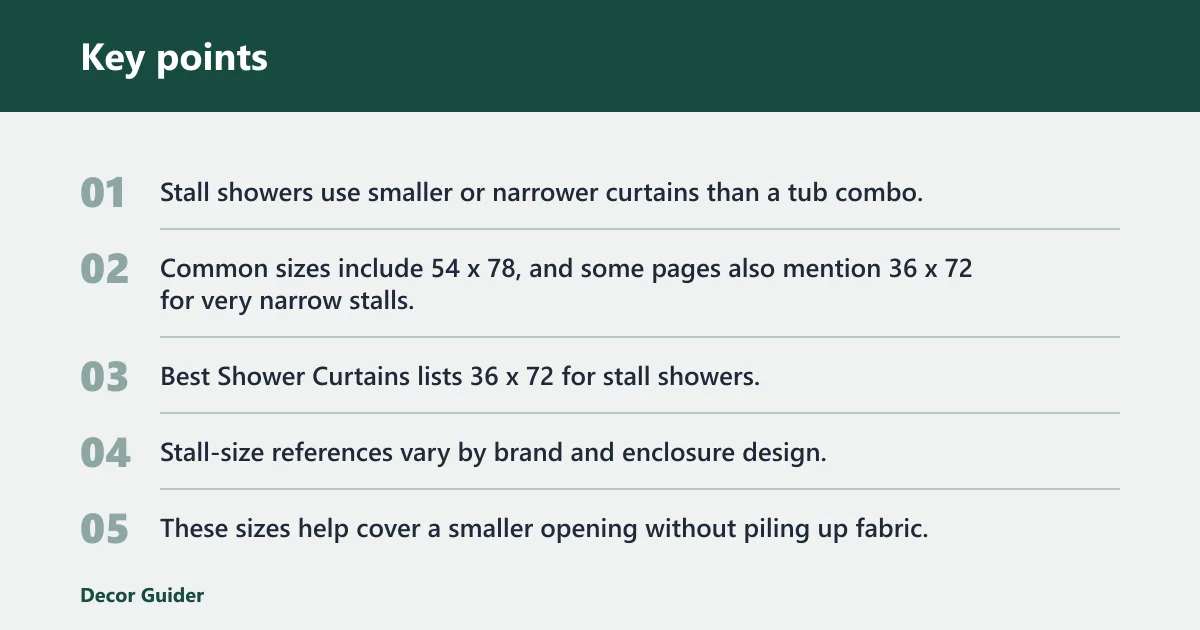
Stall showers use smaller or narrower curtains than a tub combo. Common sizes include 54 x 78, and some pages also mention 36 x 72 for very narrow stalls. The same source lists 36 x 72 for stall showers, while My Kitchen and Bath lists 54 x 78 for compact shower stalls. Stall-size references vary by brand and enclosure design, but the core idea is the same: stalls need less width than a tub opening.
These sizes help cover a smaller opening without piling up fabric. A standard tub curtain can overwhelm a stall, leave awkward folds, or hang so wide that it gets in the way at the entry. On many stalls, the narrower width is more important than the exact length.
Oversized or doorless showers
Use extra-wide curtains for oversized or doorless showers. Common widths are 84 inches and 108 inches. These larger sizes help span broad openings and reduce gaps along the sides, which is especially useful when the shower has no door to stop spray. The right width matters more than buying a longer curtain if the opening is very wide.
Suppose a doorless shower has a wide opening and a curved rod. A 72-inch curtain may cover the center but leave the ends exposed. Moving to 84 or 108 inches gives the curtain enough reach to wrap the sides more fully.
Curved rods and deep tubs
Curved rods change the width calculation because the curtain has to travel farther across the opening. They also shift the fabric outward, which can create side gaps if you use a standard width. Deep alcove tubs can create a similar problem even with a straight rod, because the curtain may clear the opening but still miss the tub edge.
In both cases, the curtain can look fine on paper and still miss the tub edge. If the rod bows outward or sits deeper than expected, consider a wider curtain before you increase length.
In-between lengths like 72 x 78
In-between sizes help when standard length is close but not correct. A 72 x 78 curtain can work when a 72 x 72 hangs too high, yet 72 x 84 would drag or bunch. These middle sizes are useful when the rod height does not match a clean standard, especially once ring drop and liner length are factored in.
That is why rod-to-floor measurement matters more than buying by label alone. The goal is a curtain that covers the opening and stops just above the floor, not one that forces you to fold up excess fabric.
What size liner should you buy?
The liner should match the curtain width closely and hang inside the tub. It is often waterproof and may be the same length as the curtain or slightly shorter, depending on the setup. The key is function: keep water in the tub and let the outer curtain hang cleanly outside it. Curtain length and liner length are related, but they are not always identical.
Match the liner to the curtain width
A liner often works best when it is the same width as the outer curtain or close to it. If the liner is too narrow, water can escape near the sides. If it is too wide, it can bunch awkwardly and fail to sit flat inside the tub. For many standard setups, the liner is sized to work with the curtain rather than to replace it.
Many standard liners are listed at 70 x 72, which aligns well with a standard curtain size. That makes them a good fit for common tub-shower combos, especially when the outer curtain is also around 72 inches wide.
Keep the liner inside the tub
The liner should hang inside the tub rim, while the decorative curtain hangs outside it. That separation keeps the waterproof layer where the water lands. A liner that falls outside the tub does very little to stop splash on the floor, even if the outer curtain looks right.
For most setups, a slightly shorter liner is better than one that drags. The liner should avoid the floor, stay inside the tub, and move freely without pulling the outer curtain with it. If you are deciding between a shower curtain liner and a door, the liner only works well when it has enough inward drop to protect the tub edge.
Choose waterproof material
Use a waterproof liner, not a decorative fabric alone. The liner is the layer that takes the water hit, so it needs to resist soaking and dry quickly. That matters even more in compact tubs, stalls, and curved-rod setups where spray reaches the sides more easily.
What size is standard shower curtain?
The most common standard shower curtain size is 72 x 72 inches. Some pages also list 70 x 72 or 70 x 70 as standard sizes, which is why shoppers see mixed labels. For a typical tub-shower combo, 72 x 72 is the safest default, but the exact name can vary by seller and product line.
What size is a normal shower curtain?
A normal shower curtain for a standard bathtub is usually 72 x 72 inches. That size fits most residential tubs and gives enough width for side overlap. If your rod is higher, lower, curved, or placed farther from the tub edge, another size may fit better. The normal size is a starting point, not a guarantee.
How to size a shower curtain
Measure the opening width, measure the rod height from the floor, and choose a curtain that clears the floor by about 1 to 2 inches. Add side coverage for the width and move to extra-long or extra-wide options when the rod or opening falls outside the standard range. If your measurement sits between sizes, choose the size that better solves the problem: wider for coverage, longer for clearance.
Do shower curtains come in different sizes?
Yes. Standard tub curtains, stall curtains, extra-long curtains, and extra-wide curtains are all common. You can also find in-between sizes for awkward heights and special setups. The correct size depends on the opening, the rod style, and how much overlap you need for splash control. Seller naming can vary, so check the actual measurements before you buy.
What size shower curtain do you need?
For a standard tub-shower combo, start with 72 x 72. For a stall shower, look at 54 x 78 or 36 x 72. For high rods, curved rods, or broad openings, move up to 72 x 78, 72 x 84, 84 inches, or 108 inches as the layout requires. If you land between sizes, prioritize the measurement that prevents splash or dragging.
What size is a regular shower curtain?
A regular shower curtain is usually the standard tub size, not a stall size. That means 72 x 72 inches in most cases. If your shower opening is narrower, wider, or mounted higher than average, regular sizing may not give you the right coverage or floor clearance. In those cases, the better choice is the size that matches the opening rather than the label that sounds normal.
Products related to this article
Sponsored / affiliate links. As an Amazon Associate I earn from qualifying purchases. I may earn additional commission from eligible campaigns.