Shower Door Problems: Troubleshooting the Common Fixes
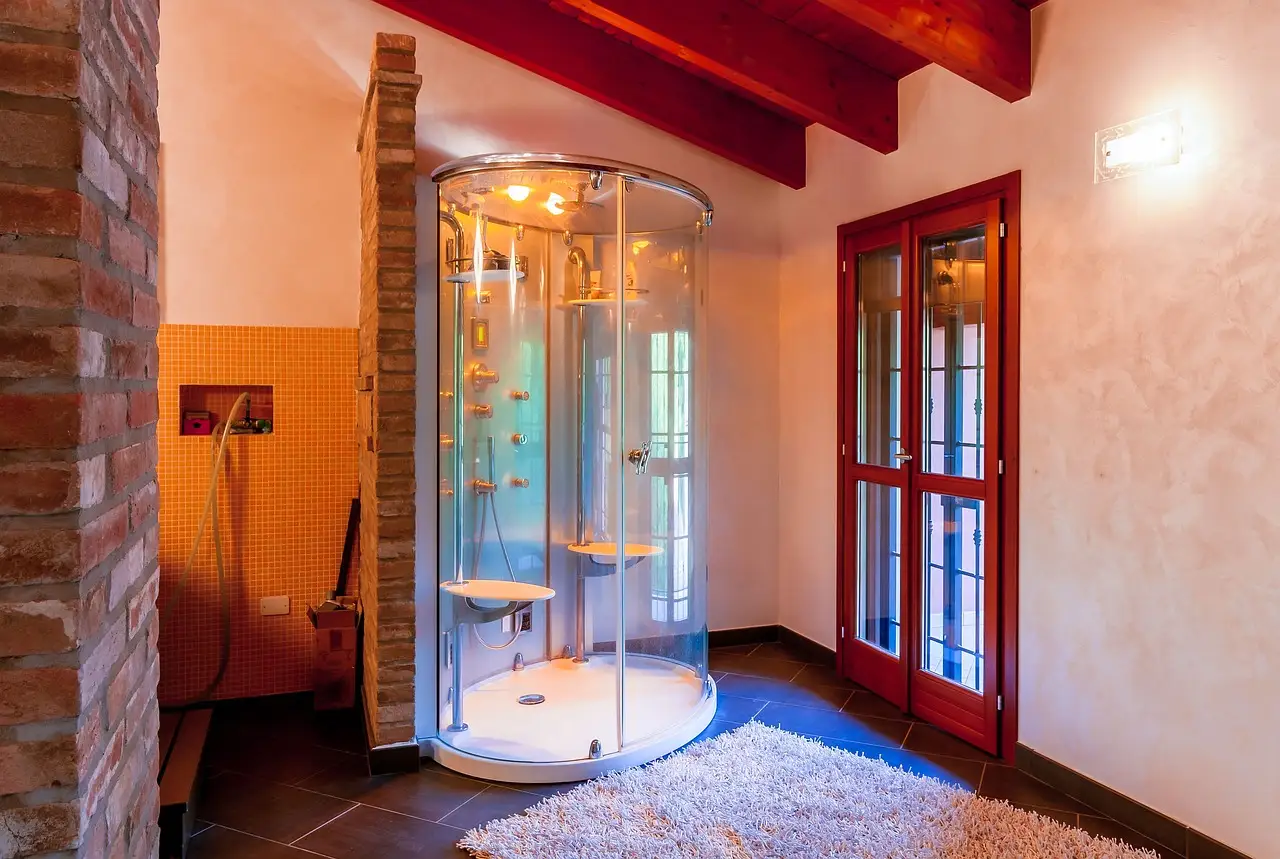
Troubleshoot shower door problems by matching the symptom to the door type: sliding doors usually bind from worn rollers or dirty tracks, pivot doors from hinge misalignment, and frameless doors from worn seals or walls that are out of plumb. Using the wrong fix can turn a small drag, leak, or squeak into damaged glass, worn hardware, and water on the floor. This guide maps common failures to the right cause, then shows what to check before you replace parts.
What you’ll need


- Phillips screwdriver
- Hex key or Allen wrench set
- Non-abrasive bathroom cleaner
- Soft brush for track and seal cleaning
- Silicone lubricant made for bathroom hardware
- Level
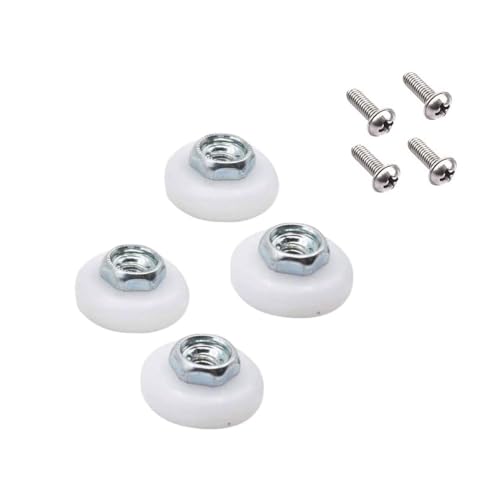
- Replacement rollers sized for the track, if needed
- Replacement hinges or wall anchors for frameless doors, if needed
- Bottom sweep, vertical seal, or magnetic strip matched to the door thickness
- 100% silicone bathroom caulk
- Caulk remover or plastic scraper
Shower door troubleshooting matrix
| Symptom | Likely cause | Quick test | DIY fix | Replacement part | Stop-DIY warning |
|---|---|---|---|---|---|
| Sliding door sticks or jumps | Roller wear, flat spots, corrosion, or dirty upper and lower track | Lift the door slightly and roll it by hand; if the drag changes, suspect rollers. If drag stays the same, inspect the track | Clean the track, adjust roller screws, and lubricate the roller axle with silicone lubricant | Rollers matched to the track profile | Stop if the track is bent, cracked, or no longer square |
| Pivot door rubs or will not close | Hinge screws loose, wall anchor failure, or glass out of alignment | Open the door halfway and look for drop at the latch side | Tighten hinge fasteners and check for movement at the wall plate | Hinges, anchors, or hinge shims | Stop if the glass edge touches metal or shows chips |
| Frameless door leaks at the bottom | Wrong sweep size, vertical gap, out-of-plumb wall, or poor threshold slope | Close the door and shine a light from inside; gaps show up at the bottom or latch side | Replace the sweep, check seal contact, and re-caulk failed edges | Bottom sweep, vertical seal, magnetic strip, caulk | Stop if the door still leaks after seal replacement and the wall is visibly out of plumb |
| Grinding noise | Debris in the track, worn rollers, or glass-to-metal rubbing | Roll the door slowly and listen for a consistent scrape at one spot | Clean the track and inspect for a rub point | Rollers or track parts | Stop if the noise comes from cracked glass or a bent hinge plate |
| Door comes off track | Track misalignment, roller failure, or a door that is no longer square | Look for uneven spacing at the top and bottom of the panel | Reset rollers and confirm the track is level | Rollers, track, alignment hardware | Stop if the panel is heavy to remove or the track is twisted |
Why is my shower door not closing properly?
A door that will not close usually has an alignment problem first, then a hardware problem second. On sliding doors, roller height and track condition are often the main things to check. On pivot and frameless doors, loose hinges, a sagging jamb, or a bad seal often keeps the latch side from meeting cleanly.
Check alignment first
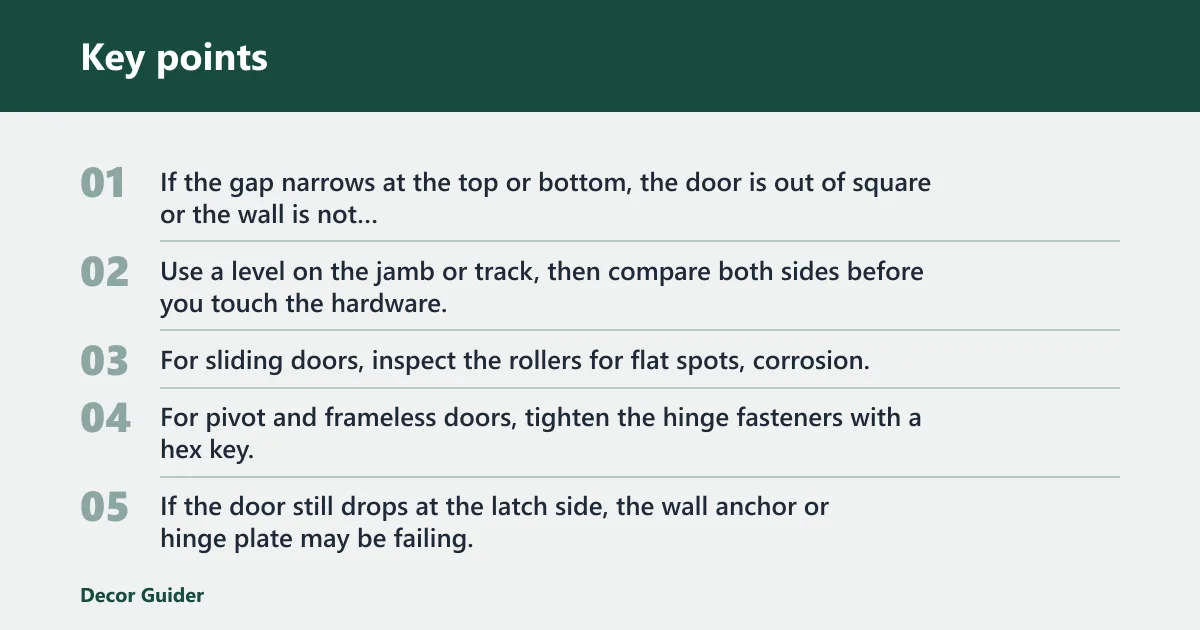
Start with the door gap. If the gap narrows at the top or bottom, the door is out of square or the wall is not plumb. Use a level on the jamb or track, then compare both sides before you touch the hardware.
Look for hinge or roller problems
For sliding doors, inspect the rollers for flat spots, corrosion, and loose adjustment screws. For pivot and frameless doors, tighten the hinge fasteners with a hex key. If the door still drops at the latch side, the wall anchor or hinge plate may be failing.
Inspect seals and magnets
If the door meets the frame but springs open, check the magnetic strip or vertical seal. A wrong-size seal can block closure, while a worn strip can fail to grab. Replace only after confirming the door is otherwise square.
What causes a shower door to come off track?
A sliding shower door can come off track when the rollers no longer hold the panel at the correct height, or when the track is bent, dirty, or misaligned. If the same door keeps derailing after cleaning, the problem is usually mechanical, not just debris.
Inspect rollers and track condition
Clean the upper and lower track with a soft brush and non-abrasive cleaner. Then look for roller flat spots, corrosion, or a loose adjustment screw. If the door rolls easier in one section than another, the track may be bent rather than dirty.
Check for debris or track bends
Run a fingertip along the track edge to find dents or a raised lip. A bent lower track can push the rollers out of their groove. If the track is visibly warped, replacement is often better than repeated adjustment.
Confirm the door is still square
Measure the gap at the top and bottom of the panel. If the spacing changes from one side to the other, the door is no longer square. That can happen after loose screws, worn rollers, or a shifted threshold.
Why is my shower door leaking at the bottom?
Bottom leaks usually come from the sweep, threshold slope, or wall plumb issues, not only from a worn seal. A frameless door can leak even with a new sweep if the threshold slopes the wrong way or the wall leans enough to leave a gap at the latch side.
Test the bottom sweep
Close the door and inspect where the sweep meets the threshold. If light or water passes under the full length, the sweep may be too short, too hard, or worn. Replace it with a size that matches the glass thickness and the gap you measured.
Check vertical seals and magnetic strips
Leaks at the latch edge often come from a missing vertical seal or weak magnetic contact. Replace a seal only with the correct profile. A strip that is too wide can prevent the door from closing fully, which creates a leak instead of fixing one.
Verify threshold slope and caulk
Water should move toward the pan, not toward the bathroom floor. If it runs outward, the threshold slope may be wrong. Remove failed caulk, clean the joint, and apply 100% silicone bathroom caulk. Most caulk needs about 24 hours to cure before water exposure.
Main troubleshooting steps
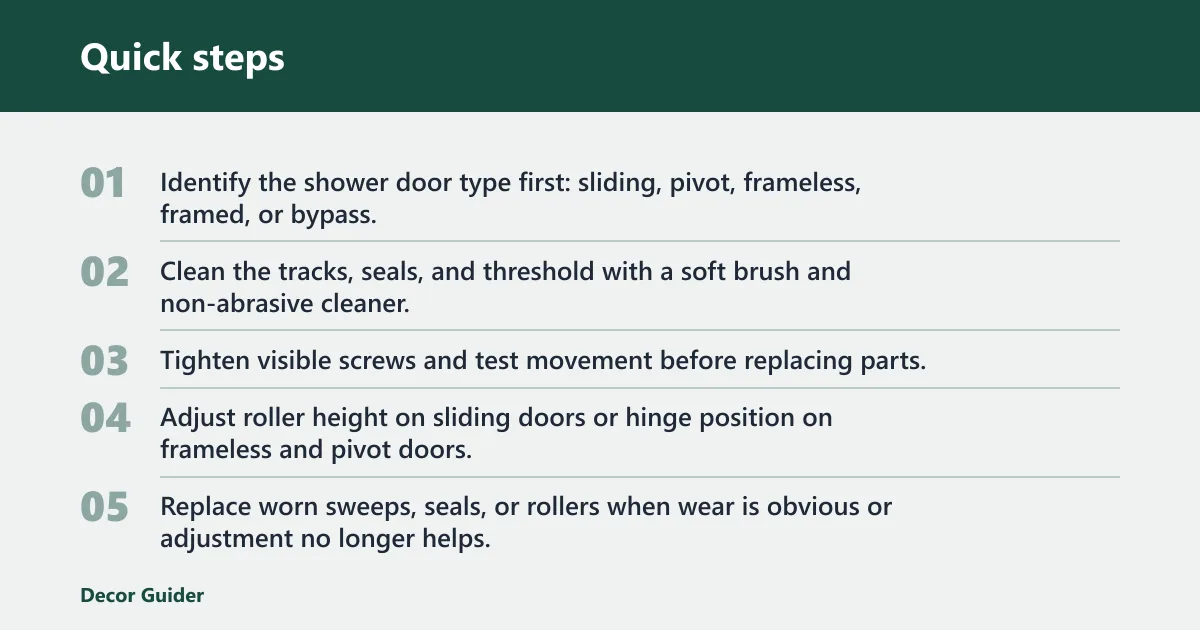
- Identify the shower door type first: sliding, pivot, frameless, framed, or bypass.
- Clean the tracks, seals, and threshold with a soft brush and non-abrasive cleaner.
- Tighten visible screws and test movement before replacing parts.
- Adjust roller height on sliding doors or hinge position on frameless and pivot doors.
- Replace worn sweeps, seals, or rollers when wear is obvious or adjustment no longer helps.
- Reseal failed gaps with bathroom-grade 100% silicone after removing old caulk.
Say your sliding door grinds only near the middle of the track. Clean the rail first, then check the rollers at that spot for flat spots or a stuck bearing. If the noise moves with the panel, the rollers are the likely fault. If it stays fixed, the track is bent.
Suppose a frameless door closes but leaves about a 3 mm gap at the latch side. Tightening the hinge may close that gap if the screws were loose. If the gap returns after adjustment, the wall anchor or the wall plumb is the real issue.
If that didn’t work, try this next
If cleaning and tightening do not change the symptom, replace the worn wear part before touching the glass. For sliding doors, that means rollers. For leaks, that means the sweep or magnetic strip. For sagging frameless doors, that means hinge hardware or wall anchors only after confirming the glass edge is sound.
Common mistakes
- Replacing rollers before checking whether the track is bent or misaligned
- Forcing a glass door closed when the hinges are sagging or the panel is out of square
- Buying a seal by appearance instead of matching glass thickness and profile
- Ignoring chips, cracks, or edge wear on tempered glass
- Using petroleum-based lubricant on tracks or seals instead of silicone lubricant
- Stopping at caulk when the real leak is a slope, gap, or plumb problem
Frequently asked questions
Why is my shower door making a grinding noise?
Grinding usually points to debris in the track, worn rollers, or glass rubbing against metal. Clean the rail first, then check for one fixed rub point as the door moves. If the sound continues after cleaning, inspect the rollers for flat spots or corrosion.
How do I stop a frameless shower door from sagging?
Tighten the hinge fasteners first, then check the wall plate and anchors for movement. If the door still sags, the hinge may be worn or the wall may be out of plumb. Stop if the glass edge is touching metal, because that can stress tempered glass.
When should I replace shower door seals or sweeps?
Replace them when they are cracked, hardened, shortened, or no longer touch the threshold or adjacent glass. A seal that no longer makes contact will not stop leaks, and a wrong-size replacement can block closure. Match the profile and glass thickness before ordering.
Can I replace shower door rollers myself?
Yes, if the track is straight and the door can be supported safely during removal. Match the roller diameter, wheel material, and mounting style to the existing hardware. Stop if the track is damaged or the panel feels too heavy to remove without assistance.
Do I need a professional for shower door troubleshooting?
Yes, when the problem involves cracked glass, recurring misalignment after adjustment, wall anchor failure, or a bent track that will not hold alignment. Call a pro sooner if the door is heavy, the glass edge is damaged, or water is already reaching drywall or flooring.
How do I realign a sliding shower door?
Start by cleaning the track, then adjust the roller screws in small increments and retest after each turn. A common adjustment is one quarter-turn at a time, followed by a full open-close cycle. If the door still drifts, the track or frame may be out of square.
Products related to this article
Sponsored / affiliate links. As an Amazon Associate I earn from qualifying purchases. I may earn additional commission from eligible campaigns.