How Much Does a Metal Bookshelf Cost?
A metal bookshelf usually costs about $50 to $300, while heavy-duty shelving often runs about $150 to $500+ once size, finish, and load rating are factored in. Those bands reflect current retail listings across major category pages and marketplaces, where compact units often start near $50 and taller steel systems climb past $300 or more (retailer/category pages; prices vary by brand and shipping). Choosing by price alone can leave you with a wobbly unit, a short shelf span, or extra assembly and anchoring costs. This guide breaks down bookshelf price ranges, assembly fees, anchoring needs, and durability trade-offs so you can match the shelf to your room and load.
- Unit price
- Shipping or delivery
- Assembly
- Anchors or wall mounting hardware
- Tax
Typical cost range
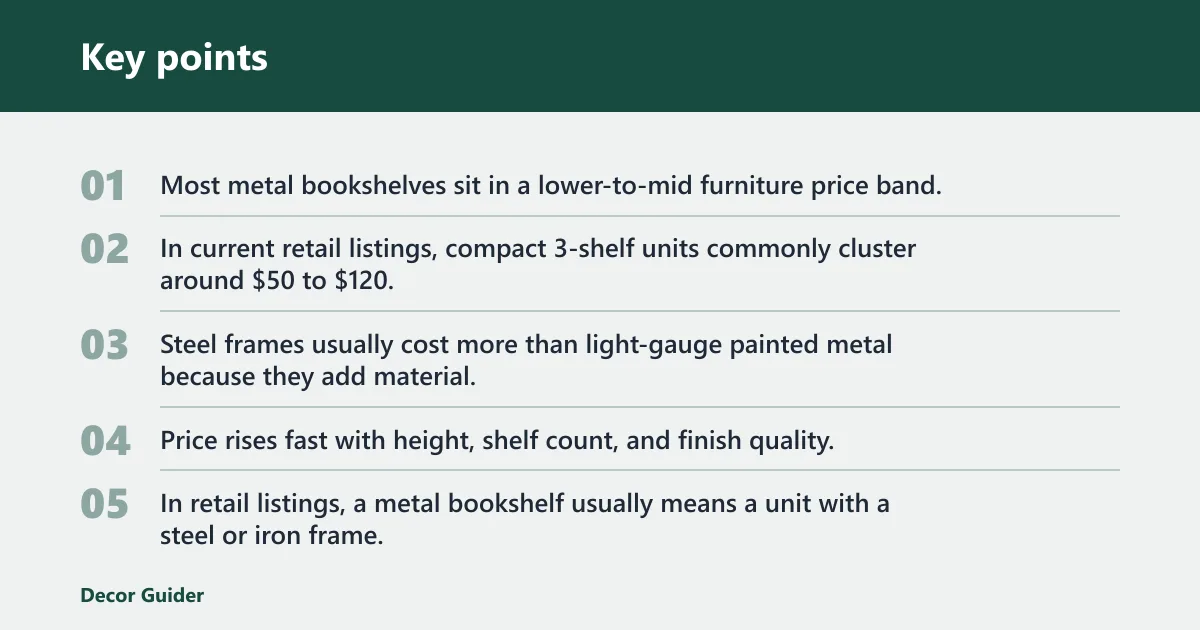


Most metal bookshelves sit in a lower-to-mid furniture price band, with simple freestanding units near the bottom and taller, load-rated steel units at the top. In current retail listings, compact 3-shelf units commonly cluster around $50 to $120, midrange 5-shelf units around $100 to $250, and heavy-duty steel units around $150 to $500+ depending on brand, size, and finish (retailer/category pages; pricing bands vary by retailer). Steel frames usually cost more than light-gauge painted metal because they add material, stiffness, and better corrosion resistance. Price rises fast with height, shelf count, and finish quality, so small changes in size can move the total quickly.
What counts as a metal bookshelf
In retail listings, a metal bookshelf usually means a unit with a steel or iron frame, or a powder-coated metal frame with shelves made from metal, wood, or engineered board. Finish and frame thickness matter as much as the label. A powder-coated steel shelf with welded joints is usually priced above a thin bolt-together frame.
Steel versus other metal frames
Steel bookshelves usually sit above lighter metal options in price because steel is dense, stiff, and suited to heavier loads. Iron can also price higher when the frame is decorative or especially heavy, but its value depends on construction quality and rust protection. Powder-coated metal often costs more than bare painted metal because the coating helps resist wear and corrosion.
What changes the price?
Height, width, depth, and shelf count are the biggest price drivers. Load rating matters too, because thicker shelves, stronger brackets, and sturdier frames cost more to build. Wall-mounted systems add installation needs, while freestanding units shift cost toward stability features like leveling feet and back bracing. Published load guidance usually shows that per-shelf ratings matter more than the marketing headline, and consumer safety guidance from CPSC emphasizes anchoring tall furniture to reduce tip-over risk (CPSC furniture tip-over guidance).
Height, width, depth, and shelf count
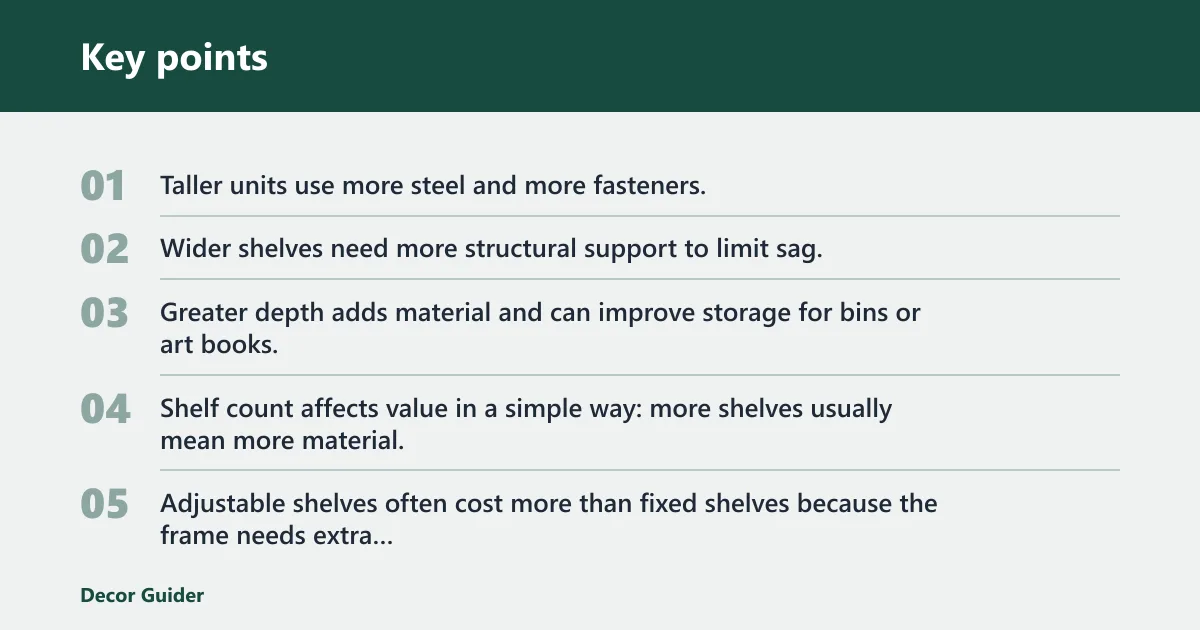
Taller units use more steel and more fasteners, so they cost more than short units with the same finish. Wider shelves need more structural support to limit sag. Greater depth adds material and can improve storage for bins or art books, but it also raises shipping weight and usually raises the retail price.
Shelf count affects value in a simple way: more shelves usually mean more material, more assembly time, and more total storage. Shelf spacing matters too. Adjustable shelves often cost more than fixed shelves because the frame needs extra holes, clips, or tracks.
Shelf thickness and load rating
Thicker shelves and stronger frames cost more because they can carry more weight without flexing. For shopping purposes, many retail listings show per-shelf ratings in the roughly 50 to 250 lb range on light-to-mid units, with heavier steel shelving often rated above that when evenly loaded (retailer/category pages; always verify the exact model). That matters for dense book collections, office binders, or mixed storage. A low-cost shelf can look fine on day one and still be poor value if the deck bows under books or the frame twists when moved.
Look for published per-shelf load ratings and, when possible, note whether the rating assumes even loading. A unit with a higher total capacity is not automatically safer than one with a lower total capacity if its shelves are thin or its frame is narrow. Stability often matters more than the headline number.
Finish quality and rust resistance
Powder coating usually costs more than basic paint, but it often gives better scratch resistance and better protection against rust in damp rooms, basements, or utility areas. That matters for long-term value. Bare or thinly finished metal can corrode faster at corners, welds, or chip points.
Freestanding versus wall-mounted design
Freestanding shelves are usually easier to buy and install, but tall units may need anchoring to prevent tipping. Wall-mounted metal shelving can save floor space and hold a lot of weight when installed correctly, but the hardware and labor can raise the total project cost. The unit price alone does not tell the full story.
Metal bookshelf cost matrix
This matrix turns the purchase into a true cost model: unit price, typical dimensions, per-shelf load range, assembly time, and anchoring status all affect the final spend. The price bands below are based on sampled current listings from major retailers and category pages, with bands widening as size, steel thickness, and finish quality rise. In practice, a unit moves up a band when it gets taller, gains a shelf, uses thicker steel, adds a powder-coat finish, or adds wall-mount hardware.
| Size / use case | Typical price band | Typical dimensions | Likely shelf count | Estimated per-shelf load range | Typical assembly time | Assembly or anchoring usually needed? | Best for | What pushes it into the next band |
|---|---|---|---|---|---|---|---|---|
| Small 3-shelf budget unit | $50 to $120 | About 24 to 36 in. wide, 10 to 14 in. deep, 24 to 36 in. tall | 3 shelves | About 50 to 100 lb per shelf | About 20 to 45 minutes | Assembly usually yes; anchoring sometimes | Paperbacks, décor, light office storage | Taller frame, thicker steel, adjustable shelves, powder coat |
| Midrange 5-shelf freestanding unit | $100 to $250 | About 30 to 48 in. wide, 12 to 16 in. deep, 60 to 72 in. tall | 5 shelves | About 75 to 150 lb per shelf | About 45 to 90 minutes | Assembly yes; anchoring often for taller versions | Home offices, mixed books, bins, binders | Greater height, deeper shelves, reinforced bracing, better finish |
| Tall heavy-duty steel unit | $150 to $500+ | About 36 to 60 in. wide, 18 to 24 in. deep, 72 to 84 in. tall | 5 to 6 shelves | About 150 to 250+ lb per shelf | About 60 to 120 minutes | Assembly yes; anchoring commonly recommended | Textbooks, binders, storage rooms, heavier mixed loads | Heavier-gauge steel, welded frame, larger footprint, commercial-style finish |
| Wall-mounted metal shelving | $80 to $400+ | Varies; usually rail- or bracket-based systems with custom spacing | 2 to 5 shelves or rails | About 50 to 200+ lb per shelf, depending on anchors and studs | About 30 to 120 minutes | Anchoring always needed; installation often yes | Small rooms, garages, utility storage, space-saving layouts | More rails, stronger anchors, heavier-duty brackets, longer spans |
Say your apartment needs one narrow shelf for paperbacks and a small bin of office supplies. A 3-shelf budget unit can be enough if the frame is stable and the shelf spans are short. If the same room needs heavier art books or a printer, the cheaper unit can become false economy.
How much does assembly add?
Assembly often adds a noticeable amount to the true purchase cost, especially for shelves with many parts or wall mounting. Taskrabbit lists furniture assembly at an average of $34 per hour, with small furniture assembly starting at around $40, medium items like shelves starting around $80, and larger items starting around $100 to assemble (Taskrabbit pricing pages; rates vary by market and complexity).
DIY setup versus paid assembly
Simple bolt-together frames may only need a hex key and a screwdriver, but larger units can take longer than expected because of alignment, shelf clips, and frame bracing. If the shelf must be leveled on an uneven floor, setup takes longer. Paid assembly makes the final price easier to predict, but it can add a large share to a budget unit.
Hardware, tools, and time
Most metal shelves ship with the basic hardware needed for assembly, but included hardware does not always mean easy assembly. Common tools include a hex key, Phillips screwdriver, and sometimes a level. Units with more fasteners, adjustable shelves, or back braces usually take more time and more care to tighten evenly.
When anchoring is needed
Tall freestanding units and anything in a child’s room, office, or high-traffic area may need anchoring. Consumer safety guidance from the CPSC recommends securing tall furniture and shelving to the wall to reduce tip-over hazards, especially where children are present. That can mean wall brackets, anti-tip straps, or proper anchors for stud or masonry walls. Wall-mounted metal shelving always depends on correct anchoring, so the installation cost can be as important as the shelf itself.
Is metal cheaper than wood?
Metal bookshelves are often cheaper than wood at the low end, but the comparison changes at higher quality levels. Sampled retailer/category listings typically put basic metal shelves around $50 to $120, midrange metal units around $100 to $250, and heavier steel shelving around $150 to $500+, while wood or wood-look shelves commonly begin around $80 to $180 for small units and move up to about $200 to $600+ for larger, sturdier, or solid-wood models (retailer/category pages; exact prices vary by material and finish). In other words, the cheapest metal unit is often cheaper than the cheapest wood unit, but premium steel can overlap with midrange wood. Durability and weight also differ.
Price and durability differences
For bookshelves, wood often brings a warmer look and can feel more substantial, but it may cost more for the same storage size. Metal usually gives better resistance to warping and a lighter frame weight. Powder-coated metal can also handle spills and cleaning better than unfinished wood surfaces.
Weight and portability trade-offs
Steel bookshelf frames are usually heavier than thin metal or many wood composites, and that weight can cut both ways. Extra mass can improve stability, but it also makes moving the unit harder. If you expect to rearrange a room often, a lighter metal frame may be easier to manage than a solid wood unit.
Which material fits each budget?
For a tight budget, metal often gives the lowest entry price for a usable shelf. For a living room or library where appearance matters more and the load is moderate, wood may justify its higher cost. For binders, textbooks, or storage that needs a stiff frame, steel is often the better value even when the sticker price is higher.
How to choose the right size
Choose size by room footprint, shelf spacing, and load, not by shelf count alone. A tall narrow shelf can fit an apartment corner but may need anchoring. A wider office unit may cost more, but it can support binders and boxes better because weight spreads across a broader base and deeper shelves.
Apartment and small-room sizes
For small rooms, look for a compact 3-shelf or 4-shelf unit with a narrow width and enough depth for standard books. Smaller units cost less and are easier to place beside a desk or sofa. They also tend to be less demanding to assemble and easier to move through tight hallways.
Office and storage-room sizes
For offices, a 5-shelf freestanding unit often gives the best balance between price and storage. Adjustable shelves help with binders, file boxes, and mixed-height items. In storage rooms, a heavier steel frame with a powder coat can be worth the extra cost because the room often has more moisture, dust, and heavier loads.
Heavy-load use cases
Picture a home office with legal binders on every shelf. A light-gauge shelf may wobble, sag, or need immediate wall anchoring, while a heavier steel frame with thicker shelves can handle the same load with less flex. In that case, a higher upfront price can be the cheaper long-term choice.
A common first-timer mistake is buying a tall shelf for a narrow wall and skipping the anchoring hardware. If the unit is loaded with books, even a small floor bump can make it feel unstable. Spending more on a stiffer frame and proper anchors often costs less than replacing a damaged shelf later.
Frequently asked questions
How much does a metal bookshelf cost?
A metal bookshelf usually costs $50 to $300, with basic small units near the low end and taller, stronger units near the high end. Heavy-duty metal shelving can run $150 to $500+ when you factor in thicker steel, better coating, and higher load ratings. Those figures align with current retailer/category pages for basic, midrange, and heavy-duty shelving.
How much do metal shelves cost?
Metal shelves often start around $50 for small, light-duty units and move up to several hundred dollars for taller or load-rated systems. The biggest price shifts come from shelf count, steel thickness, coating quality, and whether the shelf is freestanding or wall-mounted. Retail listings typically show the jump most clearly between compact 3-shelf units and taller 5- to 6-shelf models.
How much does a steel bookshelf cost?
A steel bookshelf usually sits above light metal shelving in price because steel adds stiffness and weight capacity. Retail category pages commonly place commercial-style steel shelving at the top of that band.
How much does it cost to assemble a metal bookshelf?
Furniture assembly averages $34 per hour on Taskrabbit. Small furniture assembly starts at around $40, medium-sized items like shelves start around $80 to assemble, and larger or more complex units can cost more. Wall mounting or anchoring can add extra labor and hardware costs, especially if studs, masonry, or anti-tip straps are involved.
Is a metal bookshelf cheaper than wood?
Often yes at the entry level, because simple metal frames can cost less than comparable wood units. But the gap narrows as shelf height, finish quality, and load rating rise. Wood may cost more upfront, while metal can offer better portability and better resistance to warping. The best value usually depends on size, load, and whether appearance or durability matters more.
Where do metal bookshelves sit in the overall bookshelf price range?
Metal bookshelves usually sit in the lower to middle part of the bookshelf price range. Basic units are often cheaper than solid wood, while heavy-duty steel units can approach the cost of midrange wooden shelves once size, coating, and assembly are included. In other words, metal is not automatically the cheapest material, but it often has the lowest starting point for a usable shelf.
Products related to this article
Sponsored / affiliate links. As an Amazon Associate I earn from qualifying purchases. I may earn additional commission from eligible campaigns.