Bathroom Fan Installation Cost: What to Expect and Budget
Bathroom fan installation usually costs $250–$700 for a like-for-like replacement, $500–$1,200 for a new fan in an existing ceiling opening, and $900–$2,000+ if you need new ducting or a roof or wall vent. Bad vent routing can trap moisture in the attic, increase mold risk, and lead to repair costs. This guide breaks down labor, materials, vent runs, and quote checks so you can budget the job before hiring.
This guide is part of our Bathroom cleaning and maintenance series.
Choosing the Right Fan and Grille Cover
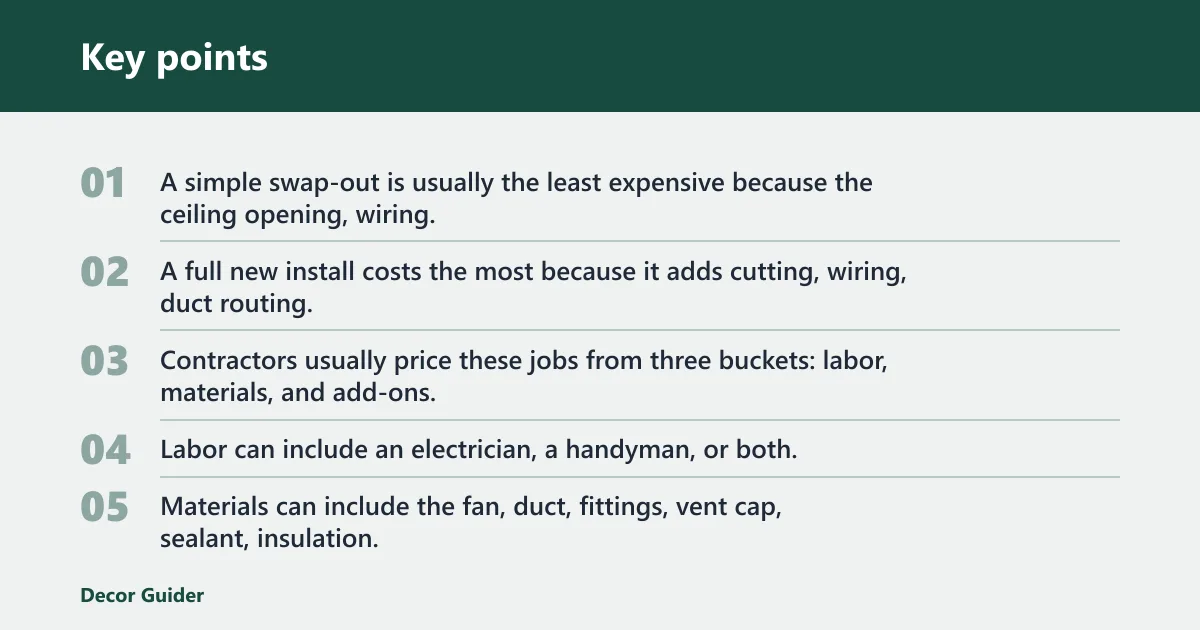


The price changes with the job size. A simple swap-out is usually the least expensive because the ceiling opening, wiring, and vent path already exist. A new fan with existing wiring costs more. A full new install costs the most because it adds cutting, wiring, duct routing, exterior termination, and finish work.
Contractors usually price these jobs from three buckets: labor, materials, and add-ons. Labor can include an electrician, a handyman, or both. Materials can include the fan, duct, fittings, vent cap, sealant, insulation, and a switch or timer. Add-ons often come from drywall repair, paint touch-up, and permit-related work.
Typical cost drivers that change the total
Several details can move the quote fast. Attic access, duct length, number of bends, and whether the installer can reach a roof or wall cap matter a lot. Electrical conditions matter too, especially if the circuit needs a new switch, timer, grounded protection where required, or a new run from the panel.
Fan features also change price. Basic models cost less than units with lights, humidity sensors, continuous-operation settings, or heater combinations. Larger fans with higher CFM ratings also tend to cost more than small-room models.
Why replacement is cheaper than a new install
Replacement is cheaper because the contractor can use the existing opening and often the existing duct path. A brand-new install has to solve the electrical supply, the vent route, and the exterior termination. Each extra step adds labor and usually creates more finish work.
If the old fan already vents outdoors correctly, the job can be straightforward. If the old setup dumps moisture into an attic or uses undersized ducting, the contractor may need to rebuild part of the system instead of simply swapping the fan.
How contractors usually price labor and materials
Many bids separate the fan unit from installation labor. That matters because a basic fan and a humidity-sensing model can differ a lot in material cost. Ask whether the quote includes the grille, damper, duct connector, vent cap, sealant, fasteners, insulation, and disposal of the old unit.
Labor may be quoted as a flat job price or as separate electrical and ventilation work. If the installer expects drywall repair or paint touch-up, those items should appear as separate line items, not as a surprise at the end.
📊 Bathroom remodels can return up to 75 percent of the cost. Source: 100+ Bathroom Design Ideas (Pictures of Tubs & Showers).
What affects the price of a bathroom fan install?
Access, duct path, electrical work, and finish repairs drive most of the price difference. A short, reachable run with existing wiring costs less than a long run that has to snake around framing and through a roof deck. The more the installer has to open, patch, or reroute, the higher the bill.
Access: attic access vs no attic access
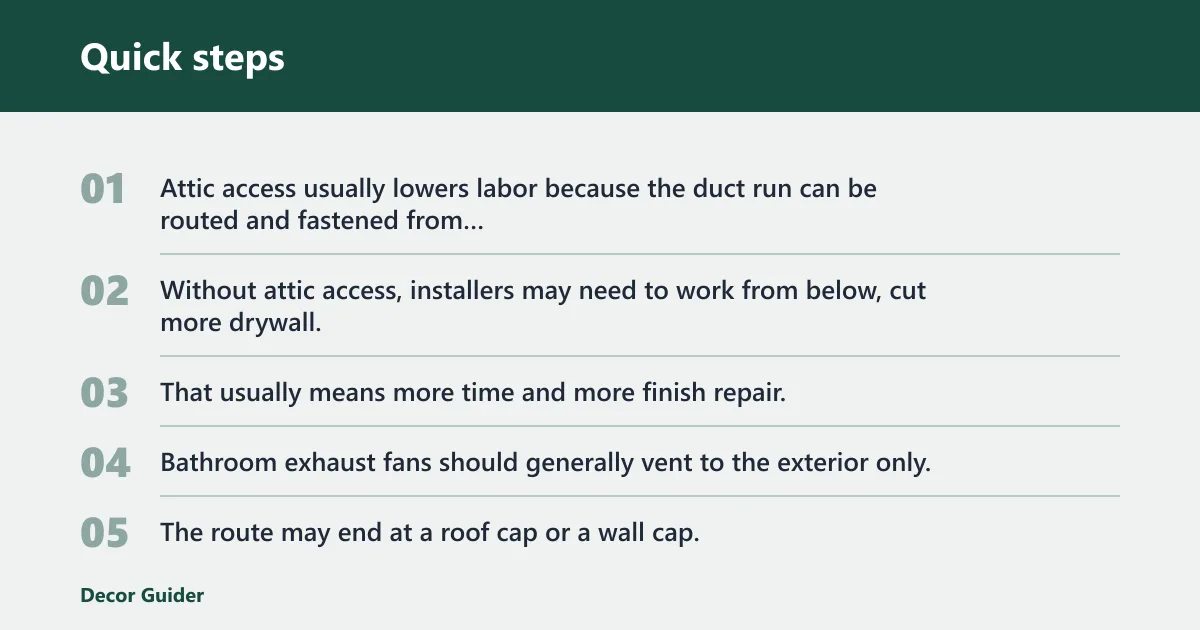
Attic access usually lowers labor because the duct run can be routed and fastened from above. Without attic access, installers may need to work from below, cut more drywall, or use a harder vent path. That usually means more time and more finish repair.
Duct path: roof cap, wall cap, length, and bends
Bathroom exhaust fans should generally vent to the exterior only. The route may end at a roof cap or a wall cap. Longer duct runs and extra bends increase labor, reduce airflow if poorly designed, and can require better fittings or insulated duct in cold climates to reduce condensation risk.
Electrical work: existing wiring, new circuit, and switch options
Most bathroom fans run on a 120V typical household supply. If the wiring already exists, the job may only need a swap and a switch upgrade. If there is no circuit, if the box needs grounding work, or if local rules require ground-fault protection, the electrician’s share of the job rises.
Finish work: drywall patching, insulation, and paint touch-up
Small holes can still create added labor. A new cut-in often needs drywall repair around the fan housing or the vent route. Cold-climate runs may also need insulated duct. If the opening changes size or location, expect paint touch-up to be part of the final cost.
Bathroom fan installation cost by project type
The three most common project types are not priced the same. The key difference is whether the contractor is only replacing a fan, using existing wiring in a new opening, or building a full vented system from scratch. Each step up adds labor and materials.
| Project type | Likely labor buckets | Material add-ons | Questions to ask a contractor |
|---|---|---|---|
| Simple replacement | Remove old fan, fit new fan into existing opening, reconnect wiring, test operation | Replacement fan, possibly a new grille, connector, tape, minor sealant | Does the existing duct meet code and exhaust outside? Will the quote include disposal and minor trim repair? |
| New fan with existing wiring | Install fan in an available opening, connect to 120V supply, add switch or timer if needed, verify exterior venting | Fan unit, duct fittings, vent cap if needed, timer switch or humidity sensor | Is the wiring already sized for this fan? Does the duct length support the planned CFM without major rerouting? |
| Full new install with new vent routing | Cut-in work, run new wiring, route duct through attic or wall cavity, install roof or wall cap, patch drywall, finish touch-up | Fan, new duct, insulated duct in cold areas, cap, fasteners, sealants, drywall materials, paint | Will you need a permit? Is attic access enough, or will you need wall or roof opening work and insulation upgrades? |
What to ask for each scenario
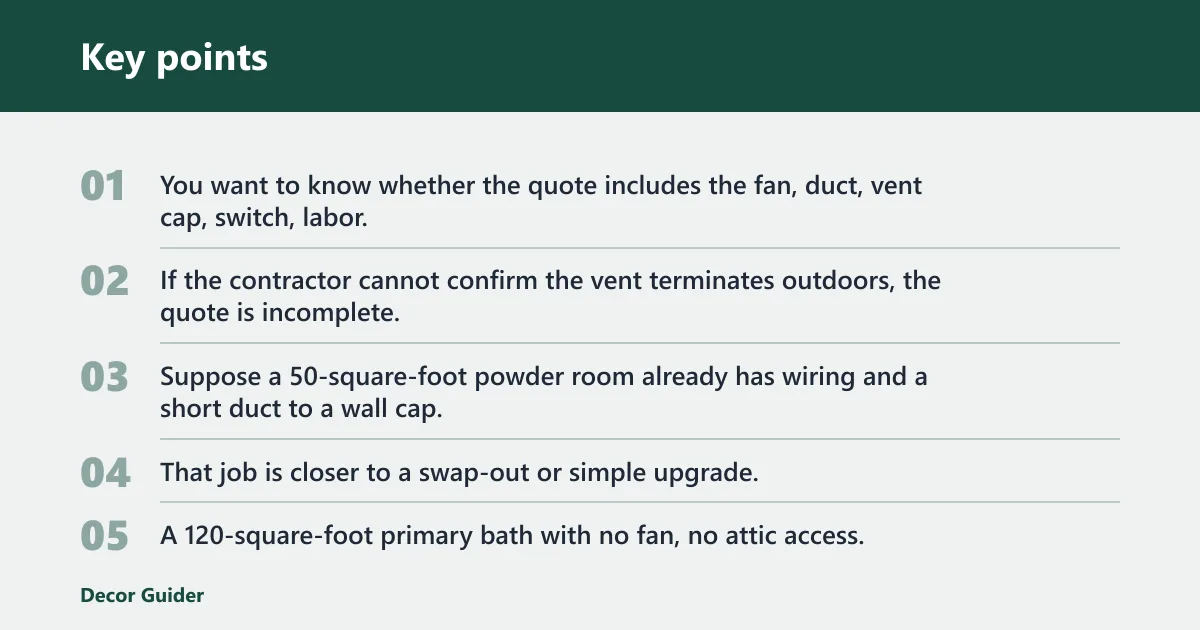
Ask for line-item pricing. You want to know whether the quote includes the fan, duct, vent cap, switch, labor, and finish repair. If the contractor cannot confirm the vent terminates outdoors, the quote is incomplete.
Suppose a 50-square-foot powder room already has wiring and a short duct to a wall cap. That job is closer to a swap-out or simple upgrade. A 120-square-foot primary bath with no fan, no attic access, and a roof termination is a full-install job, not a minor replacement.
How do you size a bathroom fan and choose features?
Fan size is usually stated in CFM, or cubic feet per minute. A common rule of thumb is more airflow for larger rooms and high-moisture spaces. Small bathrooms may only need a modest fan, while steam showers and multi-fixture baths need stronger airflow and better vent planning.
CFM basics by bathroom size
As a starting point, smaller bathrooms often fit lower-CFM fans, medium rooms usually need a midrange unit, and larger or shared baths need more airflow. Many homeowners also size up when the room has a shower used often, poor natural ventilation, or a toilet area that stays damp.
For steam showers or multi-fixture bathrooms, choose a fan with enough capacity for longer run time and steady moisture removal. A fan that is too small can run louder, stay on longer, and still fail to clear humidity well.
Noise ratings in sones
Noise is measured in sones. Lower sones means quieter operation, which matters if the fan will run often or for longer cycles. Bathroom fans with lower noise ratings usually cost more, especially when paired with higher airflow or extra features.
When to choose a timer, humidity sensor, light, or heater combo
Timer switches help the fan run long enough after showers. Humidity sensors can turn the fan on and off automatically when moisture rises. Built-in lights and heater combos add convenience, but they also add cost, wiring complexity, and sometimes higher power demand.
Continuous-operation fans can work well in damp bathrooms, but they should be sized and vented correctly. If you want a light, choose one that fits the room’s layout and wiring plan so the electrical work does not balloon.
Do you need an electrician for bathroom fan installation?
If wiring is already present and the job is only a straightforward replacement, a handyman may be able to handle parts of the work where local rules allow it. If you need a new circuit, new switch wiring, grounding corrections, or permit-controlled electrical work, a licensed electrician is the safer choice.
When existing wiring may be enough
Existing wiring can be enough when the fan location is unchanged and the circuit already supports the load. That is common in replacement jobs. A dedicated switch or timer can still be added if the wiring and box support it.
When a new circuit or grounded protection is needed
New circuit work changes the job level quickly. Bathrooms can trigger local code requirements for ground-fault protection and other safety rules. If the panel connection, circuit protection, or box grounding needs work, a licensed electrician should handle it.
Permit-related labor
Some areas require permits for new electrical or venting work. Permit-related labor can add time, inspection coordination, and extra visits. Ask whether the quote includes permit filing and reinspection if the first pass needs correction.
Can a bathroom fan be installed without attic access?
Yes, but labor often rises. Without attic access, the installer may have to work through the ceiling from below, open more drywall, or choose a wall vent path instead of an overhead run. That adds time and often increases finish repair.
How wall venting compares with roof venting
Both roof and wall caps can work when done correctly. The right choice depends on framing, exterior access, and the shortest code-compliant path outdoors. A shorter path usually costs less, but the final route still has to support proper airflow and weather sealing.
A common first-timer mistake is assuming a fan can vent into a nearby attic or soffit space. It cannot. Moisture should leave the house through a proper exterior cap, or the problem simply moves to another part of the building.
Scenario-based bathroom fan cost table
Use this table to budget before you call contractors. It separates the job into the three project types homeowners see most often, along with the labor buckets and add-ons that usually explain why one quote is much higher than another.
| Scenario | Likely budget frame | Main labor buckets | Material add-ons | Questions to ask a contractor |
|---|---|---|---|---|
| Simple replacement | $250–$700 | Removal, swap-in, reconnect, test, minor cleanup | Fan unit, grille, small connectors, sealant | Is the existing duct already vented outside? Does the quote include disposal and any trim repair? |
| New fan with existing wiring | $500–$1,200 | Mount fan, connect 120V supply, install switch or timer, verify exhaust path | Fan unit, duct fittings, timer or humidity sensor, vent cap if needed | Will the existing wiring support the fan and controls? Is the duct path short enough to avoid major rerouting? |
| Full new install with new vent routing | $900–$2,000+ | Cut-in, electrical run, duct route, roof or wall termination, drywall patching, paint touch-up | Fan unit, insulated duct, cap, fasteners, sealants, drywall materials, paint | Do you need a permit? Will attic access, roof work, or a long duct run increase labor? |
Scenario notes that affect the bid
Picture a 70-square-foot hall bath with an existing fan housing and a short duct run. The contractor may only need to replace the motor or housing, which keeps labor lower. Now picture a basement bath with no attic access and no exterior vent. The job turns into a cut-in project with more labor and finish work.
Frequently asked questions
How much does bathroom fan installation cost?
Bathroom fan installation often falls into a few rough price bands: about $250–$700 for a replacement, about $500–$1,200 for a new fan in an existing opening, and about $900–$2,000+ for a new install that needs vent routing. The final number depends on wiring, duct length, access, and how much finish repair is needed.
How much does it cost to replace a bathroom exhaust fan?
Replacing an existing bathroom exhaust fan is usually the cheapest option because the opening and vent path already exist. Expect the price to stay near the lower end if the wiring is sound, the duct vents outside properly, and no drywall patching or electrical upgrades are needed.
Do I need an electrician to install a bathroom fan?
You may not need an electrician for a simple swap if the wiring is already in place and local rules allow it. You should hire a licensed electrician for new circuits, grounding issues, switch rewiring, or any work that triggers permit and inspection requirements in your area.
What size bathroom fan do I need?
Fan size is based on room size, moisture load, and how the bathroom is used. Small baths can use lower-CFM fans, while larger rooms, steam showers, and multi-fixture layouts need more airflow. Quiet operation is often measured in sones, so compare airflow and noise together, not separately.
Does bathroom fan installation require venting outside?
Yes. Bathroom exhaust fans should vent to the exterior, rather than into an attic, crawlspace, or other interior void. Proper exterior venting helps remove moisture and odors and lowers the chance of hidden condensation, mold risk, and later repair costs.
Products related to this article
Sponsored / affiliate links. As an Amazon Associate I earn from qualifying purchases. I may earn additional commission from eligible campaigns.