Best Bathroom Exhaust Fans for Small Baths (2026): we compared
For many small bathrooms, a fan in the 50–80 CFM range at around 1.0 sone or lower is a practical choice. A rough sizing rule is about 1 CFM per square foot, then increase it for longer duct runs or frequent showers. A fan that is too small, or too loud, leaves moisture behind, which can lead to mildew, peeling paint, and a bathroom you avoid using. This guide compares the best bathroom exhaust fans for small bathrooms and shows how to match airflow, duct size, and noise to your space.
This guide is part of our Bathroom cleaning and maintenance series.
Quick comparison
| Product | Badge | Best for | Price | ||
|---|---|---|---|---|---|
 |
Broan-NuTone 80 CFM Ceiling Bathroom Exhaust Fan with LightNutone | Our pick | 80 CFM ceiling fan with light and heater | $169.00
Price as of 9 Oct 2026
|
View |
 |
Broan-NuTone RE70BN 70 CFM Bathroom Exhaust Fan ReplacementBroan-NuTone | Budget pick | 70 CFM replacement motor kit for existing fans | $35.00
Price as of 9 Oct 2026
|
View |
 |
Panasonic FV-1115VK3 WhisperGreen Select Bath Fan, 110-150Panasonic | Upgrade pick | ENERGY STAR certified fan with adjustable airflow | $240.99
Price as of 9 Oct 2026
|
View |
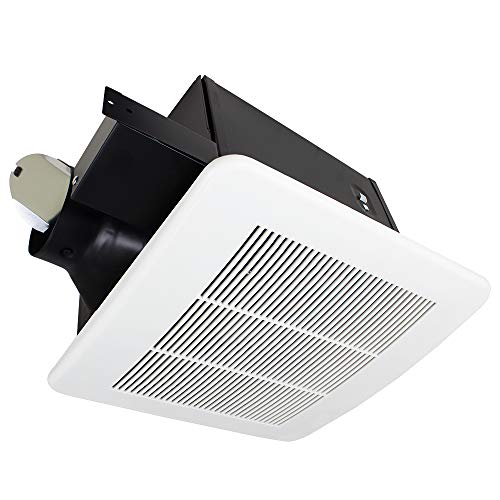 |
BV Bathroom Exhaust Fan 150CFM – Bathroom Fan, 2.0 Sones,BV | Also great | 150 CFM, 2.0 sones, 4-inch duct collar | $114.99
Price as of 9 Oct 2026
|
View |
This quick view helps you sort the fan that fits your duct, the fan that stays quiet, and the fan that works for a retrofit. The right choice usually comes down to three checks: room size, duct size, and how much noise you can tolerate.
📊 Newer bathrooms tend to have 4-inch ducts or larger. Source: 6Best Bathroom Exhaust Fans of 2026, Lab-Tested and Reviewed….
How we chose
We compared the four listed models by CFM, duct compatibility, and the install they suit best. We also looked at the two qualities Consumer Reports uses most often: airflow and noise, including the fact that the quietest fan gets a 5 out of 5 rating in its noise test. (consumerreports.org)
Fit mattered as much as output. A fan that moves more air on paper can still disappoint if the duct run is long, full of bends, or mismatched to a 3-inch or 4-inch opening.
Extra features mattered only when they added clear utility, such as a built-in light fixture or a Bluetooth speaker. Those features are nice to have, not a reason to buy a fan that is too loud or too small for the room.
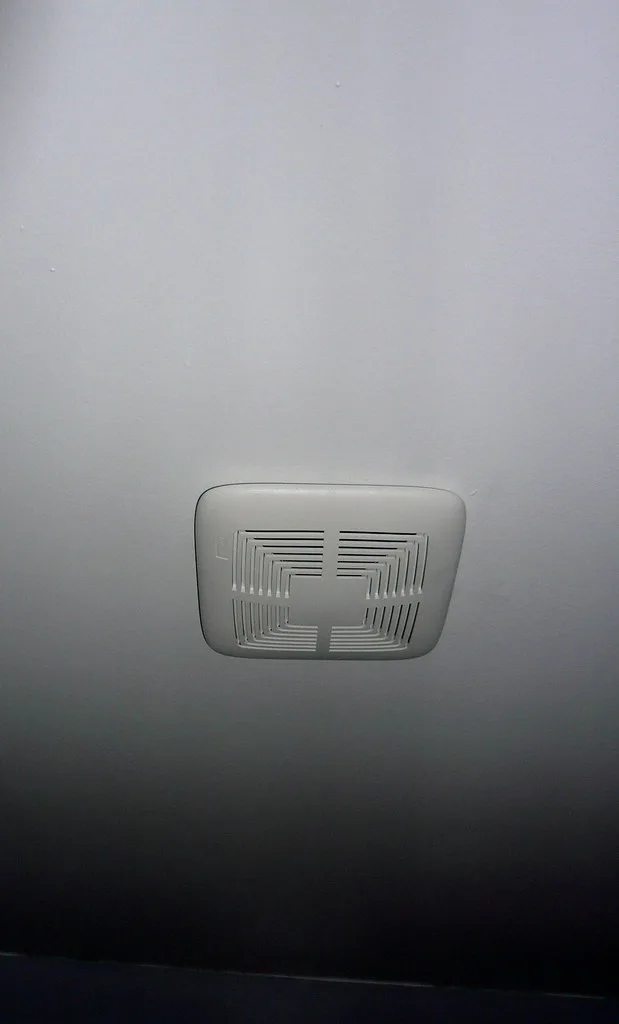
Broan-NuTone 80 CFM Ceiling Bathroom Exhaust Fan with Light and 1300-Watt Heater 765H80L: best for small baths needing light and heat
This fits a small bathroom that needs ventilation plus a built-in light fixture in one ceiling unit. At 80 CFM, it sits in the range many small rooms need, and the added heater can help in rooms where morning comfort matters.
The standout is the all-in-one layout. For a compact bath, combining airflow, lighting, and heat can save ceiling space and reduce the need for separate fixtures.
The drawback is cost and complexity. A fan with a heater is harder to justify if you only need basic ventilation, and the extra functions add little value if your main problem is poor duct fit or a noisy existing vent.
Broan-NuTone RE70BN 70 CFM Bathroom Exhaust Fan Replacement Motor Kit, Easy DIY Replacement Motor Kit for 70 CFM and 50 CFM Bath Fans, White: best for replacing an existing fan
This is for a homeowner whose current Broan-NuTone fan still fits the opening but has lost strength. A replacement motor kit can be the cleanest path when you want more airflow without cutting drywall or rewiring a full unit.
The main advantage is retrofit ease. If the housing is sound and the fan size already matches the bathroom, replacing the motor is often simpler than changing the entire assembly.
The tradeoff is obvious: it is not a universal answer. It only makes sense when the existing fan is compatible, and it will not solve a bad duct layout, an undersized duct, or a housing that no longer fits the room.
Panasonic FV-1115VK3 WhisperGreen Select Bath Fan, 110-150 CFM: best for quiet operation in larger small baths
This is the strongest option when quiet operation matters most and the bath is on the larger end of the small-bath range, or has a tougher duct run. The adjustable airflow is useful if you want one fan that can be set lower for daily use and higher when needed.
Its best trait is flexibility. The Pick-A-Flow selector lets you choose airflow instead of guessing, which helps when the room sits near the edge of the size range or the duct path is not ideal.
The drawback is price. It is also more fan than many truly tiny baths need, so it can be overkill unless you want the quieter operation, the higher-end install features, or the ability to size up later.
BV Bathroom Exhaust Fan 150CFM – Bathroom Fan, 2.0 Sones, 4″ Duct Collar | Energy-Saving Ventilation Fan – No Attic Access | HVI 2100 & UL Certified: best for higher airflow with no attic access
This is a practical pick for a retrofit where you need strong airflow and the ceiling install has to happen without attic access. The 4-inch duct collar makes it a better fit for newer ductwork than for older 3-inch vent paths.
The appeal is straightforward: high airflow, certified performance, and a design aimed at difficult installs. That combination matters when the current fan is weak and the space above the ceiling is tight.
The drawback is noise. At 2.0 sones, it is quiet enough for many buyers, but not as quiet as the best low-sone models, so it is less compelling if silence is the top priority.
What size bathroom exhaust fan do you need?

For a small bathroom, start with room size and adjust up or down based on duct length and how the room is used. A common rule of thumb is about 1 CFM per square foot, and rooms under 50 square feet often work with a lower-CFM fan if the duct run is short and straight.
That rule is a starting point, not a ceiling. If the bathroom sees frequent showers, has a long duct path, or has several bends, sizing up is often the safer choice.
Square footage rules for small bathrooms
Small bathrooms are roughly less than 50 square feet. In that range, a 50 CFM, 70 CFM, or 80 CFM fan can be appropriate depending on the layout, ceiling height, and ductwork resistance.
A simple way to think about it: the smaller and straighter the vent path, the closer you can stay to the room’s square footage. The more resistance in the duct, the more you should lean upward.
When lower CFM is enough
Lower CFM is usually enough when the room is compact, the duct is short, and the fan can move air outside with little resistance. That fits many powder rooms and modest full baths with 4-inch ducting and a direct run.
It also makes sense when your goal is basic ventilation rather than maximum clearing speed. If the room is under 50 square feet and the duct is cooperative, there is little reason to oversize just for the sake of a bigger number.
When to size up for long duct runs
Size up when the duct path includes bends, a long horizontal stretch, or a shallow ceiling that forces the vent to snake around framing. More bends increase resistance to airflow, and that makes a fan work harder to move the same amount of air.
Say your bath is 42 square feet but the duct must travel through two elbows and a long attic run. In that case, a fan above the bare minimum can be smarter than a smaller, quieter model that cannot clear moisture fast enough.
Small-bathroom sizing chart and retrofit checklist
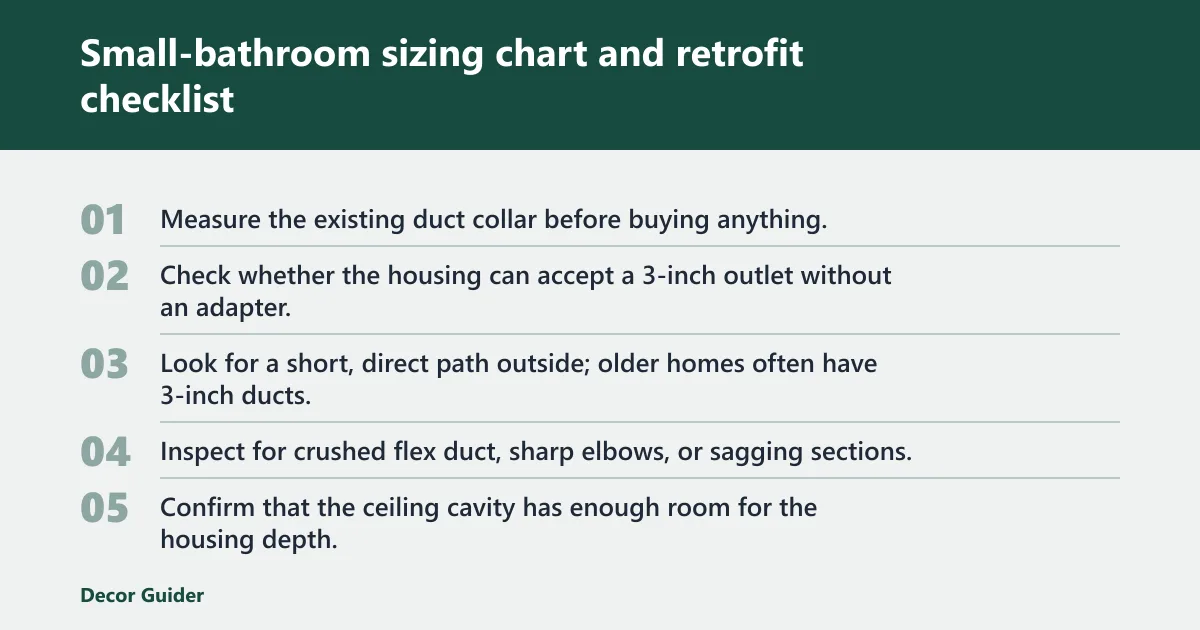
This chart turns the room, duct size, and fan output into a practical starting point. It is not a substitute for local code, but it is a useful way to avoid two common mistakes: buying too little fan for the room, or buying too much fan for a duct that cannot support it.
| Bathroom size | Typical duct setup | Recommended CFM range | What to watch for |
|---|---|---|---|
| Up to 35 sq ft | 4-inch duct, short and straight | 50-70 CFM | Low noise matters more than raw output |
| 35-50 sq ft | 4-inch duct, moderate run | 70-80 CFM | Good middle ground for most small baths |
| 35-50 sq ft | 3-inch duct, older retrofit | 50-70 CFM | Check fan compatibility and duct resistance carefully |
| 50 sq ft and above | 4-inch duct or larger | 80-110 CFM | Useful when showers are frequent or the run is long |
| Tight bath with long or bent ductwork | 4-inch preferred | 70-110 CFM | Higher output can offset duct resistance |
3-inch duct retrofit checks
- Measure the existing duct collar before buying anything.
- Check whether the housing can accept a 3-inch outlet without an adapter.
- Look for a short, direct path outside; older homes often have 3-inch ducts, and those runs can restrict airflow more than expected.
- Inspect for crushed flex duct, sharp elbows, or sagging sections.
- Confirm that the ceiling cavity has enough room for the housing depth.
4-inch duct checks
- Confirm that the fan’s outlet matches the 4-inch duct.
- Count bends. Each bend adds resistance.
- Check whether the run stays mostly straight through the ceiling or attic.
- Choose a fan that can take advantage of the larger duct instead of choking it down with a small outlet.
- Use 4-inch ducting when possible, since newer bathrooms tend to have 4-inch ducts or larger.
What to do when the current fan is weak
- Listen for how long moisture lingers after a shower.
- Check whether the fan is simply dirty or the motor is aging.
- Measure the current duct size before deciding on a replacement.
- If the housing is fine, a motor kit may be enough.
- If the duct is undersized or badly routed, upgrading the fan alone may not fix the problem.
How bathroom exhaust fans work
A bathroom exhaust fan sends air outside through a duct in the ceiling or wall. The fan draws humid air, odors, and heat out of the room, then pushes that air through the ductwork to an exterior vent.
The system works only as well as its weakest part. A strong fan with a cramped duct, long path, or too many bends will not perform like the spec sheet suggests.
Airflow and noise as the two most important qualities
Airflow and noise are the two features to check first. Consumer Reports evaluates those two qualities, and that is sensible for small baths because a fan that is loud enough to avoid using, or weak enough to leave air behind, misses the point.
Noise is especially important in a compact room. The fan sits close to the user, so even a modest increase in sound can feel more intrusive than it would in a larger space.
Broan-NuTone 80 CFM Ceiling Bathroom Exhaust Fan with Light and 1300-Watt Heater 765H80L
Choose this for a small bathroom where lighting and heat are worth paying for in the same housing. The 80 CFM output lands in a useful range for many small rooms, and the light makes it more versatile than a bare-bones vent.
The tradeoff is that you are paying for features beyond ventilation. If your ceiling layout is tight or your main issue is airflow through an older duct, a simpler fan may be the better buy.
Broan-NuTone RE70BN 70 CFM Bathroom Exhaust Fan Replacement Motor Kit, Easy DIY Replacement Motor Kit for 70 CFM and 50 CFM Bath Fans, White
Choose this when the existing Broan-NuTone housing still fits and the issue is weak performance rather than a bad ceiling layout. It is a practical way to refresh a fan without opening up the room.
The main limitation is that it solves only one kind of problem. If the duct is too small, too long, or full of bends, a new motor alone will not make the system behave like a full-size upgrade.
Panasonic FV-1115VK3 WhisperGreen Select Bath Fan, 110-150 CFM
Choose this if quiet operation is the top goal and the room needs a stronger fan than the usual small-bath baseline. The adjustable airflow is also useful when you want one model that can handle different usage levels.
The higher price is easier to justify when you care about both sound and future flexibility. It is harder to justify for a tiny powder room with a simple, short duct path.
BV Bathroom Exhaust Fan 150CFM – Bathroom Fan, 2.0 Sones, 4″ Duct Collar | Energy-Saving Ventilation Fan – No Attic Access | HVI 2100 & UL Certified
Choose this when the project needs strong airflow and a no-attic-access install path. The 4-inch collar makes it a better match for many newer vent setups, and the output can help when the run is less than ideal.
The tradeoff is that a higher-CFM fan only works well if the duct can carry it. In a small bath with a weak or restrictive duct, the extra output may not feel as useful as the spec sheet suggests.
What features are worth paying extra for in a bathroom exhaust fan
Pay extra for features only when they solve a real space problem. A built-in light fixture is useful if the bathroom is dark, and a Bluetooth speaker makes sense only if you want audio in the room and can accept the added cost.
For many small bathrooms, airflow and noise are worth more than premium extras. If the fan is loud, underpowered, or hard to fit, a light or speaker will not change the basic result.
Which one should you buy?
Start with budget, then match the fan to your duct size and noise target. A lower-priced option is fine if the duct is simple; a premium fan makes sense if the room is sensitive to noise or the layout needs adjustable airflow.
If you are replacing a working Broan-NuTone unit, the replacement motor kit is the most efficient path. If you need a full fan with a light, the 80 CFM Broan-NuTone is the most practical fit. If quietness matters most, Panasonic is the stronger pick. If you need high airflow through a 4-inch duct and no attic access, BV is the more direct choice.
Choose by duct size first, not by CFM alone. A 4-inch duct usually gives you more room to move air, while older 3-inch ducts call for more caution and a closer look at compatibility.
Choose by noise next. If the bathroom is small and used often, a quieter fan can matter more than chasing the highest airflow number available.
Choose by features last. Lights are genuinely useful. Bluetooth speakers are optional. Heater units are worth it only if you will use them often enough to justify the added cost and install complexity.
Frequently asked questions
which is the best exhaust fan for bathroom
The best exhaust fan for a bathroom is the one that matches the room size, duct size, and noise target. For small bathrooms, that often means 50–80 CFM with a low noise rating. If the duct is difficult, a better fan may be the one that fits the layout rather than the one with the highest number.
what size bathroom exhaust fan do i need
Start with room square footage and aim for about 1 CFM per square foot as a practical rule. For small bathrooms under 50 square feet, many homes land in the 50–80 CFM range. If the duct run is long or full of bends, step up rather than down.
how many cfm do I need for a small bathroom
Most small bathrooms do well with 50–80 CFM, depending on the room size and duct layout. A smaller powder room with a short, straight 4-inch duct can often use the lower end of that range. Bigger small baths, or rooms with tougher duct paths, usually need more.
is a 3-inch or 4-inch duct better for a bathroom fan
A 4-inch duct is generally the better choice because it gives the fan less resistance and usually supports more airflow. Older homes often have 3-inch ducts, and those can work, but they are less forgiving when the run is long or has several bends.
how quiet should a bathroom exhaust fan be
Quiet is a major buying factor in a small bathroom because the fan is close to the user. Consumer Reports notes that the quietest fan gets a 5 out of 5 rating in its noise test. As a rule, lower noise is worth paying for if the bathroom is used often.
can I use a higher-CFM fan in a small bathroom
Yes. A higher-CFM fan can work in a smaller bathroom if the duct fits and the run can support the airflow. That can be a smart move for long duct paths, frequent showers, or rooms that sit near the top of the small-bath size range.
what features are worth paying extra for in a bathroom exhaust fan
A built-in light fixture is the most useful extra for many small bathrooms. Bluetooth speakers are nice if you want audio, but they are not essential. Pay extra only when the added feature solves a real need, not when it distracts from airflow, duct fit, or noise.
Products related to this article
Sponsored / affiliate links. As an Amazon Associate I earn from qualifying purchases. I may earn additional commission from eligible campaigns.