How to Install a Door Stop on a Baseboard
Place the door stop on the baseboard at the swing’s strike point, typically about 1/2 to 1 inch past the closed-door edge. Then match the stop to the trim thickness and use a fastener that reaches solid wood or a wall anchor. If you miss that point or use the wrong fastener, the door can dent trim, bang hardware, or pull the stop out. This guide shows how to find the strike point, choose the right stop style, and mount it on painted baseboard without cracking the trim.
What you’ll need


- Door stop with a rubber tip or bumper face
- Tape measure
- Pencil or painter’s tape
- Stud finder or small inspection probe
- Drill/driver
- Drill bit for pilot holes
- Screwdriver bit that fits the stop screw
- Wood screw long enough to bite solid trim when possible
- Hollow-wall anchor rated for impact and shear, if the wall behind trim is hollow
- Level or straightedge
- Safety glasses
How do you find the right contact point?
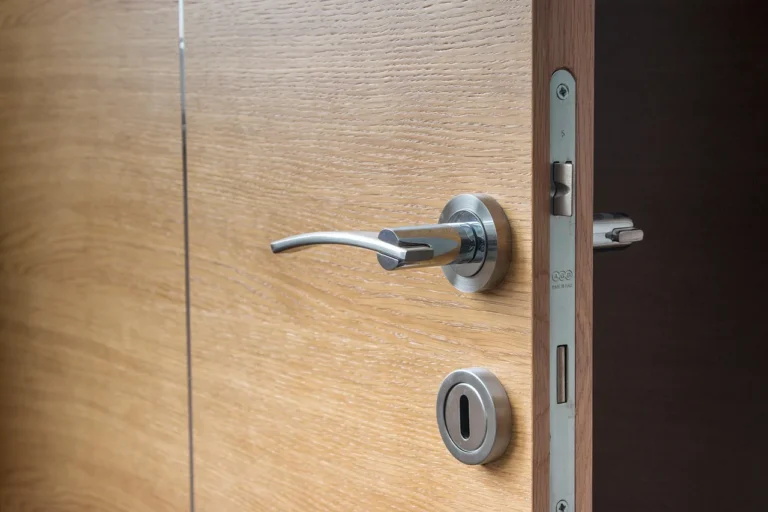
Open the door fully and watch the first place that actually touches. The true strike point may be the knob, lever tip, or door edge, and the stop must meet that point every time. Mark the trim only after the door swings naturally and stops where the hardware really lands.
Mark the real strike, not the guess
- Open the door slowly until it reaches its natural limit.
- Look for the exact contact point on the knob, lever tip, or edge.
- Hold a pencil mark on the baseboard where that point lines up.
- Close and reopen the door once more to confirm the mark lands on the same spot.
Say your bedroom door has a lever handle that reaches farther than the knob on the next room’s door. The lever tip, not the round center of the handle, sets the stop location. That difference can move the mounting point by enough to matter on narrow trim.
Measure after the strike is confirmed
Only after you confirm the contact point should you measure from the floor. The height is whatever places the rubber face directly in the swing path. On baseboard, the stop goes where the hardware hits, not where a preset height happens to look balanced.
How do you install it on baseboard?
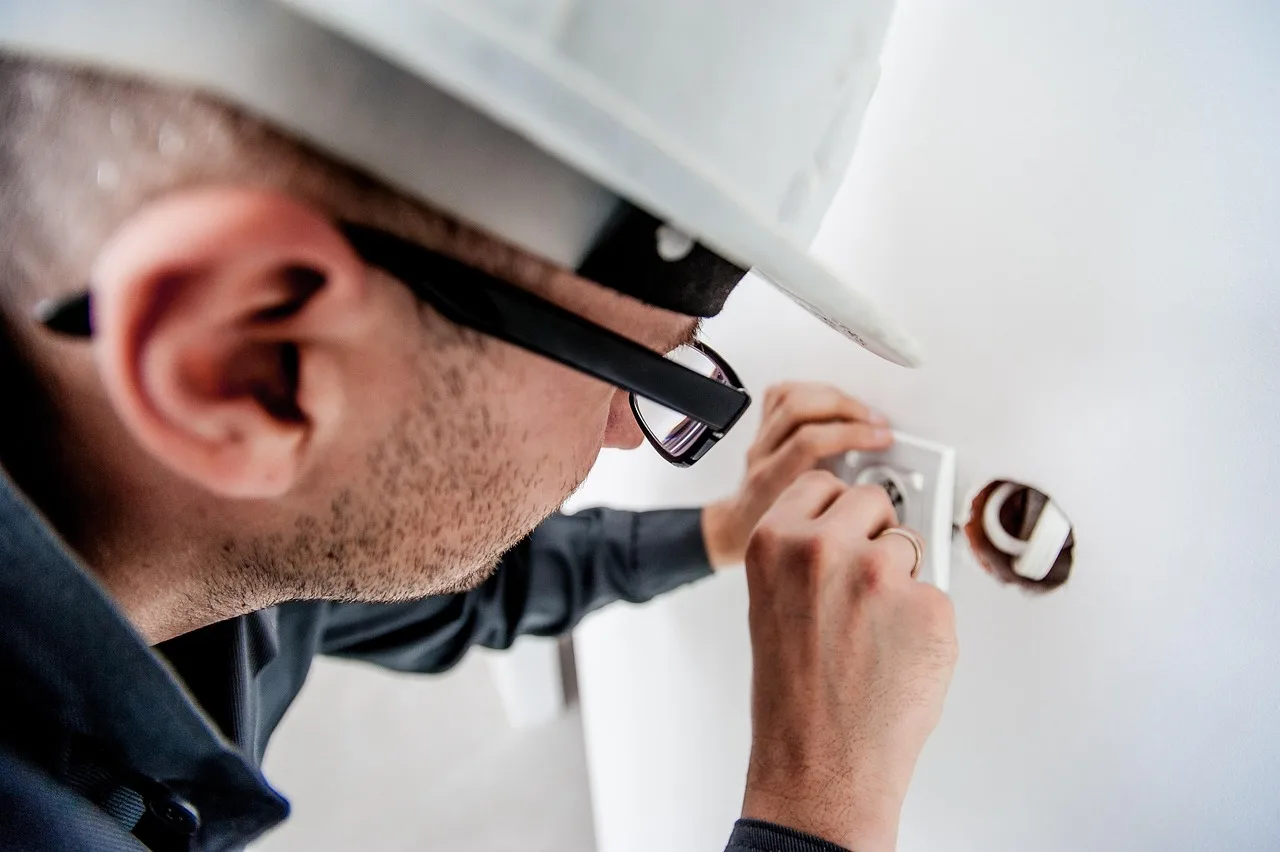
Mount the stop on solid trim, not random drywall, and fasten it so the rubber face lands squarely on the strike point. Check the trim first. Solid wood generally holds a screw better than MDF, and weaker material can loosen quickly under repeated hits.
Step-by-step installation
- Hold the stop against the marked spot on the baseboard.
- Shift it until the rubber tip lines up with the strike mark.
- Check that the screw will hit solid trim or a proper anchor zone, not a crumbly edge.
- Mark the screw hole center through the stop base.
- Drill a pilot hole sized to the screw shank.
- Set the stop in place and drive the fastener until snug.
- Open and close the door to confirm the tip contacts the knob, lever, or edge cleanly.
- Add 1/8 turn at a time if the stop shifts, then recheck the swing.
A common first-timer mistake is mounting the stop where the baseboard looks centered, then discovering the door misses it by a half inch. That usually happens when the strike point was guessed instead of observed. Recheck before fully tightening the screw.
Check the trim before you tighten
Painted softwood usually holds better than MDF, but both can split if you drive a screw too close to the edge. If the baseboard feels thin or hollow behind the paint, choose a different stop style or a better fastener instead of forcing a weak bite.
Baseboard placement checklist
Use this checklist before you drill. It keeps the stop style, fastener, and strike point matched to the room instead of guessed from appearance alone.
| Door type and room | Baseboard material | Strike point | Stop style | Fastener choice | Common mistake to avoid |
|---|---|---|---|---|---|
| Standard bedroom door | Solid wood trim | Knob or lever tip | Baseboard door stop | Wood screw into solid trim | Mounting into paint-only surface |
| Hallway door with shallow trim | Thin MDF baseboard | Knob hits flat wall area | Wall bumper door stop | Anchor rated for impact and shear, if hollow behind trim | Using tiny plastic anchors |
| Bathroom door near vanity or toilet | Painted softwood trim | Lever tip or door edge | Hinge pin door stop | No wall fastener needed | Leaving too little clearance near fixtures |
| Heavy entry or public room door | Fragile or expensive wall finish | Before handle impact | Floor-mounted door stop | Screw into hard flooring | Placing it too close to the hinge |
Which stop works best here?
The best stop depends on the trim, the hardware, and how hard the door swings. Baseboard models work when the knob hits a flat wall area. Wall bumpers help when the baseboard is shallow or missing. Hinge pin stops work near vanities, toilets, and glass panels. Floor stops suit heavy doors that swing over hard flooring.
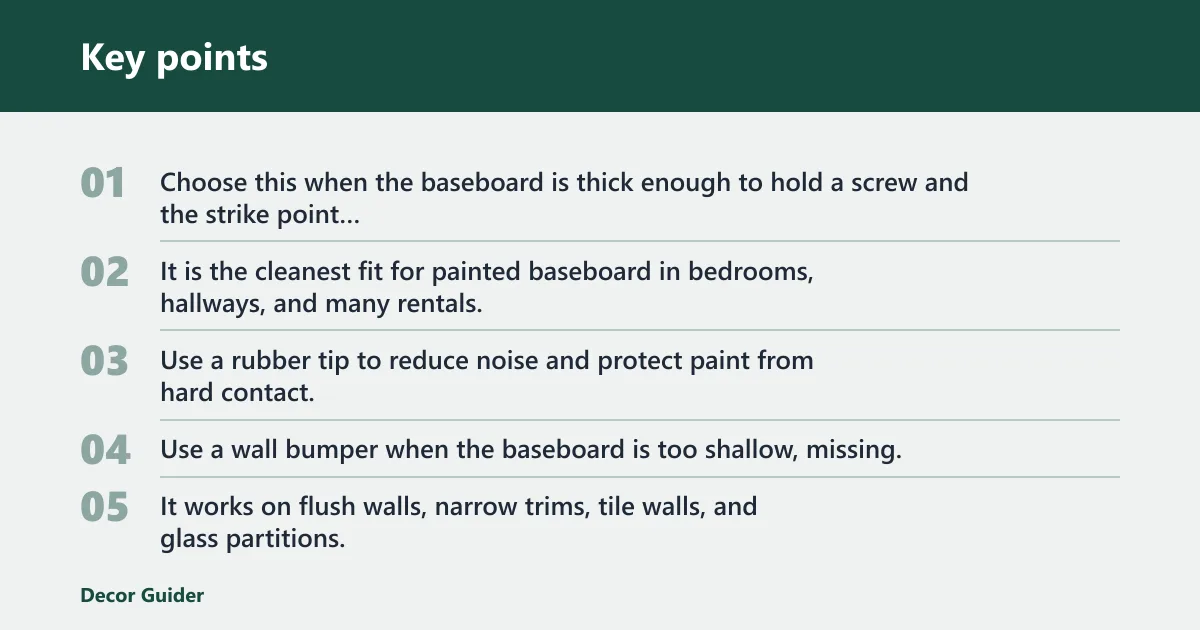
Baseboard door stop for solid trim
Choose this when the baseboard is thick enough to hold a screw and the strike point lands on trim. It is the cleanest fit for painted baseboard in bedrooms, hallways, and many rentals. Use a rubber tip to reduce noise and protect paint from hard contact.
Wall bumper door stop for shallow or missing trim
Use a wall bumper when the baseboard is too shallow, missing, or too weak to withstand repeated impacts. It works on flush walls, narrow trims, tile walls, and glass partitions. Pick a larger face for lever handles, and use a hollow-wall anchor rated for impact and shear if the wall is hollow.
Hinge pin door stop for tight spaces
Choose this when there is little room near fixtures or when you want to avoid touching the wall surface. Remove the hinge pin, slide on the stop, and reinstall the pin. Adjustable rubber buffers help fine-tune how far the door swings.
Floor-mounted stop for heavy traffic
Use a floor-mounted stop for heavy doors, frequent traffic, or walls that are fragile or costly to repair. It works best on hard flooring and should sit where it catches the door before the handle reaches the wall.
Common mistakes
Most failures come from poor placement or weak trim. The stop bounces, misses the knob, or loosens because the strike point was guessed or the fastener had too little holding power. Fix those first before switching hardware.
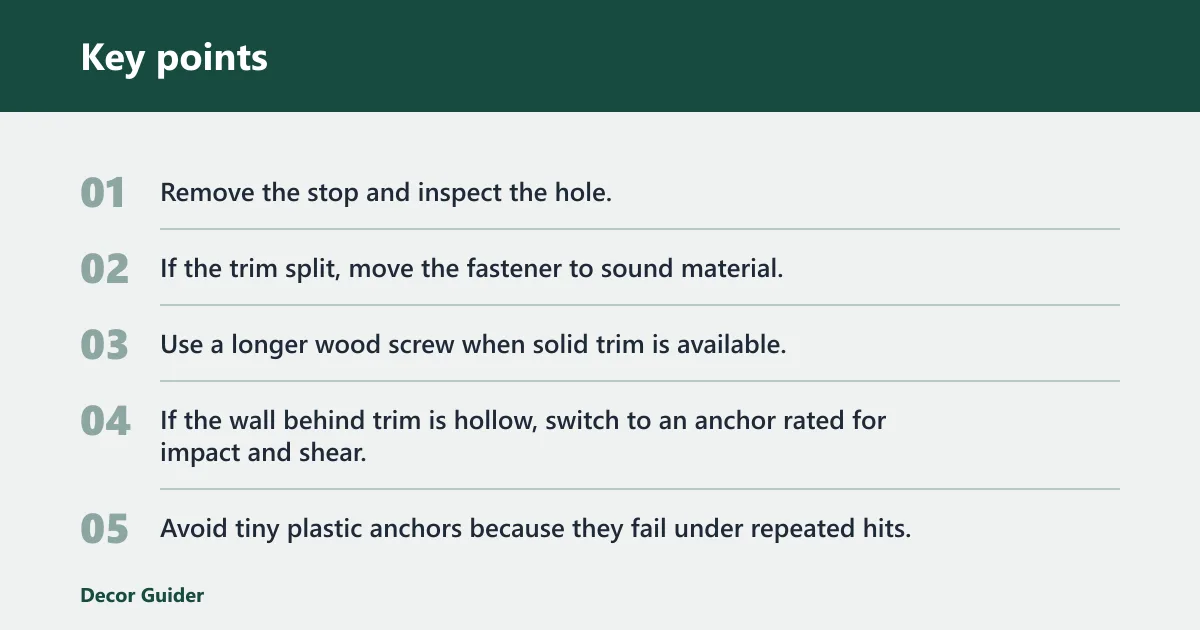
Mounting into weak material
- Remove the stop and inspect the hole.
- If the trim split, move the fastener to sound material.
- Use a longer wood screw when solid trim is available.
- If the wall behind trim is hollow, switch to an anchor rated for impact and shear.
- Avoid tiny plastic anchors because they fail under repeated hits.
Missing the strike point
- Open the door fully again.
- Mark the exact knob, lever, or edge contact.
- Shift the stop until the rubber face lands on that mark.
- If needed, move the stop 1/8 to 1/4 inch and retest.
Placing it too close to the hinge
- Move the stop farther along the swing path.
- Check the door at full open, not half open.
- Reopen the door several times to make sure the stop still catches the same point.
Suppose a hallway door with a lever handle keeps tapping the trim after installation. The stop is probably set for the knob’s center instead of the lever tip. A half-inch shift on the baseboard can solve that without changing the hardware.
If that didn’t work, try this next
- Swap to a stop with a larger bumper face if the handle is wide or offset.
- Move from baseboard mounting to a wall bumper if the trim is too thin.
- Use a hinge pin stop if the wall area is fragile or the fixture clearance is tight.
- Choose a floor stop for heavy doors that still overpower the trim stop.
Frequently asked questions
How far from the door should a baseboard door stop be placed?
Place it so the rubber face meets the strike point when the door is fully open. That distance is set by the hardware, not a fixed rule. Mark the knob, lever tip, or edge first, then set the stop to that line and confirm it catches on every swing.
Can you install a door stop into trim instead of drywall?
Yes, and that is often the better choice when the trim is solid enough to hold a screw. Baseboard mounting works when the knob hits a flat wall area and the substrate can take repeated load. MDF and very thin trim need extra caution because they can loosen or split.
What if the baseboard is too thin for a door stop?
Switch to a wall bumper or a hinge pin stop instead of forcing a weak trim mount. If the wall behind the trim is hollow, use an anchor rated for impact and shear. Tiny plastic anchors are a poor choice because repeated hits can pull them loose.
What tools do you need to install a baseboard door stop?
You need a tape measure, pencil, drill, pilot bit, driver bit, and a stop that matches the strike point. Add a level or straightedge if the trim is sloped. Keep safety glasses on during drilling, and make sure the screw length fits the trim thickness.
How do you stop a door knob from hitting the wall?
Place the stop where the knob actually contacts the trim, then use a rubber tip to absorb impact. If the knob still misses, move the stop slightly along the swing path and retest. A floor stop or hinge pin stop is a better choice when baseboard space is limited.
How do you install a door stop when there is no baseboard?
Use a wall bumper on the flat wall surface, or use a floor-mounted stop if the floor is hard and the door is heavy. If the wall is hollow, choose an anchor rated for impact and shear. For tight spaces near fixtures, a hinge pin stop avoids wall mounting altogether.
Products related to this article
Sponsored / affiliate links. As an Amazon Associate I earn from qualifying purchases. I may earn additional commission from eligible campaigns.