
How Much Does a Freestanding Tub Weigh When Full?
A filled freestanding tub often puts 800 to 1,500 pounds on a floor, and cast-iron models can push higher. If the bathroom floor is wood-framed, older, or bouncy, treat it as a reinforcement check, not a guess. Ignoring that load can crack finishes, sag joists, or turn a remodel into a repair bill. Use the tub’s listed dry weight, its stated water capacity, and the expected bather weight to estimate the filled load, then compare that total with the floor build and joist condition.
What a full tub really weighs

A full freestanding tub weighs the tub itself plus the water and the bather. That is why the same model can land in a safe range on one floor and a review-needed range on another. Material, tub size, and the bathroom structure all change the result.
Dry tub weight vs filled load
The empty tub is only the starting point. A filled tub can include the empty tub, water, and the person in it. Water alone adds a lot: one litre of water weighs about one kilogram, and a tub holding 200 to 300 litres adds 200 to 300 kilograms of water.
How water and bather weight add up
For a quick check, add dry tub weight + water weight + bather weight. A 70-gallon tub adds roughly 580 pounds of water alone, before the tub and person are counted. Freestanding tubs can weigh between 500 to over 1,000 pounds when filled, which is why floor type matters.
Why the same tub can land in a different risk category
Two bathrooms can receive the same tub and still end up with different outcomes. A slab-on-grade room usually spreads load differently than an upstairs bathroom with wood joists. Even on a framed floor, joist size, spacing, span, and direction can shift the answer from proceed to review-needed.
Tub weight worksheet
Use this as a filled-tub load check, not a substitute for the tub maker’s spec sheet or your local building rules. It separates dry tub weight, water, and bather weight so you can compare the total against the floor build and joist condition. The goal is a practical proceed-or-review decision.
| Step | What to enter | How to think about it | Decision cue |
|---|---|---|---|
| 1 | Dry tub weight | Use the manufacturer spec for the exact model. | Light acrylic usually clears easier than cast iron or stone composite. |
| 2 | Water capacity | Estimate litres to the overflow or use the listed gallon capacity. | Water weight often drives the total more than the shell. |
| 3 | Bather weight | Add one typical user, or the heaviest expected occupant if the tub is shared. | Do not leave this out. |
| 4 | Total filled load | Add dry tub + water + bather. | Compare the total to floor type and joist condition. |
| 5 | Floor type | Slab-on-grade, code-built wood floor, older wood floor, or upstairs bath. | Upper floors deserve more caution. |
| 6 | Joist check | Look at size, spacing, span, and direction under the tub area. | Long spans and soft floors move the result toward review. |
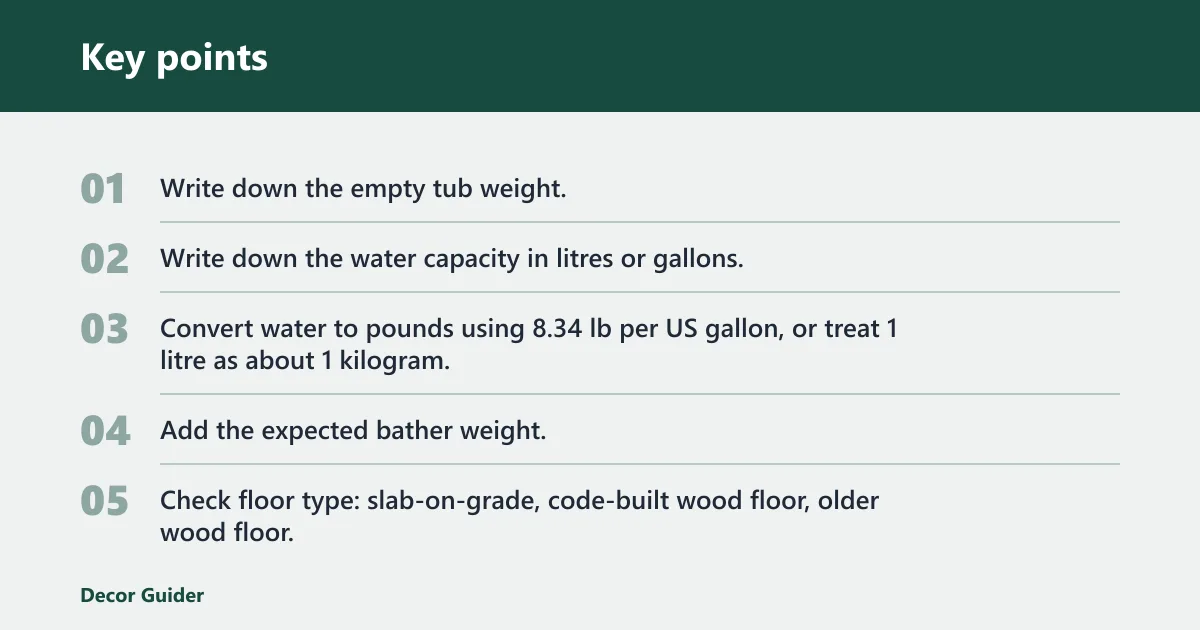
- Write down the empty tub weight.
- Write down the water capacity in litres or gallons.
- Convert water to pounds using 8.34 lb per US gallon, or treat 1 litre as about 1 kilogram.
- Add the expected bather weight.
- Check floor type: slab-on-grade, code-built wood floor, older wood floor, or upstairs bathroom.
- Inspect joists, subfloor, and any visible bounce or damage.
- Label the result low, moderate, or review-needed.
Filled-tub load labels
Low: Light acrylic tub, modest water capacity, and a code-built wood floor with good joist layout, no bounce, and no damage. This is the most likely proceed case, though the exact model still needs a check.
Moderate: Heavier acrylic, large capacity, or an older framed floor with decent joists but a long span or uncertain subfloor. This usually deserves a closer look before you order the tub.
Review-needed: Cast iron, stone composite, long joist spans, upstairs placement, visible sag, cracked tile, or any floor that feels springy. This is where reinforcement or an engineer review becomes sensible.
Say your tub weighs 120 pounds empty, holds 60 gallons, and will be used by a 180-pound bather. Water alone adds about 500 pounds, so the filled load lands near 800 pounds before any extra margin. On an upstairs bath with unknown joists, that is a review-needed result.
How much water does a soaking tub hold?
A freestanding soaking tub often holds about 150 to 320 litres, depending on size and overflow height. Standard alcove tubs are usually lower, while larger soakers can hold much more. Since one litre of water weighs about one kilogram, capacity is the fastest way to estimate the water load.
Typical capacity ranges for freestanding tubs
Large freestanding soakers run about 250 to 320 litres of capacity. A standard 60-inch by 30-inch alcove tub holds roughly 150 to 200 litres to the overflow, so a freestanding unit often carries more water. Bigger volume means more floor load.
Using 8.34 lb per gallon and 1 kg per litre
If the manufacturer lists gallons, multiply by 8.34 to estimate water weight in pounds. A 70-gallon tub adds roughly 580 pounds of water alone. If the spec is in litres, 200 to 300 litres of water adds 200 to 300 kilograms before the tub and bather are added.
Why overflow height and fill line matter
Capacity is not the same as how far you actually fill the tub. The overflow sets the practical maximum, and many users stop a little below it. That still leaves a large load, so the floor check should use the listed capacity, not a guess from the water line.
Which tub materials are heaviest?
Material changes both the empty weight and the installation risk. Acrylic tubs are relatively light compared with cast iron and stone resin, so they are easier to move and often simpler to place on code-built wood floors. Cast iron and stone composite tubs need closer review.
Acrylic tub weight and where it fits best
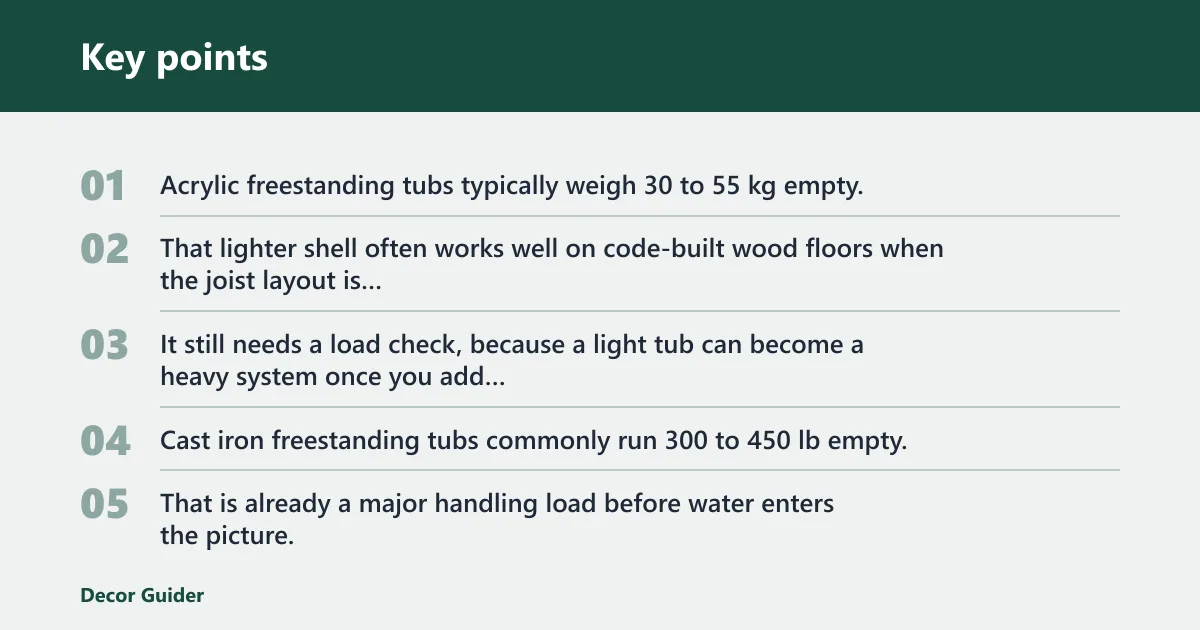
Acrylic freestanding tubs typically weigh 30 to 55 kg empty. That lighter shell often works well on code-built wood floors when the joist layout is sound. It still needs a load check, because a light tub can become a heavy system once you add water and a bather.
Cast iron tub weight and upper-floor caution
Cast iron freestanding tubs commonly run 300 to 450 lb empty. That is already a major handling load before water enters the picture, and cast iron models can push a filled load past 1,000 lb. Upper-storey bathrooms deserve extra caution here.
Solid surface and stone composite weight ranges
Solid stone composite freestanding tubs often weigh 175 to 300 lb empty. These premium soakers are much heavier than acrylic, and they often need closer structural review than lighter materials. They are not automatic no-go tubs, but they are rarely a casual install.
A common mistake is measuring a freestanding tub’s empty weight and forgetting how much the water adds once it’s filled for a bath. A 220-pound stone composite shell may look manageable until you add 250 litres of water and a person. That is how a tub that seemed reasonable turns into a load that needs a second look.
Can your floor support a freestanding tub upstairs?
Maybe, but only after you check joists, span, spacing, and direction. Upstairs bathrooms are the place where hidden floor issues matter most. A code-built wood floor can often carry a lighter acrylic tub, but long spans, soft subflooring, or heavy cast iron push the install toward review.
Joist size, spacing, and span
Floor joists carry the load to the supports below, so their size, spacing, and span matter as much as the tub weight. Wider spacing or a long unsupported span weakens the floor under a concentrated load. A full tub is not spread evenly across the entire room.
Why joist direction changes support
Perpendicular orientation usually spreads load better than a tub placed parallel to the joists. If the tub runs across several joists, the floor can share the weight more effectively. If it sits along a weak span or near a cutout, the load path gets less favorable.
Red flags for rocking, cracked tile, and soft subfloor
Rocking tubs, cracked tile, soft spots in the subfloor, and bounce in the room all signal trouble. Those symptoms mean the floor may already be moving under normal use. Do not treat them as cosmetic issues if a filled tub is planned for that spot.
When reinforcement or an engineer is warranted
Review is warranted when the filled load is heavy, the floor is older or bouncy, or the joist layout is uncertain. A heavy stone or cast iron tub on an upper floor is the classic example. Reinforcement can help, but some situations need structural review before any cuts are made.
What counts as a review-needed load
If the tub is cast iron, stone composite, or large enough to hold 250 to 320 litres, the result often moves toward review-needed. The same goes for upstairs installs, long joist spans, or rooms with cracked finishes. Freestanding tubs require floor support to handle their weight when filled.
Common fixes such as sistering and blocking
Sistering joists and adding blocking are common ways to stiffen the floor. Sistering helps increase capacity along the span, while blocking improves load sharing between joists. These fixes are useful, but they need to match the existing framing and the exact tub location.
Older homes, long spans, and heavy stone tubs
Older homes often deserve a closer look because framing details may differ from modern code-built floors. Long spans can magnify deflection, and a heavy stone or cast iron tub adds more stress. If the floor already feels soft, get the structure checked before you order the tub.
Plumbing and rough-in checks
Plumbing has to match the tub before installation day. Floor-mounted fillers need supply lines through the floor and fixed blocking between joists. Drain location, slope, and venting also matter, because the wrong rough-in can force you to move the tub or rebuild the floor opening.
Floor-mounted filler requirements
Floor-mounted fillers need supply lines through the floor, plus solid blocking between joists for support. Their final position is set by the rough-in diagram, so the tub layout and valve location must be planned together. Wall-mounted fillers usually allow more flexibility, but they still need careful placement.
Drain location, slope, and venting
Drain locations can be center, end, or offset, and the standard drain size is about 1.5 to 2 inches. The drain assembly still needs proper slope and venting, or water may drain poorly. Match the drain to the manufacturer layout before you set the tub.
Why access paths and rough-in diagrams matter
Measure doorways, hall turns, stairs, and any tight access path before you order. A tub that fits the room may still fail at delivery. Rough-in diagrams also matter because the drain, filler, and overflow all need to land where the plumbing can actually reach them.
Frequently asked questions
How much does a freestanding tub weigh when full?
A filled freestanding tub often weighs 800 to 1,500 pounds once you add the shell, water, and bather. Cast iron can push the total higher. The exact result depends on the tub’s empty weight, how much water it holds, and whether the floor is slab-on-grade or wood-framed.
How do you calculate the total weight of a filled bathtub?
Add the dry tub weight, the water weight, and the bather weight. Water is the easiest part to estimate: one litre weighs about one kilogram, and 8.34 lb per US gallon is a useful conversion. Then compare the total to joist size, spacing, span, and floor type.
Can my floor support a freestanding tub upstairs?
Sometimes yes, sometimes no. A light acrylic tub on a code-built wood floor may be fine, but an upstairs cast iron or stone composite tub deserves closer review. Check joist direction, span, and spacing, and look for bounce, cracked tile, or any sign of floor movement.
How much water does a freestanding soaking tub hold?
Typical freestanding tubs hold about 150 to 320 litres, depending on size and overflow height. Large soakers usually sit near the upper end of that range. Because one litre of water weighs about one kilogram, capacity has a direct effect on the floor load.
What is the difference between acrylic, cast iron, and stone resin tub weight?
Acrylic is usually the lightest common option at 30 to 55 kg empty. That weight spread changes handling, floor load, and how much structural review the install needs.
Do freestanding tubs need floor reinforcement?
Not always, but heavy models often do. Reinforcement is more likely when the tub is cast iron, stone composite, upstairs, or placed on a floor with long spans or weak joists. Sistering and blocking are common fixes, but a structural review is the right first step when the load looks marginal.
What should I check before installing a freestanding tub?
Check the empty tub weight, water capacity, bather weight, joist size, spacing, span, and direction. Confirm the drain location, rough-in, slope, and venting. If you are using a floor-mounted filler, verify that the supply lines and blocking match the rough-in diagram before the tub is ordered.
Products related to this article
Sponsored / affiliate links. As an Amazon Associate I earn from qualifying purchases. I may earn additional commission from eligible campaigns.