
How Much Does It Cost to Refinish a Dresser?
Refinishing a dresser usually costs about $335 to $917 when hired out, with a broad average around $625 nationally; a dresser-specific project can run $300 to $2,000 depending on size, material, labor, repairs, and finish complexity. DIY materials often run about $40 to $180, but heavy damage, veneer repair, or stripping a thick finish can push the total higher. A poor refinish can raise the final bill, leave stain blotchy, or throw off drawer fit and hardware alignment. This guide breaks down dresser-specific costs by material, damage level, and finish choice so you can decide whether to refinish, repaint, repair, or replace.
Typical cost range



Professional furniture refinishing averages $625 nationally, and Bob Vila reports a typical range of $335 to $917 based on furniture size, material, labor, and repairs. A dresser can cost $300 to $2,000 to refinish, depending on how much prep and repair it needs. DIY can be much cheaper, but sanding, stripping, filler, primer, stain or paint, and a topcoat still add up. This estimate is built from the same project variables pros use: material, drawer count, surface damage, finish method, and whether the dresser needs structural repair before coating.
What a basic refinish usually includes
A basic refinish usually means stripping or sanding off the old coating, smoothing the surface, then applying stain or paint if needed before sealing with a topcoat. For a plain solid-wood dresser in decent shape, that may be enough. If drawers stick, veneer lifts, or joints wobble, the job stops being a simple finish update. A straightforward sand-and-recoat project is generally the fastest path; a full strip-and-restain takes longer because the old finish has to come off evenly first.
What changes the price most?
The biggest cost drivers are material, dresser size, damage level, finish method, and labor. Bob Vila notes that price depends on furniture type and material, and labor is a major factor. A small dresser with a clean solid-wood surface is far cheaper to redo than a large piece with peeling veneer, swollen panels, or failed hardware.
Material
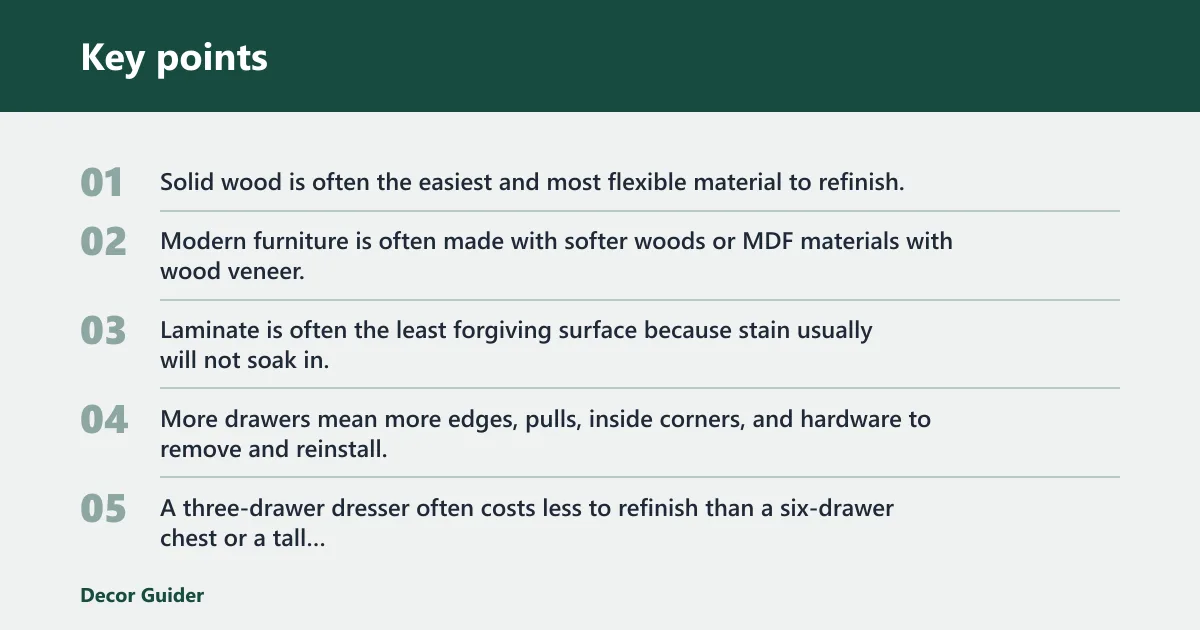
Solid wood is often the easiest and most flexible material to refinish, because it tolerates sanding and stripping better than engineered surfaces. Modern furniture is often made with softer woods or MDF materials with wood veneer, which limits how much sanding or stripping you can safely do; MDF can swell when exposed to water, and veneer can sand through quickly if the top layer is thin. Laminate is often the least forgiving surface because stain usually will not soak in, and sanding can cut through the top layer quickly.
Size and drawer count
More drawers mean more edges, pulls, inside corners, and hardware to remove and reinstall. A three-drawer dresser often costs less to refinish than a six-drawer chest or a tall double dresser, even before repairs enter the picture. Larger pieces also take more time to sand, mask, coat, and cure, which is why labor often rises faster than material cost.
Damage level and repair scope
Scratches and fading may only need sanding and a new finish. Chips, water marks, cloudy spots, and a sticky finish often need more prep. Major repairs increase refinishing cost, especially when the dresser has loose joints, damaged veneer, corner loss, or structural movement that affects drawer fit. Water damage is especially risky on MDF and veneer because swelling and delamination can make a cosmetic refinish impossible without repair.
Finish choice and labor time
Paint-only jobs often cost less than stripping to bare wood and restaining, because they may skip some of the surface correction needed for a stain-grade finish. Recoat or topcoat work is the cheapest path when the existing surface is sound. Stripping, sanding, staining, and sealing take more time, which pushes labor higher. In practice, a simple repaint may take a fraction of the prep time of a stain-grade refinish, while a damaged dresser can double the labor if repairs are needed first.
Dresser cost calculator
Use this as a practical estimate, not a quote. The ranges below assume common homeowner projects and show how material, size, damage, and finish method change the likely cost. The repair add-on column is the amount to budget if the dresser needs fix-up work before finishing. Pricing varies by region; high-cost labor markets can run above these ranges, while smaller markets may come in lower.
| Scenario | Material | Size / drawer count | Damage level | Finish method | DIY estimate | Pro estimate | Repair add-on | Refinish, repaint, or replace? |
|---|---|---|---|---|---|---|---|---|
| 1 | Solid wood | Small, 3 drawers | Light scratches, fading | Sand and refinish | $40 to $110 | $150 to $350 | $0 to $40 | Yes to refinish |
| 2 | Solid wood | Medium, 5 drawers | Sticky finish, cloudy spots | Strip and refinish | $70 to $160 | $250 to $550 | $25 to $100 | Yes to refinish |
| 3 | Wood veneer | Small, 3 drawers | Minor chips, edge wear | Paint | $55 to $140 | $180 to $400 | $30 to $120 | Yes to repaint |
| 4 | Wood veneer | Large, 6 drawers | Peeled veneer, water marks | Repair + paint | $90 to $220 | $350 to $700 | $75 to $250 | Maybe replace |
| 5 | MDF or laminate | Small, 3 drawers | Surface wear only | Paint | $60 to $150 | $200 to $450 | $0 to $50 | Yes to repaint |
| 6 | MDF or laminate | Medium, 5 drawers | Swelling, corner chips | Repair + paint | $95 to $240 | $400 to $800 | $100 to $300 | No, replace often wins |
| 7 | Solid wood | Large, 6 drawers | Deep scratches, loose joints | Strip and refinish | $90 to $220 | $300 to $700 | $60 to $180 | Yes to refinish |
| 8 | Wood veneer | Medium, 5 drawers | Heavy wear, failed topcoat | Recoat / topcoat | $40 to $100 | $120 to $250 | $0 to $60 | Yes to repaint or recoat |
Decision rule: if the dresser is solid wood and the finish is the main problem, refinishing usually makes sense; if it is veneer, MDF, or laminate with swelling or peeling, repainting or replacement often wins on value; if the price approaches the cost of a comparable new piece, replacement becomes more attractive than a labor-heavy restoration.
Should you refinish or repaint?
Refinish when the dresser has good solid wood under the old coating and you want stain to show through. Repaint when the surface is veneer, MDF, laminate, or stained wood with damage that makes a clear finish look uneven. A topcoat-only refresh is enough when the color is fine and the problem is dullness, not wear.
When stripping and restaining makes sense
Stripping and restaining makes sense when the dresser’s wood is worth revealing and the old finish is failing evenly. Old wooden dresser finishes can be removed with sandpaper or a power sander, and a stain or paint change can transform the piece after stripping. This route costs more in labor, but it preserves the wood look. It also works best when the dresser is solid wood, because sanding through veneer is a common failure case on thinner surfaces.
When paint is the cheaper fix
Paint is usually the cheaper fix when the dresser has mixed materials, patchwork repairs, or a blotchy surface that would not take stain evenly. It also helps when the goal is a clean color change rather than a wood-grain look. That is often the smarter move for veneer dressers with small chips or MDF pieces with edge wear. For laminate, paint is often the only realistic cosmetic upgrade because stain will not penetrate the surface.
When a topcoat-only refresh is enough
A topcoat-only refresh works when the existing color still looks right and the surface just needs protection. Light scuffs, dull sheen, and minor dryness can sometimes be fixed with a compatible recoat after a careful clean and light scuff-sand. It is the lowest-cost option when the finish is intact, and it is most useful for pieces that are otherwise structurally sound.
Can every dresser be refinished?
No. Solid wood dressers are the best candidates, while veneer, MDF, and laminate require more caution. Some can be painted or repaired, but not every surface can be stripped and restained without damage. If the surface has swollen panels, peeling veneer, or deep water damage, refinishing can turn into a repair project fast.
Solid wood dressers
Solid wood is the safest choice for stripping, sanding, staining, and sealing. It tolerates more material removal and usually gives you the best chance at a clean final finish. If the piece is older and structurally sound, refinishing often makes financial sense. Solid wood also supports higher-end finishes better, which is why it tends to hold value better than MDF or laminate on resale.
Wood veneer limitations
Veneer can be refinished, but only carefully. The top layer is thin, so aggressive sanding can cut through it and expose the core beneath. Small chips and lifted edges can be patched, but wide peeling or bubbling usually points toward paint or replacement rather than a stain-grade refinish. Once the veneer is through, the repair often becomes visible even after a fresh coat.
MDF and laminate red flags
MDF and laminate often limit the project to paint or a simple topcoat-style refresh. Once water gets into MDF, swelling can leave edges soft and irregular. Laminate does not take traditional stain well, so trying to refinish it like solid wood usually wastes time and materials. The more swelling, chipping, or delamination you see, the closer the piece gets to replacement territory.
Damage that turns into repair work
Deep scratches, corner chips, loose joints, and drawer hardware problems change the job from finishing to repair plus finishing. A common first-timer mistake is assuming scratches are the main issue when the real cost comes from drawer alignment or loose frame joints. Those hidden problems can add labor and parts. If the drawers drag, the runners are worn, or the knobs and pulls no longer match, those costs should be built into the quote before any sanding starts.
Repair costs before finishing
Repair work can move a dresser from a modest refinish to a much larger project. Loose joints, missing hardware, veneer patches, and structural fixes all affect labor time. If the frame is unstable or the drawers bind, finish work should wait until the structure is corrected.
Loose joints and drawer hardware
Loose joints are usually repaired with glue, clamps, and cleanup before finishing. Drawer hardware replacement is another common add-on when pulls, slides, or knobs are damaged or mismatched. These are not expensive individually, but they can extend the job enough to change a quote. For dressers with worn slides or broken pulls, repair cost can be the difference between a simple repaint and a full restoration.
Veneer patches and corner chips
Veneer repair is often a small but careful task. Corner chips and lifted edges need patching, leveling, and drying time before any paint or stain goes on. If the patch area is large, the finish may need to be painted rather than stained to hide the repair lines. This is one of the biggest reasons veneer dressers are often cheaper to repaint than to refinish.
Water damage, swelling, and structural fixes
Water marks may be cosmetic, but swollen panels are not. Once MDF or veneer swells, the surface can become uneven enough that sanding alone will not solve it. Structural fixes cost more because they affect the dresser’s shape, drawer fit, and long-term stability. If the damage reaches the carcass or drawer box, the repair cost can exceed the value of the dresser.
Materials and supplies you may need

The supply list depends on the finish method, but most projects involve cleaning, sanding, a finish product, and safety gear. Chemical stripper use requires good ventilation and protective gear. If the old finish is thick or layered, a low-VOC stripper may be a better choice than harsher products, but the label still matters. The safest product choice depends on the material under the finish and whether the goal is stain-grade wood or an opaque paint job.
Chemical stripper and ventilation
Chemical stripper is useful when sanding would take too long or risk damage. Products that contain methylene chloride require very careful handling, and many homeowners avoid them because of the ventilation and PPE demands. The U.S. EPA has warned about the hazards of methylene chloride in consumer paint and coating removers, and OSHA continues to regulate exposure in the workplace. Gloves, eye protection, and steady airflow are not optional on this kind of project. EPA OSHA
Sandpaper grits, power sander, steel wool, tack cloth
For sanding, keep a range of grits from coarse to fine so you can remove the finish, then smooth the surface before coating. A power sander speeds flat areas, while steel wool can help on certain profiles and detail work. A tack cloth helps remove dust before stain, paint, or topcoat. Care is especially important on veneer, because too much pressure can sand through the face layer quickly.
Primer, paint, stain, and polyurethane options
Primer helps paint adhere and cover uneven color. Paint is the go-to for veneer, MDF, or laminate surfaces that do not suit stain. Stain works best on raw wood, and polyurethane is a common sealer for protection after staining or painting. Matching the product to the surface matters more than picking the most durable label.
Oil-based versus water-based finishes
Oil-based finishes usually level differently and may dry slower, while water-based products often dry faster and smell less intense. Either can work, but the right choice depends on the existing surface, drying time, and the look you want. Mixing incompatible products can cause adhesion problems or cloudy results. Follow the product label for compatibility and recoating windows, especially on previously finished furniture.
Frequently asked questions
How much does it cost to refinish a dresser?
A simple small solid-wood dresser can land near $300, while a larger dresser with repairs can reach $2,000. Solid wood usually gives the best value, while veneer, MDF, or laminate may push the work toward repainting instead of refinishing.
How much does it cost to paint a dresser?
Painting a dresser is often cheaper than stripping and restaining because it can skip some of the wood-reveal prep. A small dresser may land in the low hundreds with pro labor, while DIY costs are often lower if you already have primer, paint, brushes, and sanding supplies. For veneer or MDF, paint is usually the practical path; for a large double dresser, labor can still climb into the mid-hundreds if repair work is needed first.
How much does it cost to restore a dresser?
Restoration costs more than a basic refinish because it can include structural repairs, veneer fixes, hardware work, and finish repair. A dresser with loose joints, corner loss, drawer hardware damage, or swelling may move from a simple finishing job into a much wider repair budget, often beyond the usual refinishing range. Restoration is most cost-effective when the piece has solid construction, historical value, or high-end material that replacement would not match.
How much does it cost to repaint a dresser?
Repainting a dresser usually falls in the same general range as painting a dresser, but the final price depends on prep and repair work. If the surface is stable and only needs cleaning, sanding, primer, and paint, repainting can be one of the cheapest ways to update a dresser. Small 3-drawer dressers are usually the least expensive to repaint; 5- to 6-drawer pieces cost more because of labor and hardware removal.
When is it cheaper to refinish a dresser than replace it?
Refinishing is usually cheaper than replacement when the dresser is solid wood, structurally sound, and only needs surface work. If the piece is large but well built, refinishing can preserve better construction for less than buying a comparable new dresser, especially when the current piece already fits the room. Replacement becomes more attractive when the dresser is MDF, laminate, or badly swollen and the repair-plus-finish total starts to approach the price of a new chest or wardrobe.
What factors change dresser refinishing cost
Material, size, drawer count, damage level, finish type, and labor time change the cost most. Solid wood is easier to refinish than veneer, MDF, or laminate. Scratches are cheaper to handle than swelling, peeled veneer, or structural fixes, and stripping costs more than a simple recoat or repaint. Regional labor pricing also matters, with urban markets typically landing above rural or low-cost markets.
How much does it cost to refinish a chest of drawers or wardrobe?
A chest of drawers or wardrobe usually costs more than a standard dresser because it has more surface area, more drawers or doors, and more hardware to remove and reinstall. As a rough guide, a medium chest of drawers may run in the same ballpark as a large dresser, while a wardrobe can climb higher if it includes doors, shelving, or mirrored panels. Solid wood versions are the best candidates for refinishing; veneer, MDF, and laminate versions are more likely to be painted or replaced if damage is extensive.
What if the dresser is solid wood but the drawers need hardware repair?
Solid wood with minor hardware issues is often still worth refinishing. Drawer slides, pulls, knobs, and alignment fixes can be repaired before finishing, but the hardware work should be priced separately so the quote reflects the real labor. If the dresser body is sound and the hardware fix is modest, the combined cost is usually still below replacement for a comparable solid-wood piece.
Sources
Bob Vila — Furniture Refinishing Cost
U.S. EPA — Methylene Chloride Paint Removers
OSHA — Methylene Chloride
Decor Guider — How Much Solid Wood Dresser Cost?
Decor Guider — How Much Dresser Drawer Repair Cost?
Products related to this article
Sponsored / affiliate links. As an Amazon Associate I earn from qualifying purchases. I may earn additional commission from eligible campaigns.