
How Much Does a Dresser Drawer Repair Cost?
A dresser drawer repair often costs about $15 to $60 for a simple DIY fix, around $50 to $150 for a handyman repair, and about $150 to $300 if new slides, runners, or a full drawer rebuild are needed. Waiting can turn a sticky drawer into broken joinery or a split front. The most common failed parts are runners, tracks, bottoms, and side panels, and the cost usually tracks the damaged part, not the drawer label.
What a dresser drawer repair usually costs


Most dresser drawer repairs fall into three pricing bands: a low-cost parts-only fix, a labor-only handyman visit, or a parts-plus-labor repair that includes replacement hardware, fitting, and cleanup. Small alignment jobs often stay under about $100, while broken runners, tracks, or drawer boxes can push the total toward about $300.
Labor-only vs parts-plus-labor pricing
Labor-only pricing matters when the wood is still sound and the repair is mostly adjustment, regluing, or refastening. Parts-plus-labor pricing applies when a runner, slide, bottom, or side has failed and the repairer must supply new material, cut it to fit, and mount it correctly.
Diagnostic fees are common on service calls. A cabinet shop often charges more than a mobile handyman because the shop may include higher overhead, better hardware selection, and more precise fitting. Materials markup also matters, especially for specialty slides, hardwood strips, and finish touch-up supplies.
Minor repair vs major repair cost ranges
Minor repairs usually cover loose hardware, a small runner fix, or a stuck drawer that only needs cleaning and alignment. Major repairs cover broken tracks, sagging bottoms, split sides, or a full drawer rebuild. The price jumps when the repair needs custom cutting, dovetail preservation, or matching older hardware.
Per-drawer pricing, diagnostic fees, and markup
Many repair quotes are per drawer rather than per dresser. That helps when only one drawer binds or falls out. If several drawers fail, the labor may be discounted somewhat, but multiple diagnostic passes, repeated alignment, and extra hardware can erase that savings fast.
| Service type | Typical price band | What it usually includes |
|---|---|---|
| DIY parts-only fix | $15 to $60 | Glue, screws, sandpaper, hardwood strip, filler, small hardware |
| Handyman labor-only | $50 to $150 | Diagnosis, adjustment, refastening, basic alignment, simple reinforcement |
| Parts plus labor | $100 to $300 | Replacement runner, slide, bottom panel, side repair, or hardware swap |
| Cabinet shop repair | $150 to $300+ | More exact fitting, older hardware matching, custom rebuild work |
| Diagnostic fee | $25 to $75 | Inspection and repair estimate, sometimes credited toward the job |
| Finish touch-up add-on | $20 to $80 | Filler sanding, stain blending, small paint or clear-coat touch-up |
Dresser drawer cost matrix
This matrix helps you match the symptom to the likely failed part, the probable DIY parts bill, the pro labor range, and the point where replacement is usually smarter. It is most useful when the drawer symptom is isolated to one component rather than the whole dresser.
| Symptom | Likely failed part | DIY parts cost | Pro labor range | Total expected cost | Repair-not-worth-it threshold |
|---|---|---|---|---|---|
| Drawer sticks or scrapes | Runner wear or alignment issue | $10 to $35 | $50 to $100 | $60 to $135 | If the box is warped and multiple drawers bind, replace the dresser |
| Drawer is rough on one side | Worn runner or slide | $15 to $45 | $60 to $120 | $75 to $165 | If both runners are failing and the face frame is damaged |
| Drawer falls out or tilts | Broken track, missing stop, or loose mounting bracket | $20 to $60 | $75 to $150 | $95 to $210 | If the dresser uses obsolete hardware and the box is failing too |
| Bottom sags or drops | Drawer bottom failure | $10 to $40 | $60 to $130 | $70 to $170 | If the side grooves are damaged and the bottom will not hold a new panel |
| Lower side splits | Drawer side damage | $15 to $50 | $80 to $180 | $95 to $230 | If the split reaches dovetails on a cheap drawer box |
| Loose pulls or slides | Hardware and fasteners | $5 to $20 | $50 to $90 | $55 to $110 | If repeated screw failure has stripped the wood around the mount |
| Drawer box beyond patching | Full drawer rebuild | $40 to $100 | $120 to $250 | $160 to $350 | If the dresser value is low and the repair approaches replacement cost |
Which part failed?
A stuck drawer does not always mean the runner is bad. The issue may be a worn track, a bent slide, loose hardware, a sagging bottom that rubs, or a split side that throws the drawer out of square. Pick the wrong fix and you spend money twice.
Stuck drawer symptoms and likely causes
When a drawer binds near the front, runner wear and misalignment are common suspects. If the drawer sticks halfway out, the slide or track may be out of line. If the drawer drags only when loaded, the bottom may be sagging under weight.
Picture a wide, 30-inch dresser drawer that slides fine when empty but catches once socks and sweaters are inside. That pattern usually points to load-related sagging or a runner that has worn down enough to lose clearance.
Runner, track, slide, bottom, and side failures
A drawer runner is the part of the dresser that the drawer slides in and out on. Old dressers can have runners that are worn down or missing. A broken drawer side can make the drawer sit crooked, which then makes the runner or slide seem worse than it is.
A drawer bottom failure usually looks like sagging, bowing, or a panel that has slipped out of its groove. Side damage often shows up as a split lower edge, chipped dovetail, or a loose corner that opens when you pull the drawer.
How to tell whether alignment or breakage is the real issue
Check whether the drawer has a latch or lever release before you force removal. If it will not move at all, the problem may be a stop or release mechanism, not a broken runner. Once out, look for rub marks, loose screws, missing staples, and uneven wear on both sides.
- Remove the drawer and inspect the runner, track, and stops.
- Check the bottom panel for sagging, loose fasteners, or cracked grooves.
- Look at the lower corners for splits, chipped joints, or side bowing.
- Test the drawer empty, then loaded, to see whether weight changes the symptom.
- Measure the damaged part before buying replacement material or hardware.
Drawer runner and slide repair costs
Runner and slide repairs usually cost less than a full drawer rebuild, but only if the cabinet structure is still square. Wood runner replacement is common on older furniture, while side-mount or bottom-mount slide swaps are more common on newer or retrofitted dressers. Compatibility with older dressers is often the hidden cost.
Wood runner replacement and cut-to-fit labor
Wood runners are often repaired by measuring the worn piece, cutting a replacement strip to fit, and attaching it with wood glue and a brad nailer. Hardwood is recommended for replacing drawer runners. Softwood can work in low-stress spots, but it wears faster and may need earlier replacement.
Labor rises when the runner must be cut to fit a nonstandard opening. If the drawer opening is uneven, the repairer may need to plane or shim the runner before fastening it. That extra fitting is why a simple strip replacement can cost more than the wood itself suggests.
Side-mount vs bottom-mount slide replacement
Side-mount slides usually need cleaner side clearance and more exact alignment than old wooden runners. Bottom-mount slides often require compatible mounting points under the drawer and inside the case. If the dresser is older, the new hardware may not line up with the original holes or rails.
That compatibility issue can add labor for filling old holes, drilling new ones, and adjusting the drawer box. Replacement hardware type matters too, because some slides include soft-close parts or integrated brackets that change the price.
Older dresser compatibility and hardware changes
Older dressers often need a blend of new and old methods. A repairer may keep the original drawer box but replace the runner, or switch from a worn wooden guide to modern hardware. That is often practical, but it can raise the price if the mounting pattern does not match.
Drawer bottom and side repair costs
Drawer bottom and side failures are more expensive than simple runner wear because they affect the structure of the box. A sagging bottom can often be reinforced or replaced. A split side may need epoxy, filler, or a full rebuild if the damage reaches the joints.
Sagging bottom reinforcement or replacement
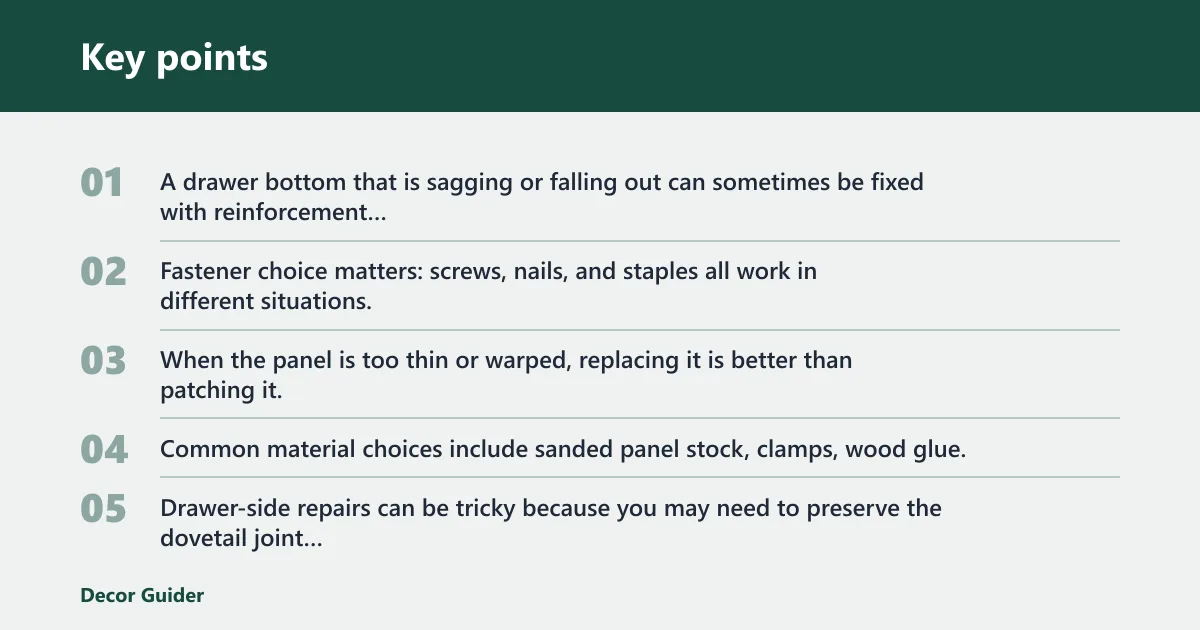
A drawer bottom that is sagging or falling out can sometimes be fixed with reinforcement strips, added fasteners, or a new panel of the same thickness. Fastener choice matters: screws, nails, and staples all work in different situations, but the wrong fastener can split thin material or pull out again.
When the panel is too thin or warped, replacing it is better than patching it. Common material choices include sanded panel stock, clamps, wood glue, and small glides or brackets if the drawer design needs support at the edges.
Split side rebuilds and dovetail preservation
Drawer-side repairs can be tricky because you may need to preserve the dovetail joint while rebuilding missing wood near the lower edge. Some drawer-side repairs use Bondo to rebuild missing wood. That Bondo repair is sandable after about 30 minutes, which helps when the goal is to recreate a small lost section before finishing.
Epoxy or filler can work for small edge rebuilds, but a long split or a crushed corner usually pushes the repair toward replacement. If the side is split through the joint and the drawer is cheap particleboard, the rebuild often costs more time than the drawer is worth.
When epoxy or Bondo is enough
Epoxy or Bondo-style filler is a reasonable choice when the damage is localized, the joints still hold shape, and the drawer still tracks square. It is a poor choice when the lower edge is gone over a long stretch or the side no longer supports the bottom groove.
Say your oak dresser drawer has a 2-inch chip at the lower rear corner, but the dovetail and bottom groove are intact. That is the kind of localized damage where filler, sanding, and refastening can make financial sense. A longer split in the same place usually does not.
Should you repair it yourself?
DIY works best when the damage is limited, the drawer can be removed easily, and the fix only needs ordinary tools. Hiring a pro makes more sense when the repair needs accurate alignment, replacement hardware, or cabinet-level fitting. The longer the drawer box has been damaged, the less likely a quick DIY fix will hold.
Tools and materials for a basic repair
What you need depends on the failure, but a basic dresser drawer kit often includes a tape measure, wood glue, clamps, sandpaper, a hardwood strip, screws or nails, and filler. A brad nailer is useful for runner replacement. For side repair, add epoxy or Bondo and a sanding block.
What a DIY fix can handle
DIY is realistic for worn runners, a loose bottom, a minor split, or simple hardware replacement. It is also practical when you can reach the damaged area without removing half the dresser. The repair usually takes 30 minutes to a few hours per drawer, depending on drying time and fitting.
A common first-timer mistake is replacing a runner before checking whether the real issue is a loose screw or a shifted stop. That turns a small alignment repair into a larger hardware project for no reason.
When a cabinet shop or handyman makes more sense
Choose a pro when the drawer front must stay perfectly matched, when the old dresser uses odd hardware, or when the damage involves multiple components. A cabinet shop is often the better call for older solid-wood dressers, while a handyman can handle straightforward repairs faster and at lower cost.
What changes the final price?
The final bill changes with dresser age, wood species, the amount of damage, the number of drawers affected, and how hard the repair area is to reach. Finish touch-up adds cost too, especially when filler, stain, or clear coat must blend with the surrounding wood.
Age of the dresser and wood species
Older dressers often have worn runners, missing stops, and odd dimensions that slow the repair. Solid hardwood usually holds repairs better than thin engineered board, but it can cost more to match. Softer woods dent and split more easily, which can increase the need for reinforcement.
Number of drawers affected
One bad drawer is usually a simple per-drawer repair. Three bad drawers may reveal a broader cabinet issue, especially if the same hardware design failed in multiple places. That is when the estimate should cover both the visible symptoms and the common root cause.
Accessibility, finish touch-up, and replacement hardware
Access matters because a runner deep inside a tight dresser takes longer to reach, measure, cut, and attach. Finish touch-up is another hidden cost when the repair leaves exposed filler, fresh wood, or patched screw holes. Replacement hardware can also vary widely in price, especially for older dressers with obsolete mounts.
Frequently asked questions
How much does a dresser drawer repair cost?
The final price depends on whether the problem is alignment, a worn runner, a broken track, a sagging bottom, or a split side.
How much does it cost to fix a broken dresser drawer?
A broken drawer often costs more than a sticky one because the box itself may need repair. A small split or loose bottom may stay near the low end, but a broken side, failed track, or full rebuild can push the total into the $150 to $300 range.
Can I repair a dresser drawer myself or hire a pro?
You can usually handle simple runner, bottom, and hardware fixes yourself if the drawer still fits square and the damage is local. Hire a pro when the repair needs exact alignment, older slide compatibility, or structural rebuild work that must hold up under daily use.
What part of a dresser drawer usually fails first?
Runner wear is often the first failure, especially on older dressers with wooden guides. After that, loose hardware, sagging bottoms, and split lower side edges are common. The first visible symptom is usually sticking, scraping, or a drawer that sits crooked in the opening.
How long does dresser drawer repair usually take?
Simple dresser drawer repairs often take 30 minutes to a few hours per drawer. Time rises when the repair needs glue curing, filler sanding, custom cutting, or hardware alignment. A full drawer rebuild takes longer than a runner swap or a bottom reinforcement.
Is it cheaper to repair a dresser drawer or replace the dresser?
Repair is cheaper when the dresser is solid, the damage is limited, and the drawer box is still square. Replacement becomes the better value when the dresser is low-cost, multiple drawers fail, or the repair cost approaches the price of a comparable used dresser.
Products related to this article
Sponsored / affiliate links. As an Amazon Associate I earn from qualifying purchases. I may earn additional commission from eligible campaigns.