Futon Bed Won’t Fold Troubleshooting: Fixes That Work
Check the fold path first: if the futon stops short, inspect the hinges, frame square, mattress fit, and loose fasteners in that order before forcing it. Forcing a jammed futon can bend the frame, strip bolts, and keep the sofa from locking flat. This guide shows how to pinpoint the bind, test each failure point, and fix a futon bed that won’t fold closed.
Common causes of folding problems
Most futons stop closing because one part of the fold path is out of line: the hinge, the rails, the mattress, or the hardware. Start where the frame first makes contact. That is usually the fastest way to separate a hardware problem from a fit problem and avoid making the damage worse. Manufacturer hardware notes commonly warn that pivot points, fasteners, and alignment must all stay within the frame’s intended range for safe operation.
Hinge binding and locked pivot points
Short answer: If one side moves smoothly and the other sticks, the hinge set is the first suspect.
The hinge mechanism is usually the first place to inspect. Look for bent pivot plates, a jammed locking position, dry pivot points, or one side moving farther than the other. If one hinge opens smoothly and the opposite side sticks, the binding is local, not a frame-wide problem.
Check for shiny metal rubbed bare near the pivot, missing hinge pins, or a hinge that closes a few inches and then stops hard. A silicone-based lubricant is the safer choice for moving hardware because it is less likely to attract grit than heavier oils. If the hinge parts are visibly bent, lubrication will only mask the issue for a short time.
Frame twist, rack, and rail misalignment
Short answer: If the two sides do not reach the same position, the frame may be racked or twisted.
Frame rails can go out of square on wood or metal futons. If the front rail reaches the floor before the back rail settles, or one arm of the frame closes farther than the other, the frame may be racked or twisted. Tight fasteners often fix a mild rack, but only if the holes and rails are still holding shape.
Wood frames can swell, split, or warp as humidity changes. Metal frames can bend, rust, or shift at the joints. Side-to-side alignment matters because even a small twist changes the fold path and keeps the backrest from reaching the flat position. If the frame is wood, check for seasonal swelling near the hinge screws and rail ends; if it is metal, check for joint slop or corrosion around the pivot points.
Mattress bulk, slip, and clearance problems
Short answer: If the frame folds without the mattress, the mattress fit or position is the issue.
The mattress can block the fold if it is too thick, badly compressed, or centered poorly. Full and queen frames need the correct mattress size and thickness for their hardware and deck geometry. A mattress that hangs over the side rail or bunches at the hinge can stop the closing motion.
Slip resistance matters too. If the mattress slides forward, it can catch on the backrest or arm hardware before the frame closes. A mattress with major compression set may also fold unevenly, which makes the frame feel stuck even when the hinges are fine. For many frames, the manual should override a generic mattress recommendation if the manufacturer specifies a maximum thickness, a tri-fold-only mattress profile, or a conversion hardware limit.
Missing or loose hardware
Short answer: Loose or missing fasteners can create enough play to jam the fold.
Loose bolts, washers, or hinge pins can create enough play to jam the fold. Missing fasteners let one side shift under load, and the frame can bind as soon as the recline changes. Check each connection point, including the opposite side and the hinge corners, not just the bolt that looks loose.
If a bolt turns easily by hand for more than about a quarter-turn after contact, it is loose enough to inspect. If a washer is missing, the bolt head can pull into the wood or metal and change the alignment of the whole frame. On wood frames, stripped holes usually show up as spinning screws or hardware that will not stay snug; on metal frames, the problem is more often an ovalized hole, a loose nut, or a corroded fastener.
What you’ll need
Short answer: Use basic hand tools first; replace hardware only after you confirm the failure point.
- Hex key set
- Socket wrench
- Screwdriver
- Silicone lubricant
- Replacement hardware matched to the frame
- Flashlight
- Work gloves
How do you diagnose the exact failure point?
Short answer: Start at the hinge, then check the rails, mattress, and floor contact in that order.
Start at the hinge, then move outward to the rails, mattress, and floor. This order isolates the bind without guesswork. If the frame closes by hand with the mattress removed, the problem is often mattress fit or floor drag. If it still sticks, the fault is in the structure or hardware. For bifold frames, the main pivot and backrest stops are usually the first places to check; for trifold or conversion hardware, add the center linkage and lock path to that inspection.
-
Open and close slowly. Move the futon through its full range once while watching both hinge sides. Stop at the first hard bind, because that point tells you where the failure begins.
-
Inspect the hinge pair. Look for bent plates, missing pins, rust, or a latch that stays partly engaged. If one side lags behind the other by more than a small visual gap, the hinge set needs service.
-
Check rail square. Measure the distance between the front-left and rear-right corners, then compare it to the opposite diagonal. A noticeable difference means the frame is racked and needs fastener adjustment before anything else.
-
Remove the mattress. Try the fold again with the mattress off the frame. If the frame closes normally, the mattress is too bulky, shifted, or not matched to the frame size.
-
Test the floor contact. Move all nearby side tables, rugs, and wall décor out of the way, then slide a sheet of paper under the feet and check for drag on carpet, skid pads, or a low spot. If the frame moves freely off the floor but binds when set down, the floor contact is part of the problem.
Say your queen futon closes halfway, then stops when the mattress reaches the hinge line. If the frame folds cleanly with the mattress removed, the fix is centered mattress fit or a thinner replacement, not new hinge hardware.
How to fix a futon that won’t fold
Short answer: Fix the likely obstruction first, then retest after each change.
Fix the most likely obstruction first, then retest after each change. If the futon still will not close after one repair, move to the next likely cause. Do not force the frame past the point of resistance, because that can turn a repairable bind into a bent rail or cracked hinge.
For wood frames, focus first on loose screws, split rail ends, and swollen joints; for metal frames, focus on pivot rust, bent tabs, and corroded fasteners. If the frame came with manufacturer instructions, follow those over any generic tightening or lubrication step, especially on conversion hardware and specialty locks.
-
Tighten all frame hardware. Snug bolts, washers, and screws with the correct hex key, socket wrench, or screwdriver until they stop turning freely, then add only about a final quarter-turn. Over-tightening can pinch a hinge and create a new bind.
-
Lubricate the pivots. Apply silicone lubricant to the hinge pivot points and the moving locking positions, then cycle the frame open and closed several times. Wipe off excess so it does not collect grit.
-
Reset the mattress. Center the mattress so equal material sits on both sides of the frame, then smooth any bunching at the fold line. If the mattress is visibly compressed at the hinge, try a thinner mattress that matches the frame size.
-
Clear the surrounding space. Move side tables, rugs, and wall obstacles away from the fold path. Leave enough room for the backrest to move without hitting the wall or a floor object, then retest the closing motion.
-
Replace damaged parts. Swap bent hinge plates, missing pins, stripped bolts, or warped rails that do not return to alignment after tightening. If the frame is corroded through or swollen and split, repair is usually no longer safe.
Suppose a metal futon closes fully on bare floor but jams on thick carpet. That points to floor drag, not a bad hinge. Protect the feet with the right skid pads, then retest before replacing frame parts.
Futon folding troubleshooting matrix
Short answer: Use the symptom, quick test, and repair threshold together before buying parts.
This matrix gives a fast way to match symptom to cause and fix. Use the quick test before buying parts, because many “stuck” futons only need alignment or hardware correction. For bent hinges, cracked wood, stripped holes, and corroded metal, the repair threshold should be based on whether the part still holds alignment under load, not just whether it still moves.
| Symptom | Likely cause | Quick test | Fix | Tools needed | Replace-vs-repair threshold |
|---|---|---|---|---|---|
| Stops at the same point on both sides | Hinge binding | Fold the frame with the mattress removed | Lubricate pivot points and tighten nearby hardware | Silicone lubricant, hex key | Replace if hinge plates are bent, cracked, or no longer sit flat against the rail |
| One side closes farther than the other | Frame twist or rack | Compare diagonal corner measurements | Square the frame and retighten all fasteners | Socket wrench, screwdriver | Replace if rails stay out of square after tightening or if a rail remains visibly bowed |
| Frame closes without mattress | Mattress too thick or off-center | Remove mattress and test again | Re-center or replace with a matching size | None | Replace if the mattress has major compression set, keeps drifting, or exceeds the frame’s intended clearance |
| Backrest catches near the end of travel | Half-engaged latch | Watch the latch as you move to fold-flat | Release the lock fully and clear debris | Screwdriver | Replace if the lock spring no longer returns or the latch will not hold after adjustment |
| Frame feels loose and wobbly | Missing bolts or washers | Check every connection by hand | Install matched replacement hardware | Hex key, socket wrench | Replace if holes are stripped, elongated, or the hardware pulls through on tightening |
| Metal squeal at the hinge | Dry pivot or corrosion | Inspect for rust or dry rubbing marks | Clean, lubricate, and retest | Silicone lubricant, cloth | Replace if corrosion is deep, pitted through, or flakes under finger pressure |
| Wood rail shifts under load | Swollen or split wood | Press the rail and watch for movement at joints | Tighten hardware; repair minor splits only if sound | Screwdriver, hex key | Replace if the rail is split at a load-bearing joint, the split opens when folded, or the wood crushes around the screw |
| Frame drags on carpet | Floor contact or low clearance | Lift the feet and refold on a harder surface | Add protective feet or skid pads | None, plus pads if needed | Replace if a bent foot prevents level contact or the frame will not sit evenly after correction |
| Mattress slides forward while folding | Poor slip resistance | Shift mattress by hand and check for movement | Re-center and add grip aids approved for the frame | None | Replace if the cover or fill no longer holds shape, or if the mattress size is mismatched enough to leave excess overhang |
| Fold-flat position will not lock | Jammed conversion mechanism | Cycle the recline positions slowly | Clear debris and align the locking points | Screwdriver, hex key | Replace if the lock will not hold after adjustment or the mechanism slips under normal hand pressure |
| One hinge side moves freely while the other binds hard | Uneven hinge wear | Swap attention side to side and compare resistance | Lubricate and retighten; confirm both sides travel evenly | Silicone lubricant, hex key | Replace if the stiff side shows permanent deformation, a missing pin, or repeated seizure after cleaning |
| Holes keep stripping during tightening | Oversized or damaged fastener holes | Check whether the bolt spins without clamping the rail | Use matched hardware only if the hole still grips securely | Socket wrench, screwdriver | Replace if the hole no longer grips, the bolt head sinks into wood, or the metal bracket deforms on tightening |
| Rail end looks split or crushed | Cracked wood or impact damage | Flex the rail gently and watch the crack open | Stop use and replace the damaged rail section | Flashlight | Replace if the crack is at a hinge, corner, or other load-bearing point |
| Rusty joint grinds even after lubrication | Corroded metal hardware | Cycle the joint and look for metal dust or pitting | Clean surface rust, then retest movement | Silicone lubricant, cloth | Replace if corrosion has thinned the metal, created sharp edges, or weakened the pivot area |
Common mistakes
Short answer: The most common mistakes are forcing the frame, tightening only one fastener, and ignoring mattress fit.
The biggest mistake is forcing the fold past resistance. That can bend the hinge, strip bolts, or crack a wooden rail. Another mistake is diagnosing the mattress before checking the frame, because a bent hinge can look like a bedding problem.
Do not tighten one bolt and stop. A futon frame often needs all fasteners checked together so the rails return to square. Also avoid using heavy oil on the pivots; it attracts dust and can make the bind return sooner.
A common first-timer mistake is testing on thick carpet and assuming the hinge failed. If the same futon moves normally on a flat hard floor, the floor contact is part of the problem, not the only cause.
Short answer: Clear the path, center the mattress, and move the frame through its intended positions without forcing it.
Close the futon by removing any side obstacles, centering the mattress, and moving the backrest through its intended recline positions until it reaches the fold-flat stop. If it hesitates, stop and inspect the point of resistance rather than pushing harder. A properly functioning frame should move evenly from both sides.
How to keep futon mattress from sliding
Short answer: Keep the mattress centered and matched to the frame, then check whether the support surface is too slick.
Keep the mattress centered on the frame and aligned with the hinge line before folding. If it still shifts, check that the size matches the frame and that the cover has enough grip for the deck surface. A mattress that slides repeatedly often has worn support or the wrong fit. If the frame is a trifold or conversion style, confirm that the mattress thickness matches the fold geometry rather than assuming a standard profile will fit.
How to disassemble a futon frame
Short answer: Remove the mattress first, keep the hardware grouped by side, and disassemble in reverse order of assembly.
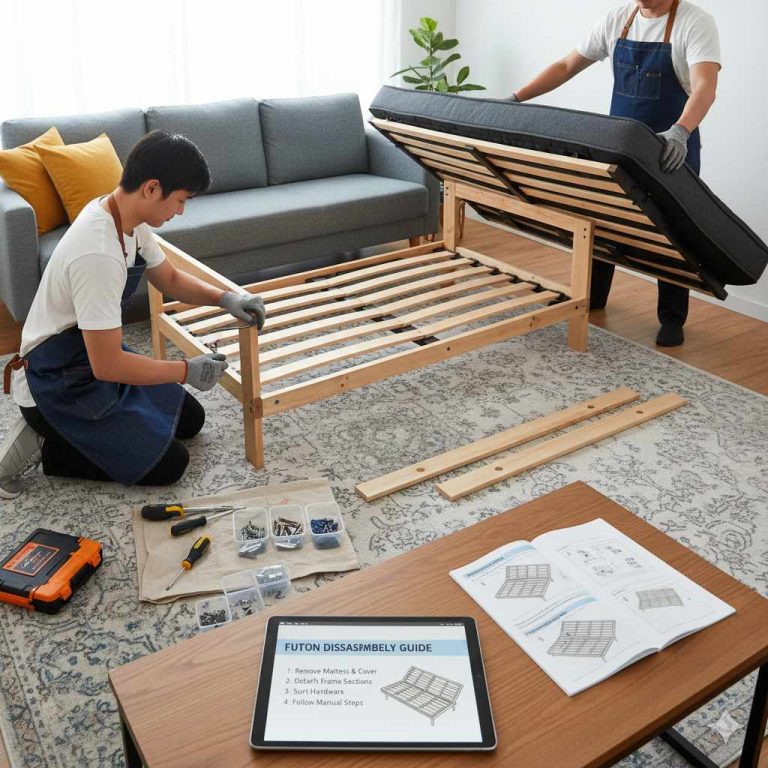
Disassemble only after the mattress is removed and the frame is fully open on a clear floor. Label the hardware by side, then remove bolts, washers, and hinge pins in the reverse order of assembly with a hex key, socket wrench, and screwdriver. Keep the hinge pairs together so reassembly preserves alignment.
Are futon beds comfortable?
Short answer: Comfort depends on support, frame levelness, and choosing a mattress that fits the frame type.
Comfort depends on mattress thickness, support condition, and whether the frame stays level. A full or queen futon with sound rails and the right mattress size can feel steady for sitting and sleeping, while a warped frame or compressed mattress feels uneven quickly. If the bed no longer closes or sits flat, comfort is already compromised. For wood frames, small seasonal movement can change feel; for metal frames, worn pivots can create a sag or ridge even when the mattress itself is fine.
Frequently asked questions
Short answer: The same basics apply in most cases: clear the path, check the latch, and confirm the frame still moves square.
How to fold a futon back up
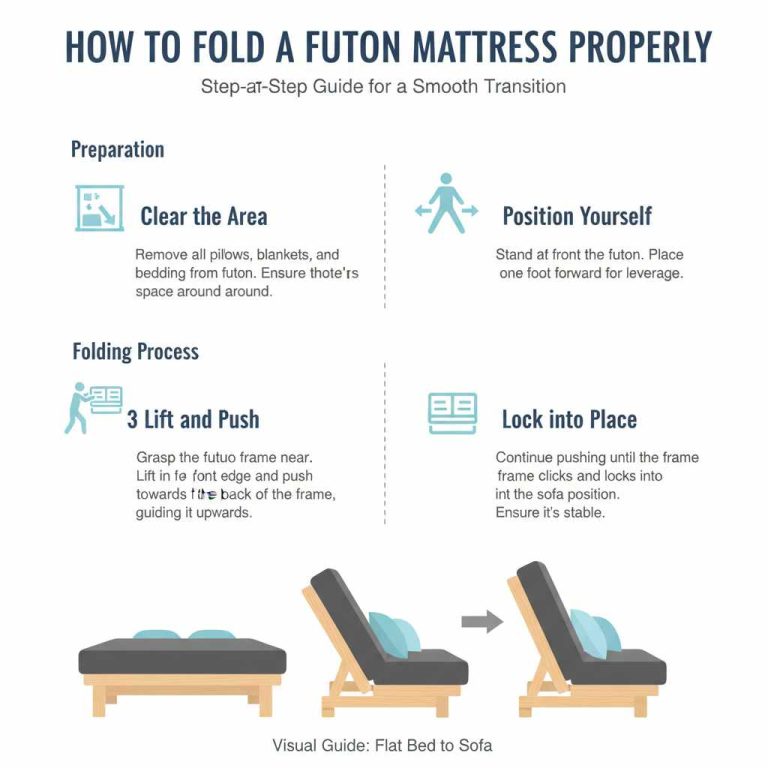
Remove anything blocking the sides, then lift the seat and backrest through the full conversion path until the hinge reaches its upright stop. If the frame stops early, check for a half-engaged latch or a mattress caught at the hinge before applying more force.
How to disassemble a futon frame: take photos of the hardware
Take photos of the hardware layout before removal, then separate the hinges, rails, and fasteners in order. Keep washers and bolts grouped by connection point. If holes are stripped, warped, or rusted through, stop and replace the damaged section instead of forcing reassembly.
How to keep futon mattress from sliding: re-center the mattress after each
Re-center the mattress after each use and check that it does not overhang the rails. If the slide returns, inspect the deck for slick spots or missing support pieces. Persistent movement usually means the mattress size or support setup does not match the frame.
Products related to this article
Sponsored / affiliate links. As an Amazon Associate I earn from qualifying purchases. I may earn additional commission from eligible campaigns.