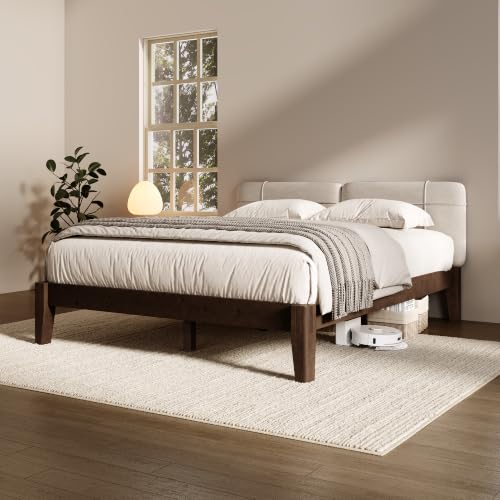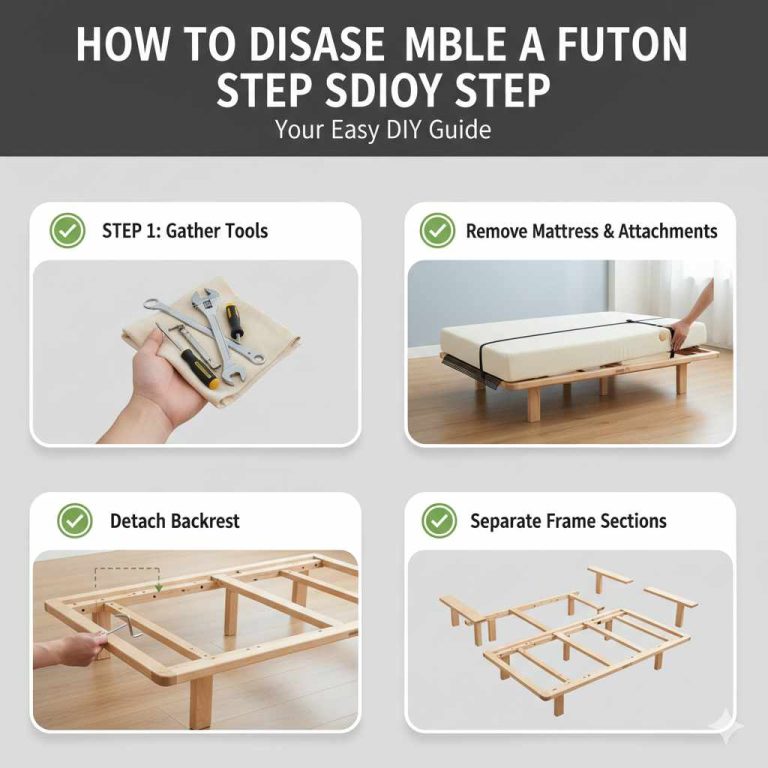
Futon Frame Wobbling Troubleshooting
Start with the failure point, not the fasteners: if the futon rocks, creaks, or leans, check hinges, frame joints, support slats, and floor contact in that order, and tighten only the part that seems to move. If you chase the wrong spot, you can strip screws, keep the wobble, and damage the frame. This guide shows how to diagnose futon frame wobbling troubleshooting step by step and fix the exact source.
What you’ll need



- Hex key set or Allen wrench set
- Socket wrench and driver bits
- Phillips and flathead screwdrivers
- Wood screws for tighter hold in sound wood
- Replacement bolts, washers, and lock nuts
- Wood glue for loose wood joints
- Wood filler or epoxy for stripped screw holes
- Rubber mallet
- Level
- Shims for uneven floor contact
- Drill and drill bits
- Replacement slats, braces, or hinge hardware if parts are damaged
- Flashlight for checking joints, pivots, and hidden cracks
Safety checks before you start
Unload the futon before inspection. Open and close the folding mechanism slowly so you can hear where motion starts. If a rail is cracked, a hinge is bent, or a joint has visible separation, stop using the frame until you repair or replace that part. A folding sofa-bed should stay stable in both positions.
Why is my futon frame wobbling?
A wobble usually means one part has play: hinges, corner joints, slats, center support, or the floor under the legs. Start by matching the symptom to the movement. Side-to-side sway usually points to loose joints or missing cross-bracing, while front-to-back rocking often comes from floor contact or a loose pivot area.
Check the motion direction first
Push the frame gently from the side, then from the front. If the movement changes with direction, you are already narrowing the fault. A futon frame made from wood or metal should move as a unit; any separate shift at one corner, hinge, or support member is a clue. A common first-timer mistake is tightening every screw before finding the one joint that actually moves.
Separate frame play from floor contact
Place the frame on a level floor and shim low legs until all contact points bear weight. If the frame is solid on one flat floor but wobbles on another spot, the issue may be uneven floor contact rather than a failed frame part. Under one leg or corner, even about a few millimeters of gap can create motion that feels like a loose frame.
Look for load-related creaking
If the frame creaks only when weight is added, the likely fault is a joint, hinge, or support member that flexes under load. That often means a loose fastener, a stripped hole, or a split at a weight-bearing joint. Picture a metal futon that feels fine empty, then clicks and shifts when someone sits near one arm; that usually points to pivot slop or a loose corner connection.
What causes a futon frame to feel unstable?
The most common causes are loose hinges, worn pivot points, corner joints that no longer clamp tightly, or support parts that have cracked or shifted. On wood frames, stripped holes and split rails are frequent. On metal frames, bent members, worn pivot holes, and loose bolts are the usual weak spots.
Hinges and pivot points
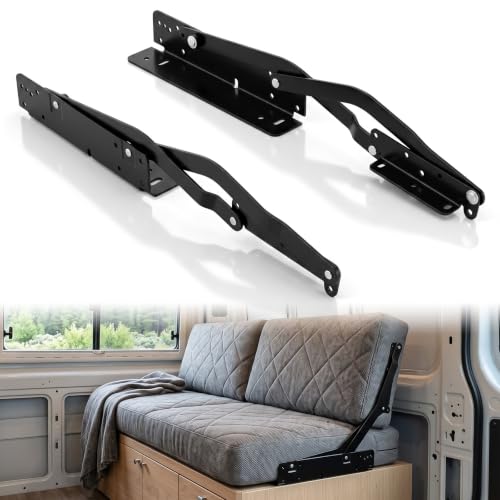
For a foldable futon, hinges should be attached in the central area and must move smoothly without wobbling. Check for looseness, binding, or side play at the folding points. If the hinge leaves or pivot pins move in their holes, the frame can shift even when every visible bolt feels snug.
Loose joints and stripped holes
Wood screws give a firmer hold than nails, so they are preferred for sturdier assembly at corners and joints. Nails can be quicker, but they are less rigid and can loosen faster in a moving frame. If a screw spins without biting, the hole is stripped. Tightening it again usually fails unless you rebuild the hole or move to a fresh fastening point.
Slats, center supports, and cross-bracing
Horizontal slats should be evenly spaced so they support weight consistently and allow breathability. Check each slat for cracks, missing fasteners, or visible motion at the ends. Cross-bracing can be added to improve sturdiness, and a center support reduces side-to-side wobble when the frame flexes in the middle. If the base is plywood, it should fit snugly within the frame and be firmly attached with screws or nails.
How do you stop a futon frame from wobbling?
Stop the wobble by tightening the specific loose part, then reinforcing the weak point if the looseness returns. Start with hinges and corner joints, then move to slats, center supports, and floor contact. If the same spot loosens again after a few cycles, the hole, rail, or bracket may be worn beyond a simple retighten.
- Remove bedding and fold the futon into its most stable position.
- Inspect hinges, pivot pins, corner joints, slats, and support rails in that order.
- Tighten bolts and screws only where movement is visible.
- Replace missing washers or lock nuts before retesting the frame.
- Fill stripped wood holes with filler or epoxy, then reinstall with wood screws after the repair cures.
- Add or reset cross-bracing if the frame sways side to side.
- Check the frame on a level floor and shim low legs until all contact points bear weight.
- Retest by sitting near the center, then near each end, and listen for renewed play or creaking.
If that didn’t work, try this next
Suppose a 78-inch wood futon still wobbles after you tighten the hinge bolts. Recheck the corner joint on the same side, then inspect the slats under that section for a split end or loose fastener. If the wobble returns after one or two retightenings, the problem is often a stripped hole, cracked rail, or warped part rather than simple looseness.
Futon wobble matrix
| Symptom | Likely failure point | Quick test | Tools needed | Repair action | Replace/retire threshold |
|---|---|---|---|---|---|
| Side-to-side wobble | Loose corner joints or missing cross-bracing | Push the top rail left and right while watching the corners | Driver, socket wrench, flashlight | Tighten corner fasteners; add or repair cross-bracing | Retire if a main rail is cracked or the joint will not clamp |
| Front-to-back rocking | Uneven floor contact or loose front support | Check for a gap under one leg with a level | Level, shims, wrench | Level the frame and reset the support feet | Retire if a leg mount is bent or broken |
| Creaking under load | Hinges, pivot points, or flexing joints | Sit near the sound source and shift weight slowly | Hex key, wrench, flashlight | Tighten hinge hardware; replace worn washers or bolts | Retire if the pivot hole is elongated or the metal is bent |
| Hinge slop | Worn hinge leaves or loose pivot pins | Open and close the frame while watching for side play | Wrench, replacement hardware | Reset fasteners; replace worn hinge parts | Retire if the hinge mounting area is cracked |
| Loose slats | Missing fasteners or split slat ends | Press each slat end and feel for lift or rotation | Screwdriver, wood screws | Reattach loose slats or replace damaged ones | Retire if multiple slats are split or the base is sagging |
| Cracked rails | Overload, poor fastening, or old damage | Inspect the full rail with a flashlight under load-free conditions | Flashlight, wrench | Replace the cracked rail or brace it only if the design allows | Retire if the crack reaches a weight-bearing joint |
| Uneven floor contact | Uneven floor or worn feet | Rock the empty frame on a level surface | Level, shims | Shim low points or replace worn feet | Retire if the frame still twists after leveling |
Common mistakes
Do not over-tighten damaged hardware. That can strip the hole further or crush soft wood around the fastener. If a screw turns freely, stop and repair the hole instead of forcing it.
Do not ignore cracked or bent parts. A warped rail or bent metal section can keep wobbling even after every bolt is snug. If the frame has a structural crack in a load-bearing area, replacement is generally safer than repeated patching.
Do not assume nails can solve a loose joint on their own. Nails are quicker to install, but wood screws hold more firmly in repair work. For recurring play, move to a better fastening method and inspect the surrounding wood for damage.
Frequently asked questions
How can I strengthen my futon frame?
Add cross-bracing where the frame sways, replace weak slats, and upgrade loose corner fasteners with properly sized wood screws. If the base is plywood, make sure it fits snugly and is firmly attached. High-density foam helps the bed surface hold shape, but it will not fix a weak frame.
Products related to this article
Sponsored / affiliate links. As an Amazon Associate I earn from qualifying purchases. I may earn additional commission from eligible campaigns.