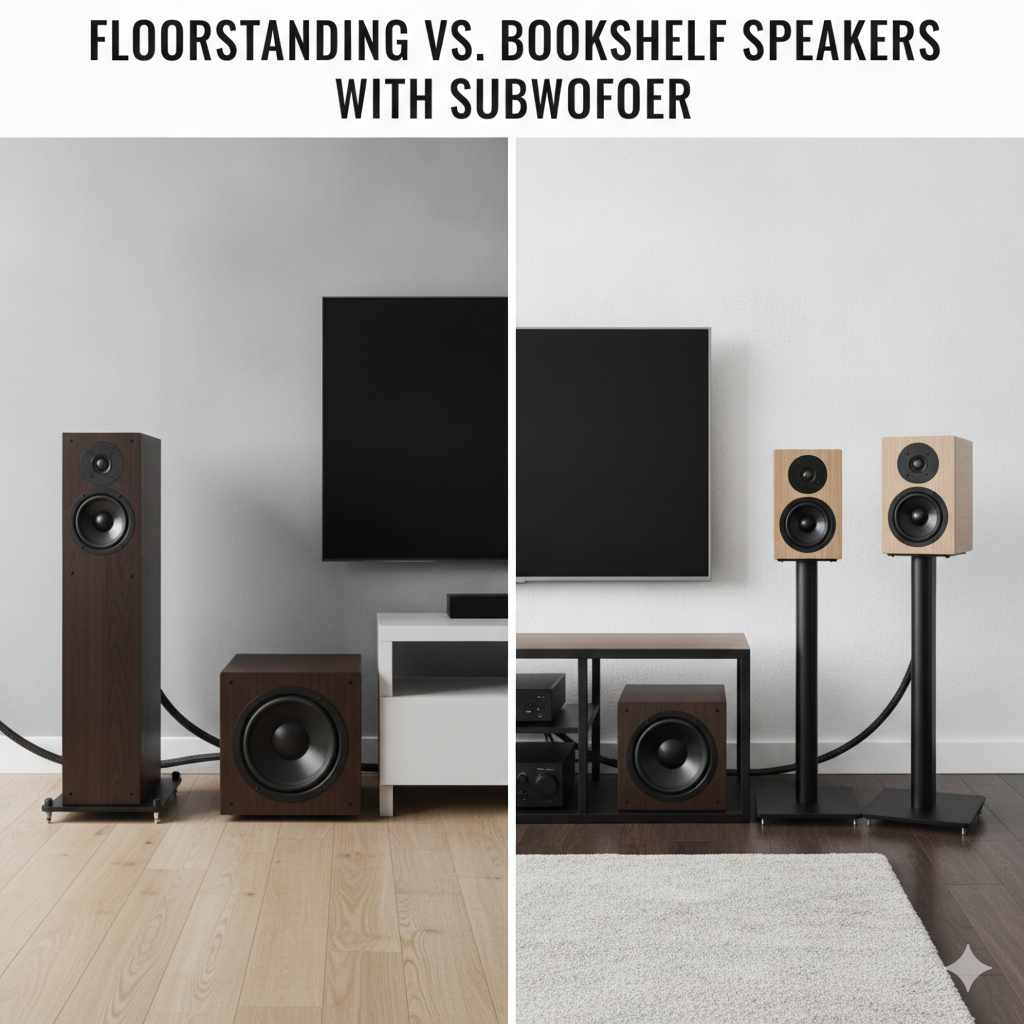
Floorstanding Vs Bookshelf Speakers With Subwoofer
The Big Your Sound Goals
What kind of sound are you chasing? Do you want to feel the rumble of an action movie? Or do you dream of hearing every note of your favorite jazz trio?
For a closely related home or decor topic, How To Build Your Own Bookshelf Step By Step gives readers a useful next step.
For another door or hardware repair, How To Make A Hidden Bookshelf Door: Diy gives readers a closely related troubleshooting step.
For a closely related home or decor topic, How To Store Books Without A Bookshelf Creatively gives readers a useful next step.
Your goals shape the perfect speaker setup. Many people think bigger is always better. That’s not always true.
Sometimes, smaller speakers with a good subwoofer make a bigger impact.
We’ll look at how different speaker types work. We’ll also see how a subwoofer fills in the gaps. By the end, you’ll know which path leads to the sound you crave.
Let’s dive into the details.
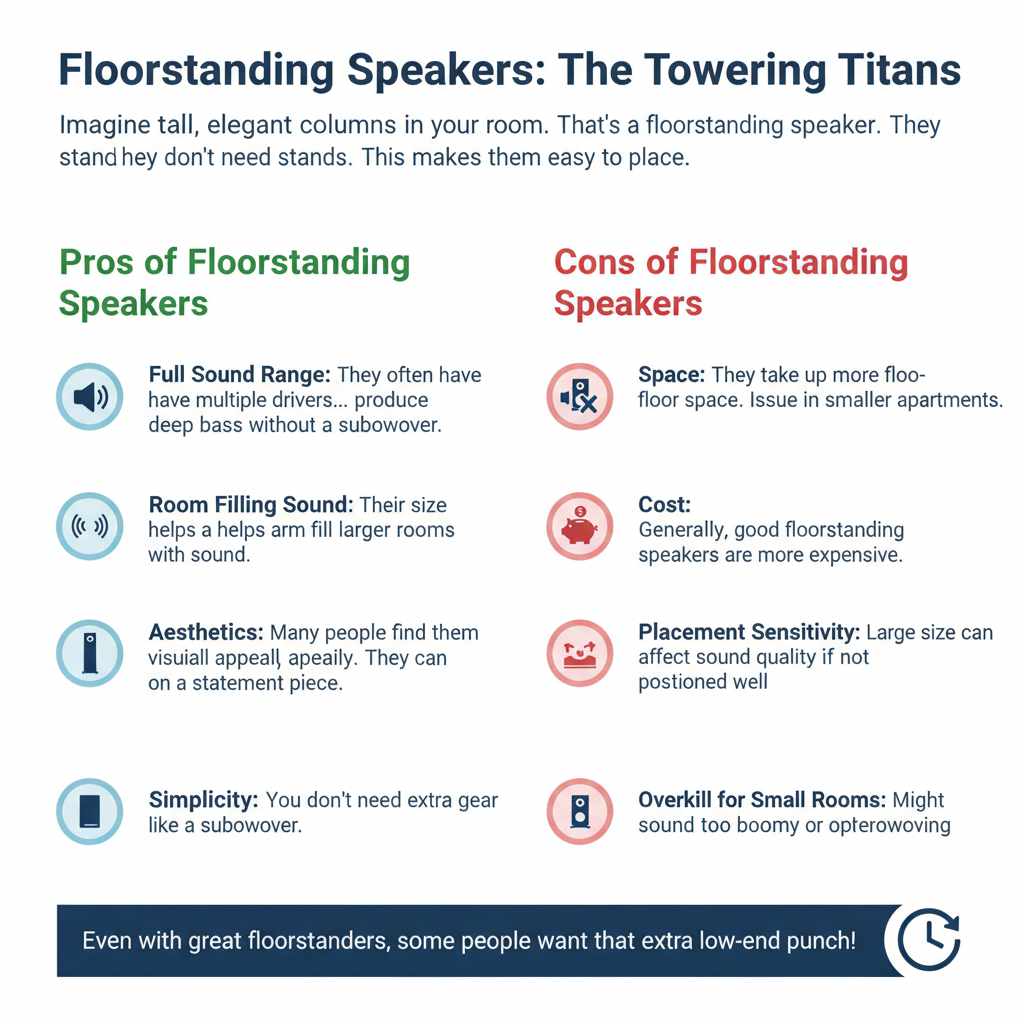
Floorstanding Speakers: The Towering Titans
Imagine tall, elegant columns in your room. That’s a floorstanding speaker. They stand on their own.
They don’t need stands. This makes them easy to place. They are often designed to produce a full range of sound.
This means they can handle bass, mids, and highs all on their own.
Pros of Floorstanding Speakers:
- Full Sound Range: They often have multiple drivers. These drivers handle different sound frequencies. This means they can produce deep bass without a subwoofer.
- Room Filling Sound: Their size helps them fill larger rooms with sound. The sound dispersal can be wide.
- Aesthetics: Many people find them visually appealing. They can be a statement piece in home decor.
- Simplicity: You don’t need extra gear like a subwoofer to get good bass.
Cons of Floorstanding Speakers:
- Space: They take up more floor space. This can be an issue in smaller apartments or rooms.
- Cost: Generally, good floorstanding speakers are more expensive than bookshelf speakers.
- Placement Sensitivity: While easier to place than some, their large size can still affect sound quality if not positioned well.
- Overkill for Small Rooms: In a tiny room, they might sound too boomy or overpowering.
I remember setting up my first set of floorstanders. They were beautiful, sleek towers. I put them in my living room.
The sound was good. It was clear and powerful. But I noticed something.
The really deep bass, like in explosions in movies, felt a bit lacking. It was good bass, but not earth-shaking bass.
This is where the subwoofer question starts to bubble up. Even with great floorstanders, some people want that extra low-end punch. It’s like adding a spice to an already delicious meal.
You don’t need it, but it can elevate the experience.
Bookshelf Speakers: Mighty Minis
Bookshelf speakers are smaller. They are designed to sit on shelves, stands, or entertainment units. They are not meant to stand on the floor by themselves.
Because they are smaller, they typically don’t produce as much deep bass as floorstanding speakers. They excel at the mid-range and high frequencies.
Pros of Bookshelf Speakers:
- Space-Saving: They are perfect for smaller rooms. They don’t dominate the space.
- Cost-Effective: Usually less expensive than floorstanders. This makes them a great entry point.
- Versatile Placement: Can be placed in many locations. On stands, shelves, or mounted.
- Excellent for Stereo: When paired with a subwoofer, they can create a very balanced sound.
Cons of Bookshelf Speakers:
- Limited Bass: Their smaller size means they struggle with very low frequencies.
- Require Stands/Mounting: You often need separate stands or mounts. This adds to the cost and setup.
- Subwoofer Necessity: For a full, rich sound, a subwoofer is almost always needed.
My friend Sarah has a cozy apartment. She loves music. She wanted great sound but had very little space.
She chose a pair of compact bookshelf speakers. At first, she loved them. Music sounded crisp.
Vocals were clear. But when she watched action movies, she felt like she was missing something. The big crashes and explosions just didn’t have the impact she expected.
This is a common story. Bookshelf speakers are fantastic for what they do. They offer precision.
They offer clarity. But for that full, cinematic rumble, they often need a partner.
Bookshelf Speaker Placement Tips
Height: Place them at ear level when you’re seated. This is crucial for good sound imaging.
Angle: Angle them slightly towards your listening position. This is called “toe-in.”
Distance: Keep them away from walls. About 1-2 feet is a good starting point. This prevents boomy bass.
Clear Path: Ensure there’s a clear line of sight to your main listening spot.
The Subwoofer: The Bass Maestro
A subwoofer is a special speaker. Its job is to reproduce very low sounds, or bass frequencies. These are the sounds that make you feel the music or the movie action.
Think of the deep thrum of a bass guitar or the roar of an engine. Most standard speakers struggle to produce these deep sounds effectively.
Why Add a Subwoofer?
- Deep Bass Extension: They add those low frequencies that other speakers miss.
- Relieves Main Speakers: They take the burden of producing bass away from your main speakers. This lets them focus on mids and highs. This can lead to clearer overall sound.
- Impactful Experience: For movies and certain music genres, a subwoofer adds a sense of realism and power.
- Flexibility: You can often adjust the subwoofer’s level independently. This lets you tune the bass to your liking or room.
Types of Subwoofers:
- Powered (Active): These have their own amplifier built-in. They are the most common type. You just need to plug them into power and connect them to your receiver or sound system.
- Passive: These need an external amplifier. They are less common for home use today.
I once went to a friend’s house. He had a mid-range bookshelf speaker setup. The sound was good, very clear.
But when he turned on a movie trailer with explosions, it felt a bit flat. Then he turned on his subwoofer. BOOM!
The room suddenly felt alive. The bass hit you in the chest. It wasn’t just noise; it was a physical sensation.
That’s the power of a good subwoofer.
Many people underestimate the subwoofer. They think it’s just for booming movie effects. But it’s also vital for music.
Many instruments, like organs, pianos, and even the human voice, have lower frequencies. A subwoofer can add richness and body to these sounds.
Subwoofer Placement Matters
Corner Placement: Often adds the most bass, but can sometimes make it sound boomy. Try it, but be ready to adjust.
Along the Wall: Placing it midway along a wall can offer a more even bass response.
The “Subwoofer Crawl”: Place the subwoofer in your main listening chair. Play bass-heavy music. Crawl around the room where the subwoofer would be.
When the bass sounds best to you, mark that spot. Put the subwoofer there!
The Core Debate: Floorstanding vs. Bookshelf + Subwoofer
So, when do you pick one over the other? It really comes down to your space, your budget, and your listening preferences. Let’s look at common scenarios.
Scenario 1: The Large Living Room
You have a big open space. You love hosting movie nights. You want sound that fills the entire area.
In this case, a good pair of floorstanding speakers might be your first choice. They are designed to project sound widely. They can handle the dynamics needed for a large room.
You might still consider a subwoofer for added impact, especially for movies.
However, a high-quality pair of larger bookshelf speakers, paired with a capable subwoofer, can also excel here. The subwoofer can ensure that deep bass isn’t missed. It can add that extra layer of excitement.
The choice here often comes down to aesthetics and how much floor space you’re willing to dedicate.
In my experience, a powerful subwoofer can make even a good pair of floorstanding speakers sound more impactful. It’s like giving them superpowers for the low end. I’ve seen setups where floorstanders are paired with a sub, and the sound is simply phenomenal.
The room truly shakes with the action.
Scenario 2: The Cozy Apartment or Small Office
Space is tight. You still want great sound for music and occasional movies. Here, bookshelf speakers are often the clear winner.
They are compact. They can be discreetly placed. But to get that full sound, a subwoofer is almost essential.
A good quality powered subwoofer can transform a small bookshelf system. It adds the weight and depth that the small speakers can’t provide on their own. This combination can often outperform larger floorstanding speakers in a small room.
The bass won’t overpower the space. The mids and highs remain clear and precise.
I helped a young couple set up their home theater in a small den. They wanted big sound but had barely any room for speakers. We chose a pair of excellent bookshelf speakers.
Then, we added a compact, but powerful, subwoofer. The results were astonishing. They had a rich, full sound that made their small room feel like a cinema.
They often said they couldn’t believe the sound coming from such small speakers.
Understanding Speaker Specs (Simply)
Frequency Response: This tells you the range of sound a speaker can produce. A lower number means it goes deeper into bass. For example, 30Hz (Hertz) is much deeper than 60Hz.
Sensitivity: Measured in decibels (dB). Higher sensitivity means the speaker is more efficient. It needs less power to get loud.
Power Handling: How much power (watts) the speaker can take. More is generally better, but match it to your amplifier.
Impedance: Measured in Ohms (Ω). Most home speakers are 4 or 8 Ohms. Make sure your amplifier can handle the speaker’s impedance.
Scenario 3: The Audiophile Who Wants It All
You appreciate nuanced sound. You want to hear every detail. You also want the impact of a cinematic experience.
For you, it might be about quality over compromise. You could opt for high-end floorstanding speakers that are known for their exceptional clarity across all frequencies. These might still benefit from a subwoofer for that ultimate low-end extension.
Alternatively, you could choose premium bookshelf speakers. Pair them with a top-tier subwoofer. This setup can be incredibly accurate.
It can deliver stunning detail. It also provides that deep, satisfying bass. This approach often gives you more flexibility in placing the subwoofer.
You can fine-tune its integration with the main speakers.
I met an engineer who was obsessed with sound. He had a dedicated listening room. He tried everything.
Eventually, he settled on a system with very high-end bookshelf speakers. He paired them with a state-of-the-art subwoofer. He spent weeks fine-tuning the subwoofer’s placement and crossover.
The result was breathtaking. The clarity was unmatched. The bass was tight, deep, and felt like it was part of the music, not an addition.
Integration: Making Them Work Together
The key to a great sound system, whether it’s floorstanders or bookshelf speakers with a subwoofer, is proper integration. This means making sure all the speakers work in harmony. This is especially true when using a subwoofer.
Crossover Frequency
This is a super important setting. It’s the point where your main speakers stop producing bass and hand it over to the subwoofer. If the crossover is set too high, your main speakers will struggle.
You might hear the bass coming from a specific spot (the subwoofer), which isn’t ideal. If it’s too low, you might miss out on bass.
Most receivers and soundbars have a crossover setting. It’s usually in the speaker setup menu. For bookshelf speakers, a crossover between 80Hz and 120Hz is common.
For floorstanding speakers, it might be lower, perhaps 60Hz or 80Hz, depending on their bass capabilities.
Getting this right is a bit of an art. It often involves trial and error. You want the bass to sound seamless, not like separate parts of the sound.
Phase Control
Subwoofers often have a phase control. This adjusts the timing of the subwoofer’s sound waves. You’ll usually see settings for 0 degrees and 180 degrees.
Sometimes, there’s a variable control.
The goal is to make the subwoofer’s output align with your main speakers. You can test this by playing bass-heavy music. Switch the phase control.
Listen to which setting sounds fuller and more natural. You want the bass to blend in, not fight with your main speakers.
I remember a time I was helping someone dial in their system. The bass was there, but it sounded a bit “one-note.” It was a bit muddy. We played around with the crossover and the phase.
When we finally got the phase set just right, the bass just locked in. It became tighter, more musical. It was a small adjustment that made a huge difference.
Quick Comparison: Floorstanding vs. Bookshelf + Sub
| Feature | Floorstanding Speakers (Alone) | Bookshelf Speakers + Subwoofer |
|---|---|---|
| Bass Output | Good to Excellent | Excellent (with Sub) |
| Room Size Suitability | Medium to Large | Small to Medium (with Sub) |
| Space Required | More Floor Space | Less Floor Space (main speakers) |
| Aesthetics | Can be Statement Pieces | More Discreet (main speakers) |
| Setup Complexity | Simpler (fewer components) | More Complex (integrating sub) |
| Typical Cost | Higher (for comparable quality) | Lower (for comparable quality, depending on sub) |
What This Means For Your Home
Choosing between floorstanding speakers and a bookshelf system with a subwoofer isn’t about one being definitively “better.” It’s about finding the best fit for your life.
When Floorstanding Speakers Shine
If you have a larger room and want a simpler, more integrated look, floorstanding speakers are a great choice. They can deliver a broad, powerful sound without needing extra boxes on the floor. They are often the go-to for many home theater enthusiasts who have the space and want that commanding presence.
Consider them if:
- Your room is 200 square feet or larger.
- You prefer a cleaner look with fewer components visible.
- You enjoy powerful, room-filling sound for both music and movies.
- Your budget allows for higher-end floorstanding models.
When Bookshelf Speakers + Subwoofer Rule
If space is a constraint, or if you want to achieve exceptional bass depth and clarity without breaking the bank, a bookshelf and subwoofer combination is often ideal. This setup offers incredible flexibility and can deliver surprisingly powerful and detailed sound.
Think about this route if:
- Your room is smaller (under 200 square feet).
- You want to maximize your listening experience without sacrificing space.
- You are on a tighter budget, as good bookshelf speakers can be more affordable.
- You love precise mid and high frequencies and want to add deep bass selectively.
It’s important to remember that a subwoofer can enhance almost any system. Even high-end floorstanding speakers can benefit from the addition of a well-integrated subwoofer for truly profound low-frequency reproduction. The goal is a balanced sound.
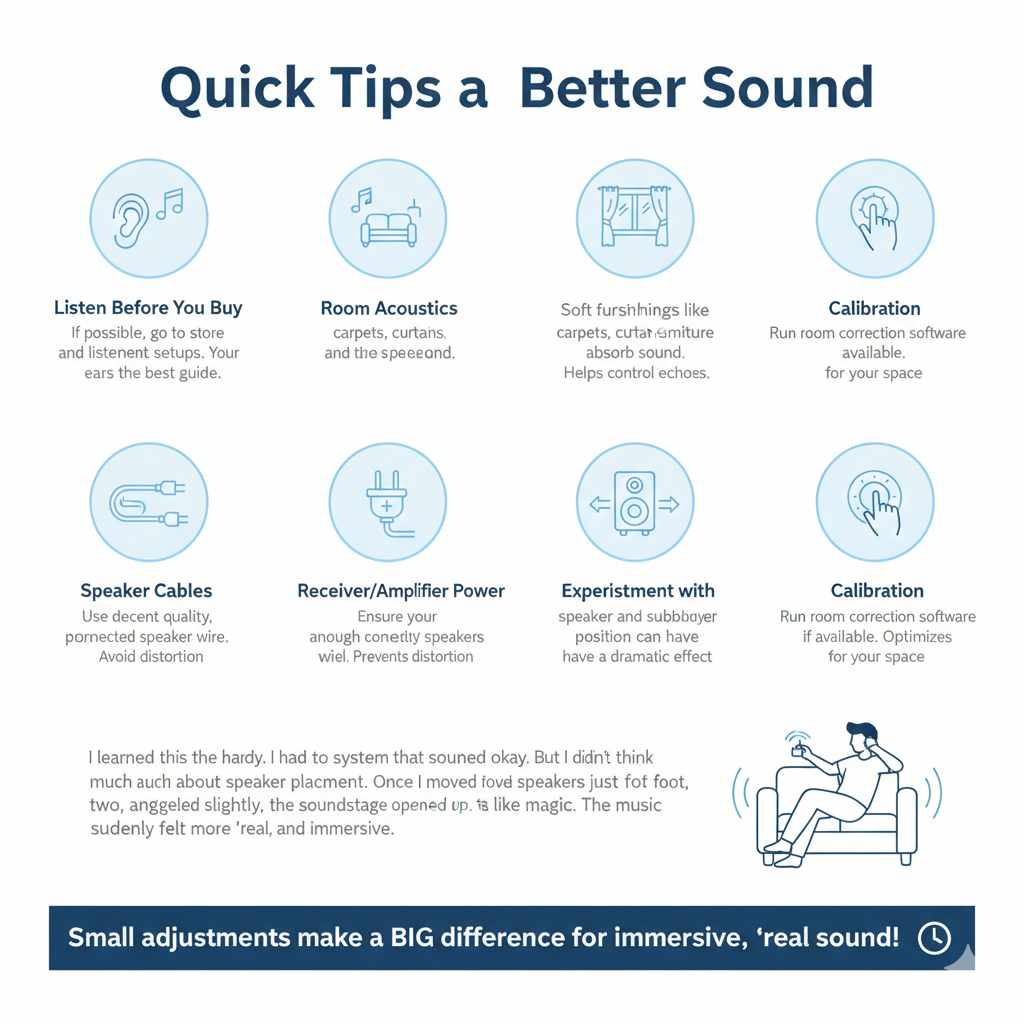
Quick Tips for Better Sound
Regardless of your speaker choice, a few simple things can make a big difference.
- Listen Before You Buy: If possible, go to a store and listen to different setups. Your ears are the best guide.
- Room Acoustics: Soft furnishings like carpets, curtains, and furniture can absorb sound. This helps control echoes. Hard surfaces reflect sound.
- Speaker Cables: While expensive cables are often debated, using decent quality, properly connected speaker wire is important.
- Receiver/Amplifier Power: Make sure your amplifier has enough power to drive your speakers well. Underpowered amps can distort sound.
- Experiment with Placement: Even small adjustments to speaker and subwoofer position can have a dramatic effect.
I learned this the hard way. I had a system that sounded okay. But I didn’t think much about speaker placement.
Once I moved my speakers just a foot or two, and angled them slightly, the soundstage opened up. It was like magic. The music suddenly felt more ‘real’ and immersive.
Frequently Asked Questions About Speakers and Subwoofers
Do I need a subwoofer if I have floorstanding speakers?
Not always, but it can significantly improve the sound. Floorstanding speakers are designed to produce a wider range of frequencies, including bass. However, a dedicated subwoofer can reproduce the very lowest bass notes more powerfully and accurately.
This adds depth and impact, especially for movies and certain music genres. It also allows your floorstanding speakers to focus on mids and highs, potentially improving their clarity.
Can bookshelf speakers sound as good as floorstanding speakers?
With the right setup, yes. Bookshelf speakers themselves might not produce the same deep bass. But when paired with a good subwoofer, they can create a sound experience that rivals or even surpasses floorstanding speakers, especially in smaller to medium-sized rooms.
The combination offers excellent clarity in the mids and highs from the bookshelf speakers and deep, impactful bass from the subwoofer.
What is the best placement for a subwoofer?
The “best” placement varies by room. A common starting point is a corner, which can boost bass output. However, this can sometimes lead to boomy sound.
Many people find the “subwoofer crawl” method effective: place the subwoofer where you’ll be sitting, play bass-heavy music, and then crawl around the room where the subwoofer would go. Mark the spot where the bass sounds best and place your subwoofer there. Avoid placing it directly in the middle of the room or too close to walls if it causes distortion.
How do I connect a subwoofer to my system?
Most modern subwoofers are “powered” or “active,” meaning they have their own amplifier. You’ll typically connect them using an RCA subwoofer cable from the subwoofer output on your AV receiver, soundbar, or amplifier to the LFE (Low-Frequency Effects) or line-in port on the subwoofer. Some subwoofers also offer stereo RCA inputs, which can be used if your source device has stereo outputs and no dedicated subwoofer out.
Make sure to consult your specific subwoofer and audio component manuals for detailed instructions.
What is the crossover setting on a subwoofer or receiver?
The crossover frequency is the point where your main speakers stop producing low bass sounds and hand that job over to the subwoofer. For instance, if you set the crossover to 80Hz, your main speakers will handle frequencies above 80Hz, and the subwoofer will handle everything below 80Hz. Choosing the right crossover setting is crucial for seamless integration between your main speakers and the subwoofer.
It ensures that the bass sounds like it’s coming from everywhere, not just from the subwoofer’s location.
Are floorstanding speakers always better than bookshelf speakers?
No, “better” is subjective and depends on your needs. Floorstanding speakers offer a fuller sound presence and can fill larger rooms. Bookshelf speakers are more compact, often more affordable, and excel in detail when paired with a subwoofer for bass.
For small rooms, bookshelf speakers with a subwoofer might provide a more balanced and less overpowering sound than large floorstanders.
Conclusion: Your Sound, Your Choice
Deciding between floorstanding speakers and a bookshelf setup with a subwoofer is an exciting part of building your perfect audio system. Think about your room size, your budget, and the kind of sound experience you desire. Whether you choose the commanding presence of floorstanders or the flexible power of bookshelf speakers with a subwoofer, the goal is immersive, enjoyable sound.
Happy listening!
Products related to this article
Sponsored / affiliate links. As an Amazon Associate I earn from qualifying purchases. I may earn additional commission from eligible campaigns.