Klipsch Vs Kef Bookshelf Speakers: Best Choice Guide
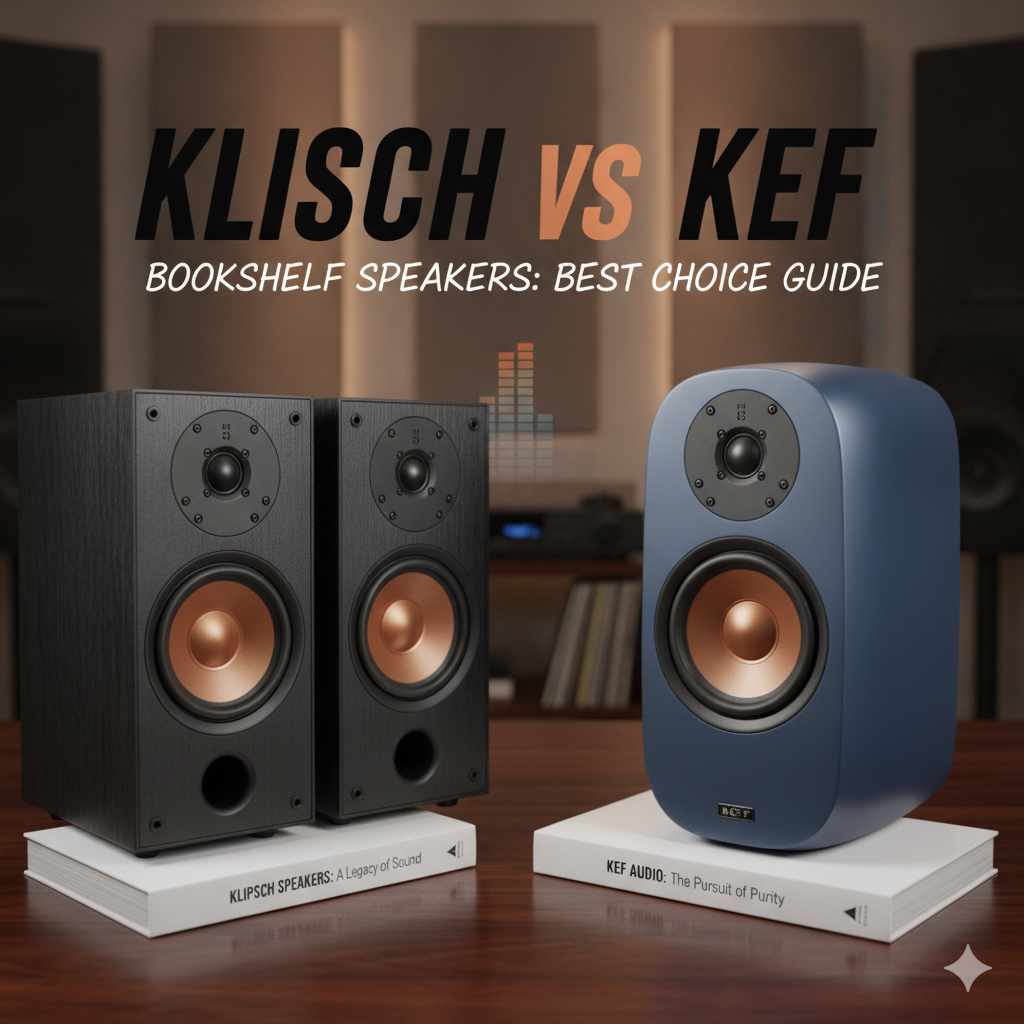
Choosing between Klipsch and KEF bookshelf speakers involves understanding their distinct sound profiles and design philosophies. Klipsch often offers a dynamic, energetic sound with strong bass and clear highs, while KEF is known for its neutral, detailed, and natural sound with advanced driver technology. Your decision depends on your listening preferences and room acoustics.
For a related storage or furniture fix, Raised Panel Vs Flat Panel Cabinet Doors: Choice helps readers compare the next practical option.
Klipsch vs KEF Bookshelf Speakers: A Deep Dive
When you’re setting up your home audio, speakers are key. They bring music and movies to life. Klipsch and KEF are two names that come up a lot.
They both have a strong history. They both make high-quality speakers. But they don’t sound exactly the same.
And they don’t look the same either. It’s not really about which one is “better.” It’s about which one is better for you.
Think about your favorite music. Do you love the punch of a drum beat? Or do you focus on the subtle details of a voice?
Your room matters too. Is it big and open? Or cozy and small?
These things help decide which speaker will feel like it was made just for your space.
We’ll look at the sound. We’ll look at the design. We’ll talk about what makes each brand stand out.
By the end, you should have a much clearer idea. You’ll know what to listen for. And you’ll feel ready to make a decision that makes you happy every time you turn on your music.
The Sound of Klipsch: Bold and Energetic
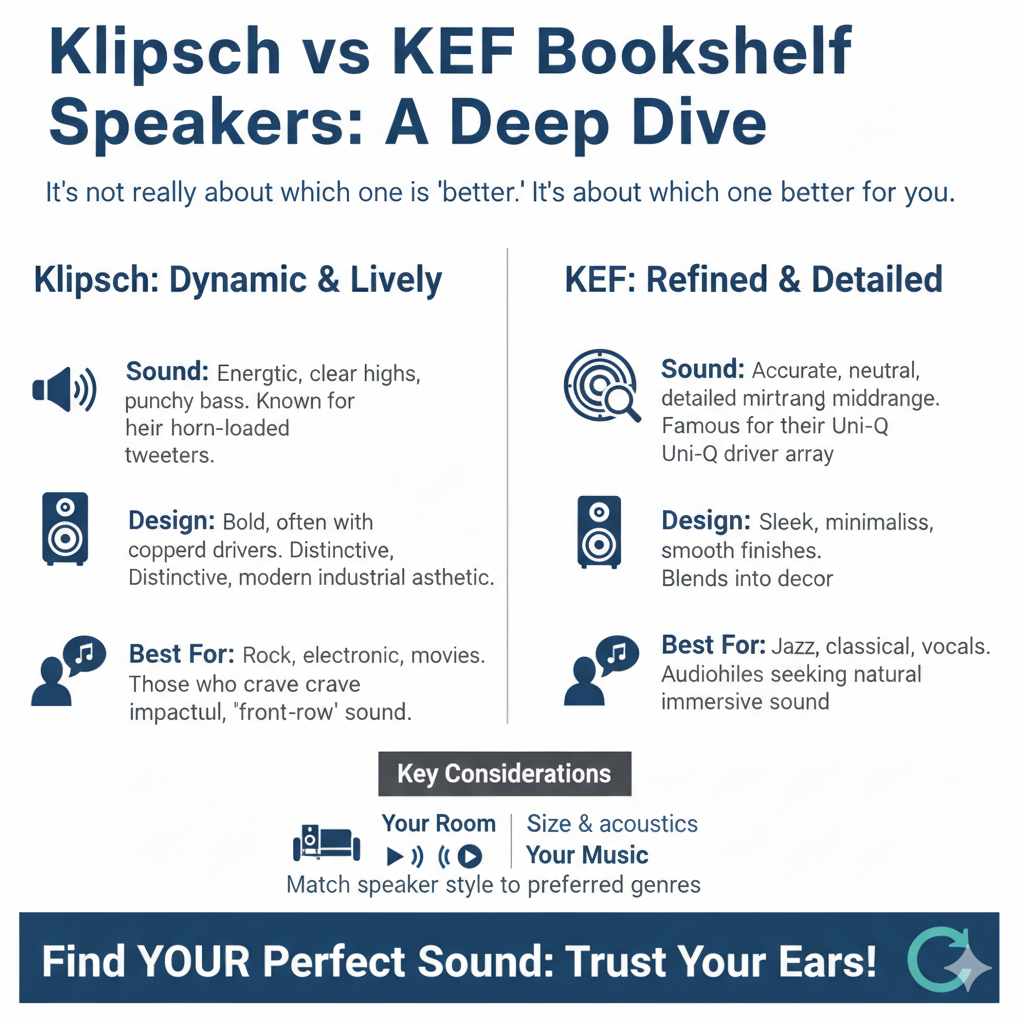
Klipsch speakers often have a sound that grabs your attention. They are known for being lively. They have a lot of energy.
This is partly because of their horn-loaded tweeters. These tweeters help make the sound very direct. They can fill a room with sound easily.
This makes them great for movies and exciting music.
When you listen to music with Klipsch speakers, you might notice the bass. It tends to be strong and punchy. It’s not usually muddy.
It’s clear and you can feel it. The treble, or the high sounds, are also very clear. This can make details in music stand out.
Sometimes, this can sound a bit bright to some listeners. But for many, it adds excitement.
Many people love Klipsch for their dynamic range. This means they can go from very quiet sounds to very loud sounds easily. This is perfect for movie soundtracks.
You can hear a quiet whisper and then a huge explosion. It’s like being right there. This energetic sound profile makes them a favorite for rock music, electronic music, and action movies.
The feeling you get from Klipsch is often one of excitement. It’s like being at a live concert. The sound is big and bold.
It doesn’t try to hide. It’s upfront and in your face, in a good way. It makes you want to tap your feet.
It makes you want to sing along. It’s a sound that makes you feel the music.
Key Klipsch characteristics:
- Dynamic and lively sound
- Strong, punchy bass
- Clear, detailed treble
- Excellent for movies and energetic music
- Horn-loaded tweeter technology
- Wide dynamic range
I remember setting up a pair of Klipsch bookshelf speakers in my friend’s living room. He’s a huge action movie fan. The first movie we watched was an old favorite.
The sound was totally different. When the car chases happened, I could feel the rumble. The dialogue was super clear, even with all the background noise.
He just grinned the whole time. He said it felt like he was in the theater again. That’s the kind of impact Klipsch can have.
Klipsch Sound Profile Snapshot
Energy: High
Bass: Punchy and impactful
Treble: Bright and detailed
Midrange: Clear, good for vocals
Overall Feel: Exciting, dynamic, direct
Best For: Action movies, rock, electronic music, large rooms
The Sound of KEF: Neutral and Refined
KEF speakers are known for a different kind of sound. They aim for accuracy. They want to sound as neutral as possible.
This means they try not to color the sound. They want you to hear the music exactly as the artist intended. This is often called a “flat” response.
It’s what many sound engineers aim for.
The heart of KEF’s approach is often their Uni-Q driver. This is a special design. It puts the tweeter inside the midrange cone.
This makes the sound come from a single point. This is great for what’s called “point-source” sound. It means the sound waves spread out more evenly.
It makes the listening area wider. It helps with imaging and soundstage too.
When you listen to KEF, you’ll likely hear a lot of detail. You can pick out individual instruments. You can hear the subtle breaths of a singer.
The bass is often tight and controlled. It’s there when it needs to be, but it doesn’t overpower. The treble is smooth.
It’s detailed but not harsh. This makes them very easy to listen to for long periods.
This neutral sound makes KEF speakers very versatile. They are fantastic for classical music, jazz, and acoustic sets. They reveal all the textures and nuances in these genres.
They are also great for audiophiles. People who want to hear every tiny detail will love them. They are like a magnifying glass for sound.
The feeling you get from KEF is one of clarity and precision. It’s like sitting in the studio with the musicians. You hear everything in its right place.
The sound is honest. It’s not trying to impress you with loudness. It’s impressing you with how true to the original recording it is.
It’s a more cerebral listening experience.
Key KEF characteristics:
- Neutral and accurate sound
- Highly detailed and refined
- Smooth treble
- Tight, controlled bass
- Uni-Q driver technology
- Excellent imaging and soundstage
- Wide listening sweet spot
I remember spending an afternoon with a pair of KEF bookshelf speakers. I was listening to an old jazz record. I’d heard it a hundred times before.
But with these speakers, it was like hearing it for the first time. I could hear the subtle scrape of the bow on the upright bass. I could hear the light taps on the cymbal.
The trumpet solo had this beautiful, natural tone. It wasn’t just music; it was an experience. It felt very intimate, like I was in a small club.
KEF Sound Profile Snapshot
Energy: Moderate
Bass: Tight, controlled, accurate
Treble: Smooth, detailed, clear
Midrange: Natural, articulate
Overall Feel: Neutral, precise, detailed
Best For: Classical, jazz, acoustic, critical listening, smaller to medium rooms
Design and Build: Aesthetics and Engineering
Beyond sound, how speakers look and how they are made matters. Both Klipsch and KEF pay attention to this. But their styles are different.
Klipsch speakers often have a classic look. Many models feature a wood grain finish. They have a bold grille that covers the woofer.
The distinctive orange cone woofer is a signature look. The horn tweeter is also very visible. They tend to look robust and powerful.
They fit well in rooms that have a more traditional or modern rustic feel. The build quality is generally very solid. They feel like they are built to last.
KEF speakers often have a more modern and minimalist aesthetic. They frequently have a sleek, unibody cabinet. The Uni-Q driver is often centrally located and looks very integrated.
Many KEF models have a seamless finish, with no visible screws or grilles. This gives them a very clean and sophisticated look. They can blend into modern, contemporary, or minimalist decor very easily.
The engineering behind them is often quite advanced. They use high-quality materials and precise manufacturing.
Let’s look at some common design elements:
Design Contrast: Klipsch vs. KEF
Klipsch
Aesthetics: Classic, bold, often vintage-inspired
Materials: Wood grain finishes common
Signature: Orange cone woofers, visible horn tweeters
Build: Robust, solid construction
Style Fit: Traditional, rustic, industrial
KEF
Aesthetics: Modern, minimalist, sleek
Materials: Premium finishes, seamless cabinets
Signature: Uni-Q driver, clean lines
Build: Precision engineered, high-tech feel
Style Fit: Contemporary, minimalist, Scandinavian
I’ve seen both brands in friends’ homes. My friend Mark has a basement home theater. He chose Klipsch because he wanted that big, exciting sound for action movies.
The speakers, with their dark wood and prominent woofers, really fit the vibe of his room. On the other hand, my cousin Sarah just redecorated her apartment. She picked KEF speakers.
They have a white, seamless finish that practically disappears against her walls. She loves that they sound amazing but don’t draw attention to themselves visually.
Understanding the Core Technologies
The way speakers are designed and the technologies used inside make a big difference. Both Klipsch and KEF are known for specific innovations.
Klipsch relies heavily on its Tractrix Horn technology. This is a geometrically designed horn. It’s shaped to help sound waves spread out evenly.
It’s also designed to reduce distortion. The tweeter is placed inside this horn. This allows for very efficient sound production.
It means the speakers can get loud without needing a lot of power. This is why Klipsch speakers often have high sensitivity ratings.
The woofer cones in Klipsch speakers are often made from Cerametallic material. This is a stiff but lightweight material. It helps the cone move quickly and accurately.
This results in tight, punchy bass. It also helps prevent cone breakup, which can cause distortion.
KEF’s flagship technology is the Uni-Q driver array. As mentioned, this places the tweeter in the acoustic center of the midrange cone. This is a complex engineering feat.
It ensures that the sound from both drivers leaves from the same point in space. This is crucial for creating a clear, focused sound image. It also provides a wider dispersion pattern.
This means the sound quality stays consistent across a much larger listening area. You don’t have to be sitting in one specific “sweet spot” to get great sound.
KEF also invests heavily in advanced cabinet design. They often use complex internal bracing and damping. This helps to minimize unwanted vibrations.
Vibrations in the speaker cabinet can color the sound. KEF aims to make the cabinet as acoustically inert as possible. This allows the drivers to perform at their best.
Here’s a simplified look at what makes them tick:
Technology Spotlight
Klipsch Core Tech
Tractrix Horns: Efficient, wide dispersion, low distortion for highs.
Cerametallic Woofers: Lightweight, stiff for accurate bass response.
High Sensitivity: Easy to drive, can get loud with less power.
Focus: Dynamic, powerful, impactful sound.
KEF Core Tech
Uni-Q Driver: Single point source for uniform sound, wide dispersion.
Advanced Cabinetry: Minimal vibration, acoustically inert for clarity.
MAT (Metamaterial Absorption Technology): (In some models) Absorbs rear sound waves.
Focus: Accuracy, detail, natural sound reproduction.
Which Speaker is Right for Your Room?
Your room is a big factor in how speakers sound. It’s not just about the speakers themselves. The size, shape, and furniture in your room all play a role.
This is where the differences between Klipsch and KEF can really matter.
Klipsch speakers, with their efficient horns, tend to work very well in larger spaces. Their direct sound can cut through room acoustics. If you have a big living room or an open-plan layout, Klipsch can fill it with sound without sounding strained.
Their energetic nature can also help overcome the acoustic challenges of a large space. If you like to listen at higher volumes for movies or parties, Klipsch is a strong contender. You can place them a bit further apart, and they’ll still fill the space effectively.
KEF speakers, especially those with the Uni-Q driver, are excellent for creating a focused sound. They are great for smaller to medium-sized rooms. Their ability to maintain sound quality across a wider listening area is a big plus.
This means you don’t have to sit in a perfect spot to get the best sound. This is ideal for a typical living room or a dedicated listening room. Their neutral sound is also less likely to excite the room’s natural echo.
This can lead to cleaner sound in rooms that might be a bit “live” or reverberant. If you have a smaller setup or a more controlled listening environment, KEF’s precision shines.
Consider your listening habits too. Do you often have people over? Do you blast music for parties?
Klipsch might be more suited. Do you prefer quiet, focused listening sessions? Do you enjoy dissecting complex musical pieces?
KEF might be a better fit.
Room considerations:
Room Matching Guide
Ideal for Klipsch
Room Size: Large, open-plan spaces
Listening Style: Louder volumes, parties, movies
Room Acoustics: Can help overcome room challenges due to efficiency
Placement: Flexible, can be placed further apart
Ideal for KEF
Room Size: Small to medium rooms, dedicated listening spaces
Listening Style: Critical, detailed, calm listening
Room Acoustics: Excellent in controlled or average acoustics
Placement: Can be more critical for optimal imaging, but forgiving
I once visited a friend who had a very long, narrow living room. It was hard to get good sound coverage. He tried several speakers.
When he switched to a pair of Klipsch bookshelf speakers, it made a huge difference. The sound seemed to reach every corner without getting lost. The dynamics were still there, even from his couch at the far end.
Comparing Specific Models
Both brands offer a range of bookshelf speakers. It’s helpful to look at some popular examples to see how they stack up. Keep in mind that specific models change, but the general philosophies remain.
In Klipsch’s lineup, you might look at the RP-600M or the RP-500M from their Reference Premiere series. These are often praised for their ability to deliver big sound from a small package. They’re known for that signature Klipsch punch and clarity.
The 600M, for example, uses a 1-inch titanium dome tweeter with a Tractrix horn and a 6.5-inch Cerametallic woofer. This combination is a recipe for dynamic, engaging sound. They are often recommended for stereo music listening and as front speakers in a home theater system.
On the KEF side, models like the LS50 Meta or the Q350 are very popular. The LS50 Meta is a legendary speaker. It uses a 12th generation Uni-Q driver.
It’s designed to be incredibly accurate and detailed. It features a rear Uni-Q driver and a bespoke cabinet design. The Q350 is a more entry-level option but still carries the KEF DNA.
It uses a 5.25-inch Uni-Q driver. It’s known for its natural sound and excellent dispersion. These KEF speakers are often favored by those who want to hear every nuance in their music.
They’re also highly regarded for their ability to create a realistic soundstage.
Here’s a quick comparison, keeping in mind that exact specs vary:
Popular Model Comparison (General)
| Feature | Klipsch (e.g., RP-600M) | KEF (e.g., LS50 Meta) |
|---|---|---|
| Sound Profile | Dynamic, energetic, forward | Neutral, detailed, accurate |
| Bass | Punchy, extended | Tight, controlled, refined |
| Treble | Bright, clear, revealing | Smooth, detailed, natural |
| Key Technology | Tractrix Horn, Cerametallic Woofer | Uni-Q Driver Array, advanced cabinet |
| Aesthetics | Classic, bold, wood accents | Modern, minimalist, sleek |
| Best For | Movies, rock, pop, general listening | Jazz, classical, acoustic, critical listening |
When I was helping a friend choose speakers, we listened to the KEF LS50 Meta and a pair of Klipsch bookshelf speakers side-by-side. He’s a huge classical music fan. With the KEFs, he could hear the breath of the flutist.
The violins had this sweet, natural tone. With the Klipsch, the music was more exciting. The brass instruments were more powerful.
But for his preference for classical music, the KEFs were the clear winner. He wanted that subtle detail and accuracy.
When to Worry: Red Flags and Considerations
While both brands are excellent, there are times when one might be a better fit than the other, or when you might encounter issues.
For Klipsch: If you find the treble too sharp or fatiguing, it might be a sign. This can happen if your room is very “live” with a lot of hard surfaces. The bright sound of Klipsch can be amplified by reflections.
In such cases, adding some soft furnishings like rugs or curtains can help. Also, if you prefer a very laid-back, subtle sound, Klipsch might be too forward for you. Some people find horn-loaded speakers too “in-your-face” for certain types of music or for very long listening sessions.
For KEF: If you find KEF speakers sound a bit too polite or lack excitement, it could be why. If you listen to a lot of high-energy music like EDM or heavy rock, you might miss the punch and slam that Klipsch offers. Also, if your room has a lot of soft furnishings and is very “dead” acoustically, KEF’s neutral sound might sound a bit too subdued.
They benefit from a room that isn’t overly dampened. Sometimes, the bass from KEF can be perceived as lacking if you’re used to the more boosted bass of some other brands.
It’s also important to consider your amplifier. Both brands have varying sensitivities. Klipsch speakers are generally more sensitive.
This means they don’t need a super powerful amplifier to get loud. KEF speakers, while not necessarily difficult to drive, might perform best with an amplifier that can offer good control, especially over the bass frequencies.
Potential concerns:
Things to Watch For
Klipsch Concerns
Bright Treble: Can be fatiguing in reflective rooms.
Forward Sound: May be too intense for some listeners/genres.
Bass Emphasis: While punchy, might not satisfy extreme bassheads.
KEF Concerns
Lacking Excitement: Might seem subdued for high-energy music.
Bass Recess: Can sound thin if room is too dead or listener expects boom.
Sweet Spot: While wide, optimal imaging still benefits from good placement.
I once had a client who bought a pair of highly-rated speakers. He said they sounded “muddy.” We went over to his place. His living room was filled with thick carpet, heavy drapes, and a large sofa.
It was very acoustically dead. The speakers he had were designed for a more neutral or slightly bright room. They were just absorbing too much sound.
We experimented with pulling furniture away from walls and adding some strategically placed panels. It made a difference, but it showed me how much the room can impact even good speakers.
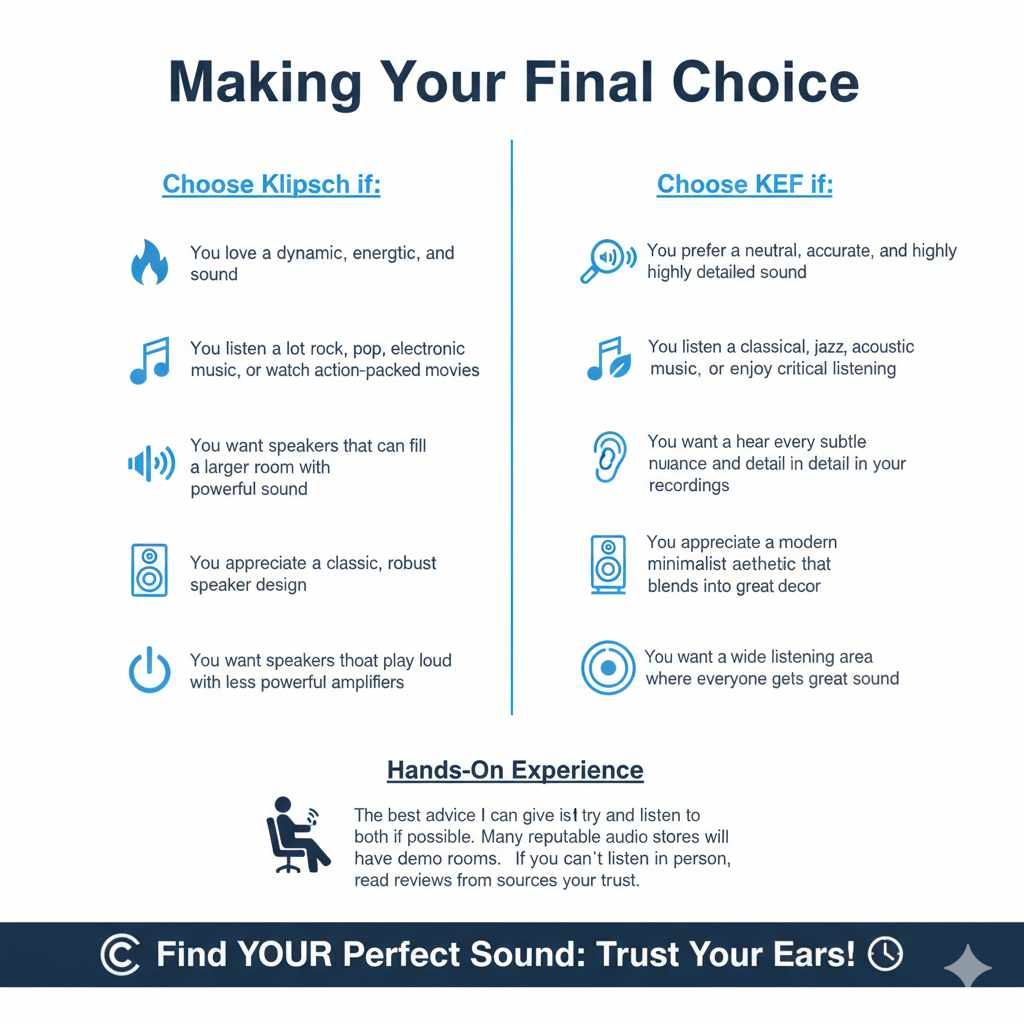
Making Your Final Choice
So, how do you pick? It really comes down to your personal taste and how you plan to use your speakers.
Choose Klipsch if:
- You love a dynamic, energetic, and forward sound.
- You listen to a lot of rock, pop, electronic music, or watch action-packed movies.
- You want speakers that can fill a larger room with powerful sound.
- You appreciate a classic, robust speaker design.
- You want speakers that can play loud with less powerful amplifiers.
Choose KEF if:
- You prefer a neutral, accurate, and highly detailed sound.
- You listen to classical, jazz, acoustic music, or enjoy critical listening.
- You want to hear every subtle nuance and detail in your recordings.
- You appreciate a modern, minimalist aesthetic that blends into your decor.
- You want a wide listening area where everyone gets great sound.
The best advice I can give is to try and listen to both if possible. Many reputable audio stores will have demo rooms. If you can’t listen in person, read reviews from sources you trust.
Look for comparisons that discuss sound profiles for the types of music you enjoy. Consider the size of your room and your existing audio gear.
Think of it like choosing between two fantastic restaurants. One might be known for its bold, spicy flavors that excite your palate. The other might be known for its delicate, nuanced dishes that reveal subtle tastes.
Both are great, but one will better match what you’re craving at that moment.
Frequently Asked Questions
Can I use bookshelf speakers for home theater?
Yes, bookshelf speakers can be excellent for home theater. Many people use them as their front left and right speakers. They can also be used as surround speakers. Brands like Klipsch are particularly popular for home theater due to their dynamic and impactful sound, which is great for movies. KEF speakers offer excellent detail and imaging, which can enhance the immersive experience.
Do I need a subwoofer with bookshelf speakers?
It depends on the bookshelf speaker and your preferences. Most bookshelf speakers can produce decent bass, especially larger ones like the Klipsch RP-600M. However, for truly deep bass, especially for movies or certain music genres, adding a subwoofer is highly recommended. It will complement the bookshelf speakers by handling the very low frequencies, allowing the main speakers to perform better.
Are KEF speakers good for rock music?
KEF speakers can be very good for rock music, but it depends on your preference. They will reproduce rock music with excellent detail and clarity. You’ll hear all the instruments clearly. However, if you prefer a more aggressive, punchy, and forward sound that many associate with rock music, a brand like Klipsch might feel more immediately impactful. KEF’s strength is in its accuracy and detail, which can make rock sound very refined.
Are Klipsch speakers too bright?
Some listeners find Klipsch speakers, especially those with horn-loaded tweeters, to have a bright treble. This can be exciting and reveal a lot of detail. However, in certain rooms with a lot of hard surfaces (reflections), this brightness can become fatiguing. If you have such a room, consider adding acoustic treatment or choosing a different model or brand. For many, the brightness is part of their engaging sound signature.
Which brand is more expensive, Klipsch or KEF?
Both brands offer a range of products at different price points. Generally, KEF’s higher-end models, especially those featuring advanced Uni-Q drivers and technologies like the LS50 Meta, tend to be priced higher than comparable Klipsch models. However, both offer excellent value within their respective ranges. It’s always best to compare specific models directly for pricing.
Do I need to break in my new speakers?
Yes, most new speakers benefit from a break-in period. This is where the speaker’s drivers, particularly the suspension surrounds, become more pliable. During break-in, the sound can subtly change, often becoming a bit smoother and more dynamic. Play music at moderate volumes for 20-50 hours to allow the drivers to reach their optimal performance. Both Klipsch and KEF speakers will benefit from this.
Conclusion
Choosing between Klipsch and KEF bookshelf speakers is a great problem to have. Both offer exceptional sound quality. They just approach it from different angles.
Klipsch brings the energy and excitement. KEF offers precision and detail. Consider your music, your room, and your ears.
Trust your own listening experience. You’ll find the perfect speakers to bring your audio to life.
Products related to this article
Sponsored / affiliate links. As an Amazon Associate I earn from qualifying purchases. I may earn additional commission from eligible campaigns.